

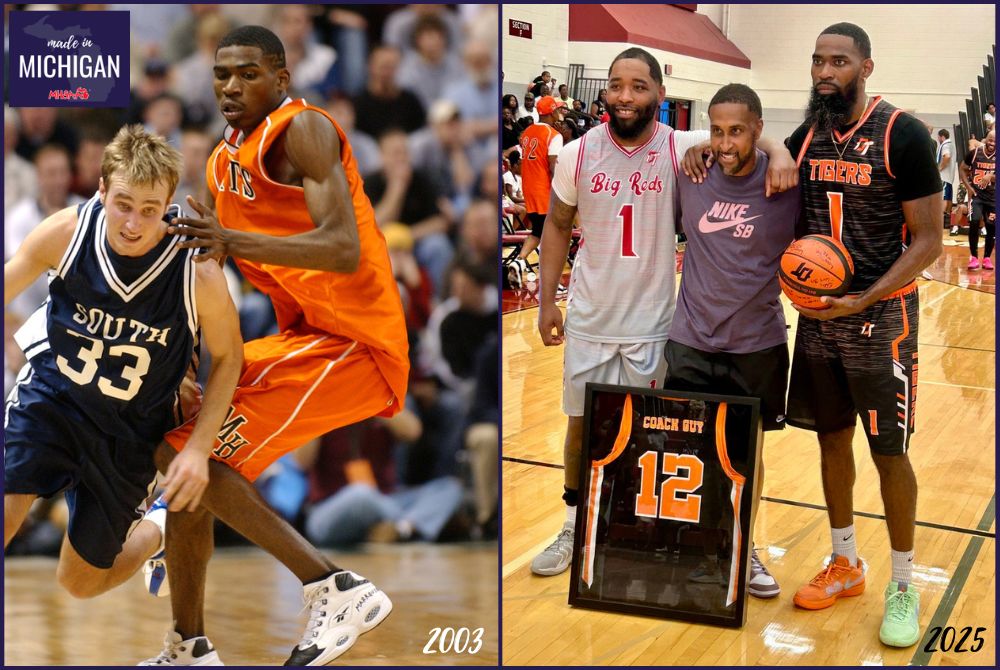
Inspired by Home, Eager to Give Back, Spencer Hosts Hoop City Alumni Games
By
Tom Kendra
Special for MHSAA.com
July 2, 2026
Eddie Spencer now lives more than 1,100 miles away in Dallas, but his thoughts are never far from his hometown of Muskegon Heights.
 It was there in “the Heights” where Spencer learned the game of basketball, developing into a 6-foot-5 forward who could shoot and handle the ball – leading Heights to the Class C Semifinals as a junior in 2002 and the Class B Final as a senior in 2003.
Spencer, 41, said the biggest lessons he learned from basketball had nothing to do with shooting or rebounding.
“Playing basketball taught me how to work hard, stay focused and, really, how to be a man,” said Spencer, who went on to become a three-year starter at Central Michigan, graduating in 2008.
“I wanted to find a way to give something back.”
Spencer’s desire to return some love to his hometown led to the Hoop City Alumni basketball tournament, which is set for its third year at Muskegon High School’s historic Redmond-Potter Gymnasium on Aug. 22 with five alumni games – highlighted by the finale, featuring Muskegon vs. Muskegon Heights.
The last two years, the RPG was standing-room-only with more than 2,000 fans for the finale, with Muskegon fans in their trademark cardinal red and Heights fans proudly in their orange and black.
“Honestly, when I walked out of the locker room that first year and saw all of the excitement and pride in that gym, it brought tears to my eyes,” said Spencer. “It really brought back that old feeling of Heights vs. Muskegon, like back in high school.”
A rivalry like no other
Few rivalries in the state can match the history and the intensity of Muskegon vs. Muskegon Heights.
The Big Reds and Tigers played each other in football 55 years in a row from 1922-76, with the most competitive years and largest crowds occurring during the 1940s and 1950s.
In more recent years, the rivalry was on the basketball court, including a run of nine years from 2003 to 2011 when the two schools played the final game of the Muskegon Area Sports Hall of Fame Holiday Classic, with Heights winning six of those nine matchups. The rivalry came to an end in 2011 after a period of upheaval and enrollment losses at Heights.
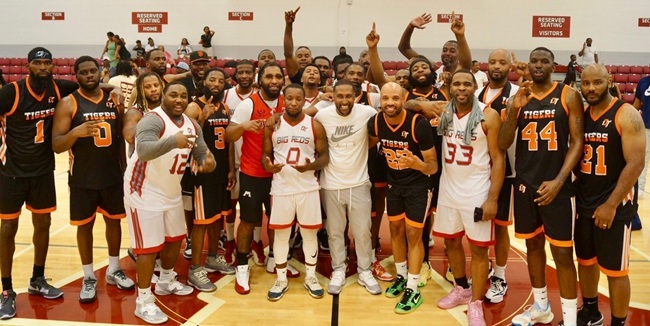 Now, thanks to the efforts of Spencer and his crew (notably Muskegon head coach and athletic director Keith Guy and 2014 Mr. Basketball Award winner DeShaun Thrower from Muskegon) the rivalry has resumed each August at the alumni game.
“It definitely divides the community for a couple of hours,” said Spencer, who also ran cross country at Heights. “There is already a huge buzz about this year’s event and tons of trolling and trash talking.”
Spencer played several years of professional basketball, including overseas, after graduating from CMU. He then returned home and coached basketball for several years at Muskegon Heights under Guy before the latter moved on to lead the Big Reds.
Spencer moved to Dallas eight years ago and has coached AAU basketball and served as a personal trainer, in addition to his work in the mortgage industry. About five years ago, he helped a friend organize an alumni basketball game in the Dallas area – and he knew immediately that he had to do the same back home.
“The first thing I thought was that we have to do this with Muskegon and Muskegon Heights,” said Spencer, who noted that the games also feature alumni cheerleaders.
The event is not designed for recent high school graduates, with most of the teams’ players in their 30s and 40s.
This year’s tournament will begin with Mona Shores vs. Muskegon Orchard View alumni at 2 p.m. and a Muskegon-area girls game (East vs. West) at 3 p.m.
North Muskegon squares off against Muskegon Reeths-Puffer at 4 p.m., followed by the addition this year of ex-standouts from Grand Rapids against Kalamazoo at 5 p.m. – all leading up to the Heights vs. Muskegon finale at 6 p.m.
Spencer expects attendance to be strong all day (admission is $10), but acknowledges the crowds and atmosphere move to a whole different level for the final game. This year’s tournament also will be live-streamed so people can pay to watch the games from anywhere in the world, with those details still being worked out.
Beyond basketball
Spencer knows that beyond the basketball and beneath the banter, the Hoop City Alumni event is really a celebration of two proud communities.
It has become the weekend when many make plans to come back home to Muskegon, not only to relive the glory days, but to celebrate the post-basketball accomplishments of those prep greats – including some who have gone on to become doctors, lawyers, business leaders, coaches and school principals.
“We are really utilizing the game of basketball to help the community,” said Spencer, whose daughter, Nya, graduated from Muskegon High. “When people feel pride in their community, they want to make it better. We want all the kids, especially, to be there and to see how playing sports can be the start of great things for them.”
 The Hoop City games have evolved into a full weekend of events, starting with a Friday back-to-school event with backpacks and school supplies giveaways at Rowan Park in downtown Muskegon Heights, pre- and postgame adult gatherings Friday and Saturday night and a picnic Sunday.
But make no mistake, basketball is the centerpiece.
Heights won the inaugural alumni game in 2024, and Muskegon prevailed at the buzzer last year, making this year’s event (which has been dubbed “The Trilogy”) the rubber match, at least for now, in the latest installment of the decades-old rivalry.
This year’s game will be hard-pressed to match the drama and emotion of last summer’s contest.
In a back-and-forth affair, it was Thrower who forced a turnover at the defensive end and then hit the game-winning shot at the buzzer for Muskegon, leading to a raucous scene as Big Reds fans stormed the court.
It was a highly-emotional moment for Thrower, who was playing his first competitive game in years after a foot injury, and it came just a few months after the death of his mother, Nina Morgan Thrower.
“The way the whole event went and the way it ended, it felt like a movie, for sure,” said Thrower, who has worked alongside Spencer to grow the showcase.
“I know that my mom was with me on that day, in that moment.”
PHOTOS (Top) At left, Muskegon Heights’ Eddie Spencer (1) defends during the 2003 Class B Final against Grand Rapids South Christian; at right, Spencer (far right) stands for a photo at last year’s Hoop City alumni event with former coach Keith Guy and past Muskegon High standout DeShaun Thrower. (Middle) Spencer, far left, poses with the rest of the Muskegon Heights and Muskegon High alumni teams after last season’s Hoop City matchup. (Below) This season’s Hoop City poster advertises five alumni games. (Hoop City photos provided by Eddie Spencer.)

Lawrence's Schuman Sets Example for Well-Rounded Success
By
Pam Shebest
Special for MHSAA.com
December 14, 2022
LAWRENCE — If redshirting was a thing in high school, at least two coaches at Lawrence would stick that label on senior John Schuman.
 “We don’t want to lose this kid ever,” said Derek Gribler, the Tigers’ first-year varsity football and baseball coach.
“If we could put a red shirt on this kid every year, we would.”
Athletic director John Guillean, who also coaches varsity basketball, agreed.
“He is what we strive to have all our student-athletes achieve: high GPAs, multi-sport athletes, good, overall well-rounded human beings,” Guillean said.
Schuman has participated in five of the seven boys sports Lawrence sponsors.
As a freshman and sophomore, Schuman played football, wrestled, ran track and played baseball.
He had wrestled since he was 4, and went from the 119-pound weight class as a freshman to 145 the following year. That sophomore season he qualified for his Individual Regional. But as a junior, he traded wrestling for basketball.
“My older brother wrestled at Lawrence, so I would come to practices,” he said. “I quit for a couple years (in middle school) because I liked basketball, too. It was hard to do both. Obviously, in high school, I still struggled with choosing,” he added, laughing.
 Guillean is thrilled Schuman made the switch.
“He’s 6-(foot-)4, he’s super athletic, defensively he’s a hawk, offensively he can put the ball in the bucket. But really, aside from his skills, just that positive attitude and that positive outlook, not just in a game, but in life in general, is invaluable,” the coach said.
Last season, Schuman earned honorable mention all-league honors in the Berrien-Cass-St. Joseph Conference, averaging 9.1 points and 9.1 rebounds per game.
Lawrence left the BCS for the Southwest 10 Conference this year, joining Bangor, Bloomingdale, Hartford, Decatur, Comstock, Marcellus, Mendon, Centreville, White Pigeon and Cassopolis. Schuman and senior Tim Coombs will co-captain the Tigers, with Guillean rotating in a third captain.
At a school of fewer than 200 students, Schuman will help lead a varsity team with just nine – joined by seniors Andy Bowen and Gabe Gonzalez, juniors Christian Smith, Noel Saldana, Ben McCaw and Zander Payment, and sophomore Jose Hernandez, who will see time with the junior varsity as well using the fifth-quarter rule.
“I attribute a lot of (last year’s successful transition) to my coach, helping me get ready because it wasn’t so pretty,” the senior said. “But we got into it, got going, and my teammates helped me out a lot.”
Great anticipation
Gribler is one coach already looking ahead to spring sports after seeing what Schuman did during football season.
In spite of missing 2½ games with an injury, the wide receiver caught 50 receptions for 870 yards and 11 touchdowns.
“I just like the ability to run free, get to hit people, let out some anger,” Schuman laughed.
 Gribler said the senior is “an insane athlete.
“On top of his athletic ability, how smart he is in the classroom (3.88 GPA), he helped mold the culture we wanted this year for football. He got our underclassmen the way we wanted them. He was a big asset in many ways.”
Schuman earned all-conference honors for his on-field performance in football as well.
“I would say that my main sport is football,” the senior said. “That’s the one I like the most, spend the most time on.”
In the spring, Schuman competed in both track and baseball, earning all-conference honors in both.
“Doing both is tough,” he said. “I have to say my coaches make it a lot easier for me. They help me a lot and give me the ability to do both, so I really appreciate that.
“Throughout the week you’re traveling every day, it seems like. Baseball twice a week and track, but it’s worth it.”
Schuman’s commitment is so strong that he made a special effort not to let his teammates down last spring.
“He qualified for state in the long jump and did his jumps up in Grand Rapids, then he drove all the way to Kalamazoo to play in the District baseball game,” Guillean said. “That speaks volumes about who this kid is. He did his jumps at 9 a.m. (but did not advance) and made it back to Kalamazoo for a 12:15 game.”
Big shoes to fill
As the youngest of four children of Mark and Gretchen Schuman, the senior was following a family tradition in sports.
Oldest brother Matthew played football, basketball and baseball as well as competed in pole vault and wrestling.
Middle bother Christopher competed in football, wrestling and baseball.
Sister Stephanie played basketball, volleyball and softball.
“I like to say they blazed a pretty good trail for me at this high school,” Schuman said.
As for feeling pressure to live up to his siblings, “I used to when I was younger, but now I feel like I’ve made my own way and done enough things to be proud of that I’m happy with it.”
His own way led him to achieve something none of the others did.
He was named the Tigers’ Male Athlete of the Year, just the third junior to earn the boys honor over the last 25 years.
“I was very honored to win that as a junior,” Schuman said. “There were good athletes in the grade above me. I guess hard work pays off.”
Guillean said while Schuman is “darn good at every sport here,” an athlete does not have to be a “top dog” in every sport.
“Learn how to take a back seat,” he said. “Learn how to be a role player. That will make you a better teammate and a well-rounded human being.
“Johnny has that work ethic, in the classroom, on the field, on the court, on the track. It doesn’t go unnoticed and, obviously, he’s reaping the benefits now.”
 Pam Shebest served as a sportswriter at the Kalamazoo Gazette from 1985-2009 after 11 years part-time with the Gazette while teaching French and English at White Pigeon High School. She can be reached at [email protected] with story ideas for Calhoun, Kalamazoo and Van Buren counties.
PHOTOS (Top) Lawrence’s John Schuman has participated in five varsity sports during his first 3½ years of high school. (Middle) Lawrence athletic director John Guillean. (Below) Lawrence football and baseball coach Derek Gribler. (Action photos courtesy of John Schuman; head shots by Pam Shebest.)