

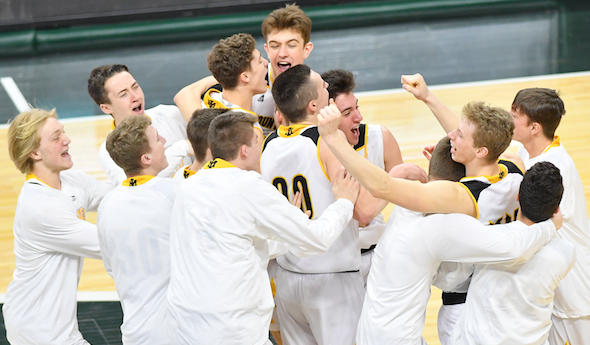
Iron Mountain Dream Season Continues
March 14, 2019
By Geoff Kimmerly
Second Half editor
EAST LANSING – “Living this dream.”
Iron Mountain coach Bucky Johnson put special emphasis on those words Thursday afternoon.
He may have been pointing out the present tense of “living” after his Mountaineers ended the season for 2018 Class C champion Detroit Edison. Or maybe the “dream” as his team earned a shot to play for its first MHSAA boys basketball championship since winning the Upper Peninsula-only bracket in 1939.
Iron Mountain faced a tall task in the day’s first Division 3 Semifinal, even for a team that hasn’t tasted defeat this season. But the Mountaineers held off Edison 60-57 in their first Semifinals appearance since 1994.
“There’s not a lot of U.P. teams that get to come down here and experience this,” Iron Mountain junior guard Foster Wonders said. “To come down here and win too is something special. We take pride in that. It’s been unbelievable.”
Iron Mountain (27-0) will face also-unbeaten Pewamo-Westphalia in Saturday’s 4:30 p.m. championship game.
The Mountaineers have enjoyed quite a visit to East Lansing. On Wednesday, they spent an hour with 1973 graduate Tom Izzo, then watched his Michigan State team practice Thursday morning.
And all of that set up the Semifinal they weren’t necessarily expected to win – despite the perfect record they brought downstate. Edison (18-9) had more losses than all but one team making the trip to Breslin this weekend, but all seven to in-state opponents had come against Division 1 and 2 teams, and the Pioneers had just toppled top-ranked Flint Beecher in their Quarterfinal.
Edison then led most of the first quarter, carrying a seven-point advantage into the second.
“In the U.P. you don’t really see any athletes like that, with the length and athleticism they had,” Iron Mountain junior guard Marcus Johnson said.
 But he and his teammates had a few surprises for Edison as well.
First was a game plan to attack the paint, which resulted in two first-quarter fouls for Pioneers’ 6-foot-6 junior Bryce George. He ended up limited to only 15 minutes for the game, with eight points and six rebounds that could’ve been a lot more with more time on the floor. He had four points and four rebounds before picking up that second foul 5:11 into the game.
Next, Iron Mountain played only six players, and four all 32 minutes. Edison had 12 players with at least four minutes of action, but couldn’t wear the Mountaineers down.
Not surprising was how Iron Mountain won. Johnson was averaging 23.3 points per game entering this week, and sophomore guard Foster Wonders was averaging 23.9. Wonders had 28 on Thursday, making nearly half his shots from the floor and 9-of-10 free-throw tries. Johnson had 23 points, with five 3-pointers and perfection on six free-throw attempts.
“One thing we knew about this team is they were winners. If a team has gone all season not losing a basketball, game, you have to respect them to the utmost,” Edison coach Brandon Neely said. “These guys play six guys, and one guy played four minutes. The thing about this team is they play so well as a team because they know where guys are. Teams like that are a great example to learn from.
“They played like champions.”
Sophomore guard Ralph Johnson came off the bench to lead Edison with 14 points, and senior forward Brian Taylor was held to 11 points and seven rebounds. Taylor, the team’s leading scorer coming into this week, was also its lone senior this season.
Edison shot a game-high 47 percent from the floor during the fourth quarter and got within 45-44 with 3:26 to play. But Iron Mountain’s “makers” – as Bucky Johnson called them, spinning off the “shooters shoot” phrase – had connected on 64 percent of their shots during the third quarter and made 50 percent during the fourth, including both shots from the floor and 10 straight free throws after Edison pulled within a point.
“Coach Izzo told us some people like it, some people love it and some people live it,” Marcus Johnson said. “And we want to live it. It’s an awesome feeling to get to the championship, and we want to get it home.”
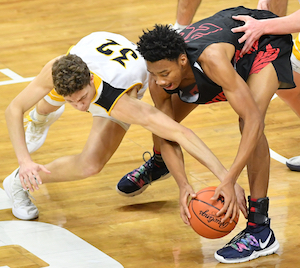
PHOTOS: (Top) Iron Mountain celebrates Thursday its first Semifinal win since 1939. (Middle) Jake Dumais (32) battles Edison’s Brian Taylor for a loose ball.
Breslin Bound: Boys District Preview
March 7, 2016
By Geoff Kimmerly
Second Half editor
A total of 11 boys basketball teams head into the MHSAA Tournament today with perfect records.
But there are plenty of others expected to make strong pushes toward a trip to East Lansing in a little more than two weeks.
Below is a look at four teams from each class that look good to be in the hunt. Follow all of the scores and brackets in real time at MHSAA.com, and click for a glance at every team with three or fewer losses heading into the postseason.
Class A
Canton (20-0) – The Chiefs have improved from 15 to 16 to now 20 wins over the last three seasons, and after repeating as Kensington Lakes Activities Association South champions went on to win the league’s overall title with an overtime victory over Walled Lake Western. Canton also put up an incredible 35-point win in early January over Grosse Pointe South, which finished 17-3.
Detroit U-D Jesuit (20-0) – The Cubs might be the favorites after making the Class A Semifinals last season and losing to eventual champion Detroit Western International. Led by Mr. Basketball finalist guard Cassius Winston, U-D Jesuit has beaten an impressive slate including Class C contenders Flint Beecher and Detroit Allen Academy and last week Detroit East English by 16 points.
East Lansing (19-0) – A young Trojans team will have to be careful in a District featuring tough familiar opponents. But led by sophomore Brandon Johns, arguably the best in his class in the state, East Lansing hasn’t had a ton of trouble yet, with only five wins by fewer than 10 points (although that includes two in overtime).
Macomb Dakota (20-0) – The Cougars did go 21-3 before falling in the Regional Final last season, but haven’t been considered this strong of a contender arguably ever. They avenged that postseason loss on Dec. 15 by downing Clarkston by 11, and nonleague wins against Lansing Everett and Saginaw Arthur Hill also provided valuable experience against unfamiliar but solid opponents.
Class B
Lansing Catholic (18-1) – A game against East Lansing last week that would have been telling was canceled because of bad weather, but the Cougars have shown a great combination of post strength and perimeter play while facing most of the rest of the Lansing area’s best. The loss came to rival Williamston by three after Lansing Catholic won the first meeting in overtime by three.
New Haven (18-2) – Unlike last season, New Haven enters the tournament with losses – its first during 2014-15 didn't come until the Quarterfinal. But those defeats this time have come against Class A schools Utica Ford and contender East English (16-4), and the Rockets built their record against a Class A-heavy schedule.
Onsted (19-0) – Mr. Basketball candidate and sizable center Austin Davis gets most of the attention, and with great reason. But he’s also got plenty of help, especially in a veteran backcourt, and it’s paid off in a league with three teams that have won at least 14 games; Hillsdale’s only losses were twice to the Wildcats.
Wyoming Godwin Heights (17-3) – The reigning Class B champion has two more losses heading into the tournament this season than a year ago. But the three defeats came to Class A teams that have won 15, 14 and 19 games, respectively. Tonight’s opponent, Wayland (17-2) provides another tough challenge out of the gate.
Class C
Detroit Allen Academy (18-2) – Allen has taken a big jump from 11-11 last year playing a schedule that hardly resembles the typical for a Class C team. The Wildcats’ best wins were arguably against Class B River Rouge (17-3) by 11, Class A Saginaw Arthur Hill (14-5) by 20 and Class A Detroit Renaissance (16-4) by four.
Flint Beecher (17-2) – The Class C champion three of the last four seasons prepares by facing a number of larger power programs, and this winter was no different; Beecher beat East English by three but also played and lost to reigning Class A champion Detroit Western International and likely Class A favorite Detroit U-D Jesuit.
Kalamazoo Hackett (20-0) – Hackett earns the mention among four undefeated Class C teams because it saw the toughest competition; four of six other teams in the Southwestern Athletic Conference Valley won at least 10 games, and Kalamazoo Christian’s only losses were twice to the Fighting Irish. All of that said, only Christian once and Schoolcraft twice got within 10 points of Hackett this winter.
Southfield Christian (18-2) – The Eagles are regulars in later rounds of the tournament and fell to Beecher in a Regional Semifinal last season. They’ve again prepped for a long run by facing bigger opponents, with a win over Class A Belleville (16-4) and Southfield and that only loss by a point in overtime in December to Class A West Bloomfield.
Class D
Bellaire (19-1) – Aside from a loss to Class C East Jordan in December, Bellaire has dominated winning a Ski Valley Conference featuring five teams with at least 10 wins including Class C Johannesburg-Lewiston (18-2) and Class D Onaway (16-4). The Eagles won their four games against those two opponents all by double figures.
Frankfort (18-2) – The Panthers have made it to at least the Quarterfinals the last three seasons and the Semifinals in 2014, and there’s little reason not to anticipate a similar run. The losses this winter were in overtime to undefeated Class C contender McBain and also-Class C Traverse City St. Francis, and Frankfort has beaten its share of larger schools too.
Hillman (20-0) – The Tigers have made the Regional Finals three straight seasons and played in a Quarterfinal last year, losing to eventual champion Powers North Central. They opened this winter with a 17-point win against Cedarville and have allowed only one opponent to come closer than 11.
Powers North Central (20-0) – The Jets have won 47 straight games and 72 of their last 73 with junior Jason Whitens again leading a group that includes more teammates from their MHSAA 8-player football champion. North Central handed Crystal Falls Forest Park its only two losses and beat Class B Menominee (16-4); no other opponents came close.
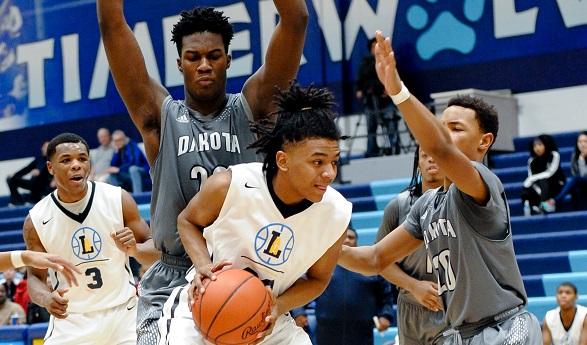
PHOTO: Macomb Dakota defenders surround a Saginaw Arthur Hill player working to get to the hoop during a game earlier this season. (Click to see more at HighSchoolSportsScene.com.)