

Jergens, Howardsville Driven to Go Far
December 4, 2018
By Wes Morgan
Special for Second Half
Its entire student body can fit in a single bus with room to spare.
 Yet Marcellus Howardsville Christian is now regarded as a boys basketball giant with senior scoring point guard Dylan Jergens fueling a historic run.
Last year the Eagles fought all the way to the Class D Quarterfinals, and with most of that roster still intact, they expect nothing less than earning a final-four spot at Michigan State University’s Breslin Center come March.
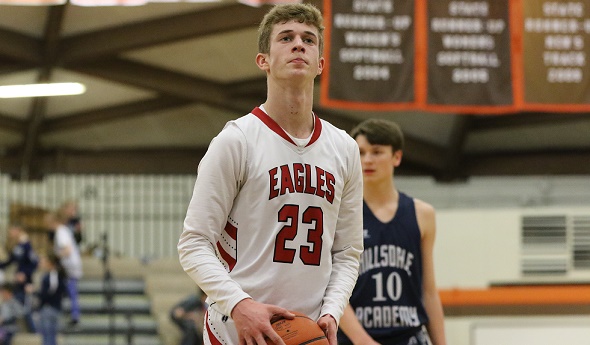
Finishing with a 20-6 record last winter, Howardsville Christian made history when it defeated Bellevue 58-46 for a Regional championship. Faced with a considerable size mismatch in the Quarterfinals versus Hillsdale Academy — a 66-38 defeat — the last chapter of the 2017-18 season was a letdown after a remarkable story otherwise.
Jergens and Co. are determined to prove last year’s success wasn’t just a flash in the pan.
“I’m excited for this season and the opportunities we have ahead of us,” he said. “Towards the end of the season we kind of had it going. It was an amazing feeling. Winning Districts and then winning Regionals for the first time in history was amazing. We were disappointed because we didn’t complete our goal of making it to Breslin, but we had a lot of fun.
“We came out a little overconfident (against Hillsdale Academy), thinking we were only one game away. We thought, ‘We’ve made it this far; we don’t think we can lose.’ We should have prepared more for their big guy; he really killed us on the boards and got layups. Looking back, we could have had a better game plan of how to guard him. But they were a good team, so give them credit.”
A junior-heavy class last winter soaked in everything it could in order to apply that experience to 2018-19.
“We’re definitely going to be ready for it and anything that is thrown at us,” Jergens said. “It’s going to be difficult. Last week we opened up against Mendon and really struggled. We know every team wants a piece of us after that run. They want to be able to come at us. It’s going to be more challenging because everyone wants to knock us off.”
As a junior, the 6-foot-4 Jergens averaged 32.1 points, 5.4 rebounds, 6.3 assists and 3.2 steals per contest. He shot 58 percent from the field and 41 percent from 3-point land. At the free throw line, he knocked down 76 percent of his shots.
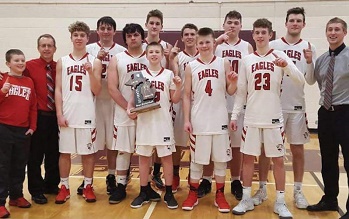 Though he certainly has been the catalyst of the Eagles’ success the last two years and a key player since joining the varsity squad as a freshman, the two-time Associated Press and Basketball Coaches Association of Michigan all-state first team selection is surrounded by an unselfish cast of players he’s shared the court with most of his life.
Fellow seniors Logan Cornwell (forward), David Cripps (guard), Colton Fair (small forward) and Reece Herschbach (center) all return, and exciting sophomores Jason Jergens (shooting guard) and Josh Parks (guard) bring long-range marksmanship to the table after seeing meaningful minutes as freshmen. Junior forwards Zach Grandlinard and Joe Nagel, and sophomore forward Ethan Johnson and sophomore guard Michael Cripps fill out a capable bench.
“The biggest strengths of our team this year are we have experience, and we have talent,” Howardsville Christian coach Tim Jergens said. “We return five starters from last year, and they have played together since elementary school. The team as a whole has great basketball I.Q., and we have players that have put the time in to be really good.”
None more than Dylan Jergens, whose effort over the years resulted in a scholarship offer from Central Michigan University, where he remains verbally committed. It’s a reminder that college programs will find talent no matter where it resides, even if it is at a school of only 32 students.
“Ever since I was little I wanted to play Division I basketball, not knowing if it would happen or not,” he said. “I just fell in love with the game and worked at it my whole life, every day. Last summer I felt like I was getting a lot better and thought good things were coming and could play at the next level.”
Though he’s certainly aware of the areas of his game he’d like to improve this year in order to have a better chance of seeing the floor sooner in Mount Pleasant next season, he’s not letting his future plans become a distraction.
“I don’t feel special,” Jergens said. “Everybody means something at our school, and everybody looks out for one another. It’s a super small classroom, and I’ve grown close to everyone in my class. None of it would be possible without my teammates and coaches and the school rallying around me. We’re hoping we can just do what we know we can do.”
 Wes Morgan has reported for the Kalamazoo Gazette, ESPN and ESPNChicago.com, 247Sports and Blue & Gold Illustrated over the last 12 years and is the publisher of JoeInsider.com. He can be reached at [email protected] with story ideas for Berrien, Cass, St. Joseph and Branch counties.
PHOTOS: (Top) Howardsville Christian’s Dylan Jergens lines up a free throw during last season’s Quarterfinal against Hillsdale Academy. (Middle) Jergens and his teammates hold up a piece of the hardware they won during last season’s historic run. (Photos courtesy of JoeInsider.com.)
Breslin Bound: Boys Report Week 1
December 12, 2012
By Geoff Kimmerly
Second Half editor
Michigan’s top boys basketball teams traditionally waste little time each December seeing how they match up against the rest of the elite.
And last week proved no different, as major matchups and a few upsets in the Detroit and Grand Rapids areas no doubt caused some re-ranking in those regional pecking orders.
Below is a look at 10 teams who stuck out with their play last week. It isn't a state ranking – merely one of the week's notable performances.
Records and results are based on what has been reported to the MHSAA.com Score Center.
1. Detroit Pershing (2-0) – The Doughboys have been considered by most one of the top two teams heading into the season, along with Romulus. Pershing beat Romulus 83-76 and also downed River Rouge – another elite team – 68-48 during opening week.
2. Muskegon Heights (2-0) – Heights may have gone through a number of changes over the last year, but it remains elite on the court. The Tigers opened with a 74-50 win over Way Point, then defeated reigning Class A runner-up Rockford 60-59.
3. Grand Rapids South Christian (2-0) – The Sailors opened with a 54-42 win over Wyoming before notching a solid upset of 2012 Class A Quarterfinalist Grand Rapids Christian, 69-63.
4. Romulus (1-1) – The Eagles may have fallen to Pershing already. But they also opened with a 69-67 win over Dearborn Heights Robichaud – which earlier in the week beat Westland John Glenn, another considered among the elite heading into the season.
5. Holt (2-0) – The Rams have been more spoiler than contender of late in the powerful Capital Area Activities Conference Blue, but they could be back in the hunt. Holt opened with a 54-51 win over Lansing Waverly and followed by beating Lansing Eastern 69-60.
6. St. Joseph (2-0) – The Bears were a middling 11-10 last season, but opened this winter with two solid victories. They beat usual power Kalamazoo Central 73-65 and followed with a 53-37 win over Portage Northern.
7. Brown City (2-0) – Dan Blemaster was the point guard on the DeWitt team that made a surprise run to the 2004 Class B Final, and he has opened his coaching career with a pair of wins. Brown City beat Peck 37-33 and Armada 70-56.
8. Bloomfield Hills Andover (2-0) – Andover is playing its final season before merging with Lahser next fall. And after finishing 10-11 last season, the Barons got it going right last week with a 51-46 win over Farmington and a 78-48 victory over Cranbrook-Kingswood.
9. Muskegon (2-0) – The Big Reds are expected to do big things under coach Keith Guy, who came over from Heights this fall. So far, so good, with a 60-45 win over Holland West Ottawa and a 70-67 victory over Benton Harbor.
10. Grand Rapids Catholic Central (1-1) – The Eagles lost a tough one at the end of the week, 69-66 to Zeeland West. But they opened with a 77-67 win over Grand Rapids Christian.
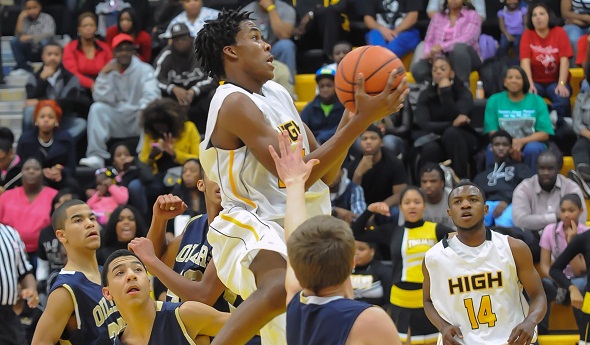
PHOTO: Saginaw, last season’s Class A champion, opened last week with a 78-60 win over Mount Pleasant. (Click to see more at HighSchoolSportsScene.com.)