

Jets' Streak Withstands Mightiest Challenge
March 23, 2017
By Geoff Kimmerly
Second Half editor
EAST LANSING – Seth Polfus might still be giggling and shaking his head. He couldn’t believe it either.
Southfield Christian was going to be the greatest threat so far to Powers North Central’s nation-leading 81-game winning streak. Anyone closely following the Jets’ record-setting run knew it.
But no one would’ve guessed Polfus – a 5-foot-9 senior guard, the team’s fifth-leading scorer, coming off three missed jumpers – would be the one to finish victory 82.
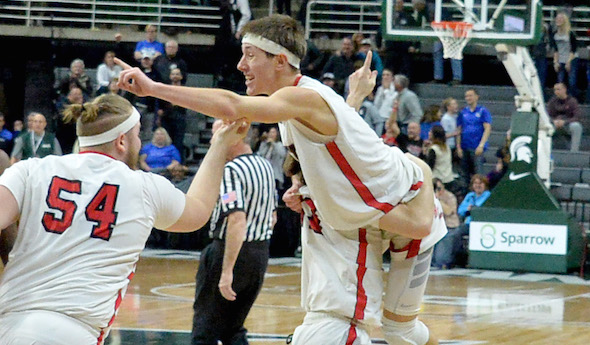
With four seconds to play in Thursday’s first Class D Semifinal, the team’s Mr. Basketball finalist double covered, and history seemingly hanging in the Breslin Center air, North Central’s Dawson Bilski sent a halfcourt pass deep to Polfus, who bobbled the ball at the baseline. Recovering, he somehow got up a shot around outstretched arms with one tenth of a second on the clock – and it dropped to give the Jets an 84-83 double overtime victory that could well be remembered as the game of this Finals weekend, even though no title was awarded for winning it.
Regardless, it surely will be remembered as the defining game of North Central’s winning streak, however long it lasts. Southfield Christian won three straight Class D titles from 2012-14, and then played in Class C the last two seasons while the Jets built their legacy. After last season’s Finals, this school year’s classifications were released showing the Eagles headed back to Class D.
“We knew if we made it to this point, they’d be there,” said Jets senior Jason Whitens, that Mr. Basketball finalist. “So everything from that point was getting better each day, preparing for that but not overlooking any opponent because you never know when something’s going to slip up, and teams are after you. We’ve got a big target on our back, and we got the job done.”
North Central (27-0) will next face Buckley in Saturday’s 10 a.m. Class D Final.
Polfus will have a busy weekend. A 4.0 student, he’ll later that afternoon accept one of 32 MHSAA/Farm Bureau Insurance Scholar-Athlete Awards for his achievements as an all-around athlete and student.
But he wrote his legend with that most improbable shot, the basket of a lifetime for a player who tore a knee ligament two seasons ago and spent last year’s Breslin run mostly holding down the bench.
“I didn’t know how much time was on the clock. I didn’t even know I shot it,” Polfus said. “We set up that play and Dawson was going to be coming down the court, and I knew I was going to be in that position because they were going to go double (Whitens down the sideline), and the ball was coming and I was ‘Oh man, it’s actually coming at me right now.’ And then I lost (the ball) … and I didn’t really know where I was. And then I saw the 6-4 kid coming at me, pump-faked him like I always do when I’m really scared. And then just launched it, and I saw it hit off the rim, thought it was an air ball, and then I just didn’t know what happened.”
 “I saw him go wide open,” Bilski added, “and I have enough trust in Seth – I grew up with him – I knew he was going to get the job done.”
Needless to say, none of what happened past halfcourt was coach Adam Mercier’s plan.
“I think one thing that summarizes these guys, and they’ve always been this way, is that they’re good at adapting,” Mercier said. “You run sets and plays, and sometimes you get in the way coaching. (But) sometimes you let kids make mistakes, and you let kids make plays.”
The Jets had to make a few. Southfield Christian led by 10 with two minutes to go in the third quarter, only to see the Jets tie it back up with a 14-4 run to end the period.
The two teams went back and fourth during the fourth, with the Eagles pushing the game to overtime on sophomore Harlond Beverly’s free throw with six seconds to go in regulation.
“We had a couple chances, they had a couple chances to put it away,” Southfield Christian coach Josh Baker said. “That’s kinda what we’re used to with these guys and the work ethic they put in.”
Southfield Christian got up by three at the end of the first overtime, but Whitens drained a 3-pointer with 17 seconds left to push the game to a second extra period. As that one wound down, the Jets led 82-80 with 20 seconds to go after a Bilski blocked shot and free throw.
But Eagles senior Brock Washington fearlessly drilled a 3-pointer with 10 seconds to play, pushing his team ahead by one and setting up Polfus’ dramatic moment.
“That’s what you want in the playoffs, what you want in the final four – a great game, a great matchup,” Washington said. “We’ll all look back one day and we’ll all be proud of what we did, but we all wanted to get that win.
“Everybody was prepared. Everybody was ready for the challenge. We’ve just gotta make the extra play.”
All five starters scored in double figures for the Eagles (21-6). Junior Bryce Washington had 23 points and Beverly had 22, seven assists and six steals, while Brock Washington added 12 points and 10 rebounds. Senior forward Trenton Temple had 10 points and 10 rebounds, and sophomore guard Caleb Hunter had 11 points and also seven assists.
Four other Jets average at least 10 points a game, and Polfus finished fifth in the points column again with seven (just above his 5.5 ppg average). Whitens had 31 points and 10 rebounds, Bilski added 23 points and 12 boards, and senior Bobby Kleiman had 14 points and eight rebounds. Polfus was the only starter who didn’t play the full 40 minutes, sitting for a mere three.
“I think win or lose tonight, they guys have already built their legacy. They didn’t need to win this game to prove anything,” Mercier said. “I’m just so happy for our guys to overcome. I know a lot of people have doubts about us, and deservedly so. We’re a small Class D school with 115 kids, so a lot of people discredit our 81-game winning streak up to this point, because who have you beat?
“That was a question mark coming in. So these kids played the underdog role. At the same time, we’re the two-time defending state champs, we’ve won that many games in a row and we deserve to be here as well. I was just so elated at pushback by our kids tonight … just that pushback, because how many games did we have single digits (during this streak)? So how are our kids going to respond? Those were the questions coming in. And these kids answered them tonight.”
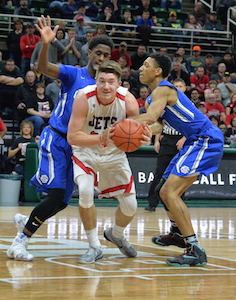
PHOTOS: (Top) North Central teammates carry Seth Polfus down the court after his game-winning shot Thursday. (Middle) The Jets’ Jason Whitens works for an opening while the Eagles’ Brock Washington (left) and Harlond Beverly defend.
Breslin Bound: Boys Report Week 2
December 18, 2017
By Geoff Kimmerly
Second Half editor
It's difficult to draw much from the first two weeks of a four-month basketball season.
But it doesn't take long to sense a turnaround coming (see Detroit Mumford below) or a new championship contender on the rise (hello Grand Rapids Catholic Central?). This week's installment includes a few more teams that quickly have made an impression, to carry us through the end of 2017.
 Breslin Bound is powered by MI Student Aid, and will return during the first week of January. These reports are based on results and schedules posted for each school at MHSAA.com – to offer corrections, email me at [email protected].
Week in Review
The countdown of last week’s five most intriguing results:
1. Grand Rapids Catholic Central 73, Grand Rapids Christian 49 – The Cougars reversed a 39-point loss suffered last season to the eventual Class A runner-up.
2. Hazel Park 74, Detroit U-D Jesuit 63 – Last week a win over Detroit East English got Hazel Park on this list, and this time it’s a double-digit victory over the Cubs (20-4 last season).
3. Dansville 42, Pewamo-Westphalia 34 – The Aggies followed a win over Class B Detroit Osborn with this one over reigning Central Michigan Athletic Conference champion P-W, which beat Dansville by 18 and two points in their meetings last season.
4. Saginaw 69, Saginaw Arthur Hill 61 – The Trojans bounced back from an early-week loss to Detroit Renaissance to beat the rival Lumberjacks for the seventh straight time since falling to them during the 2014-15 postseason.
5. Warren DeLaSalle 77, West Bloomfield 67 – The Pilots have played two of their first three games against teams that made at least the MHSAA Semifinals last season, winning this one over the Class A Lakers.
Watch List
With an eye toward March, here are two teams in each class making sparks:
CLASS A
Mount Pleasant (3-0) – The Oilers improved to post upper-division finishes in the formerly two-division Saginaw Valley League the last two seasons, going 15-9 overall last winter. All of the SVL will play in one division this winter, and Mount Pleasant is off to a nice start with three double-digit wins including a 22-pointer over a Midland Dow team it split with last season.
Troy (3-0) – The Colts play in a tough Oakland Activities Association Red that includes Clarkston, West Bloomfield and Hazel Park among others, but they could be in the mix after reaching the Quarterfinals (and falling there to West Bloomfield) last winter. Troy finished last week by handing rival Athens its first loss, 66-58.
CLASS B
Detroit Mumford (4-0) – With one more win, Mumford will be halfway to bettering last season’s 9-12 finish. The Mustangs have three straight double-digit wins after beating St. Clair Shores South Lake, Oak Park and Warren Michigan Collegiate on successive days over the weekend.
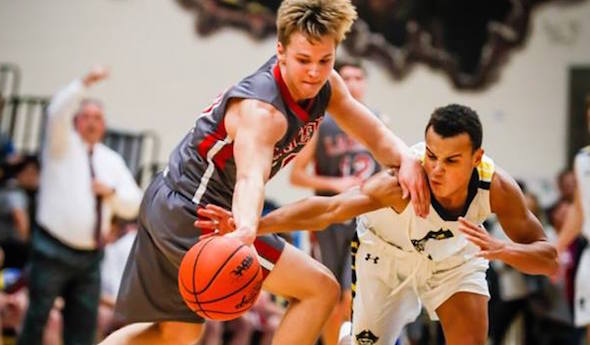
Spring Lake (3-0) – Back-to-back overtime wins over Class A teams has Spring Lake riding high. The Lakers got past Rockford 48-46 and Grand Haven 69-66 last week as they prepped for the Ottawa-Kent Conference Blue season and powerhouse Grand Rapids Catholic Central – which Spring Lake eliminated in last year’s Regional Final after finishing third to the Cougars in league play.
CLASS C
Houghton Lake (2-0) – They are only two games win, but a 35-28 overtime win over Beaverton on Thursday should have the Bobcats’ spirits high. The Beavers were runners-up in the Jack Pine Conference last season and Houghton Lake came in fifth after losing to Beaverton by 29 and 23.
Iron Mountain (4-0) – The Mountaineers might be the favorites in the Mid-Peninsula Conference after finishing third last winter despite going 2-1 (including a District win) over co-champion Norway. The Knights left the league this year, but Iron Mountain surely still enjoyed taking a 48-40 win from them Friday.
CLASS D
Bear Lake (3-0) – Only two weeks into the season, the Lakers are making some noise in the West Michigan D. They sit atop the conference after opening with a 12-point win over reigning champion Baldwin, and that’s been by far Bear Lake’s closest game. The Lakers finished 15-7 overall and tied for third in the league last season.
Wyoming Tri-unity Christian (4-0) – As usual, Tri-unity will play a wide variety of opponents including many larger to prepare for the postseason, a strategy that frequently pays off. One of the losses it took last year on the way to the Quarterfinals was against Grand Rapids NorthPointe Christian, and Tri-unity avenged with a 49-41 win Friday.
Can't-Miss Contests
Be on the lookout for results of these games coming up:
Tuesday – Flint Hamady (3-0) at Flint Beecher (3-1) – The reigning Class C champion Buccaneers took three from their rivals last season, but one meeting by only four points.
Tuesday – McBain (2-0) at Buckley (1-1) – Although the Bears took a four-point loss on opening night two weeks ago, both of these teams were perfect for the regular season last winter and Buckley is the reigning Class D runner-up.
Wednesday – Grand Rapids Catholic Central (3-0) at Wyoming Godwin Heights (2-0) – By early returns, these are looking like two of the best teams from Grand Rapids and two of the state’s best in Class B as well.
Dec. 26 – Detroit Martin Luther King (2-0) vs. Southfield Christian (2-1) at Cass Tech – Southfield Christian was a last-second basket from playing for the Class D title last season and can see how it stacks up against the Class A Crusaders.
Dec. 29 – Saginaw (1-1) vs. Detroit Cass Tech (2-0) at Detroit Renaissance – There are high expectations for the Technicians, making this matchup with an annual power arguably the most intriguing at the Motor City Roundball Classic.
PHOTO: Spring Lake got past Grand Haven in overtime last week to stay undefeated. (Photo by Tim Reilly)