

Johnson Family Reunion: Tuesday will Bring Together Officiating Brothers, Coaching Cousins
By
Mike Dunn
Special for MHSAA.com
December 12, 2025
GAYLORD – What a night it will be.
The Big North Conference game this Tuesday between visiting Traverse City Central and host Gaylord has a coaching connection that will be a draw in itself. Central is led by former Gaylord hoops standout Luke Johnson, while Gaylord is coached by Luke’s cousin Justin Johnson – another past Blue Devils hoops standout who graduated in 1995 with school records for single-game, single-season and career 3-pointers.
Luke graduated in 1997 as Gaylord’s all-time leading scorer with 1,571 points and went on to play four years at Central Michigan University. He coached the boys at Elk Rapids for 14 seasons and is now in his second year coaching in Traverse City, where he is also an assistant principal at Traverse City East Middle School. Justin, owner and operator of the local Bulldog Painting business, is in his first year as the Blue Devils’ head coach after serving previously as the JV coach.
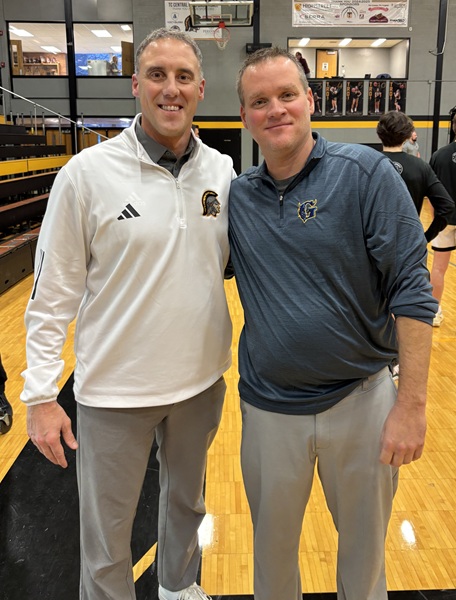 The cousins were Gaylord teammates on the storied 1994-95 team that captured the District title with a thrilling come-from-behind victory at the old Petoskey gym. They will be facing each other as head coaches on the hardwood for the first time – and Justin’s son Carter, a junior wing, is in his first year on the Gaylord varsity.
On top of that, the Johnson cousins will be coaching against each other in the gymnasium named after Luke’s grandfather Jim Mongeau. Ironically enough, the Jim Mongeau gymnasium was dedicated on December 16, 1994, the same day 31 years before.
If that was solely the storyline for Tuesday’s game, it would make for a memorable occasion.
But there is more to this story … much more.
Three brothers with whistles
As it turns out, the biggest storyline of this memorable night is the officiating crew.
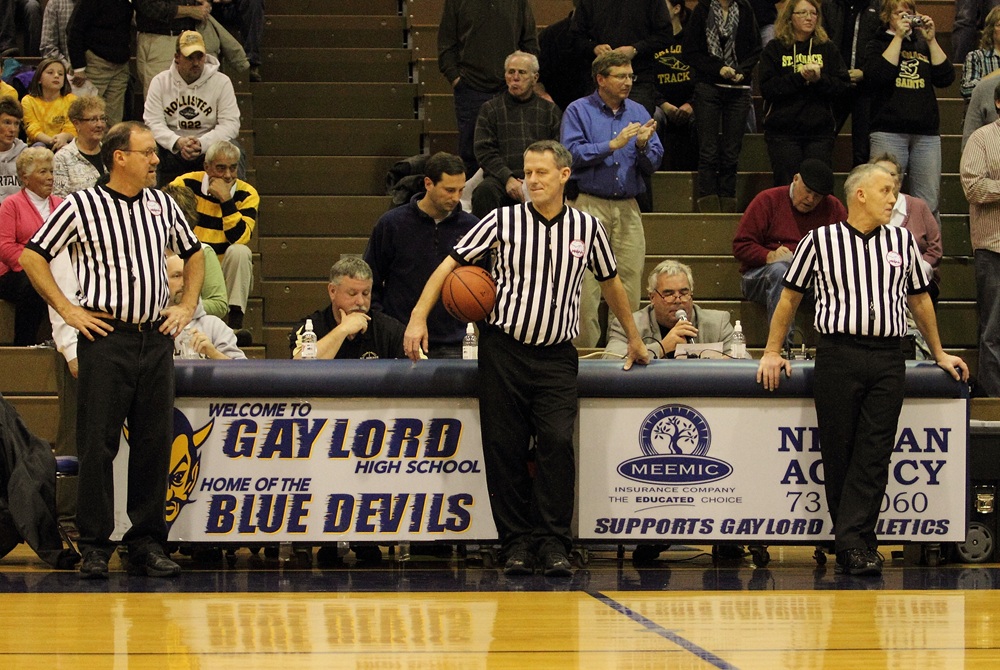
Not only will Luke and Justin be facing off Tuesday with Justin’s son also competing on the floor, but the three men wearing the striped shirts with whistles around their necks will be Johnson brothers Tommy, Steve, and Dave. Tom is Luke’s dad, and Steve is Justin Johnson’s father.
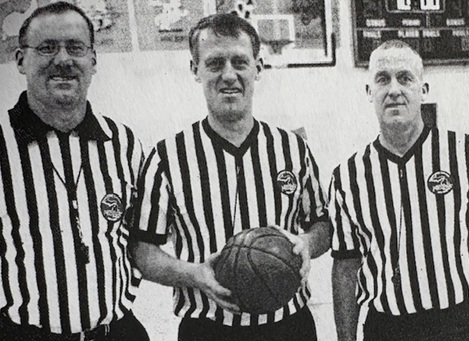
Between them, there is more than 125 years of hardwood officiating experience: Tom is in his 50th year, Steve is in his 45th, and Dave in his 32nd season.
The brothers have worked together more times than they can count over the decades, though not as much in recent years. Tom has had his own crew of officials for a while. Steve and Dave have teamed with Charlie Lovelace to form their own crew.
Tuesday’s game in Gaylord will be the first time any of the brothers have worked a game coached by Luke or Justin.
And it very well could be the final time the three brothers officiate a game together. In fact, this is quite likely given the present circumstances.
Tom’s battle with cancer
Tom has inoperable pancreatic cancer and is undergoing regular chemotherapy treatments. Just the fact that he is still actively officiating this season is remarkable in one way, given his prognosis, and yet not remarkable at all for anyone who knows Tommy and the inner drive and mental toughness that is so much a part of his make-up – character traits he has exhibited since the glory days in the late 1960s when he was a star student-athlete competing for Gaylord in football, basketball, and baseball.
That inner drive and willingness to persevere continue to serve Tom well, especially during this challenging season of life.
 As Steve said, “Tommy definitely has the Johnson gift of stubbornness.”
And Dave agreed: “Tommy is fighting this with everything he has. He’s gonna go down swinging, because that’s just who he is.”
Tom has been very open about his battle with cancer. He was diagnosed Nov. 13, 2023, and at one point his weight was down to 138 pounds.
Tom was at home in his favorite chair in February with wife Jenni tending to him – “My wife’s been a saint through all this and the best nurse I’ve ever had,” he noted – when he made a decision.
“I told my wife if I just sit here in this chair, I’m gonna die and I don’t want to just give in to this,” Tom said.
“I made up my mind right then that I’m gonna take the proactive approach to this. I’m gonna live till I die. People think I’m being funny when I say that, but I’m serious. I’m gonna live till I die. I’m not gonna sit out the rest of my life. It’s all in the hands of the good Lord, and He’s the One who’s gonna let me know when my time comes.”
Tom retired as a physical education teacher at Gaylord in 2007 but has continued to coach as well as officiate volleyball, basketball and baseball. Because of recent developments, Tom was initially going to give up coaching the Gaylord boys golf team last spring but opted to stay on, extending his coaching career that dates back 49 years at Gaylord and includes a long stint as the varsity boys hoops coach from 1987-97 and then 2003-07 in addition to being the freshmen football coach for a stint, the baseball coach, and, for the past 16 years, the boys golf coach.
“The golf kids were great to work with,” Tom recalled. “I had some limitations, and they accepted and adapted and it was actually a fun season.”
‘I want to be out there’
Fast forward to the present school year. It would have been easy for Tom to lay down his whistle, but he’s not ready for that. He officiated about 30 nights during the volleyball season, and that went pretty well. Now he plans to continue officiating basketball as long as he is physically able and knows he can still call a good game.
“I just want to be out there doing one of the things God has designed for me to do,” he said. “I still enjoy it. We set a goal at the start of the school year to get through the volleyball season first and make it to Thanksgiving, and we’ve met that goal. The next goal is Christmas. And we’ll set other goals after that. But in the meantime, I plan to stay as active as I can doing things I love doing.”
Tom plans to officiate the full basketball season, as God enables him. The one date he is especially looking forward to, though, is Tuesday, Dec. 16.
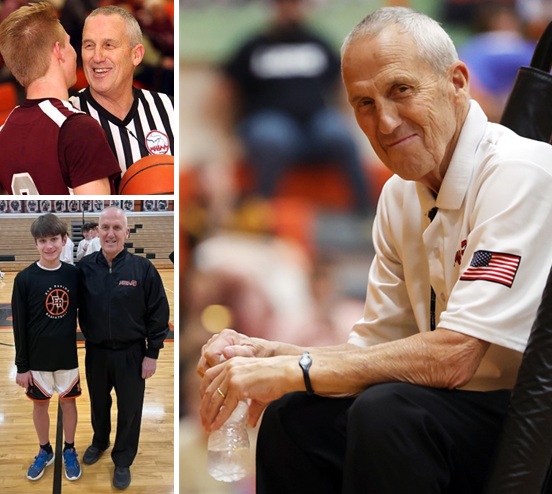 “It’ll be a great night,” Tom said. “I’ve reffed numerous games at ‘The Mong’ since it opened in 1995, but this will be a very special night not just for me but for all the Johnson family.
“I only hope in the midst of it I can communicate in some way how much I have appreciated the Gaylord community over the years and how much I’ve loved being a part of this community along with my family, and especially being part of Gaylord schools for so many years.”
Tom has quite a unique history with Gaylord basketball as a player and a coach. Tom played in the final high school game in the old community center during his junior year and played in the first game at the old gym that now serves as the middle school gym. He also coached the final high school game at the old gym during the 1994-95 season and coached the first game played at the newly-dedicated Jim Mongeau Gymnasium in January of 1995 against St. Ignace.
He also coached the amazing District championship game against favored Petoskey in its old gym packed to the rafters that March of 1995, a game that many still talk about to this day. The Blue Devils, with Justin knocking down the long ones and Luke distributing and driving through the lane, narrowly edged the excellent Petoskey team that featured Trevor Huffman and John Flynn.
Brennan Fitzek hit what proved to be the game-winning shot in the waning seconds, and Gaylord made a final stop on defense to secure the hard-earned trophy.
"We had some epic battles with Petoskey in those days," Tom said. "Petoskey had some great teams with Huffman and Flynn and a great coach in Dennis Starkey, who is still a friend to this day. It was tremendous competition."
‘I was just mowing’
It was Dave Johnson, the youngest of the brothers, who first had the idea of officiating the Dec. 16 game together.
“I was just mowing my grass one day soon after Justin was hired as the varsity coach and thinking ahead about the night when Luke comes from T.C. Central to play Gaylord,” Dave recalled. “Here you have the two coaches who are cousins from Gaylord facing each other in the gym named after their grandfather and Justin’s son playing for Gaylord on top of that. Wouldn’t it be cool if we three brothers could officiate the game that night?”
Dave dismounted the mower then and there and made phone calls to Steve and Tommy to see what they thought about the possibility. Then they contacted Luke and Justin and, before very long, everything was set in motion.
“The stars all aligned,” Dave said with a chuckle. “Justin and Luke were both on board with it, and they got the approval of their ADs. Everything that needed to happen for this to come together happened. It’s gonna be a great night and a historic night.”
When the family got together for a meal in September to celebrate Tom’s birthday, all the details about the Dec. 16 game were discussed. By the time the meal was over, everything was ironed out and everyone was in agreement.
“There’s so much nostalgia and history wrapped up in this one night,” Dave noted. “You have Tommy, the son-in-law of Jim Mongeau, in his 50th year officiating. To me, this night is really a tribute to Tommy and Jen and their lives revolving around Gaylord athletics.”
It will be a milestone night in another way.
 “This will probably be the final time we three brothers have the chance to officiate a game together,” Dave said. “Steve is working through a knee injury right now, and my health is not what it used to be either. But if this is our final game as an officiating crew, we couldn’t have picked a better one.”
Steve’s knee has been giving him fits lately and, for the first time in 45 seasons, has caused him to miss some games because of an injury. He is hoping to recover well enough to return to the floor in January and resume a normal schedule.
There is only one game Steve will officiate in the whole month of December, and it’s the one game he wouldn’t miss for anything.
“I know it’ll be one of the best nights of my life,” Steve said. “How great it’ll be for Dave and I to get to work with Tommy again and to see all the people there. It’ll be a night for reflecting on so many memories and making some new ones.”
Looking forward
“I’m thrilled with how this has all come together,” Luke said. “This night will not only be a great tribute to my dad but to a family that’s been involved in Gaylord athletics for 50-plus years.
“If you include my grandfather, then you’re going back 70 years or more with Gaylord. I know my dad impacted a lot of lives as a teacher and a coach over the years, and my grandfather had the same kind of legacy before him.”
Luke is naturally excited for the game itself but more excited for the moment, especially given his dad’s health challenges.
“Obviously, the circumstances with my dad create a different perspective for the night,” he added. “My hope is we can just soak in the history and enjoy the moment and not let it rush by. We likely won’t have another night like this one.”
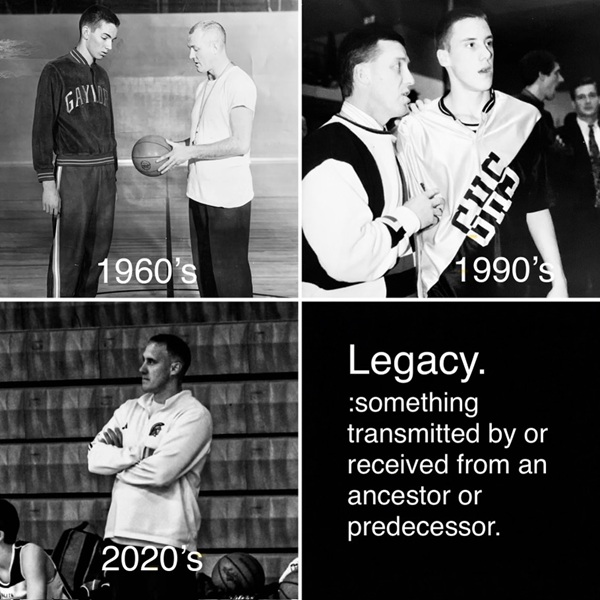
PHOTOS (Top) Brothers, from left, Steve, Dave and Tom Johnson – here at Gaylord High School – will referee the varsity boys basketball game Tuesday between Gaylord and Traverse City Central. (2) Cousins Luke Johnson, left, and Justin Johnson are the varsity coaches for Traverse City Central and Gaylord, respectively. (3) The Johnson brothers, here during their younger days, have a combined 127 yards of officiating to their credit. (4) Tom Johnson is in his 50th season officiating, a run filled with many memories including refereeing his grandson’s game at Elk Rapids (lower left). (5) This collage, from top left, includes longtime coach Jim Mongeau speaking with a Gaylord player during the 1960s, Tom Johnson coaching a player during the 1990s, and Luke now coaching. (Photos courtesy of, in part, RD Sports Photo and Photography by Joanie Moore, with others collected by the Weekly Choice and Charlevoix County News.)
Season Low High Enough for Resilient Rockford to Earn Saturday Return
By
Steve Vedder
Special for MHSAA.com
March 13, 2026
EAST LANSING – Forget about the value of running up huge point totals. The only thing that mattered to Rockford's boys basketball team was staying alive to fight another day.
Despite being held to their lowest point total of the season, the resilient Rams made enough key plays down the stretch to knock off Auburn Hills Avondale 38-35 in Friday's first Division 1 Semifinal at the Breslin Center.
The 38 points were the fewest scored by Rockford (24-4), seven less than the team totaled in its regular-season finale against Grand Haven and just the fifth time the Rams had scored fewer than 60 points in a game this season.
No problem, said Rams coach Kyle Clough, whose team advanced to Saturday's 12:15 p.m. championship game.
"It shows we have various strengths against a team like Avondale, which is electrifying. They took away some of the things we're good at," Clough said. "We didn't know about scoring (how many) points, but it could've been 10-9 as long as we can play tomorrow."
Rockford nearly let a 34-29 lead with four minutes left in the game slip away as the Yellowjackets turned two turnovers into two layups to cut the margin to 34-33 with 52 seconds remaining. But the Rams' Jake Bascom broke away with a clutch dunk with 50 seconds to go, and Avondale missed a potential game-winning layup with two seconds left. Josh Bascom sealed the win with two free throws.
The Yellowjackets' last lead was 23-22 with 2:21 left in the third quarter, although they did tie the game 27-27 during the first minute of the last quarter.
 The win upped Rockford's record in games decided by eight points or fewer to 10-2, an impressive number for a team that starts two sophomores and a freshman. Clough said much of the credit goes to the Rams' two senior starters – Bascom, who had 13 points, and guard Dylan Gross, who had 12.
"Dylan and Jake are both three-year starters, so that's a lot of comfort," Clough said. "We won a couple games early, and that helped build our confidence."
Sophomore forward Josh Bascom said experience isn't the only factor in success.
"We're built for the now," he said. "There have been a lot of games where it's been a five-point game and we know what we have to do to win. We trust our teammates to make the right plays."
Jake Bascom said he and Gross have thrived in the role of senior leaders.
"I think they look to us to get through a tough year," he said. "We've had some great games, some battles this year, and we know what we have to do to win."
Jaidon Bourgeois led Avondale with 12 points.
Yellowjackets first-year coach Aaron Fox said it wasn't as much poor shooting by either club that led to the low point totals as it was strong defense. Avondale made only 1 of 14 3-point attempts while Rockford shot just 40 percent (14 of 35) from the floor.
"It was a hard-fought game. We made a couple mistakes at the end, and it kind of took us out of it," Fox said. "Rockford is a very disciplined team, and that's always a struggle for us. We've worked on it and we did some good things, but there were some things we'd like back.
"I thought we executed well, we just missed (a shot) at the end. Against a team like Rockford, little things are magnified. It's all about doing the little things against a high-caliber team like Rockford."
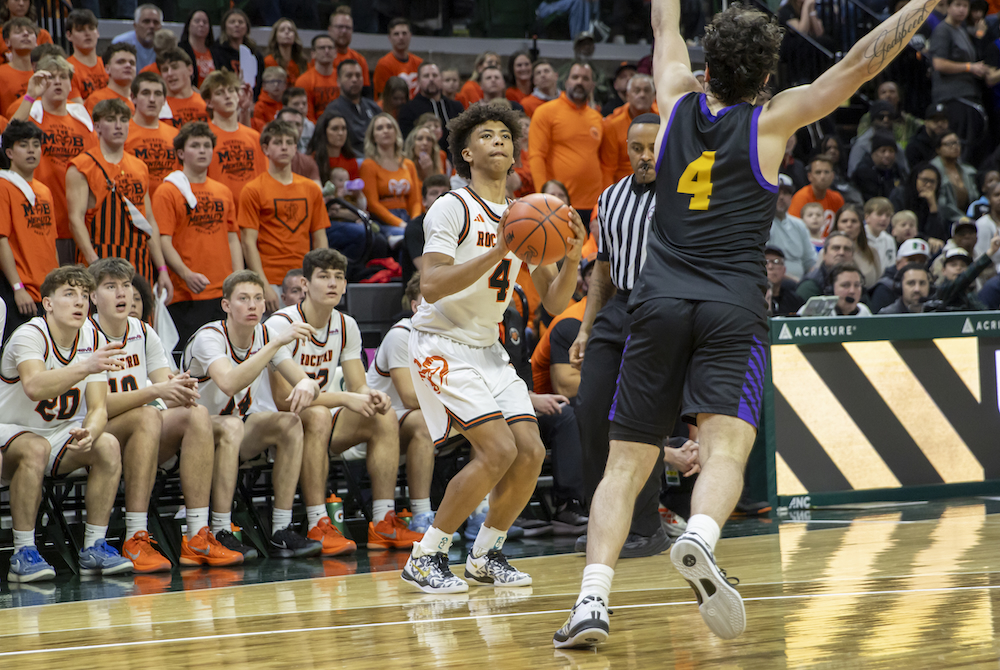
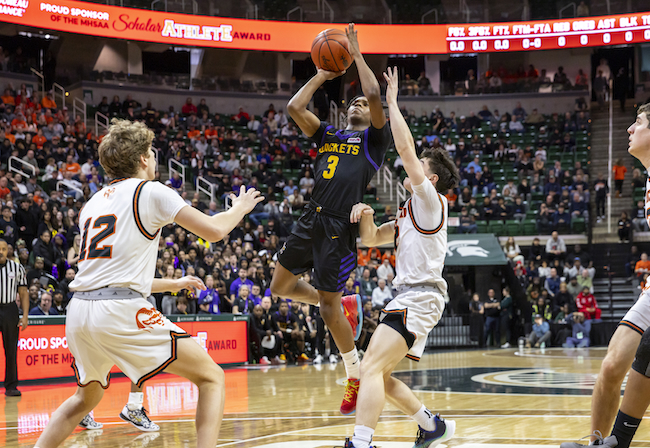
PHOTOS (Top) Rockford’s Jace Opoku-Agyeman lines up to take a shot while defended by Avondale’s Maxwell Muhl on Friday. (Middle) Avondale’s Qualaeb Ross (3) gets up a shot in the lane. (Photos by Adam Sheehan/Hockey Weekly Action Photos.)