

Johnston Finds Home with Onsted Hoops
March 13, 2020
By Doug Donnelly
Special for Second Half
ONSTED – When Mary Kay LaFerney moved from California to Michigan, she had no idea the impact a group of freshmen and sophomore boys were going to have on her son.
 And she certainly didn’t know it would be because of basketball.
But that’s what happened this past season for LaFerney and her son, Zachary Johnston, at Onsted High School in Lenawee County. Johnston, 15, who has Down syndrome, wanted to be part of the junior varsity basketball team. The JV head coach Travis Wobrock was on board with the idea.
“He came to every practice and every game,” Wobrock said.
Johnston didn’t mind filling water bottles, grabbing towels or throwing out basketballs. He would also often take part in layup lines at the start of practice and shoot baskets when he could. It didn’t take long before Johnston made a request.
“He said he wanted a jersey,” Wobrock said.
The Onsted junior varsity team members had bigger ideas for Johnston. They wanted him to play in a game.
“Every week, one of the kids on the team would come to me and ask when Zach was going to get his chance,” Wobrock said. “They wanted this to happen so bad.”
As the season drew closer to the finish, Wobrock put the plan in motion. He contacted Clinton junior varsity basketball coach Greg Dutton and told him about Zachary. Dutton was instantly in favor of helping Johnston get into the action.
“When I played at Napoleon, we had a team manager, Alex DeNato, who had Down syndrome,” Dutton said. “He never had the opportunity to get a basket in one of our games, but he would lead us in pre-game speeches and occasionally led us out of the locker room for pre-game warmups.”
The Onsted players decided to wrap Zachary’s jersey up and present it to him a couple of days before the game vs. Clinton.
 “He got into the car, and he was smiling,” LaFerney said. “He was carrying a bag. I asked him what was in the bag. He said, ‘Take a peek.’ He was so excited to have a jersey.”
Wobrock videotaped the moment Johnston opened his jersey and posted it on social media. Thousands of people viewed it and read about plans for Johnston to play in the game. As the JV game went on, the stands began to fill up. Some held signs for Zachary. Fans were chanting his name.
“It was the biggest crowd we’ve ever had for a JV game,” said Wobrock.
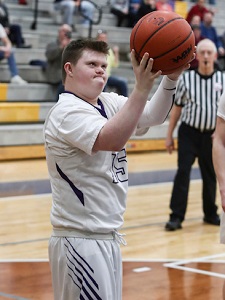
The players on the floor kept looking over at the bench to see if Johnston was ready. Finally, late in the game, Wobrock walked with Johnston to the scorer’s table. Johnston showed the scorekeeper his jersey – number 15 – checked into the game, and ran onto the court.
“When the crowd erupted, it gave me chills,” Wobrock said. “I’ve never seen anything like that. All the kids stood up. Everyone stood up. We weren’t even focused on basketball that night. We were focused on Zach.”
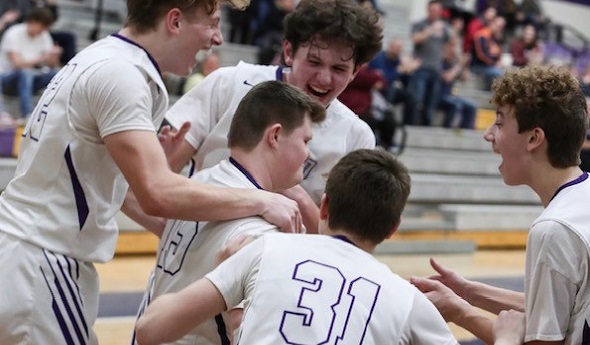
As players from both teams circled around Johnston, he got his chance. Finally, on a pass from Clinton’s Derek Tomalak, Johnston took aim at the basket and sank the jump shot.
The crowd erupted. Several people were in tears.
“I can’t remember being that emotional before the varsity game even started,” Onsted varsity basketball coach Brad Maska said. “I’m proud of my JV coaches for how they handled that night.”
Dutton said he was more than happy to help the Onsted basketball team make the moment happen. He was also glad his children got to watch from the stands.
“It was a special thing to be a part of and witness,” he said. “I am happy Travis asked our team to be involved. It helps bring into the limelight that basketball is just a game and that there are greater things in life than wins and losses. It's about building young men to be caring, thoughtful individuals when they are done playing.”
Wobrock, who is the graduation coach at Onsted High School, said his eight-player squad learned a lot of valuable lessons this season with Johnston as their manager. The players - Daniel Harrah, Jordan Santimore, Brody Giroux, Zack Gillean, Bradlee Vanbrunt, Harrison Moore, Matt Marsh and Brandon Corder – were just as emotional as everyone else in the Onsted gym.
“They’ve been amazing through this whole thing,” Wobrock said. “I’m very proud of them.
 “It’s amazing how they have taken him under their wing. They give him fist-bumps in the hall and hugs. They eat lunch with him. I think that’s kind of how it started. They saw him eating alone at lunch and the whole table invited him to their table. The relationship has just taken off. He’s one of the guys.”
LaFerney is a California native and lived in the San Diego area until two years ago when her family moved to Michigan, where her husband was originally from and has family. They bought a home in the Onsted Community Schools district. It’s been a perfect fit for her son, who is a freshman at the school.
Being part of the school, part of the team, has been extremely important to Zachary, she said. “He’s a smart kid. He’s very aware of his situation and surroundings. He knows how people are treating him.
“This is about way more than just basketball,” she added. “It’s about inclusion. Coach Wobrock was amazing about making sure Zachary was included in every way possible. The players on that team really care for Zachary.”
Wobrock recognized the impact basketball has had on Johnston – and the other players on the Wildcats team.
“Just because someone is different,” Wobrock said, “it doesn’t mean they don’t have the same goals, the same dreams, as everyone else.”
 Doug Donnelly has served as a sports and news reporter and city editor over 25 years, writing for the Daily Chief-Union in Upper Sandusky, Ohio from 1992-1995, the Monroe Evening News from 1995-2012 and the Adrian Daily Telegram since 2013. He's also written a book on high school basketball in Monroe County and compiles record books for various schools in southeast Michigan. E-mail him at [email protected] with story ideas for Jackson, Washtenaw, Hillsdale, Lenawee and Monroe counties.
PHOTOS: (Top) Onsted junior varsity teammates celebrate with Zachary Johnston after his basket against Clinton. (Middle) Johnston squares up and takes aim. (Below) Johnston shares a celebratory moment with coach Travis Wobrock. (Photos courtesy of Eric Tjolsen.)
Next Generation Chargers Make C Final
March 23, 2017
By Geoff Kimmerly
Second Half editor
EAST LANSING – Carson Meulenberg and Trenton Koole had never played a game of this magnitude before taking the Breslin Center floor Thursday.
But their dads had, and perhaps indirectly that provided them a little experience. At least it seemed like it.
Covenant Christian didn’t seem bothered by any of the usual anxieties teams face when they play during the final weekend for the first time. The Chargers – in an MHSAA Semifinal for the first time since winning Class D in 1994 – got ahead early and never slowed in downing Manton 62-35 to earn a spot in Saturday’s Class C championship game.
Koole’s dad Scott played on that 1994 team that beat Eben Junction Superior Central 79-70 in the championship game. Scott Koole also played with Dave Meulenberg on the 1993 team that beat Muskegon Western Michigan Christian 53-42 to win the Class D title that season as well.
“To just stay calm, keep your composure, play your best,” Carson Meulenberg recalled of the advice his father gave him before Thursday. “Don’t worry about a lot of things. A lot of it is worrying about nothing, so just go play your game.”
And Covenant Christian’s game this season frequently has focused on defense, which was lockdown against the Rangers and will be especially key in Saturday's 4:30 p.m. Final against Flint Beecher.
Koole blocked Manton’s first shot of the game, and Covenant Christian had three blocks during the first five minutes. The Rangers still hung in to trail only 11-7 at the end of the first quarter, but the Chargers (21-5) scored the first 19 points of the second and never led again by fewer than 20.
They held usually sharp-shooting Manton (21-5) to 22 percent success from the floor, including 16 percent from 3-point range.
“Finally,” Calvin Christian coach Tyler Schimmel said. “To be honest, since the first District game, we haven’t played that well. I told the guys before (this) game, you’re due for one, especially defensively.
 “This year, we actually have (had games like this). That’s why I kept telling my guys they’re a good team. They’re capable of doing those types of things.”
Koole led Covenant Christian with a game-high 14 points and eight rebounds, and Meulenberg and junior forward Zach Kaptein both had 10 points. Senior guard Benji Kuiper had six points, seven rebounds, six assists and five steals, and junior Tyler Cammenga had nine points and seven rebounds.
Manton’s top three scorers this season were juniors and sophomores; junior Jayden Perry led again with 13 points, and junior Hunter Ruell had eight points.
“On film, we knew they were going to be athletic just by watching them,” Manton coach Ryan Hiller said. “Once they started getting offensive boards, and the transition game, and I don’t know how many shots they blocked that first half … through the first five minutes, we saw a trend there, and we had to adapt the things we normally do, and we struggled there.”
Manton was playing in its first Semifinal since 1996. The Rangers had been eliminated in the District Finals the last three seasons, losing those games by a combined seven points.
Covenant Christian is riding a streak of 14 wins in 15 games, and now has some bragging rights at home in addition to Saturday’s opportunity.
“He talks about it all the time to me, brags and says he made it this far,” Koole said of his dad's Finals memories. “Now I can go back to him and tell him I did the same thing.”
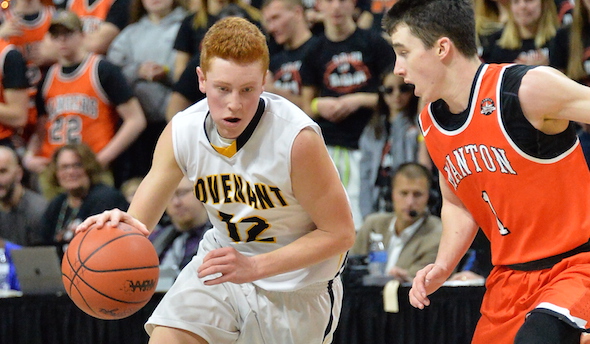
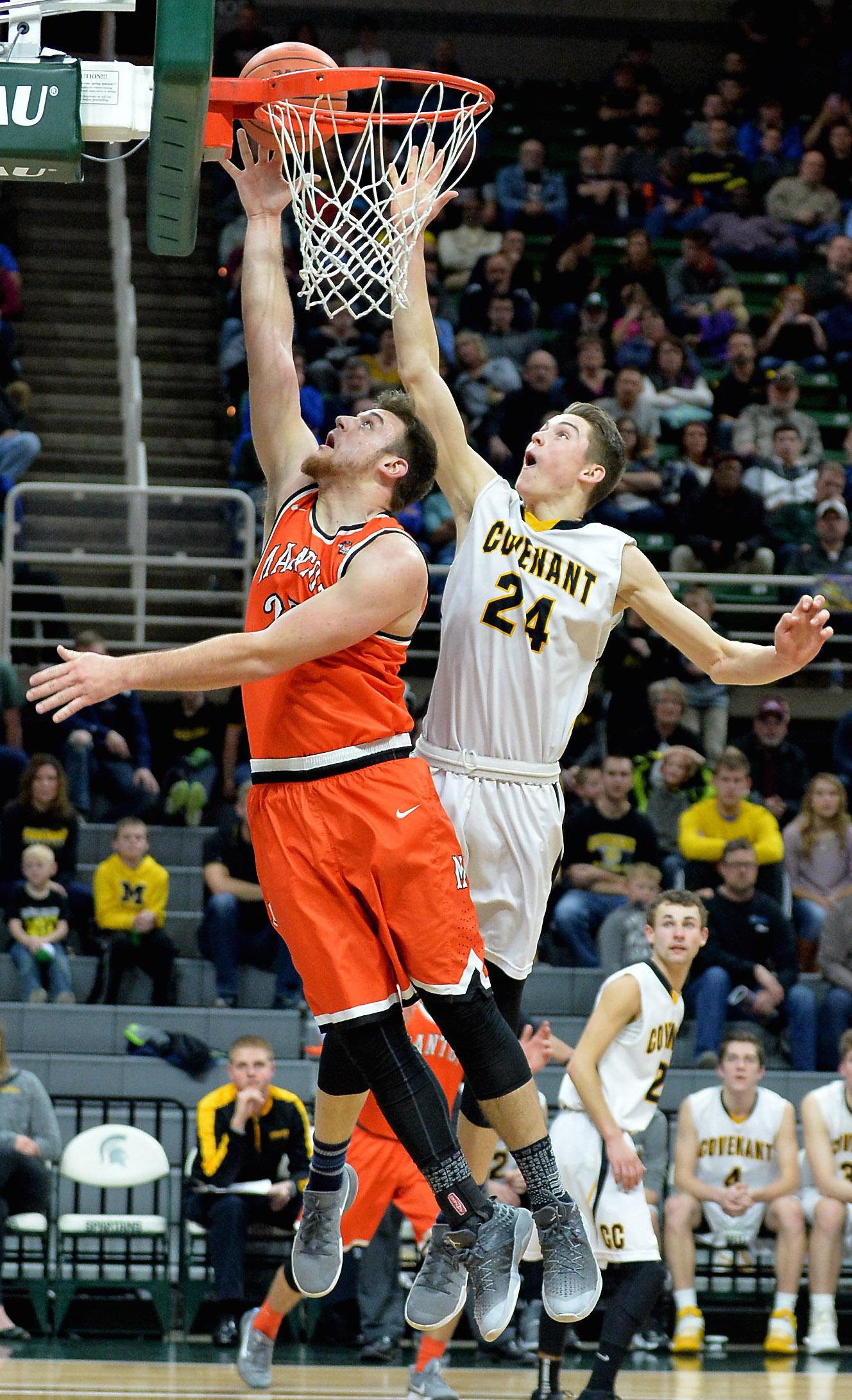
PHOTOS: (Top) Covenant Christian’s Benji Kuiper (12) works to get around Manton’s Jayden Perry during Thursday’s Semifinal. (Middle) The Rangers’ Wyatt Baker gets up a shot with the Chargers’ Carson Meulenberg (24) defending.