

Johnston Retires as Winningest Coach, Much More to Beaverton Dream He Built
By
Paul Costanzo
Special for MHSAA.com
March 15, 2024
Before Roy Johnston left the court that bears his name for the final time as Beaverton head boys basketball coach on Feb. 23, 1,500-plus fans, family and current and former players had one more chant.
 It wasn’t the name of the coach they all adored after he wrapped up the winningest career in MHSAA basketball history. It wasn’t even the school song, or a slogan.
With Johnston pumping a raised fist, the community chanted “Judy” to honor his wife, who could not be at the game or celebration as she was battling cancer.
It was a fitting tribute to the woman behind the coach who became more than the face of the community, and one last opportunity for those fans to say thank you to her for her own efforts and sacrifices in helping the Beaverton become something pulled straight from the movie screen – the small-town sports tale complete with the iconic coach in the lead role and generations of locals living their dedication by filling the stands for every game.
Judy Johnston passed away this past Saturday, a little more than two weeks after the ceremony that honored her husband. She was 81.
All interviews for this story were completed prior to her passing, but a common theme when talking about Johnston’s 50-year career and importance to Beaverton was that the entire family, specifically Judy, had played a big role.
“His family has put forth an incredible amount of effort into our community,” said former player Brent Mishler. “In basketball and in general.”
Family is at the center of Johnston and Beaverton’s immense success over his 50 years. Not only has he coached multiple generations of several Beaverton families – including three generations of Mishlers – but he’s coached his own children, and grandchildren.
Small town programs often rely on players who have grown up around them and together, and Beaverton has that in spades.
“It was a dream,” former player and Johnston’s co-coach, Shad Woodruff, said of having his son Layk play for Johnston. “I got to play for Roy and be part of all that Beaverton basketball is – it’s not just a sport around here. We have video of (Layk) dribbling a basketball in the gym literally before he could walk. He’s been the little guy that always looked up to (Roy’s grandsons) Spencer Johnston and Carter Johnston, so just to be a part of Beaverton basketball is special.
 “It’s like when your kid gets there, you’re giving your kid to the community for a while and saying, ‘Here you go.’ It’s amazing to watch your son out there, especially in a community like ours. Roy has created this thing with Beaverton basketball where every Friday night, it’s like church. Everybody’s there.”
The numbers behind Johnston’s career, which started in 1966 in Yale, are remarkable. He holds the MHSAA record for wins by a boys basketball coach at 833, the vast majority coming at Beaverton, the program he took over in 1974.
The Beavers won 21 conference titles, 17 District titles and five Regional titles during Johnston’s 50 years, adding a run to the MHSAA Semifinals in 1984.
Just six of Johnston’s seasons ended in records below .500, and in a fitting tribute to their coach, this year’s Beavers scratched and clawed their way to a five-game win streak at the end of the season to ensure his last wouldn’t be No. 7, finishing the year 12-12 with a loss to Beal City in the District Final.
Included in that streak was a 54-45 victory over rival Gladwin on the night Johnston was honored. The Beavers trailed by as many as nine during the second half before rallying to win, led by a 26-rebound performance from 6-foot, 1½-inch senior Reese Longstreth, who Woodruff called the epitome of a Beaverton basketball player.
“I’ve been fortunate to be around Roy for 40 years, and I’ve seen a lot of great wins, especially in that gym,” Woodruff said. “I can’t put anything above that one.”
Layk Woodruff made the final basket in the game, which will forever be the final basket made in Roy F. Johnston Gymnasium during the Johnston era.
“It was super emotional, I’d say, for a bunch of reasons,” Layk Woodruff said of the game. “We felt like it was our responsibility, we had to that game for Roy. It was a rivalry game, last home game of the year – there were a lot of emotions when that game ended. I didn’t even think about (hitting the final shot) until a couple days later. Now that I get to think about it, it’s pretty cool to say that was me. I’ll always remember that.”
One celebration led to another, as Johnston’s retirement ceremony followed the game. A tribute video created by Beaverton graduate Jason Brown, who owns a digital media company, and narrated by longtime Beaverton public address announcer Scott Govitz was played. Govitz admitted to getting choked up at times while recording the video.
“There were a couple times where I did more than one take,” he said.
Govitz was at the center of a massive effort to create the ceremony, with support from athletic director Will Gaudard, school staff and members of the community, including multiple businesses and organizations. Govitz had arranged for special lighting and video screens for the presentation. Special tickets were printed for the night – which also happened to be Beaverton’s Hall of Fame night. Following the video, a spotlight was shone on center court, where a single chair sat, one of Johnston’s vintage red blazers draped over its back.
The more than 100 former players who had come to celebrate their coach each had a glow stick they cracked on, and walked through the darkness to surround the chair.
Then Johnston walked the red carpet – much like his starters have for years when being introduced prior to games – and addressed the crowd.
He didn’t speak for long, but as Johnston so often does, he hit all the right notes, mixing gratitude with humor.
“Gladwin County is a great place to raise a good family,” Johnston said after thanking the traveling contingent from Gladwin.
“I want to thank everyone for a great run. Fifty years. A great run.”
For outsiders, it was a chance to see the softer side of Johnston rather than the man intensely patrolling the sidelines during games. It was a glimpse at the man that handed out suckers before games to every kid in attendance.
 “He belonged on an episode of ‘Grumpy Old Men,’ and he still could play the role,” Govitz said with a laugh. “He would always say, ‘Don’t listen to the way I say it, listen to what I say.’ He just wants you to do things correctly. His players, maybe they didn’t adore it at the time, but they adore it now. Being a part of that program taught them more than basketball skills. … What will happen, once they leave, they find that great respect for it. And, he does things quietly that no one ever knows or sees – helping someone in need, especially the ones in college, checking up on them or sending them some money. That helps build a program and build relationships. He said in his last speech that it’s about getting along with others. If you can’t get along well with others, you can’t get along. That’s what it’s about.”
Mishler echoed that sentiment, and some of the memories that stick out most to the 2002 graduate were when Johnston got after him in his own special way.
“Playing for him was a privilege,” said Mishler, whose father Steve played for Johnston in the ’70s, and his son Cameron played through 2021. “The life lessons he taught set you up for success in life for the future. ‘You need to hear what I’m saying, not the method I’m saying it.’ That’s so true. Being honest and having expectations, and expecting people to hit those expectations, is not a bad thing.”
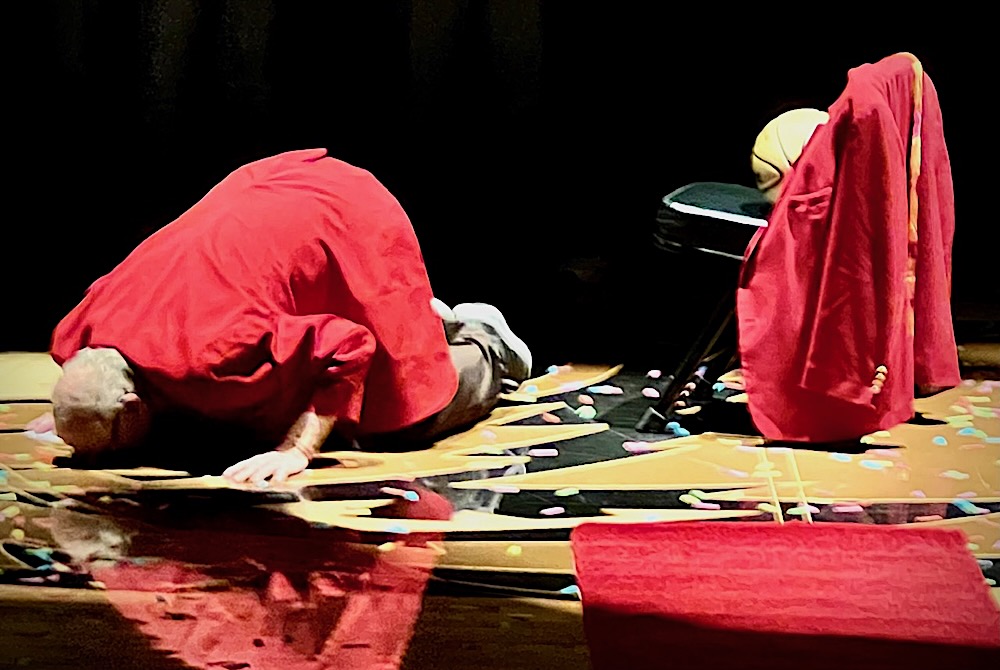
After Johnston was done speaking, he knelt down and kissed the floor to say goodbye to the job he’s done for most of his life, and in a way, thank you, to the community he helped create and that he’ll now need more than ever.
“Roy’s good at making you feel like he’s not big on that stuff (being recognized), and he isn’t, but he definitely does appreciate it,” Shad Woodruff said. “He understands how important he is to the community, and that he’s done something really special. He understands what he’s done is a pretty big feat, but he doesn’t talk about it. He doesn’t brag about it.”
 Paul Costanzo served as a sportswriter at The Port Huron Times Herald from 2006-15, including three years as lead sportswriter, and prior to that as sports editor at the Hillsdale Daily News from 2005-06. He can be reached at [email protected] with story ideas for Genesee, Lapeer, St. Clair, Sanilac, Huron, Tuscola, Saginaw, Bay, Arenac, Midland and Gladwin counties.
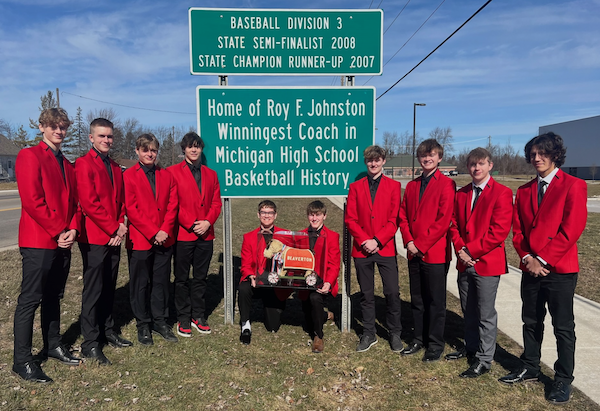
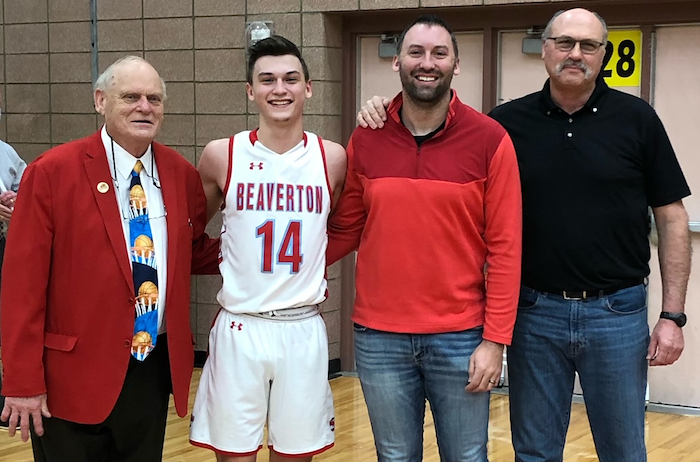
PHOTOS (Top) Beaverton boys basketball coach Roy Johnston kisses the court that bears his name during a celebration of his retirement Feb. 23. (Middle) This season’s team stands at the entrance to town with signs announcing the program and coach’s successes. (Below) Johnston takes a photo with three generations of Mishlers – Cameron, Brent and Steve. (Top photo by Stephanie Johnston.)
Breslin Bound: 2025-26 Boys Regional Preview
By
Geoff Kimmerly
MHSAA.com senior editor
March 3, 2026
Burt Lake Northern Michigan Christian Academy won its first District championship in boys basketball last week. Fruitport won its first since 1938.
 Yale defeated Croswell-Lexington and Marshall defeated Battle Creek Pennfield in District Final matchups of teams that shared league titles. Ann Arbor Pioneer, Grand Rapids Catholic Central, Colon and Detroit Cass Tech all finished second in their leagues this season but won their Districts as well, defeating their respective league champions to advance to this week’s Regionals.
Districts offer every team new life and second chances – and after a week full of those, 128 hopefuls are only three more wins from booking a trip to Michigan State.
Find everything you need to know this week about tickets, brackets and more as the tournament continues on the Boys Basketball page. To watch any of several games online, visit the NFHS Network, and see below for several of the intriguing matchups. Host sites are in bold.
“Breslin Bound” is powered by MI Student Aid and based on results and schedules posted for each school at MHSAA.com.
Week in Review
The countdown of last week’s five most intriguing results:
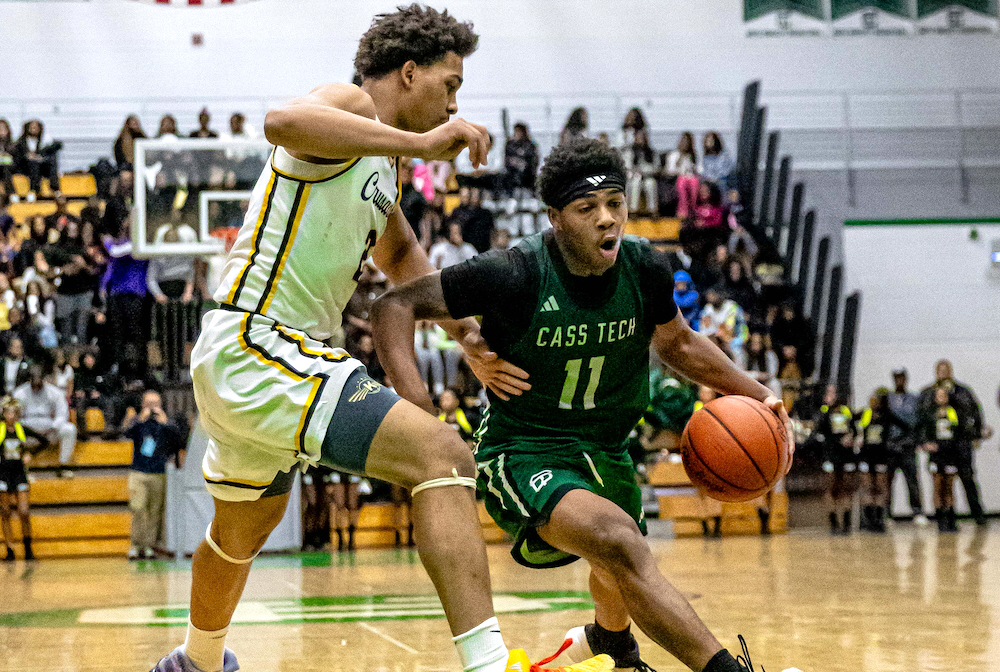
1. Detroit Cass Tech 66, Detroit Martin Luther King 23 The Technicians (18-6) avenged a pair of regular-season losses to rival King (18-6) in a big way in this Division 1 District final after previously falling by seven points Jan. 21 and then 68-63 in the Detroit Public School League Tournament championship game on Feb. 15.
2. Rockford 83, Muskegon 70 The Rams (20-3) won this Division 1 District Final matchup for the second-straight season, ending Ottawa-Kent Conference Green champion Muskegon’s run at 20-3.
3. Hudsonville Unity Christian 60, Grand Rapids South Christian 39 This Division 2 District Final pitted the champs from the O-K Black and Gold, with Unity (21-3) adding to its 17-point win over the Sailors (20-4) from Dec. 12.
4. Colon 54, Mendon 47 The Magi (20-4) had finished second to Mendon in the Southern Central Athletic Association West after losing in overtime both times they faced the Hornets (22-2) during the regular season, but got past them in regulation in this Division 4 District Final.
5. Grand Rapids Catholic Central 44, Grand Rapids Christian 41 The Cougars (18-6) had fallen to Grand Rapids Christian (17-6) by nine points just 10 days earlier to lose the O-K White title to the Eagles, but rebounded to win a Division 2 District title for the third-straight season.
Regionals at a Glance
These could be among our most competitive brackets. Host sites are in bold:
DIVISION 1
Caledonia
Grand Rapids Northview (20-4) vs. Grandville (14-10)
Holland West Ottawa (13-11) vs. East Kentwood (21-2)
Grandville and West Ottawa deserve nods for reaching this week, the Bulldogs for avenging two regular-season losses to Hudsonville with a 49-37 District Final win and the Panthers as they added to a nice streak of four wins in five games by joining Grandville, East Kentwood and Rockford as one of four District champs from the Ottawa-Kent Conference Red. But the most anticipated matchup this week would see O-K Gold co-champion Northview take on the Falcons, who won that O-K Red that also will see all six teams finish with winning records this season.
Detroit Renaissance
Bloomfield Hills Brother Rice (19-5) vs. Detroit Cass Tech (18-6)
Farmington (12-12) vs. Warren Fitzgerald (18-6)
Brother Rice and Cass Tech have been in the statewide favorites conversation most of this decade, and although neither won its league this season it wouldn’t be shocking to see either playing at Breslin with an opportunity to win it all in two weeks. Only three of Rice’s losses were to in-state opponents – East Lansing (23-1), Rockford (20-3) and Detroit Catholic Central (17-6) – and Cass Tech’s six defeats came by a combined 21 points. Farmington has emerged after finishing fifth in the Oakland Activities Association Red and defeated Redford Thurston (20-3) to advance, and Fitzgerald has won 12 of its last 15 and claimed the Macomb Area Conference White title.
Kalamazoo Loy Norrix
Jackson (18-6) vs. Kalamazoo Central (20-2)
Kalamazoo Loy Norrix (16-7) vs. East Lansing (23-1)
Reigning Division 1 champion East Lansing has been stopped only once this season, by Grand Rapids Northview on Feb. 7. The Trojans also defeated Loy Norrix 78-50 two weeks ago, and last year downed Kalamazoo Central by 35 points in the Regional Final. The Maroon Giants are among the state’s elite again this season and perhaps even a step up from a year ago, with losses to only Detroit Martin Luther King (18-6) and Bloomfield Hills Brother Rice (19-5). The focus is on those two, but Jackson has won 11 of its last 12 games, and Loy Norrix has its most wins since 2011-12.
DIVISION 2
Fowlerville
Chelsea (18-5) vs. Marshall (19-4)
Lansing Sexton (22-2) vs. Michigan Center (20-3)
All of these teams are league champions, Sexton in the Capital Area Activities Conference White, Michigan Center in the Cascades Conference East, Chelsea sharing with two others in the Southeastern Conference White and Marshall as co-champion in the Interstate 8 Athletic Conference. Marshall downed the other I8AC co-champ Battle Creek Pennfield to advance and also defeated Michigan Center 64-50 on Dec. 13. Sexton defeated Chelsea by two points last season in their Regional Final and has been even better this winter with its only losses to Division 1 East Lansing and Lansing Waverly. Michigan Center bounced back from two losses to end the regular season, and Chelsea has three defeats by one or two points and shared the SEC White title with Division 1 teams Ypsilanti Lincoln and Jackson.
Manistique
Kingsford (16-6) vs. Cheboygan (18-6)
Ludington (22-2) vs. Gladwin (23-1)
Gladwin won the Jack Pine Conference overall championship and is riding a 23-game winning streak since falling to Sanford Meridian (17-7) in its season opener. The Flying Gs take on another league champion in Ludington, which won the West Michigan Conference Lakes and has lost to only Division 1 Traverse City West (16-5) and North Muskegon (22-2). Those two will play one of the most intriguing Regional Semifinals in any division, but Kingsford or Cheboygan also will be formidable Thursday. The Flivvers made the Division 2 Semifinals a year ago, defeating Ludington by 40 in the Regional Final along the way. Cheboygan has doubled its win total this season from two years ago and got through close games with Grayling and Ogemaw Heights last week to advance.
Owosso
Flint Hamady (16-6) vs. Frankenmuth (23-1)
Freeland (21-3) vs. Portland (18-5)
This group is a complete repeat of last year’s Regional that saw Freeland advance to the Quarterfinals by defeating Portland. Heading into this year’s bracket, Frankenmuth finished first and Freeland second in the Tri-Valley Conference Red, and Freeland handed the Eagles their only loss, 54-48 on Feb. 13, after Frankenmuth had won their first meeting 47-43. Hamady won the Genesee Area Conference Blue and advanced to this week with a 17-point win over Flint Powers Catholic (16-7). Portland finished second in the CAAC White behind Lansing Sexton (22-2) and has won nine of its last 10 games.
DIVISION 3
Cass City
Reese (15-10) vs. International Academy of Flint (18-4)
Sandusky (16-7) vs. Harbor Beach (21-3)
Harbor Beach has totaled at least 20 wins the last three seasons and reached the Regional Final a year ago, but must defeat a familiar opponent for a third time to take that step again. The Pirates won the Big Thumb Conference Black and Sandusky finished third – and Sandusky also had a win over Reese just two weeks ago. The Rockets emerged by upsetting Saginaw Michigan Lutheran Seminary (19-5) in their District Final and now must take on another league champion in IAF, which won the Genesee Area Conference Red. The Phoenix bounced back from a pair of losses to end the regular season to earn their second District title over the last three years, and all of IAF’s defeats came to opponents with at least 18 wins.
Clinton
Ottawa Lake Whiteford (21-3) vs. Onsted (22-2)
Jonesville (18-6) vs. Ecorse (18-5)
Whiteford/Onsted should be another Regional Semifinal with notable statewide interest as both are league champions – in the Tri-County Conference and Lenawee County Athletic Association, respectively – with only a handful of losses between them. Whiteford actually shared the TCC title but has won 11 straight games and lost only twice to in-state opponents. Both Onsted defeats came to Division 2 teams. Ecorse also is a league champion, in the Charter School Conference Silver, and only three years removed from a run to the Division 3 Semifinals. Jonesville was the runner-up in the Cascades Conference West and reached this week with two five-point wins in its District including a triple-overtime victory over Hudson.
Kingsford
Ishpeming Westwood (23-1) vs. Menominee (20-4)
East Jordan (22-2) vs. Elk Rapids (20-3)
This is another field of four league champs, starting with Western Peninsula Athletic Conference winner Westwood, which made the Division 3 Semifinals a year ago and defeated Great Northern Conference champ Menominee 55-52 on Feb. 6. That was one of three Maroons defeats against teams still playing this week, and Menominee is only two years removed from winning a Regional title. East Jordan won the Ski Valley Conference and defeated Mancelona (21-3) for the third time this season to win their District Final. Elk Rapids won the Northern Shores Conference and has lost to only Division 1 and 2 opponents. The Elks got past Northwest Conference champion Maple City Glen Lake by three points last week to advance.
DIVISION 4
Detroit Douglass
Detroit Douglass (17-7) vs. Allen Park Inter-City Baptist (21-3)
Whitmore Lake (17-7) vs. Southfield Christian (19-5)
Inter-City Baptist defeated Douglass in a Regional Semifinal a year ago during its run to Breslin and has lost to only Division 1 and 2 teams this season that all have won at least 17 games. The host Hurricanes also have lost to only Division 1 and 2 teams, all with at least 14 wins – and Douglass nearly made the PSL championship game before falling to Cass Tech in overtime of their semifinal. Inter-City Baptist won the Michigan Independent Athletic Conference Blue and has two victories over both Whitmore Lake and Southfield Christian, which split their regular-season series with Whitmore Lake winning the first game and the Eagles taking the rematch.
Hillman
Rudyard (14-10) vs. Pickford (23-0)
Burt Lake Northern Michigan Christian (16-7) vs. Hillman (21-2)
As noted above, Northern Michigan Christian is coming off its first District championship in this sport. The Eagles also have a win over Rudyard this season and a 23-pointer over Posen – which shared the North Star League Little Dipper championship with Hillman. That adds another level of intrigue to this bracket as Hillman and Posen split and Hillman lost their second meeting – although the Tigers already avenged their other loss, to Rogers City, twice including last week. Pickford has 27 and 29-point wins over Rudyard this season and is pursuing a second-straight Regional title after missing a trip to Breslin last season with a two-point Quarterfinal loss. Rudyard has won 10 of its last 13 games and in its District Final avenged a 20-point loss to Brimley from 10 days earlier with a two-point win.
Merrill
Fowler (22-2) vs. Baldwin (20-4)
Wyoming Tri-unity Christian (22-1) vs. Saginaw Nouvel Catholic Central (16-7)
This power-packed Regional starts with Tri-unity, the reigning Division 4 champion with its only loss this season to Division 2 Fruitport (21-3) on Dec. 20. The Defenders must first take on a Nouvel team that finished second in the TVC Blue and has won eight of its last nine games including 55-50 over Mount Pleasant Sacred Heart (18-5) in their District Final. And whichever team comes out of Fowler/Baldwin will provide a major challenge as well. The Eagles also ran into Tri-unity last year – in the Division 4 championship game, won by the Defenders 49-32 – and Fowler’s only losses this winter were to Division 3 Pewamo-Westphalia (22-2). Baldwin will do its best to prevent that rematch and is plenty capable after avenging an earlier defeat to clinch the outright West Michigan D League title while riding a run of nine wins over its last 10 games.
MHSAA.com's weekly “Breslin Bound” reports are powered by MI Student Aid, a division within the Department of Lifelong Education, Advancement, and Potential (MiLEAP). MI Student Aid encourages students to pursue postsecondary education by providing access to student financial resources and information. MI Student Aid administers the state’s scholarship and grant programs that help make college Accessible, Affordable and Attainable for you. Click to connect with MI Student Aid and find more information on Facebook and X @mistudentaid.
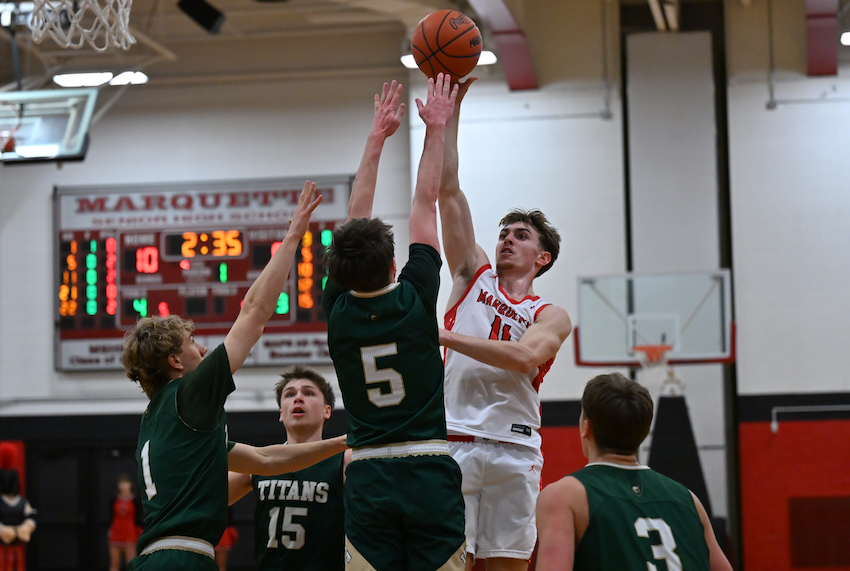
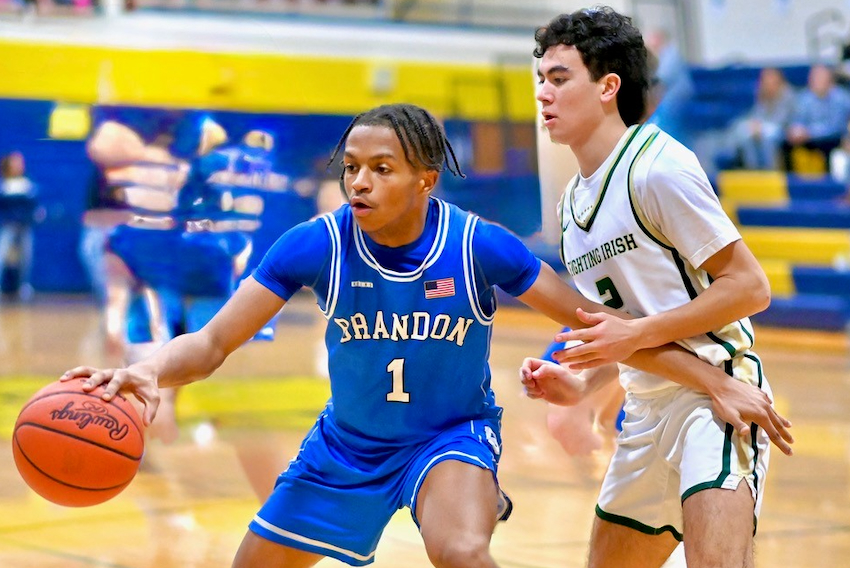
PHOTOS (Top) Detroit Cass Tech’s Amari Wash (11) makes a move toward the lane during his team’s Division 1 District Final win over Detroit Martin Luther King on Friday. (Middle) Marquette's Ford Richardson gets up a shot while surrounded by Traverse City West's Ashton Royle (15), Jacob Banish (1), Blake LaFaive (5), and Carter Grubb (3) during the Sentinels’ 69-52 Division 1 District Final win. (Below) Pontiac Notre Dame Prep and Ortonville Brandon face off in a Division 2 District opener. (Cass Tech/King photo by Olivia B. Photography. Marquette/TC West photo by Cara Kamps. Notre Dame Prep/Ortonville Brandon photo by Terry Lyons.)