

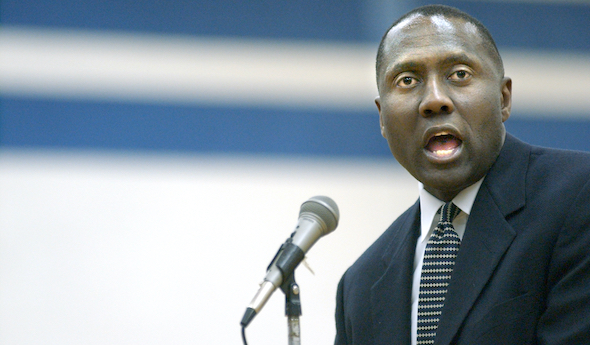
Joplin Always Has Known Value of Home
By
Doug Donnelly
Special for MHSAA.com
July 9, 2020
It is no accident that Stan Joplin has never ventured too far from his hometown of Milan on the border of Monroe and Washtenaw Counties in extreme southeast Michigan.
 In fact, that has been by design.
“Mr. (Phil) Barnes once told me that you never want to get too far from home,” Joplin said recently, recalling one of his high school administrators. “If you are close by your home, people will remember you.”
It has been more than 40 years since Joplin played basketball at Milan, and no one is forgetting him anytime soon.
A coach at the high school and Division I collegiate levels and then high school again over nearly 40 years, the 63-year-old Joplin is two seasons removed from his last tenure leading the program at Sylvania Southview. But those decades of wisdom continue to be passed on to Southview students as Joplin serves as an assistant principal at the high school.
“The farthest I ever lived from Milan was when I was coaching at Kent State,” he said. “I’ve remained in southeast Michigan or northwest Ohio all of these years. I have been very fortunate to have the opportunity to stay close to home and receive a good education. You can’t put a price on education. Sooner or later, basketball was going to come to an end.”
It gave him a running start at the beginning.
One of the first four-year starters in Monroe County Region history, Joplin grew up around the game. People like Barnes, coach Ron Dingman and Ann Arbor’s Sandy Sanders all played key roles in Joplin’s early success.
Barnes was a mentor, offering advice and some key life lessons. Dingman was the coach who inserted Joplin into the starting lineup as soon as he could and kept him there as he led the Big Reds in scoring and was named team MVP four consecutive seasons. Sanders was a local basketball guru with connections from Ann Arbor to Detroit.
“Mr. Sanders was umpiring a baseball game and saw me shooting over at the elementary school,” Joplin said. “He invited me to come up to Ann Arbor to play.”
Sanders saw the basketball talent in Joplin and put him on the court in Ann Arbor with other prep talent and some University of Michigan players.
“That’s where I met guys like Campy Russell and Joe Johnson,” Joplin said.
Sanders took area players – including Joplin – to Detroit to play at the famed St. Cecilia Gym. St. Cecilia is well-known in basketball circles for hosting standouts like George Gervin, Magic Johnson and, more recently, Jalen Rose.
“You can imagine what kind of eye-opening experience that was,” Joplin said. “It showed me how hard I had to work. That was huge for me. That really exposed me to basketball.”
Growing up, his neighbor played basketball at Milan, and Joplin would get to go to all the games to watch him. Joplin read about Milan and other local basketball players in the Ypsilanti Press, Ann Arbor News and Monroe News, soaking up everything he could about the game.
“I just wanted to be an athlete,” he said.
He was more than just an athlete. An all-stater, he scored more than 1,500 career points – still a Milan record – and was recruited to play at the University of Toledo for Bobby Nichols.
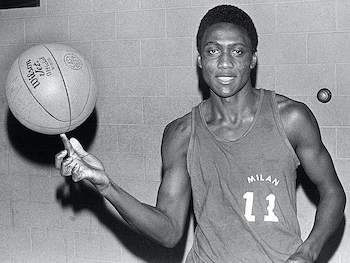 “It was the perfect situation,” Joplin said of growing up where he did. “Milan was a small town. A lot of the students I went to elementary school with I spent my whole time in school with. I knew everyone in the city.”
At Toledo, Joplin blossomed into an all-around player with a knack for elevating his game during key moments. He was named second team all-Mid-American Conference in 1977-78 and 1978-79. The 1979 Rockets won the MAC championship and made the NCAA Tournament. It was there that Joplin had the biggest moment of his career when he knocked down a 20-foot jumper to beat Iowa, 74-72, in the first round. The Rockets would lose a close game in the second round to a Notre Dame team that included four future NBA players. During Joplin’s four years at Toledo, the Rockets went 82-27.
While making national headlines, Joplin also was earning his education, something that Barnes encouraged along the way.
“I followed in his footsteps, went to college, got my degree and went into administration,” Joplin said.
After graduating from UT’s College of Education in 1979, Joplin began coaching at the high school level and was soon head coach at Toledo Start High School. He went on to become an assistant at Kent State University then joined the Rockets’ coaching staff during which time he earned a Master of Administration degree. He would later join the Michigan State University staff with Jud Heathcote and Tom Izzo.
In 1996, Joplin was named head coach at his alma mater, where he remained for 12 years, going 203-155 overall and making the NIT field four times. After he was let go following the 2007-08 campaign, Joplin reached into his education background to become an administrator in the Toledo area. He probably could have landed an assistant coaching job somewhere because of his connections in the sport, but chose not to go that route. He remained close to home.
He coached for a few seasons at Holland (Ohio) Springfield and one year at Sylvania Southview but is enjoying being a basketball fan these days.
“Basketball is the one thing I’ve done my whole life. I miss coaching, but I don’t need it,” he said.
Joplin goes to most of the Southview games and will go on the road occasionally to watch games in which some of his former players are coaching. He gets back to Michigan State University every now and then to watch the Spartans practice and relishes friendships he’s made in the game with people like former University of Michigan head coach Tommy Amaker and former Boston College head coach Al Skinner.
“I’ve got a lot of close friends that I stay in touch with,” he said.
He is not ruling out a return to the sidelines, but is not planning on it, either.
“I watch a lot of basketball. The game has changed,” he said. “The 3-point shot has taken the center out of the game. But, the game itself, is fine.”
Joplin is in the hallways more than the gym these days at Southview. His students know more about Mr. Joplin the school administrator than Stan Joplin the legendary basketball player from Milan – and he is fine with that.
“Every once in a while, someone will say something or bring me a video and say, ‘Hey, Mr. Joplin, I didn’t know you played.’ I just tell them that’s not me, that is just some guy with a lot more hair. It’s become kind of a running joke.”
Made in Michigan 2020
June 24: Fracassa's Remarkable Records Still Rule - Read
June 16: Muskegon Grad Casts "Magic" in HBO Series - Read
 Doug Donnelly has served as a sports and news reporter and city editor over 25 years, writing for the Daily Chief-Union in Upper Sandusky, Ohio from 1992-1995, the Monroe Evening News from 1995-2012 and the Adrian Daily Telegram since 2013. He's also written a book on high school basketball in Monroe County and compiles record books for various schools in southeast Michigan. E-mail him at [email protected] with story ideas for Jackson, Washtenaw, Hillsdale, Lenawee and Monroe counties.
PHOTOS: (Top) Milan basketball legend Stan Joplin serves as an assistant principal at Sylvania Southview High School. (Middle) Joplin still owns the career scoring record at Milan.
Breslin Bound: 2025-26 Boys District Preview
By
Geoff Kimmerly
MHSAA.com senior editor
February 23, 2026
The march to Breslin Center ramps up significantly this week as more than 700 boys basketball teams across Michigan begin a journey they hope will end in East Lansing.

We always switch up our “Breslin Bound” format once the MHSAA Tournament starts, as last week’s most intriguing results below are followed this time by glances at three District brackets of note in each division. Host sites are bolded, and teams playing in those brackets are listed by seed as determined by Michigan Power Ratings (MPR).
Everything you could want to know this week about tickets, brackets and more can be found on the Boys Basketball page. To watch any of several games online, visit the NFHS Network.
“Breslin Bound” is powered by MI Student Aid and based on results and schedules posted for each school at MHSAA.com.
Week in Review
The countdown of last week’s five most intriguing results:
1. Saginaw Heritage 73, Grand Blanc 60 The Hawks (18-4) avenged a 28-point loss to Grand Blanc (17-4) from December in this matchup of Saginaw Valley League division champions.
2. Detroit Catholic Central 64, Detroit Martin Luther King 54 The Shamrocks (15-6) won the annual Operation Friendship championship game matching the winners from the Catholic High School League and Detroit Public School League, and adding to a 54-46 overtime win over King (17-5) from December.
3. Gladwin 49, Beaverton 46 Gladwin (21-1) claimed the overall Jack Pine Conference championship with its second win this month over Beaverton (17-5).
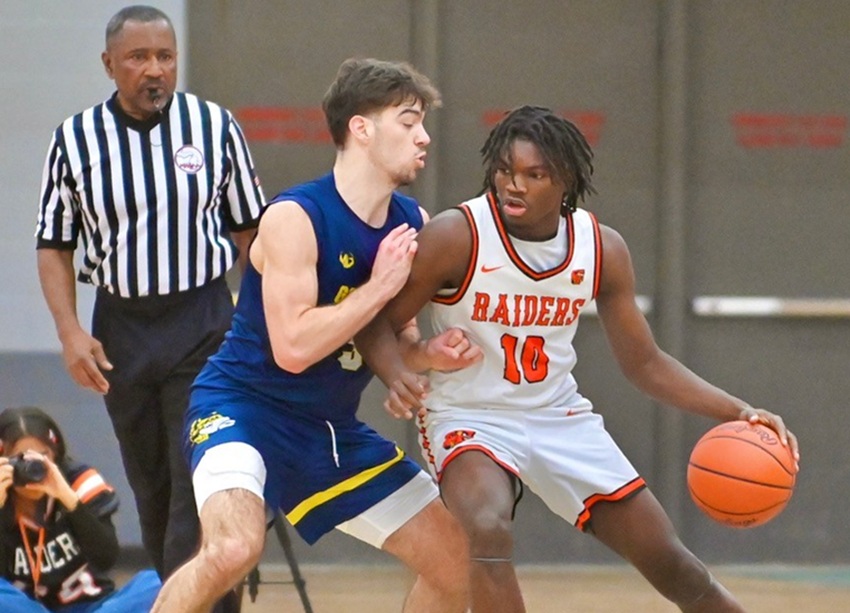
4. Flushing 52, Goodrich 51 Flushing (18-4) held on for a second close win over Goodrich, this time in the Flint Metro League championship game, after winning their Jan. 27 meeting by four.
5. Wayne Memorial 61, Hartland 48 The Zebras (19-3) capped off their regular season by defeating the Eagles (18-4) in the Kensington Lakes Activities Association title game.
Districts at a Glance
These could be among our most competitive brackets. Host sites are in bold, and teams are listed by seed:
DIVISION 1
Detroit Cass Tech
1. Detroit Martin Luther King (17-5), 2. Detroit Cass Tech (16-6), 3. Detroit Western (19-2), 4. Grosse Pointe South (11-11), 5. Grosse Pointe North (10-12).
King and Cass Tech have met twice this season – King won the Jan. 21 matchup 60-53 that helped decide the PSL Blue title, and then 68-63 in the PSL Tournament city championship game Feb. 15. King also defeated Western, 56-36, in a league tournament semifinal, while Cass Tech and Western didn’t face each other during this regular season. Grosse Pointe North has won seven of its last nine games and defeated Cass Tech by a point in their District matchup last season, and South owns a big early win over North.
Flushing
1. Saginaw Heritage (18-4), 2. Flushing (18-4), 3. Saginaw United (13-8), 4. Flint Carman-Ainsworth (8-14), 5. Swartz Creek (11-11).
As noted by the results above, Heritage and Flushing emerged at the end of last week as the top teams from the Saginaw Valley League and Flint Metro League, respectively. Saginaw United finished second in the SVL South and split with SVL North runner-up Mount Pleasant this season, and despite losing to Heritage early should also be considered a contender. Flushing has only one loss this calendar year, to Pontiac Notre Dame Prep in overtime, and Heritage has lost only twice since Jan. 1 and defeated Mount Pleasant twice by 20 or more points to win the SVL North.
Muskegon
1. Rockford (18-3), 2. Muskegon (19-2), 3. Greenville (20-2), 4. Muskegon Mona Shores (10-10), 5. Muskegon Reeths-Puffer (6-16), 6. Cedar Springs (7-15).
Rockford and Muskegon are the anticipated matchup to decide this bracket, and they met in last season’s District Final with the Rams winning 64-62. Rockford has victories over Bloomfield Hills Brother Rice and East Kentwood but finished second to the latter in the O-K Red. Muskegon has downed Wayne Memorial and Lansing Waverly and won the O-K Green. And definitely don’t count out River Cities Alliance champion Greenville, which has two losses by a combined six points and introduced itself loudly with a December win over Grand Rapids Northview.
DIVISION 2
Comstock Park
1. Grand Rapids Catholic Central (16-6), 2. Grand Rapids Christian (16-5), 3. Grand Rapids NorthPointe Christian (17-5), 4. Wyoming Kelloggsville (14-7), 5. Comstock Park (5-17), 6. Ada Forest Hills Eastern (2-20).
Grand Rapids Christian claimed the O-K White title outright last week in part thanks to a 51-43 win over Grand Rapids Catholic Central, and they split their regular-season series as the Cougars won their Jan. 20 meeting by five. NorthPointe was second in the O-K Silver and Kelloggsville fourth, and on opposite sides of this bracket certainly could provide obstacles as the Cougars and Eagles pursue a third round.
Ludington
1. Ludington (20-2), 2. Hart (19-3), 3. Reed City (10-12), 4. Manistee (12-10), 5. Big Rapids (9-13).
Ludington finished undefeated in the West Michigan Conference Lakes and has reached Regional Finals the last two seasons. Hart was second in the WMC Rivers and is seeking a first District title since 2019. They have key mutual opponents; both lost to North Muskegon this winter, and Hart also took a loss from Fremont while Ludington swept the Packers. Manistee and Ludington played Thursday – Ludington winning 68-55 – and they could meet again in a District Semifinal if Manistee gets past Big Rapids tonight.
Yale
1. Yale (20-2), 2. Croswell-Lexington (17-5), 3. Imlay City (16-6), 4. Almont (10-10), 5. North Branch (7-15).
All five of these teams are from the Blue Water Area Conference and finished among the top six, with Yale and Croswell-Lexington sharing the championship and splitting their matchups – the Pioneers won Jan. 20 in overtime, 64-57, while Yale won the rematch Friday 60-41. Imlay City finished third in the BWAC and despite losing both games against both champs took Croswell-Lexington to overtime the second time they played.
DIVISION 3
Kent City
1. Blanchard Montabella (15-7), 2. Kent City (14-8), 3. Morley Stanwood (13-9), 4. Ravenna (13-9), 5. Lakeview (7-15), 6. White Cloud (3-19).
The top four seeds all finished second or third in their respective leagues and will look to add a trophy winning what could be one of the most tightly-contested brackets in any division. Montabella tied for second in the Mid-State Activities Conference West and has won six of its last seven games since falling to Ravenna 43-39 on Jan. 28. Ravenna, which tied for third in the WMC Rivers, has bounced back from a late rough stretch and opened this season with a win over Morley Stanwood – which finished second in the Central State Activities Association White while splitting with third-place Kent City, which won their Friday matchup by 20.
Mancelona
1. Mancelona (20-2), 2. East Jordan (20-2), 3. Indian River Inland Lakes (14-8), 4. Harbor Springs (11-11), 5. Boyne City (9-12), 6. Charlevoix (6-15).
By the numbers, Mancelona and East Jordan has been so close at the top of this District that East Jordan actually passed Mancelona in MPR during the week after seeding. East Jordan also won the Ski Valley Conference by game over Mancelona, claiming their matchups 48-38 and 45-36. Inland Lakes finished third in the Ski Valley, losing to both league title contenders twice, and Harbor Springs is coming over after finishing third in the Northern Shores Conference and losing to East Jordan by only six points, 45-39, on Thursday.
Unionville-Sebewaing
1. Harbor Beach (19-3), 2. Elkton-Pigeon-Bay Port Laker (18-3), 3. Cass City (16-6), 4. Unionville-Sebewaing (11-11), 5. Bad Axe (6-15).
There is a great deal of familiarity in this bracket as well, as Harbor Beach won the Big Thumb Conference Black and Laker and Cass City were first and second, respectively, in the BTC White. Harbor Beach saw both during the first half of the regular season, defeating Cass City by seven and Laker by three. Laker defeated Cass City by seven and nine to win their league. USA tied for fifth in the BTC White – with an eight-point win over Cass City and a four-point loss to Laker in February rematches.
DIVISION 4
Lake Linden-Hubbell
1. Dollar Bay (19-2), 2. L’Anse (15-6), 3. Baraga (15-6), 4. Lake-Linden-Hubbell (7-15), 5. Chassell (5-16).
Dollar Bay won the Copper Mountain Conference championship and L’Anse and Baraga both finished among the upper half among a strong group – in fact, Baraga defeated Dollar Bay by 11 just 10 days ago. Dollar Bay did defeat Baraga in last season’s District Final, and the Blue Bolts’ only other loss this season was to Division 1 Marquette. L’Anse is enjoying its first winning season since 2018-19 and swept Baraga during the regular season.
Rogers City
1. Hillman (19-2), 2. Posen (15-5), 3. Gaylord St. Mary (13-9), 4. Rogers City (12-9), 5. Onaway (5-17), 6. Atlanta (4-13).
Hillman and Posen shared the North Star League Little Dipper championship, splitting the regular-season series with Posen and winning their most recent matchup 57-50 on Jan. 27. They may meet again, but Hillman also took a loss from potential Wednesday opponent Rogers City before winning their rematch by 20. Rogers City also defeated Posen twice. Gaylord St. Mary is intriguing after finishing fourth in the Ski Valley Conference but, as noted above, defeating that league’s champion East Jordan earlier this month.
Three Oaks River Valley
1. St. Joseph Michigan Lutheran (17-4), 2. St. Joseph Our Lady of the Lake Catholic (13-7), 3. New Buffalo (14-8), 4. Eau Claire (11-11), 5. Three Oaks River Valley (3-17).
Michigan Lutheran finished first, Our Lady and New Buffalo tied for second, and Eau Claire finished fourth in the Berrien-Cass-St. Joseph League. New Buffalo handed Michigan Lutheran its only conference defeat in their second of two games – winning by a point – and New Buffalo and Our Lady split their two games, decided by five and two points. Michigan Lutheran also defeated New Buffalo to clinch a District championship a year ago.
MHSAA.com's weekly “Breslin Bound” reports are powered by MI Student Aid, a division within the Department of Lifelong Education, Advancement, and Potential (MiLEAP). MI Student Aid encourages students to pursue postsecondary education by providing access to student financial resources and information. MI Student Aid administers the state’s scholarship and grant programs that help make college Accessible, Affordable and Attainable for you. Click to connect with MI Student Aid and find more information on Facebook and X @mistudentaid.
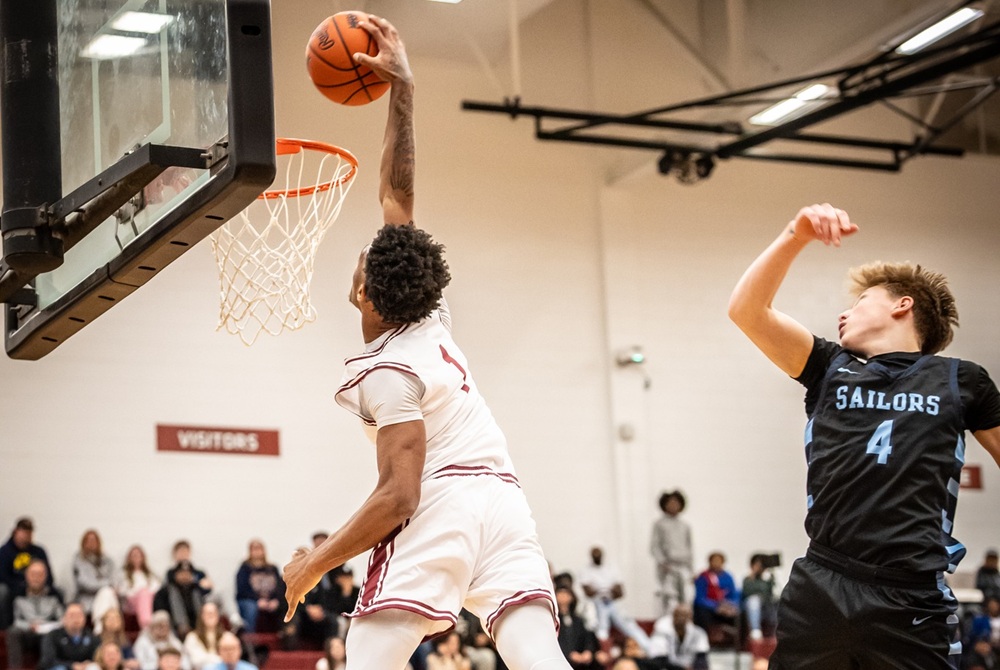
PHOTOS (Top) Muskegon’s James Martin throws down a dunk against Muskegon Mona Shores during a Jan. 30 win. (Middle) Flushing’s Raymond Neither (10) works for post position against Goodrich’s Jensen LePla during the Raiders’ 52-51 Metro League title clincher. (Muskegon/Mona Shores photo by Tim Reilly. Flushing/Goodrich photo by Terry Lyons.)