

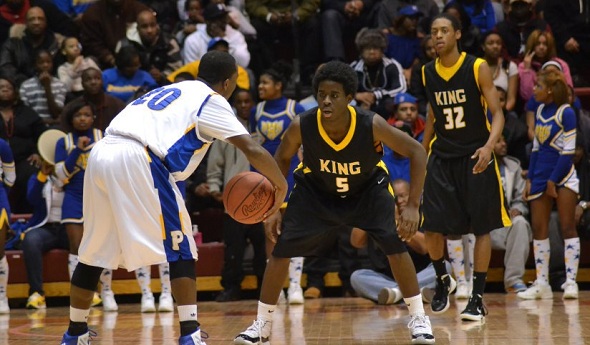
Kings of the Detroit PSL
February 23, 2012
The Detroit Martin Luther King boys basketball team came into this season riding high hopes – and high outside expectations too as many saw the Crusaders among teams to beat in Class A this winter.
And King made good right away, with a 10-1 start that included wins over Detroit Country Day and Bay City Western.
That made the Crusaders' Jan. 20 game at Detroit Pershing arguably the biggest in the Detroit Public School League this regular season -- and King's 87-78 loss to the Doughboys a letdown that spiraled into three losses in four games heading into the PSL Tournament.
“In retrospect, we look at it as almost a blessing in disguise,” King coach Pierre Brooks said. “It was kind of a reality check. We needed to go back to the drawing board, clean up some things as far as strategy. I think we peaked at the right moment.”
It’s tough to argue with that. King avenged that Pershing loss by beating the Doughboys 76-69 in Thursday’s PSL Final at Detroit Mercy’s Calihan Hall. The PSL championship is King’s first since 1999, and the performance earned the team one of Second Half's High 5s this week.
Climbing out of that downturn started with a team meeting. Brooks, for his part, didn't have to do much talking. The Crusaders have eight seniors, led by four-year varsity players Dennis Norfleet and Malik Albert. They were bent on finishing with a flourish instead of a disappointment.
And Brooks had a sound plan. King is known for aggressive man-to-man pressure defense. So in the tournament, Brooks put his team in a zone. That new look seemed to throw off opponents – the Crusaders won their four PSL Tournament games by an average of 10 points, and also avenged an earlier loss to Crockett by beating the Rockets 69-67 in a semifinal.
Albert, who leads the team scoring 23.1 points per game, had 29 in the final including 16 in the fourth quarter. Freshman center William Abbott, who averages 2.6 points and 4.5 rebounds per game, added 12 and 13, respectively.
Brooks, who also coached under Benny White for three seasons at King before taking over the program last winter, said his players have begun to come down from the celebration and refocus on their next goal. They host their Class A District beginning March 5. And on the other side of the bracket is Detroit Southeastern, which also beat King last month and in the District Final a year ago.
“We’ve got guys who have been on varsity the last four years … (and) they’ve been through it all in terms of highs and lows,” Brooks said. “They constantly talk about how they want to end their senior year. They’ve got that desire and passion.”
PHOTO courtesy of the Detroit Public Schools League.
D1 Preview: Follow the Fan Favorites
March 13, 2019
By Geoff Kimmerly
Second Half editor
Friday's first Semifinals – formerly Class A, now Division 1 – always are the most popular ticket of Boys Basketball Finals weekend.
But you’ll want to get to Breslin Center especially early to see this season’s contenders.
It’s no secret that fans statewide are eager to see Ypsilanti Lincoln freshman Emoni Bates. But local Okemos no doubt will bring a big crowd as well. Howell, just down I-96, should too as it plays in its first Semifinal in more than 90 years. And Detroit U-D Jesuit always seems to bring a following, led by a festive student section.
Division 1 Semifinals – Friday
Howell (20-6) vs. Ypsilanti Lincoln (21-4), Noon
Detroit U-D Jesuit (24-2) vs. Okemos (23-2), 2 p.m.
Division 1 Final – Saturday, 12:15 p.m.
Tickets cost $10 per pair of Semifinals and $10 per two-game Finals session (Divisions 4 and 1). All Semifinals will be streamed live on MHSAA.tv and viewable on a pay-per-view basis. The Divisions 2, 3 and 4 championship games will be broadcast live on Fox Sports Detroit’s primary channel, while the Division 1 Final will be shown live on Fox Sports Detroit PLUS. All four championship games will be streamed live on FoxSportsDetroit.com and the FOX Sports app. Free radio broadcasts of all weekend games will be available on MHSAANetwork.com.
Below is a glance at all four semifinalists. Click on the name of the school to see that team’s full schedule and results from this season. (Statistics are through teams' Regional Finals.)
DETROIT U-D JESUIT
Record/rank: 24-2, No. 1
League finish: First in Detroit Catholic League Central
Coach: Pat Donnelly, 11th season (207-53)
Championship history: Class A champion 2016.
Best wins: 91-54 over honorable mention Roseville in Quarterfinal, 79-59 over honorable mention Detroit Cass Tech, 70-69 over Division 3 No. 1 Flint Beecher, 54-47 over Detroit Edison.
Players to watch: Daniel Friday, 6-4 sr. G/F (16.9 ppg, 6.2 rpg, 3.4 apg, 1.5 bpg); Jalen Thomas, 6-10 F/C (12.7 ppg, 10.5 rpg, 3.5 bpg).
Outlook: The Cubs have reached at least the Quarterfinals six seasons straight and won their six playoff games this winter by an average of 27 points per. Jesuit hasn’t lost since Jan. 5, and it’s only instate defeat was Dec. 1 to Division 2 No. 1 New Haven. Friday and Thomas earned all-state honorable mentions last season and senior guard Caleb Hunter (9.6 ppg) made the all-state first team in Class D. Senior guard Julian Dozier adds 12.8 ppg and leads the team at 5.9 assists per contest.
HOWELL
Record/rank: 20-6, unranked
League finish: Second in Kensington Lakes Activities Association West
Coach: Nick Simon, seventh season (108-55)
Championship history: Class B runner-up 1927.
Best wins: 57-56 over No. 5 Saginaw in Quarterfinal, 59-46 over Orchard Lake St. Mary’s in Regional Semifinal, 55-49 over Linden in District Final, 58-57 over Wayne Memorial.
Players to watch: Josh Palo, 6-2 sr. G (17.7 ppg, 4.8 rpg, 3.7 apg); Tony Honkala, 6-2 jr. G/F (10.2 ppg).
Outlook: Howell played its first Quarterfinal since 2014 on Tuesday to earn its first trip to the Semifinals since 1927. The Highlanders have won 14 of their last 16 games, the only losses during that time both to No. 3 Canton, and while giving up 50 or more points only four times during the run. Palo earned an all-state honorable mention last season and is one of four seniors in the starting lineup.
OKEMOS
Record/rank: 23-2, honorable mention
League finish: First in Capital Area Activities Conference Blue
Coach: Jeff Wonch, seventh season (101-58)
Championship history: Class B champion 1982 & 1981, Class A runner-up 2006.
Best wins: 50-45 over East Kentwood in Quarterfinal, 39-34 (Regional Final), 56-41 and 41-35 over DeWitt, 72-28 over Howell.
Players to watch: Evan Thomas, 6-4 sr. G/F (17.3 ppg, 8.0 rpg), Noah Pruitt, 5-9 jr. G (10.7 ppg, 3.0 apg).
Outlook: Okemos is returning to the Semifinals for the first time since the runner-up run in 2006, although Wonch has been to Breslin a little more recently – he led Bath to the Class C championship in 2007. The Chiefs only losses this season were Detroit Catholic Central and Haslett, which both went on to win at least District titles. Long-range shooting could be key – entering the week, five players had made at least 13 3-pointers and the team as a whole was making 33 percent of its shots from beyond the arc.
YPSILANTI LINCOLN
Record/rank: 21-4, honorable mention
League finish: First in Southeastern Conference White
Coach: Jesse Davis, fourth season (54-34)
Championship history: Has never appeared in an MHSAA Final.
Best wins: 56-52 over No. 8 Detroit Martin Luther King in Quarterfinal, 81-79 over Detroit Catholic Central in Regional Final, 58-55 over Ann Arbor Skyline in Regional Semifinal.
Players to watch: Emoni Bates, 6-10 fr. (29.2 ppg, 53 3-pointers, 10.1 rpg, ); Jalen Fisher, 5-10 sr. G (13.1 ppg, 3.3 spg).
Outlook: Bates entered this season known as perhaps the top player his grade in the country. It’s fair to say his impact has been even greater than anticipated. He’s keyed Lincoln’s run to its first Regional title and now first Semifinal berth, making game-winning shots in both of last week’s games as he’s continued building one of the most memorable freshman seasons in state history. But his teammates certainly have done their parts. In addition to Fisher, seniors Amari Frye (10.6 ppg, 5.6 rpg) and Tahj Chatman (10 ppg, 2.9 apg) also are averaging double-digit scoring, and Lincoln as a team is making nearly 45 percent of its shots from the floor with Bates, Fisher and Chatman also all at 73 percent or better from the free-throw line.
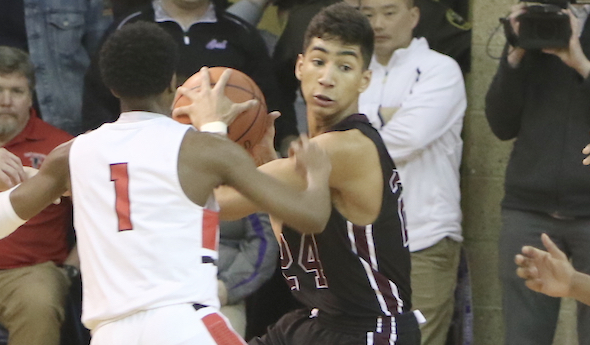
PHOTO: Okemos’ Evan Thomas looks for an opening during Tuesday night’s Quarterfinal win while East Kentwood’s Ja’moni Jones (1) defends. (Photo by Eric Sawatzki.)