

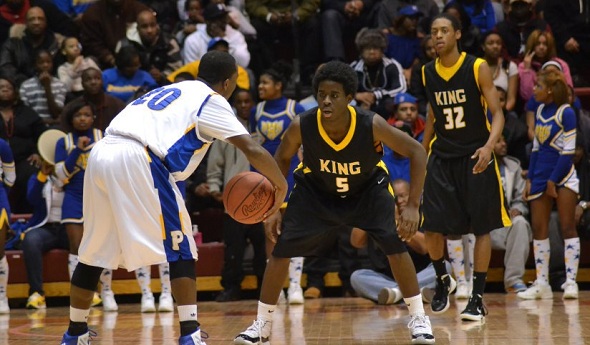
Kings of the Detroit PSL
February 23, 2012
The Detroit Martin Luther King boys basketball team came into this season riding high hopes – and high outside expectations too as many saw the Crusaders among teams to beat in Class A this winter.
And King made good right away, with a 10-1 start that included wins over Detroit Country Day and Bay City Western.
That made the Crusaders' Jan. 20 game at Detroit Pershing arguably the biggest in the Detroit Public School League this regular season -- and King's 87-78 loss to the Doughboys a letdown that spiraled into three losses in four games heading into the PSL Tournament.
“In retrospect, we look at it as almost a blessing in disguise,” King coach Pierre Brooks said. “It was kind of a reality check. We needed to go back to the drawing board, clean up some things as far as strategy. I think we peaked at the right moment.”
It’s tough to argue with that. King avenged that Pershing loss by beating the Doughboys 76-69 in Thursday’s PSL Final at Detroit Mercy’s Calihan Hall. The PSL championship is King’s first since 1999, and the performance earned the team one of Second Half's High 5s this week.
Climbing out of that downturn started with a team meeting. Brooks, for his part, didn't have to do much talking. The Crusaders have eight seniors, led by four-year varsity players Dennis Norfleet and Malik Albert. They were bent on finishing with a flourish instead of a disappointment.
And Brooks had a sound plan. King is known for aggressive man-to-man pressure defense. So in the tournament, Brooks put his team in a zone. That new look seemed to throw off opponents – the Crusaders won their four PSL Tournament games by an average of 10 points, and also avenged an earlier loss to Crockett by beating the Rockets 69-67 in a semifinal.
Albert, who leads the team scoring 23.1 points per game, had 29 in the final including 16 in the fourth quarter. Freshman center William Abbott, who averages 2.6 points and 4.5 rebounds per game, added 12 and 13, respectively.
Brooks, who also coached under Benny White for three seasons at King before taking over the program last winter, said his players have begun to come down from the celebration and refocus on their next goal. They host their Class A District beginning March 5. And on the other side of the bracket is Detroit Southeastern, which also beat King last month and in the District Final a year ago.
“We’ve got guys who have been on varsity the last four years … (and) they’ve been through it all in terms of highs and lows,” Brooks said. “They constantly talk about how they want to end their senior year. They’ve got that desire and passion.”
PHOTO courtesy of the Detroit Public Schools League.
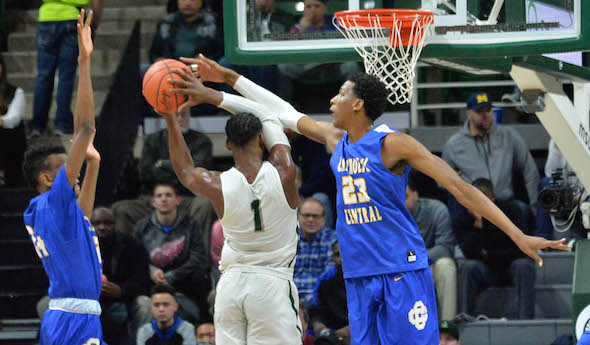
GRCC Earns 1st Final with Size, Surprise
March 23, 2018
By Geoff Kimmerly
Second Half editor
EAST LANSING – Grand Rapids Catholic Central’s victory celebration had a championship feel Friday night.
The Cougars hadn’t locked down their first MHSAA boys basketball title yet. But it was impossible to not understand their heightened excitement.
Leading from start to finish, GRCC eliminated New Haven with a 69-53 Class B Semifinal win at the Breslin Center, in the process ending the reigning champion’s 52-game winning streak.
And if that was at all a surprise, how the Cougars got there was just as stunning.
Junior guard Austin Braun, carrying a 7.8 points-per-game average heading into the week, scored 31 while Mr. Basketball finalist Marcus Bingham, Jr., watched the final five minutes from the bench after fouling out.
“I got a couple buckets early and my teammates just really got me going, just getting me hyped on the bench,” Braun said, “and just telling me, ‘If they don’t stop you, just score the ball.’
“It helps when you have two bigs and Darrell (Belcher) and Devin (Boyd) were great players around me. It just opens up a lot for me.”
Grand Rapids Catholic Central (24-2) will play for that first championship against Benton Harbor at 6:45 p.m. Saturday in the final game of this boys basketball season.
Those bigs – the 6-foot-11 Bingham and 6-8 senior Jacob Polakovich – were plenty effective in a number of ways Friday.
 Bingham had 11 points and 13 rebounds, and Polakovich had eight points and eight rebounds. But their larger impact came defensively. Bingham had six blocks, and together the tandem played a significant role in New Haven’s 30-percent shooting from the floor.
The Rockets’ 6-7 junior star Romeo Weems put together a solid line with 20 points, eight rebounds and seven steals. But even he was off his usual sharpness, making only 7 of 25 shots from the floor.
New Haven (26-1) as a team entered the week making 49 percent of its shots, with Weems connecting on 53 percent.
“We adjusted our shots. We saw it on film and we went to attack them,” New Haven coach Tedaro France II said. “We wanted to jump stop and pump fake. (But) they changed our shot selection a lot, disrupted our shots in the paint with some of their size.”
Braun, meanwhile, was just about perfect offensively. He made 8 of 9 shots from the floor, including his lone 3-point try, and 14 of 16 free throw attempts. He also had three assists and three steals.
The first of those steals came between buckets as he scored the game’s first four points. The free throw shooting came in handy at the end, as Braun drilled nine over the final five minutes to help the Cougars extend an 11-point lead to 18 after Bingham’s night was done.
“I knew he could score like that,” Polakovich said. “It’s just always been a matter of having a lot of mismatches inside with me and Marcus and being able to crash. … (But) a lot of people don’t realize he’s capable of doing that every single night. He’s a lot more than just a really great passer.”
Bingham did finish with 11 points despite a tough 3-of-11 shooting night as well, and grabbed 13 rebounds with six blocked shots. Weems was followed by senior guard Tavares Oliver, Jr., with 15 points and senior forward Ashton Sherrell with 12 points and seven rebounds.
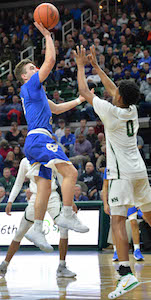
PHOTOS: (Top) Grand Rapids Catholic Central’s Marcus Bingham, Jr., gets a hand on Romeo Weems’ shot Friday at the Breslin Center. (Middle) GRCC’s Austin Braun puts up a shot with Ronald Jeffrey III defending.