

Launching Pad and Destination
November 30, 2012
By Rob Kaminski
MHSAA benchmarks editor
Lamont Simpson’s “home” is a place he visits twice a week during his peak season, when NCAA Division I officiating duties have him navigating the Midwest like a person in a race for frequent flyer miles.
His travels pale in comparison to Stacey Thomas, who has lived in Latvia, Turkey and Sweden thanks to the game of basketball.
Then there’s Jim Garofalo, who authored his own cheat sheets to assist with the eight different rules books which intertwined during a period of time in his hockey officiating career, which included a trip to the Olympic Games.
So, naturally, there’s Simpson officiating an MHSAA Pre-District Football Playoff game in Detroit last fall, taking a postgame earful from a father who believed his son was the subject of a cheap shot during the game.
There’s Thomas, blowing a whistle with teenagers at the Healthy Kids Club in Detroit this summer
There’s Garofalo, ditching seven of the rules books over the last few years, and using only one now: the high school rules book.
It’s true that Simpson is at the pinnacle of his career, working Big Ten, Mid-American Conference and Horizon League men’s basketball, in addition to the WNBA in the summer, where he recently worked his eighth straight WNBA Finals.
And, yes, Thomas has her sights set on the NCAA Division I level and beyond, as her officiating career is still in its infancy.
Sure, Garofalo has achieved much on the ice both as an amateur and professional referee.
But, like so many in the officiating family, they deeply appreciate their roots and the people who helped them along the way. It’s a people business, first and foremost.
This week, continuing its "Making – and Answering – the Call" series, Second Half introduces Simpson, an officiating veteran of more than three decades. Profiles of Thomas and Garofalo will follow later this month.
It's about patience and honesty
The late June heat at the Kensington Valley Golf Course doesn’t seem to bother Lamont Simpson. The secret to his cool aura lies in his hand, a golf ball which he has identified as “Ref” in permanent marker.
Simpson is indeed a ref – permanently – thanks to a suggestion from Robert Menafee during the late 1970s, and the 1977 Detroit Redford grad has been most comfortable in the heat of competition’s spotlight ever since.
“I was at a football game at Henry Ford a year or two after high school, and Mr. Menafee, my former coach, saw me and asked what I was doing,” Simpson recalled. “He said I should try officiating. That’s the first I’d ever thought about it.”
It would be the impetus to a craft that has consumed nearly 30 years of Simpson’s life, as he now jets around the country as a top-flight NCAA Men’s Basketball official, and one of the senior officials in the WNBA, where he recently called his eighth consecutive Finals.
For all of his accomplishments, Simpson can still recall with great detail various moments that led to his current standing; mental snapshots which help to explain why he still registers as an MHSAA football official each year, and why he gives so freely of himself to anyone interested in getting a start in officiating.
“I still remember my first game, thinking, ‘I can’t believe I’m doing this,’” Simpson recalled. “In my second year I did a PSL (Detroit Public School League) playoff game, and to this day, walking into that gym is still one of my most gratifying times. There were about two or three thousand people in the stands, and I remember the butterflies.”
Fast forward to the Pontiac Silverdome in November 1992. In the waning seconds of the MHSAA Class A Football Final, a pigskin floats in the air doing its best butterfly imitation. Following a double-reverse pass, the tipped ball is finally corralled by Muskegon Reeths-Puffer’s Stacey Starr at the 10-yard line and carried into the end zone to give his school a 21-18 win over Walled Lake Western in one of the most frenzied finishes in MHSAA Finals history.
Simpson had a good view of the moment.
“I was the back judge, working my first MHSAA Final. My first thought is to get in position and then, ‘Oh man, the ball is tipped,’” Simpson replays in his mind. “You’re part of a game-ending situation and you don’t want to screw it up. You almost become a fan in a game like that—a moment like that—but you’ve got your job to do. Afterward, when it was all over, I just remember thinking, ‘What a football game I got to be a part of.’”
 Simpson would also get a shot as a Football Final referee in 2003, and worked the 1995 Boys Basketball Final which featured Flint Northern’s team led by future MSU Spartans Mateen Cleaves and Antonio Smith. But, Simpson remembers that game for a different reason.
“It was the last time that the Final was worked with a two-person crew.” Simpson said. “I remember the great athletes in the game, and being part of history as the last two-man crew in the Finals is something to be proud of.”
Simpson is quick to point out, however, that simply having what it takes to officiate an athletic event at any level is something of which to be most proud. While it’s natural for new officials to covet championship assignments and careers beyond the high school level, Simpson stresses patience, hard work, and – in many cases – honesty with one’s own performance as the most valuable traits an official can possess.
“I work and speak at a lot of camps, and I stress that people need to work at the craft – mechanics, rules, physical appearance – and above all have patience.” Simpson said. “The thing I see in younger officials now that is so different than when I was coming in, is they don’t have the patience; they don’t want to pay their dues.”
Sometimes, even the greatest amount of patience, perseverance and hard work isn’t enough. And, that’s where honesty in self-evaluation comes in. Yes, there are egos in officiating. To some extent, it’s a prerequisite. However, humility can also lead to finding a niche in the game.
Simpson himself is an example.
“My goal was to work in the NBA, but after seven years in the CBA, I realized that it probably wasn’t going to happen,” he said. “But, you know, there was still a lot of good basketball out there to work. When I left the CBA, I did so on my own terms, and went to work on my college career. So, sometimes you weigh your options and focus on the next goal.
“The point is, work at being the best at whatever level you work. I’ve seen guys spend a lot of money at the same camps year after year, and never get that college assignment,” Simpson said. “Maybe it’s time for them to focus on a different level.”
In that respect, the very thing that drives officials and gets them in the game in the first place can by the very thing that drives them out. Passion and drive, the need to reach the next level, can keep people focused in their chosen quest; the frustration of not advancing can also lead to their exit.
True, Simpson is one of 32 officials in the WNBA, and just worked his eighth WNBA Final. He has a full NCAA Division I men’s basketball schedule. But, the father of three grown children and grandfather of five cannot express enough the fringe benefits that officiating brings at any level.
“You become a better people person through officiating. Your communication skills are sharper,” he says. “Not only what to say and when to say it, but you learn to listen. You have to be a listener in this business, and that’s a great skill to have in life.”
It also provides the opportunity to be a teacher and recruiter. It’s one of the reasons he’s closing in on nearly three decades as an MHSAA registered official. What better way to pass the knowledge forward?
“No matter where you end up, always remember where you started, and keep your friends,” Simpson said. “I return every call, every text. I still talk to the same guys I grew up with. From an officiating standpoint if we could all just bring along one person at a time, think of the effect that would have.”
Simpson does more than his share, from speaking at camps and clinics – all voluntarily, mind you – to the behind the scenes recruitment, such as the time he surrendered all of his baseball umpiring equipment to a friend under the condition that person register with the MHSAA and begin working games.
He thinks back to the suggestion from Coach Menafee frequently. “Oh, all the time,” Simpson said. “I think of the places I’ve been, the things I’ve seen, the people I’ve met and the person I’ve become. This is what being an official does.”
There’s a scenario that Simpson replays time and again when he talks of officiating, and it doesn’t pertain to his collegiate or professional experience. In fact, it’s not even about basketball.
“It’s Friday night, and you’re working the big rivalry game between two communities. You get on the field, the bleachers are packed, the bands are playing, and you’re right in the mix,” Simpson says with reverence. “That’s it right there. It doesn’t get much better than that. That’s it.”
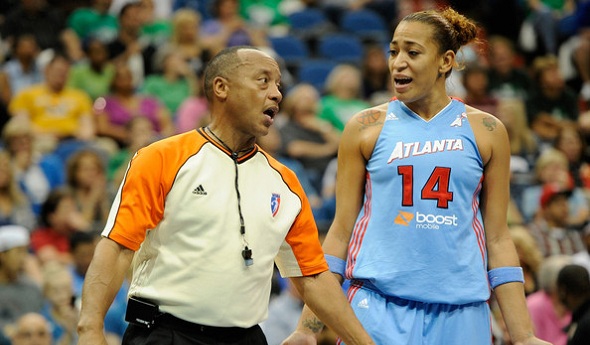
PHOTO: Lamont Simpson officiates WNBA games during the summers, including this contest involving the Atlanta Dream and player Erika de Souza (14).
NOTE: This is the fifth installment in the series "Making – and Answering – the Call" detailing the careers and service of MHSAA officials. Click the links below to view the others.
Breslin Bound: Boys Report Post-Break
January 7, 2019
By Geoff Kimmerly
Second Half editor
The first full week of January means changing lanes for the high school boys basketball season, with many of the mega nonleague matchups in the rear-view mirror and league championship chases up ahead.
 But first we have a few weeks of catching up to do after another highlight-filled holiday break showed us a few more contenders to keep an eye on as we settle into the local portion of our annual winter hoops run.
Breslin Bound is powered by MI Student Aid and based on results and schedules posted for each school at MHSAA.com. To offer corrections or fill in scores we’re missing, email me at [email protected].
Week in Review
The countdown of last week’s five most intriguing results:
1. Canton 64, Grand Rapids Catholic Central 57 – The Winter Jam at Lawrence Tech was filled with great matchups, but Canton’s win over the reigning Class B runner-up – GRCC’s lone defeat – was the most impressive.
2. Benton Harbor 79, Saginaw 70 – These two are MHSAA championship contenders most seasons, and the Tigers moved to 10-0 with this win at Grand Blanc’s GottaGetIt Classic as they continue to build on last year’s Class B title.
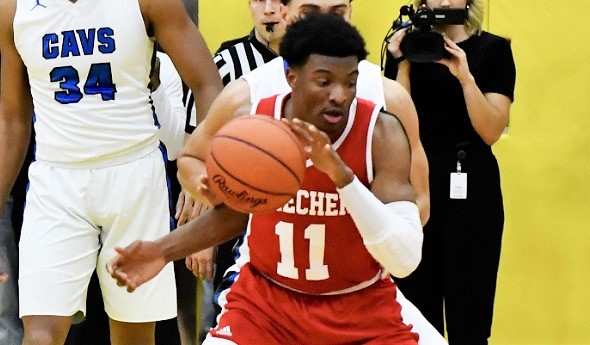
3. Flint Beecher 57, Flint Carman-Ainsworth 50 – The Division 3 Bucs are up to 8-0 this winter after winning a rare matchup with this one of their Division 1 neighbors.
4. Detroit Martin Luther King 45, Kalamazoo Central 43 – The Crusaders came up with arguably their best win of a great start by handing the Maroon Giants their lone defeat during Friday’s Muskegon Classic.
5. Muskegon 55, East Kentwood 53 – The Big Reds are 3-2 while playing another tough early slate, and this win over the Falcons at the Hall of Fame Classic has been the highlight.
Watch List
With an eye toward March, here are two teams in each division making sparks:
DIVISION 1
• Muskegon Reeths-Puffer (7-1) – The Rockets are climbing after finishing 10-12 and tying for fifth in the Ottawa-Kent Conference Black a year ago and winning just three games total in 2016-17. Annual league favorite Muskegon awaits, of course. But Reeths-Puffer has looked up to the task so far with wins over Ludington and Holland West Ottawa and the only defeat by five Dec. 7 to one-loss Zeeland West.
• Saginaw Heritage (5-1) – Since opening with a loss to still-undefeated Sanford Meridian, the Hawks also are perfect – and compared to a 3-4 start last season. They started the new year with a 64-53 win over Frankenmuth as they seek to build on last season’s 14-7 finish.
DIVISION 2
• Flat Rock (7-1) – Just 6-15 two seasons ago, Flat Rock improved to 18-6 and second in the Huron League last winter and last week edged Grosse Ile 42-40 after splitting with the Red Devils in 2017-18. Flat Rock’s only loss this season came by four Dec. 11 to Temperance Bedford. On Friday, the Rams get the first of two opportunities against reigning league champ Monroe St. Mary Catholic Central after being swept by the Falcons last season.
• Holland Christian (6-0) – The Maroons jumped 10 wins last season to finish 14-8 and second in the O-K Green, and might be starting on another leap. Holland Christian handed Maple City Glen Lake its only loss this season, 48-44 on Dec. 28 at the Lakeshore Cup at Grand Haven, and then downed Petoskey 66-59 the next day. Up next is reigning O-K Green champ Hudsonville Unity Christian, which defeated the Maroons three times last season.
DIVISION 3
• Kalamazoo Hackett (6-1) – The Irish bounced back from their only loss, to Division 1 Rochester Hills Stoney Creek, by handing Schoolcraft a 72-56 defeat Dec. 18. That win has Hackett just ahead of Schoolcraft in first place in the Southwestern Athletic Conference Valley standings after the Irish finished second to Kalamazoo Christian (and 18-4 overall) a year ago.
• North Muskegon (7-0) – The Norsemen’s encore to last winter’s 20-4 finish has been perfect, including handing Ravenna the latter’s only defeat, 61-51 on Dec. 21. That victory has North Muskegon one win ahead of the Bulldogs in the West Michigan Conference, and no other opponent has come closer than 14 points.
DIVISION 4
• Athens (8-0) – After going 16-5 last season, Athens has big games this week against Jackson Christian and Battle Creek St. Philip (both 5-3) as it goes for a perfect first half. Union City gave the Indians their closest game Dec. 20, an eight-point win, and Athens came up big in December against Hillsdale Academy – which, although struggling, was a Class D semifinalist a year ago.
• Camden-Frontier (9-0) – The Redskins have the early lead in the Southern Central Athletic Association East after finishing second to Hillsdale Academy last winter, and doubled up the Colts in their Dec. 13 meeting. Camden-Frontier also repeated as the Pat Paterson Holiday Tournament champion with double-digit wins over Hillsdale and Reading to get halfway to besting last year’s 17 wins.
Can't-Miss Contests
Be on the lookout for results of these games coming up:
Tuesday – Novi (3-3) at Canton (5-1) – Novi beat Canton by five in last season’s Kensington Lakes Activities Association semifinals and then by two when they met again in a District Semifinal; they were the Chiefs’ only defeats of the season.
Tuesday – Macomb Dakota (6-1) at Sterling Heights Stevenson (6-1) – These two are tied for first in the Macomb Area Conference Red after Dakota edged Stevenson for the title by a win a year ago.
Thursday – Bellevue (6-0) at Camden-Frontier (9-0) – Both lead or are tied for the lead in their respective divisions of the SCAA, plus might end up among the top-ranked in all of Division 4.
Friday – Frankenmuth (4-3) at Bridgeport (7-0) – The same may not end up true this winter, but a year ago Bridgeport’s sweep of Frankenmuth gave the Bearcats the Tri-Valley Conference East title ahead of the runner-up Eagles.
Saturday – Grand Blanc (7-2) at Kalamazoo Central (5-1) – Coming off a key league matchup with Davison on Friday, Grand Blanc heads west to see another statewide Division 1 contender in Central.
Second Half’s weekly “Breslin Bound” reports are powered by MI Student Aid, a part of the Student Financial Services Bureau located within the Michigan Department of Treasury. MI Student Aid encourages students to pursue postsecondary education by providing access to student financial resources and information, including various student financial assistance programs to help make college more affordable for Michigan students. MI Student Aid administers the state’s 529 savings programs (MET/MESP) and eight additional aid programs within its Student Scholarships and Grants division. Click for more information and connect with MI Student Aid on Facebook and Twitter @mistudentaid.
PHOTO: Flint Beecher’s Earnest Sanders works for post position during his team’s win over Flint Carman-Ainsworth on Dec. 27. (Photo by Terry Lyons.)