

Launching Pad and Destination
November 30, 2012
By Rob Kaminski
MHSAA benchmarks editor
Lamont Simpson’s “home” is a place he visits twice a week during his peak season, when NCAA Division I officiating duties have him navigating the Midwest like a person in a race for frequent flyer miles.
His travels pale in comparison to Stacey Thomas, who has lived in Latvia, Turkey and Sweden thanks to the game of basketball.
Then there’s Jim Garofalo, who authored his own cheat sheets to assist with the eight different rules books which intertwined during a period of time in his hockey officiating career, which included a trip to the Olympic Games.
So, naturally, there’s Simpson officiating an MHSAA Pre-District Football Playoff game in Detroit last fall, taking a postgame earful from a father who believed his son was the subject of a cheap shot during the game.
There’s Thomas, blowing a whistle with teenagers at the Healthy Kids Club in Detroit this summer
There’s Garofalo, ditching seven of the rules books over the last few years, and using only one now: the high school rules book.
It’s true that Simpson is at the pinnacle of his career, working Big Ten, Mid-American Conference and Horizon League men’s basketball, in addition to the WNBA in the summer, where he recently worked his eighth straight WNBA Finals.
And, yes, Thomas has her sights set on the NCAA Division I level and beyond, as her officiating career is still in its infancy.
Sure, Garofalo has achieved much on the ice both as an amateur and professional referee.
But, like so many in the officiating family, they deeply appreciate their roots and the people who helped them along the way. It’s a people business, first and foremost.
This week, continuing its "Making – and Answering – the Call" series, Second Half introduces Simpson, an officiating veteran of more than three decades. Profiles of Thomas and Garofalo will follow later this month.
It's about patience and honesty
The late June heat at the Kensington Valley Golf Course doesn’t seem to bother Lamont Simpson. The secret to his cool aura lies in his hand, a golf ball which he has identified as “Ref” in permanent marker.
Simpson is indeed a ref – permanently – thanks to a suggestion from Robert Menafee during the late 1970s, and the 1977 Detroit Redford grad has been most comfortable in the heat of competition’s spotlight ever since.
“I was at a football game at Henry Ford a year or two after high school, and Mr. Menafee, my former coach, saw me and asked what I was doing,” Simpson recalled. “He said I should try officiating. That’s the first I’d ever thought about it.”
It would be the impetus to a craft that has consumed nearly 30 years of Simpson’s life, as he now jets around the country as a top-flight NCAA Men’s Basketball official, and one of the senior officials in the WNBA, where he recently called his eighth consecutive Finals.
For all of his accomplishments, Simpson can still recall with great detail various moments that led to his current standing; mental snapshots which help to explain why he still registers as an MHSAA football official each year, and why he gives so freely of himself to anyone interested in getting a start in officiating.
“I still remember my first game, thinking, ‘I can’t believe I’m doing this,’” Simpson recalled. “In my second year I did a PSL (Detroit Public School League) playoff game, and to this day, walking into that gym is still one of my most gratifying times. There were about two or three thousand people in the stands, and I remember the butterflies.”
Fast forward to the Pontiac Silverdome in November 1992. In the waning seconds of the MHSAA Class A Football Final, a pigskin floats in the air doing its best butterfly imitation. Following a double-reverse pass, the tipped ball is finally corralled by Muskegon Reeths-Puffer’s Stacey Starr at the 10-yard line and carried into the end zone to give his school a 21-18 win over Walled Lake Western in one of the most frenzied finishes in MHSAA Finals history.
Simpson had a good view of the moment.
“I was the back judge, working my first MHSAA Final. My first thought is to get in position and then, ‘Oh man, the ball is tipped,’” Simpson replays in his mind. “You’re part of a game-ending situation and you don’t want to screw it up. You almost become a fan in a game like that—a moment like that—but you’ve got your job to do. Afterward, when it was all over, I just remember thinking, ‘What a football game I got to be a part of.’”
 Simpson would also get a shot as a Football Final referee in 2003, and worked the 1995 Boys Basketball Final which featured Flint Northern’s team led by future MSU Spartans Mateen Cleaves and Antonio Smith. But, Simpson remembers that game for a different reason.
“It was the last time that the Final was worked with a two-person crew.” Simpson said. “I remember the great athletes in the game, and being part of history as the last two-man crew in the Finals is something to be proud of.”
Simpson is quick to point out, however, that simply having what it takes to officiate an athletic event at any level is something of which to be most proud. While it’s natural for new officials to covet championship assignments and careers beyond the high school level, Simpson stresses patience, hard work, and – in many cases – honesty with one’s own performance as the most valuable traits an official can possess.
“I work and speak at a lot of camps, and I stress that people need to work at the craft – mechanics, rules, physical appearance – and above all have patience.” Simpson said. “The thing I see in younger officials now that is so different than when I was coming in, is they don’t have the patience; they don’t want to pay their dues.”
Sometimes, even the greatest amount of patience, perseverance and hard work isn’t enough. And, that’s where honesty in self-evaluation comes in. Yes, there are egos in officiating. To some extent, it’s a prerequisite. However, humility can also lead to finding a niche in the game.
Simpson himself is an example.
“My goal was to work in the NBA, but after seven years in the CBA, I realized that it probably wasn’t going to happen,” he said. “But, you know, there was still a lot of good basketball out there to work. When I left the CBA, I did so on my own terms, and went to work on my college career. So, sometimes you weigh your options and focus on the next goal.
“The point is, work at being the best at whatever level you work. I’ve seen guys spend a lot of money at the same camps year after year, and never get that college assignment,” Simpson said. “Maybe it’s time for them to focus on a different level.”
In that respect, the very thing that drives officials and gets them in the game in the first place can by the very thing that drives them out. Passion and drive, the need to reach the next level, can keep people focused in their chosen quest; the frustration of not advancing can also lead to their exit.
True, Simpson is one of 32 officials in the WNBA, and just worked his eighth WNBA Final. He has a full NCAA Division I men’s basketball schedule. But, the father of three grown children and grandfather of five cannot express enough the fringe benefits that officiating brings at any level.
“You become a better people person through officiating. Your communication skills are sharper,” he says. “Not only what to say and when to say it, but you learn to listen. You have to be a listener in this business, and that’s a great skill to have in life.”
It also provides the opportunity to be a teacher and recruiter. It’s one of the reasons he’s closing in on nearly three decades as an MHSAA registered official. What better way to pass the knowledge forward?
“No matter where you end up, always remember where you started, and keep your friends,” Simpson said. “I return every call, every text. I still talk to the same guys I grew up with. From an officiating standpoint if we could all just bring along one person at a time, think of the effect that would have.”
Simpson does more than his share, from speaking at camps and clinics – all voluntarily, mind you – to the behind the scenes recruitment, such as the time he surrendered all of his baseball umpiring equipment to a friend under the condition that person register with the MHSAA and begin working games.
He thinks back to the suggestion from Coach Menafee frequently. “Oh, all the time,” Simpson said. “I think of the places I’ve been, the things I’ve seen, the people I’ve met and the person I’ve become. This is what being an official does.”
There’s a scenario that Simpson replays time and again when he talks of officiating, and it doesn’t pertain to his collegiate or professional experience. In fact, it’s not even about basketball.
“It’s Friday night, and you’re working the big rivalry game between two communities. You get on the field, the bleachers are packed, the bands are playing, and you’re right in the mix,” Simpson says with reverence. “That’s it right there. It doesn’t get much better than that. That’s it.”
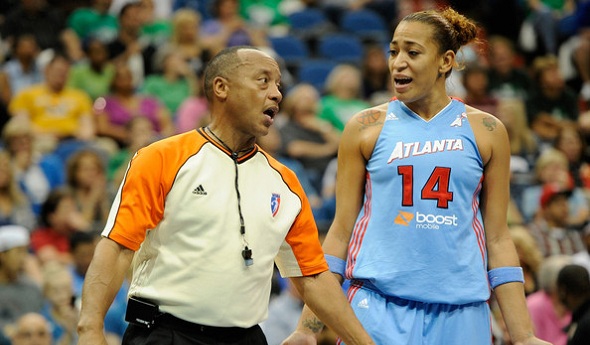
PHOTO: Lamont Simpson officiates WNBA games during the summers, including this contest involving the Atlanta Dream and player Erika de Souza (14).
NOTE: This is the fifth installment in the series "Making – and Answering – the Call" detailing the careers and service of MHSAA officials. Click the links below to view the others.
Breslin Bound: Boys Report Week 1
December 11, 2017
By Geoff Kimmerly
Second Half editor
One of the best parts of boys basketball season is how quickly the state’s elite teams begin testing themselves against each other to get an idea where they stand coming into the winter.
 We saw plenty of those titanic matchups last week – although the first game to top our “Week in Review” for 2017-18 allowed us to look back more than look forward.
As during last season, the weekly Breslin Bound report – powered by MI Student Aid – will look at five results from the previous week that particularly popped, plus a few teams to keep on your radar during the months ahead and five games during the week to come that you might want to check out.
These reports are based on results and schedules posted for each school at MHSAA.com – to offer corrections, email me at [email protected].
Week in Review
The countdown of last week’s five most intriguing results:
1. Rapid River 65, Powers North Central 43 – The Rockets put an end to North Central’s MHSAA-record 84-game winning streak, which began on opening night of the 2014-15 season.
2. Canton 65, Belleville 61 – This opener shook Class A quite a bit with Canton losing to Belleville by 23 last year and the Tigers expected to contend for a spot at Breslin this upcoming March.
3. Detroit Cass Tech 84, Flint Beecher 53 – The Technicians are expected to be among Class A contenders after winning 19 games a year ago, and this was a great sign as reigning Class C champ Beecher no doubt will be in that mix again as well.
4. Clarkston 65, Wayne Memorial 55 – The reigning Class A champ got a nice win over another expected contender before finishing the week with a five-point victory in another test, against Flint Carman-Ainsworth.
5. Hazel Park 86, Detroit East English 72 – The Vikings may have taken a step toward joining the elite with a big win over one of the anticipated best from the Detroit Public School League.
Watch List
With an eye toward March, here are two teams in each class making sparks:
CLASS A
Canton (2-0) – The Chiefs opened 0-2 a year ago with losses to Detroit Country Day and Belleville, the teams they beat last week. Canton plays in a Kensington Lakes Activities Association Black with expected favorites Wayne and Westland John Glenn, but showed last week it should be right in the mix after finishing third and 13-8 overall in 2016-17.
Mattawan (2-0) – The Wildcats were 7-14 a year ago and haven’t had a winning season this decade. But they couldn’t have gotten off to a better start, opening with a 55-54 win over Paw Paw after falling to the eventual 18-win Redskins by 16 a year ago.
CLASS B
Escanaba (2-0) – Coming off a banner football season, the Eskymos provided some early excitement on the basketball court last week after winning 12 games last winter. Escanaba avenged last year’s 20-point opening night loss with a 60-45 win over Negaunee, which won 20 games last season.
Essexville Garber (2-0) – The Dukes’ 5-16 campaign last winter ended with seven straight losses including by a basket to Bay City John Glenn in the District. The bounce-back began last week with a 25-point win over Pinconning followed by a 14-pointer over the rival Bobcats.
CLASS C
Bad Axe (2-0) – An ability to win close games surely would be beneficial as Bad Axe looks to build on last season’s 10-10 finish. The Hatchets beat both Imlay City and Harbor Beach by three points last week; both opponents finished with winning records last winter.
Detroit Pershing (1-0) – The Doughboys have had three middling seasons since their last 20-win run in 2013-14, but they’re expected to be among the state’s best even as they will play a mostly Class A schedule. Last week’s 81-74 overtime win over 2017 Class D semifinalist Southfield Christian was an impressive way to start.
CLASS D
Ewen-Trout Creek (2-0) – The Panthers’ 6-foot-7 senior Jacob Witt is probably one of the most unknown standout all-around athletes in the state, but he could finish this season with his team making some noise. Ewen-Trout Creek went 14-9 last season and last week avenged a 2016-17 loss to Hancock with a 38-point win.
Rapid River (2-0) – The Rockets not only ended North Central’s streak, but opened with a 56-53 win over Carney-Nadeau, which is coming off a 15-win season. Rapid River was 11-13 last winter after opening with an eight-point loss to Carney-Nadeau and a 53-pointer to the Jets, but the Rockets did close 2016-17 on an 8-4 run.
Can't-Miss Contests
Be on the lookout for results of these games coming up:
Tuesday – Dansville (2-0) at Pewamo-Westphalia (1-0) – The Pirates regularly are among contenders statewide in Class C, but Dansville and 6-9 Caleb Hodgson surely would love to take their place starting in the Central Michigan Athletic Conference standings.
Thursday – Rapid River (2-0) at Crystal Falls Forest Park (2-0) – These look like early contenders to go after the top Class D spot from the Upper Peninsula as reigning MHSAA champion North Central is expected to fall back toward the pack.
Friday – Saginaw Arthur Hill (0-1) at Saginaw (0-0) – This one rarely disappoints; all three meetings went Saginaw’s way by double digits last season, but that third one did come in a District Final.
Friday – Hazel Park (1-0) at Detroit U-D Jesuit (2-0) – The Cubs are off to another strong start and have a tough game against East English on Tuesday before Hazel Park comes in looking for another big early win.
Sunday – Detroit Pershing (1-0) vs. Orchard Lake St. Mary’s (2-0) at Ecorse – This looks to be the premier game of the Hoopz 4 Hope Classic, as the Eaglets also have a pair of double-digit wins to start this winter.
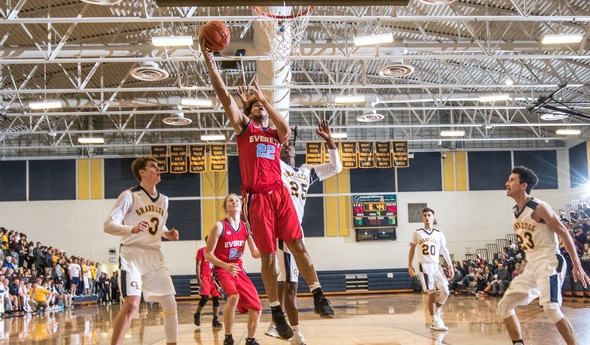
PHOTO: Lansing Everett was among teams that began 2-0 to start the season last week. (Click for more from HighSchoolSportsScene.com.)