

Launching Pad and Destination
November 30, 2012
By Rob Kaminski
MHSAA benchmarks editor
Lamont Simpson’s “home” is a place he visits twice a week during his peak season, when NCAA Division I officiating duties have him navigating the Midwest like a person in a race for frequent flyer miles.
His travels pale in comparison to Stacey Thomas, who has lived in Latvia, Turkey and Sweden thanks to the game of basketball.
Then there’s Jim Garofalo, who authored his own cheat sheets to assist with the eight different rules books which intertwined during a period of time in his hockey officiating career, which included a trip to the Olympic Games.
So, naturally, there’s Simpson officiating an MHSAA Pre-District Football Playoff game in Detroit last fall, taking a postgame earful from a father who believed his son was the subject of a cheap shot during the game.
There’s Thomas, blowing a whistle with teenagers at the Healthy Kids Club in Detroit this summer
There’s Garofalo, ditching seven of the rules books over the last few years, and using only one now: the high school rules book.
It’s true that Simpson is at the pinnacle of his career, working Big Ten, Mid-American Conference and Horizon League men’s basketball, in addition to the WNBA in the summer, where he recently worked his eighth straight WNBA Finals.
And, yes, Thomas has her sights set on the NCAA Division I level and beyond, as her officiating career is still in its infancy.
Sure, Garofalo has achieved much on the ice both as an amateur and professional referee.
But, like so many in the officiating family, they deeply appreciate their roots and the people who helped them along the way. It’s a people business, first and foremost.
This week, continuing its "Making – and Answering – the Call" series, Second Half introduces Simpson, an officiating veteran of more than three decades. Profiles of Thomas and Garofalo will follow later this month.
It's about patience and honesty
The late June heat at the Kensington Valley Golf Course doesn’t seem to bother Lamont Simpson. The secret to his cool aura lies in his hand, a golf ball which he has identified as “Ref” in permanent marker.
Simpson is indeed a ref – permanently – thanks to a suggestion from Robert Menafee during the late 1970s, and the 1977 Detroit Redford grad has been most comfortable in the heat of competition’s spotlight ever since.
“I was at a football game at Henry Ford a year or two after high school, and Mr. Menafee, my former coach, saw me and asked what I was doing,” Simpson recalled. “He said I should try officiating. That’s the first I’d ever thought about it.”
It would be the impetus to a craft that has consumed nearly 30 years of Simpson’s life, as he now jets around the country as a top-flight NCAA Men’s Basketball official, and one of the senior officials in the WNBA, where he recently called his eighth consecutive Finals.
For all of his accomplishments, Simpson can still recall with great detail various moments that led to his current standing; mental snapshots which help to explain why he still registers as an MHSAA football official each year, and why he gives so freely of himself to anyone interested in getting a start in officiating.
“I still remember my first game, thinking, ‘I can’t believe I’m doing this,’” Simpson recalled. “In my second year I did a PSL (Detroit Public School League) playoff game, and to this day, walking into that gym is still one of my most gratifying times. There were about two or three thousand people in the stands, and I remember the butterflies.”
Fast forward to the Pontiac Silverdome in November 1992. In the waning seconds of the MHSAA Class A Football Final, a pigskin floats in the air doing its best butterfly imitation. Following a double-reverse pass, the tipped ball is finally corralled by Muskegon Reeths-Puffer’s Stacey Starr at the 10-yard line and carried into the end zone to give his school a 21-18 win over Walled Lake Western in one of the most frenzied finishes in MHSAA Finals history.
Simpson had a good view of the moment.
“I was the back judge, working my first MHSAA Final. My first thought is to get in position and then, ‘Oh man, the ball is tipped,’” Simpson replays in his mind. “You’re part of a game-ending situation and you don’t want to screw it up. You almost become a fan in a game like that—a moment like that—but you’ve got your job to do. Afterward, when it was all over, I just remember thinking, ‘What a football game I got to be a part of.’”
 Simpson would also get a shot as a Football Final referee in 2003, and worked the 1995 Boys Basketball Final which featured Flint Northern’s team led by future MSU Spartans Mateen Cleaves and Antonio Smith. But, Simpson remembers that game for a different reason.
“It was the last time that the Final was worked with a two-person crew.” Simpson said. “I remember the great athletes in the game, and being part of history as the last two-man crew in the Finals is something to be proud of.”
Simpson is quick to point out, however, that simply having what it takes to officiate an athletic event at any level is something of which to be most proud. While it’s natural for new officials to covet championship assignments and careers beyond the high school level, Simpson stresses patience, hard work, and – in many cases – honesty with one’s own performance as the most valuable traits an official can possess.
“I work and speak at a lot of camps, and I stress that people need to work at the craft – mechanics, rules, physical appearance – and above all have patience.” Simpson said. “The thing I see in younger officials now that is so different than when I was coming in, is they don’t have the patience; they don’t want to pay their dues.”
Sometimes, even the greatest amount of patience, perseverance and hard work isn’t enough. And, that’s where honesty in self-evaluation comes in. Yes, there are egos in officiating. To some extent, it’s a prerequisite. However, humility can also lead to finding a niche in the game.
Simpson himself is an example.
“My goal was to work in the NBA, but after seven years in the CBA, I realized that it probably wasn’t going to happen,” he said. “But, you know, there was still a lot of good basketball out there to work. When I left the CBA, I did so on my own terms, and went to work on my college career. So, sometimes you weigh your options and focus on the next goal.
“The point is, work at being the best at whatever level you work. I’ve seen guys spend a lot of money at the same camps year after year, and never get that college assignment,” Simpson said. “Maybe it’s time for them to focus on a different level.”
In that respect, the very thing that drives officials and gets them in the game in the first place can by the very thing that drives them out. Passion and drive, the need to reach the next level, can keep people focused in their chosen quest; the frustration of not advancing can also lead to their exit.
True, Simpson is one of 32 officials in the WNBA, and just worked his eighth WNBA Final. He has a full NCAA Division I men’s basketball schedule. But, the father of three grown children and grandfather of five cannot express enough the fringe benefits that officiating brings at any level.
“You become a better people person through officiating. Your communication skills are sharper,” he says. “Not only what to say and when to say it, but you learn to listen. You have to be a listener in this business, and that’s a great skill to have in life.”
It also provides the opportunity to be a teacher and recruiter. It’s one of the reasons he’s closing in on nearly three decades as an MHSAA registered official. What better way to pass the knowledge forward?
“No matter where you end up, always remember where you started, and keep your friends,” Simpson said. “I return every call, every text. I still talk to the same guys I grew up with. From an officiating standpoint if we could all just bring along one person at a time, think of the effect that would have.”
Simpson does more than his share, from speaking at camps and clinics – all voluntarily, mind you – to the behind the scenes recruitment, such as the time he surrendered all of his baseball umpiring equipment to a friend under the condition that person register with the MHSAA and begin working games.
He thinks back to the suggestion from Coach Menafee frequently. “Oh, all the time,” Simpson said. “I think of the places I’ve been, the things I’ve seen, the people I’ve met and the person I’ve become. This is what being an official does.”
There’s a scenario that Simpson replays time and again when he talks of officiating, and it doesn’t pertain to his collegiate or professional experience. In fact, it’s not even about basketball.
“It’s Friday night, and you’re working the big rivalry game between two communities. You get on the field, the bleachers are packed, the bands are playing, and you’re right in the mix,” Simpson says with reverence. “That’s it right there. It doesn’t get much better than that. That’s it.”
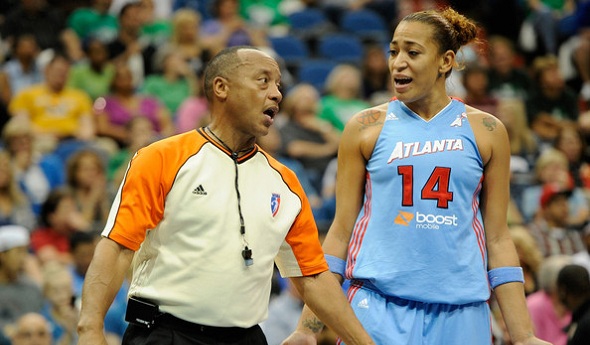
PHOTO: Lamont Simpson officiates WNBA games during the summers, including this contest involving the Atlanta Dream and player Erika de Souza (14).
NOTE: This is the fifth installment in the series "Making – and Answering – the Call" detailing the careers and service of MHSAA officials. Click the links below to view the others.
1970-1995: Detroit, Flint Ruled Class A Boys Basketball
By
Ron Pesch
MHSAA historian
March 7, 2022
Geographic domination.
It really hasn’t happened on the basketball court in the MHSAA’s top classification since the mid-1990s.
Class A state titles – designated Division 1 in basketball since 2019 – have bounced around Michigan over the last 25-plus years like, well, an over-inflated wayward basketball. Kalamazoo Central, Pontiac Northern, and Clarkston grabbed back-to-back titles between 1996 and 2021. The Saginaw area locked down five Class A crowns within that stretch; Arthur Hill snagged one in 2006, while Saginaw High immediately followed with two in a row in 2007 and 2008. The Trojans also won in 1996 and 2012. Greater Lansing has three titles – one by Lansing Everett, another by Lansing Waverly, then one by Holt High School – about eight miles outside the city limits.
 Then it’s single titles to Grand Rapids Ottawa Hills, Rockford, Muskegon, Ann Arbor Pioneer, and Ypsilanti Lincoln. Metro Detroit schools Romulus, Pershing, Central, Western, and U-D Jesuit also have single championships during that span.
But from 1970 to 1995, a trip to the Finals to watch the ‘A’ title game meant – with rare exception – you were watching a team from Flint or Greater Detroit. Or both.
Flint: Home of the Vikings
Opened in the fall of 1928, Flint Northern had been the Vehicle City’s top basketball school, winning Class A titles in 1933, 1936, 1939, and 1940 under coach Jim Barclay, then another in 1947 under Les Ehrbright. The Vikings also advanced to the state championship game in 1954 under Carl Stelter, losing to Muskegon Heights in overtime, 43-41.
Then, things went mostly quiet for the next decade and a half.
Jack Marlette was only the fourth varsity basketball coach in school history. Since arriving at Northern in 1949, he had served as head coach in tennis and golf, sophomore coach in basketball and football, junior varsity coach in basketball and football, equipment manager, and head trainer.
Midseason 1955, he replaced Stelter as the varsity basketball coach, when Stelter was named a principal within the Flint school district.
“Marlette coached teams posted a record of 112 victories and 99 defeats,” stated Len Hoyes in the Flint Journal when the coach stepped down in March 1967. “Included are six city championships, two districts, and a Saginaw Valley Conference crown in 1956.” His 1957 team reached the MHSAA Quarterfinals, losing to East Detroit.
With the announcement, Northern wooed 36-year-old Dick Dennis to take his spot come the 1967-68 season. Dennis’ teams had posted an impressive 105-21 varsity record at Alpena High School over seven seasons. Perhaps more impressively, his teams had beaten two of the Flint area’s finest in the MHSAA Regional round in 1966.
Dennis agreed to the move to Northern, “but had one important request,” stated reporter Bruce Johns in the Journal. “He wanted Bill Frieder as the junior varsity coach.”
Frieder, who would ultimately become a legendary basketball figure in Michigan, had landed his first basketball job as JV coach under Dennis at Alpena during the 1965-66 school year.
“… (A) son-in-law of Larry Laeding, former Saginaw High coach and a former player for the Trojans, Freiders (sic) had a 20-11 JV record for two years,” noted the Journal at the time of the hiring. (Laeding’s Saginaw team had won the Class A basketball championship in 1962.)
Dennis’ varsity squad posted an 11-6 record that first year, followed by a 13-6 mark in 1968-69, the program’s best season in 10 years. Frieder’s 1967-68 JV Vikings finished with a 13-3 mark, earning a share of the Saginaw Valley Conference’s title. In his second year, Frieder’s squad went a flawless 16-0.
But a teacher’s strike in Flint the following school year caused Frieder to resign from his position.
“At this point, I want to emphasize that I am highly opposed to teachers’ striking as I feel it sets a poor example for children and such an act reflects upon me personally,” stated Frieder in a letter of resignation to the Flint Board of Education.
Unable to work around it, he stepped aside.
Another shake-up
After three seasons at the helm, in May 1970, Dennis accepted an assistant principal position within the district. Northern administration interviewed nine “capable” candidates for the opening, including the former JV coach.
“Out of the candidates, we felt that Bill was the best qualified,” Northern athletic director Jim Fowler told the Journal’s Dean Howe 22 days later. “Bill is familiar with our situation at Northern, he’s familiar with the kids and unquestionably a fine coach.
“… it was Dennis’s strong recommendation that finally swung the gavel Frieder’s way,” stated Howe.
“Bill has a tremendous ability to get along with the kids,” Dennis had told the Journal in 1969. “… there are some coaches who never accomplish this. Bill’s two outstanding characteristics are his loyalty to the job and kids and his tremendous amount of pride.
“He just loves the game. Bill works just as hard at developing good citizens as he does to winning.”
Under Frieder, the Vikings quickly returned to the state spotlight, winning two straight MHSAA Class A championships in 1971 and 1972.
 For the first time since 1954, Northern enjoyed final round success. Frieder’s 1971 Vikings, powered by senior Tom McGill and the Britt brothers, Wayman and James, clipped the taller – and favored – crew from Detroit Kettering, led by Lindsay Hairston, 79-78.
A year later, Frieder’s team beat Pontiac Central, a squad it had defeated twice during the regular season, 74-71. It was the Vikings’ 33rd-straight victory.
Frieder returned for the 1972-73 season. The Vikings posted an 18-7 record and won a District title. In July, his JV coach from the past two seasons, Grover Kirkland, was named head basketball coach at Flint Northwestern. In August, Frieder resigned. Rumors had been flying that he might go to the University of Michigan as an assistant. A Saginaw native, Frieder stated his “retiring is a result of many things.” Primarily, he planned to return to Saginaw to go into the produce business with his father.
The rumors, it turned out, were true. A little over a month later, the University of Michigan appointed Frieder as assistant basketball coach.
“We think it’s very fine to have a man of Bill’s caliber on our staff,” said Johnny Orr, Michigan’s head men’s basketball coach.
“If at this point in my life, I could describe the job I wanted most, the thing I wanted most to do in my life, this would fit it to a tee,” said Frieder at the time of the announcement.
Bill Troesken, 29, who had stepped down in June of 1973 after three years as varsity coach at Flint Powers Catholic, was hired by Northern to replace Frieder. His team would grab another Class A championship in March 1978.
A Long Drought
Flint’s oldest high school, Flint Central, was opened in 1875. Incredibly, the boys basketball team never won a state title – or even appeared in a championship game – until coach Stan Gooch arrived on the scene.
“Gooch, who starred in basketball at Flint Tech High, Flint Junior College, and Central Michigan (University), began his coaching career as bench boss of the sophomore team at Central High in 1959,” recalled Brendan Savage for MLive in 2008 at the time of his induction into the National High School Athletic Coaches Association Hall of Fame. “He took over the reins of the junior varsity the following year and was promoted to varsity coach in 1966.” Gooch guided Flint Central to its first state championship game in 1967, but Central was trounced by Detroit Pershing, a PSL squad considered by many to be the greatest basketball team in Michigan prep history. Guided by coach Will Robinson, the Doughboys were led on the court by future NBA players Spencer Haywood and Ralph Simpson.
Gooch resigned following the 1967-68 season to become head coach at Flint Junior College (which was converted into a countywide college, and rebranded as Genesee Community College in 1969, then renamed Mott Community College in 1973). After 10 seasons, Gooch stepped down, and within months, he replaced his replacement at Flint Central, Clif Turner, who had guided the program through the 1977-78 season.
Central then won three straight Class A titles from 1981-83, helping to build the legend of Flint basketball.
Then it was Northwestern’s turn. In both 1984 and 1985, Coach Kirkland’s Wildcats beat Detroit Southwestern. With those wins, the Flint city schools had now won six of the last eight titles.
“City of Champions defies explanation” trumpeted the Journal at the end of March 1985, after Northwestern had won Class A and Flint Beecher had won the boys title in Class B.
“No single factor can be pinpointed as the reason Flint has dominated,” wrote Phil Pierson under the headline, “while metropolitan Detroit, an area approximately 10 times larger, has failed to win a Class A Championship since 1979.”
Northwestern’s Glen Rice “became the area’s first recipient of the Mr. Basketball award presented by the Michigan High School Basketball Coaches Association and has been named to the Parade and Basketball Weekly All-American teams. (Beecher’s Roy Marble finished second, while Central’s Terence Greene finished fourth in Mr. Basketball balloting).
Was this success the opportunity to play year-round, asked Pierson. Coaching? The talent on the court?
Other areas across the state featured these same strengths, concluded the writer. “It may just be that the reason for Flint’s success is too obvious to be considered by the philosophers: the cyclical nature of high school sports.
“There was nothing wrong with Flint basketball from 1948-70 when there were no state Class A or B championships. Other teams and programs were just better.”
The Return of the PSL
It took five years after the return to the MHSAA Tournament before the PSL earned a Class A title with that ’67 Pershing squad. The next arrived in 1970, again by Pershing, then in 1973 by Southwestern, and again in 1979 by Mackenzie. Class A was won by Metro Detroit in 1974, by Birmingham Brother Rice, in 1975 by Highland Park, and in 1976 by Detroit Catholic Central.
From 1971 to 1985, Flint’s public school champions had defeated Pontiac Central twice, and PSL teams from Kettering, Murray-Wright, and, famously, Southwestern, on four straight occasions between 1982 and 1985.
On only two occasions between 1975 and 1995 did the Class A crown leave the city of Flint or Metro Detroit. In both instances, it landed in Lansing. In 1977, the Lansing Everett Vikings, led by Earvin Johnson – nicknamed “Magic” by the press – wrestled it away by downing Brother Rice in a 60-56 overtime thriller. In 1980, Lansing Eastern, powered by the state’s first Mr. Basketball winner, Sam Vincent, did the same, with a 64-53 victory over Highland Park.
The Cycle of Basketball
As soon as the ink dried on Pierson’s words, it seems, the cycle rotated.
Romulus took down Southwestern in ’86 before the PSL took control of Class A beginning with the 1987 season. Cooley, coached by Ben Kelso, snagged the first of three straight that year. After finishing as runner-up in seven of the previous eight title games, Southwestern, coached by Perry Watson, grabbed back-to-back victories in ’90 and ’91. Coach Johnny Goston’s Pershing teams beat Benton Harbor for consecutive titles in 1992 and 1993. Then Murray -Wright, coached by Robert Smith, captured its first crown in 1994.
On four of the eight occasions between 1987 and 1994, the Class A game featured an all-PSL card.
 The 1995 Class A final wrapped the amazing run as No. 1-ranked Flint Northern, powered by Mateen Cleaves’ game-leading 28 points and Antonio Smith’s 24 points and 15 rebounds, decimated No. 2 Pershing, 86-64 before a crowd of 11,179 at the Breslin Center. Northern had trailed 44-37 at the half.
It was Northern’s first title since 1978. It would also be the program’s last. The introduction of “school of choice” in Michigan in 1996, combined with plunging birth rates in the U.S. that peaked in 1978, meant upheaval in enrollment across the state’s public schools. In Flint, declining enrollment – also impacted by the pending closure of a massive automotive manufacturing complex operated by General Motors known as “Buick City” – forced the closure of Central following the 2008-09 school year. Northern closed in 2013. Following the 2017-18 school year, Northwestern and Flint Southwestern merged, leaving Southwestern as the city’s lone high school.
In Detroit, Northern, Mackenzie, and Murray-Wright were among four high schools closed by the Detroit Public Schools in 2007 due to cost constraints and declining enrollments. Cooley was shuttered in 2010. Southwestern, dedicated in 1922, and Kettering, opened in 1965, both closed in 2012.
Of the 26 Class A title games waged between 1970 and 1995, Flint City Schools and the PSL teams each won nine of those contests. On 15 occasions, the championship game featured a match-up of Flint and Detroit PSL teams. On only seven occasions did schools from outside Wayne, Oakland, or Genesee counties ever crash the championship party. Saginaw High School ended with runner-up honors in 1973, 1976, and 1990, with Lansing and Benton Harbor High Schools being the only others.
Parade of Talent
Basketball junkies attending title games during those years watched an incredible collection of talent come out of those teams from Flint, the PSL and metropolitan Detroit during the span.
On the coaching side:
► Frieder ended up as head coach at Michigan with the 1980-81 season, then Arizona State in 1989.
► Gooch compiled over 400 varsity wins and 86 JV victories during his time at Flint Central.
► Kirkland ended his basketball coaching career in 2000 as Flint’s all-time winningest varsity coach, compiling a 518-148 mark. His Wildcats compiled 60-straight wins between January 1984 and February 1986 and presently rank No. 3 in consecutive wins in state history. In 2020, Detroit Free Press writer Mick McCabe named Northwestern’s 28-0 team from 1985 as the greatest boys basketball team he covered in his 50 years of reporting.
► Southwestern’s Watson served as an assistant at Michigan for two seasons, then guided the men’s basketball team at the University of Detroit Mercy from 1993 to 2008, compiling a 258-185 record over 15 seasons.
► Kelso, a Flint Southwestern graduate who did not play high school basketball but ended up as the all-time scorer at Central Michigan when he graduated in 1973, would be a finalist for the head coaching spot at CMU in 1997. At Cooley from 1984 through 1998, he later served as an assistant basketball coach at Kansas State in 2005-06.
► Kettering’s Charles Nichols, on hand since the school opened, coached tennis, football, and track during his first years at the school. With the 1970-71 season, he took over basketball coaching duties from Walt Jenkins, guiding the team for four campaigns. In December 1974, he joined Dick Vitale’s coaching staff at the University of Detroit for parts of two seasons. He returned to Kettering in 1978 as athletic director, then later served as assistant director of the PSL until his retirement in 2002.
The players included:
Flint
► Central’s Eric Turner, Marty Emery, Mark Harris, Keith Gray, Terence Green, and Darryl Johnson.
► Northern’s Terry Furlow, Dennis Johnson, Gary Pool, Antonio Smith, and Mateen Cleaves.
► Northwestern’s James Person, Jeff Grayer, Glen Rice, Andre Rison, Anthony Pendleton, and Daryl Miller.
Detroit PSL
► Cass Tech’s Tony Jamison and William Mayfield.
► Cooley’s Yamen Sanders, Earl Stark, Rafael Peterson, Michael Talley, and Daniel Lyton.
► Kettering’s Lindsay Hairston, Joe Johnson, Eric Money, and Coniel ‘Connie’ Norman.
► Mackenzie’s Steve Caldwell and Dave Traylor.
► Murray-Wright’s Willis Carter and Robert Traylor.
► Northern’s Katu Davis and Leonard Bush.
► Pershing’s Phil Paige, Robert Hawkins, Calvin Harper, Willie Mitchell, Carlos Williams, Todd Burgan, and Winfred Walton.
► Southwestern’s Darryl Robertson, Antoine Joubert, Clarence Jones, Sam Sillmon, Tarence Wheeler, Anderson Hunt, Loren Clyburn, James Hunter, Jalen Rose, Voshon Lenard, and Howard Eisley.
Metro Detroit
► Birmingham Brother Rice’s Will Franklin, Kevin Smith, and Tim Andree.
► Detroit Catholic Central’s Mike Prince and David Abel.
► Highland Park’s Terry Duerod, Percy Cooper, and Renardo Brown.
► Pontiac Central’s brothers Campy, Larry and Walker D. Russell; Larry Cole, Tim Marshall, and Clyde Corley.
► Romulus’s Terry Mills, and Stevie Glenn.
 Ron Pesch has taken an active role in researching the history of MHSAA events since 1985 and began writing for MHSAA Finals programs in 1986, adding additional features and "flashbacks" in 1992. He inherited the title of MHSAA historian from the late Dick Kishpaugh following the 1993-94 school year, and resides in Muskegon. Contact him at [email protected] with ideas for historical articles.
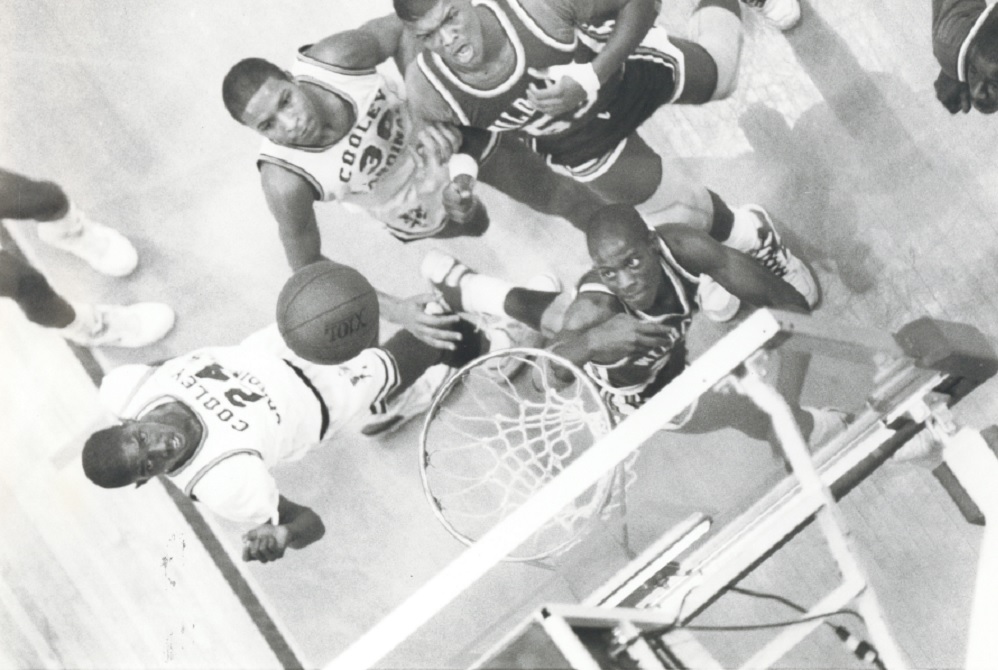
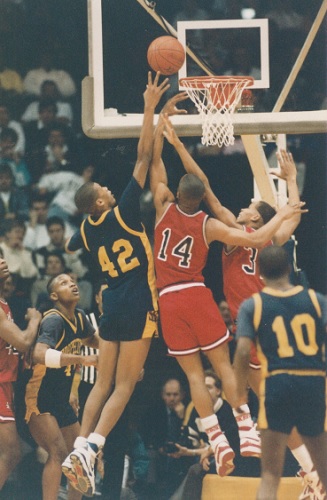
PHOTOS (1) Detroit Cooley's Rafael Peterson (24) and Benson Maurice match up with Flint Northwestern's Archie Munerlyn (53) and Reggie Richardson during the 1988 Class A Final. (2) The Class A/Division 1 championship has been won by teams across the southern half of the Lower Peninsula over the last 25 years. (3) Grover Kirkland, here in 1975, built Flint Northwestern into a power. (4) Detroit Southwestern's Jalen Rose (42) and Cooley's Michael Talley (14) work to grab a loose ball during the 1989 Class A Final. (Photos courtesy of the Detroit News [1] and Gary Shook [4], or collected by Ron Pesch.)