

Launching Pad and Destination
November 30, 2012
By Rob Kaminski
MHSAA benchmarks editor
Lamont Simpson’s “home” is a place he visits twice a week during his peak season, when NCAA Division I officiating duties have him navigating the Midwest like a person in a race for frequent flyer miles.
His travels pale in comparison to Stacey Thomas, who has lived in Latvia, Turkey and Sweden thanks to the game of basketball.
Then there’s Jim Garofalo, who authored his own cheat sheets to assist with the eight different rules books which intertwined during a period of time in his hockey officiating career, which included a trip to the Olympic Games.
So, naturally, there’s Simpson officiating an MHSAA Pre-District Football Playoff game in Detroit last fall, taking a postgame earful from a father who believed his son was the subject of a cheap shot during the game.
There’s Thomas, blowing a whistle with teenagers at the Healthy Kids Club in Detroit this summer
There’s Garofalo, ditching seven of the rules books over the last few years, and using only one now: the high school rules book.
It’s true that Simpson is at the pinnacle of his career, working Big Ten, Mid-American Conference and Horizon League men’s basketball, in addition to the WNBA in the summer, where he recently worked his eighth straight WNBA Finals.
And, yes, Thomas has her sights set on the NCAA Division I level and beyond, as her officiating career is still in its infancy.
Sure, Garofalo has achieved much on the ice both as an amateur and professional referee.
But, like so many in the officiating family, they deeply appreciate their roots and the people who helped them along the way. It’s a people business, first and foremost.
This week, continuing its "Making – and Answering – the Call" series, Second Half introduces Simpson, an officiating veteran of more than three decades. Profiles of Thomas and Garofalo will follow later this month.
It's about patience and honesty
The late June heat at the Kensington Valley Golf Course doesn’t seem to bother Lamont Simpson. The secret to his cool aura lies in his hand, a golf ball which he has identified as “Ref” in permanent marker.
Simpson is indeed a ref – permanently – thanks to a suggestion from Robert Menafee during the late 1970s, and the 1977 Detroit Redford grad has been most comfortable in the heat of competition’s spotlight ever since.
“I was at a football game at Henry Ford a year or two after high school, and Mr. Menafee, my former coach, saw me and asked what I was doing,” Simpson recalled. “He said I should try officiating. That’s the first I’d ever thought about it.”
It would be the impetus to a craft that has consumed nearly 30 years of Simpson’s life, as he now jets around the country as a top-flight NCAA Men’s Basketball official, and one of the senior officials in the WNBA, where he recently called his eighth consecutive Finals.
For all of his accomplishments, Simpson can still recall with great detail various moments that led to his current standing; mental snapshots which help to explain why he still registers as an MHSAA football official each year, and why he gives so freely of himself to anyone interested in getting a start in officiating.
“I still remember my first game, thinking, ‘I can’t believe I’m doing this,’” Simpson recalled. “In my second year I did a PSL (Detroit Public School League) playoff game, and to this day, walking into that gym is still one of my most gratifying times. There were about two or three thousand people in the stands, and I remember the butterflies.”
Fast forward to the Pontiac Silverdome in November 1992. In the waning seconds of the MHSAA Class A Football Final, a pigskin floats in the air doing its best butterfly imitation. Following a double-reverse pass, the tipped ball is finally corralled by Muskegon Reeths-Puffer’s Stacey Starr at the 10-yard line and carried into the end zone to give his school a 21-18 win over Walled Lake Western in one of the most frenzied finishes in MHSAA Finals history.
Simpson had a good view of the moment.
“I was the back judge, working my first MHSAA Final. My first thought is to get in position and then, ‘Oh man, the ball is tipped,’” Simpson replays in his mind. “You’re part of a game-ending situation and you don’t want to screw it up. You almost become a fan in a game like that—a moment like that—but you’ve got your job to do. Afterward, when it was all over, I just remember thinking, ‘What a football game I got to be a part of.’”
 Simpson would also get a shot as a Football Final referee in 2003, and worked the 1995 Boys Basketball Final which featured Flint Northern’s team led by future MSU Spartans Mateen Cleaves and Antonio Smith. But, Simpson remembers that game for a different reason.
“It was the last time that the Final was worked with a two-person crew.” Simpson said. “I remember the great athletes in the game, and being part of history as the last two-man crew in the Finals is something to be proud of.”
Simpson is quick to point out, however, that simply having what it takes to officiate an athletic event at any level is something of which to be most proud. While it’s natural for new officials to covet championship assignments and careers beyond the high school level, Simpson stresses patience, hard work, and – in many cases – honesty with one’s own performance as the most valuable traits an official can possess.
“I work and speak at a lot of camps, and I stress that people need to work at the craft – mechanics, rules, physical appearance – and above all have patience.” Simpson said. “The thing I see in younger officials now that is so different than when I was coming in, is they don’t have the patience; they don’t want to pay their dues.”
Sometimes, even the greatest amount of patience, perseverance and hard work isn’t enough. And, that’s where honesty in self-evaluation comes in. Yes, there are egos in officiating. To some extent, it’s a prerequisite. However, humility can also lead to finding a niche in the game.
Simpson himself is an example.
“My goal was to work in the NBA, but after seven years in the CBA, I realized that it probably wasn’t going to happen,” he said. “But, you know, there was still a lot of good basketball out there to work. When I left the CBA, I did so on my own terms, and went to work on my college career. So, sometimes you weigh your options and focus on the next goal.
“The point is, work at being the best at whatever level you work. I’ve seen guys spend a lot of money at the same camps year after year, and never get that college assignment,” Simpson said. “Maybe it’s time for them to focus on a different level.”
In that respect, the very thing that drives officials and gets them in the game in the first place can by the very thing that drives them out. Passion and drive, the need to reach the next level, can keep people focused in their chosen quest; the frustration of not advancing can also lead to their exit.
True, Simpson is one of 32 officials in the WNBA, and just worked his eighth WNBA Final. He has a full NCAA Division I men’s basketball schedule. But, the father of three grown children and grandfather of five cannot express enough the fringe benefits that officiating brings at any level.
“You become a better people person through officiating. Your communication skills are sharper,” he says. “Not only what to say and when to say it, but you learn to listen. You have to be a listener in this business, and that’s a great skill to have in life.”
It also provides the opportunity to be a teacher and recruiter. It’s one of the reasons he’s closing in on nearly three decades as an MHSAA registered official. What better way to pass the knowledge forward?
“No matter where you end up, always remember where you started, and keep your friends,” Simpson said. “I return every call, every text. I still talk to the same guys I grew up with. From an officiating standpoint if we could all just bring along one person at a time, think of the effect that would have.”
Simpson does more than his share, from speaking at camps and clinics – all voluntarily, mind you – to the behind the scenes recruitment, such as the time he surrendered all of his baseball umpiring equipment to a friend under the condition that person register with the MHSAA and begin working games.
He thinks back to the suggestion from Coach Menafee frequently. “Oh, all the time,” Simpson said. “I think of the places I’ve been, the things I’ve seen, the people I’ve met and the person I’ve become. This is what being an official does.”
There’s a scenario that Simpson replays time and again when he talks of officiating, and it doesn’t pertain to his collegiate or professional experience. In fact, it’s not even about basketball.
“It’s Friday night, and you’re working the big rivalry game between two communities. You get on the field, the bleachers are packed, the bands are playing, and you’re right in the mix,” Simpson says with reverence. “That’s it right there. It doesn’t get much better than that. That’s it.”
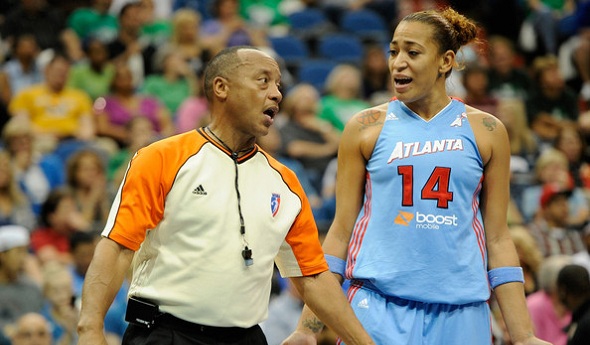
PHOTO: Lamont Simpson officiates WNBA games during the summers, including this contest involving the Atlanta Dream and player Erika de Souza (14).
NOTE: This is the fifth installment in the series "Making – and Answering – the Call" detailing the careers and service of MHSAA officials. Click the links below to view the others.
Will Carleton Hoops Creates '1 Big Family'
By
Doug Donnelly
Special for MHSAA.com
March 8, 2021
By Doug Donnelly
Special for Second Half
HILLSDALE – The Thielen siblings, with oldest daughter Lizzy and three younger brothers, are getting to do something few families in Michigan have had the opportunity to experience – playing high school basketball together on the same team.
 When there weren’t enough girls out for the girls basketball team this winter at Will Carleton Academy in Hillsdale, basketball coach Jason Coward decided to add the girls who would have played for the Cougars to his team.
One of them was Thielen, who has moved back and forth between the junior varsity and varsity boys team – giving her the opportunity to play with all three brothers, sometimes on the same night.
“I would be so sad if I wasn’t able to play basketball this season,” Thielen said. “I really enjoy the opportunity to play with my brothers. Not a lot of girls get to say they did that. I’m thankful I can.”
Will Carleton Academy, with just 50 students, has one of the smallest enrollments of any school in the Michigan High School Athletic Association. They normally have enough players for JV and varsity girls and boys teams and participate annually in the MHSAA postseason.
This year, however, for a variety of reasons including the effects of COVID-19, Coward said only four or five girls were with the program when the season was launched in February.
“Frankly, some of the girls found other things to do,” he said. “It was a long wait to decide if there would even be a season. They grew tired of waiting. We didn’t know. They didn’t know. Some of the girls that we thought were going to play made other plans.”
Coward was familiar with some of the Cougars girls because he coached them in middle school.
 “I knew they were good competitors who could play,” he said.
So, instead of putting the girls team on the shelf for the year, he did the next best thing – he put them on the boys team. Thielen, Sophia Crites and Clemmie Gadwood are all regular contributors at the varsity level. Gadwood has started most of the Cougars’ games this season while Thielen and Crites come off the bench and have also split time between the JV and varsity, something that is allowed this season with an MHSAA rule change that allows players to play in five quarters a night.
Coward said there was no hesitation in the girls being part of the team.
“I don’t treat them any differently,” he said. “They are just part of the team. They do everything I ask. They are great teammates and great to have on the team. They run the drills and have gotten so much better.”
Thielen said the transition from the girls game to the boys game wasn’t always easy. Opponents are often bigger, the game somewhat more physical and the boys use a bigger basketball. Still, in the end, it's all just basketball.
Will Carleton Academy is off to a 6-4 start. The Cougars had a four-game winning streak earlier this season, beating Jackson Homeschoolers, Battle Creek Calhoun Christian, Coldwater Pansophia Academy and Litchfield. They’ve beaten Litchfield and Pansophia Academy a second time as well.
In the second win over Litchfield, Gadwood, a sophomore, made four first-quarter 3-pointers and finished with 12 points.
Gadwood and Thielen have brothers on the team. Gabe Gadwood, a senior, averages around 20 points a game and is the team’s top scorer.
Thielen said it helps having brothers on the team.
“We are all one big family,” she said. “We go home at night and talk about our games or practices together.”
On Friday, the Cougars played Britton Deerfield. BD head coach Darren Shiels was impressed with the play of WCA.
“It should really help their girls program,” said Shiels, who has coached at Britton and Britton Deerfield for more than 15 seasons. “Playing against tougher competition always makes you better.”
Will Carleton will conclude its regular season March 19. Before then they have two games with Jackson Prep along with dates with North Adams-Jerome and Waldron. The Cougars are grouped in a Division 4 District at Pittsford that includes undefeated Hillsdale Academy.
The Cougars are not the only school in southeast Michigan to have girls play as part of the boys team. Vandercook Lake is not fielding a girls team this winter. Earlier this year, Shelby Moore knocked down a 3-pointer in a Jayhawks game against East Jackson. She did so on an assist from her brother.
Coward said the school had discussions during the preseason about becoming a co-op with another Hillsdale County school for girls basketball but decided it would be better to incorporate the girls into the Cougars boys team instead.
The girls coach, Lakyn Sattison, became an assistant coach for the boys team – and Coward said the girls and boys varsity teams could practice together next season. For another month they’ll continue to play together as one – thankful for the opportunity to take the floor every night, proudly wearing school colors.
“It’s definitely a different game,” Thielen said. “The game is pretty quick, but it’s a lot of fun. I’ve had to improve my skills. It’s helped me improve my skills. It’s just a different level of competition.
“Sure, I wanted to play with my classmates and other girls in my school, but I’m getting to play. And that’s all that matters.”
 Doug Donnelly has served as a sports and news reporter and city editor over 25 years, writing for the Daily Chief-Union in Upper Sandusky, Ohio from 1992-1995, the Monroe Evening News from 1995-2012 and the Adrian Daily Telegram since 2013. He's also written a book on high school basketball in Monroe County and compiles record books for various schools in southeast Michigan. E-mail him at [email protected] with story ideas for Jackson, Washtenaw, Hillsdale, Lenawee and Monroe counties.
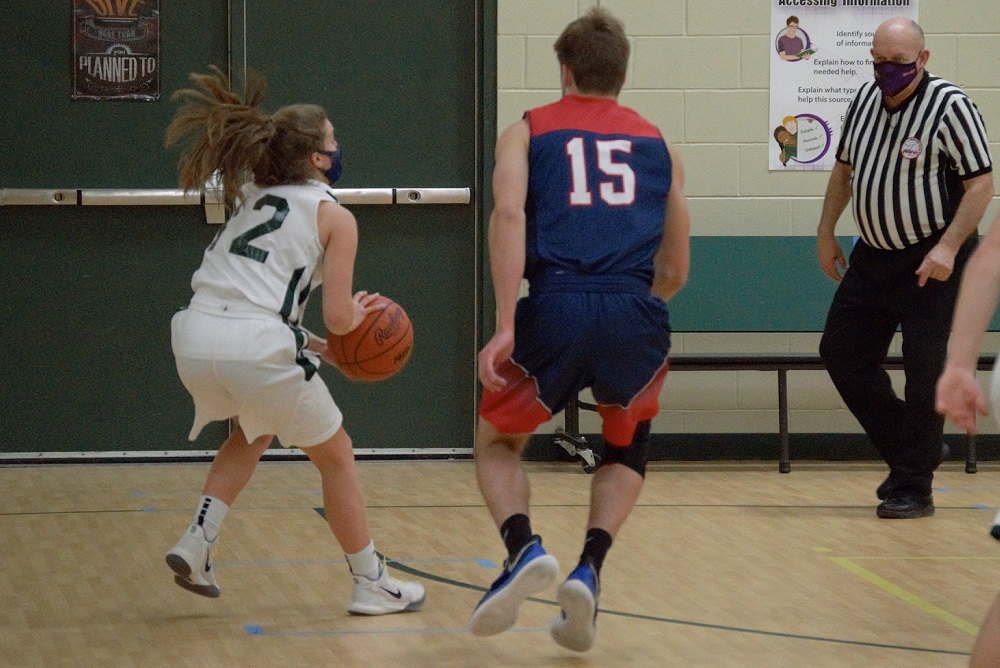
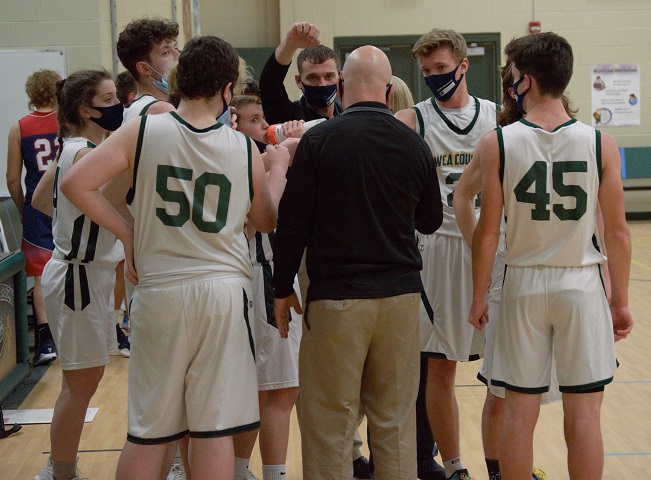
PHOTOS: (Top) Will Carleton Academy’s Clemmie Gadwood (12) positions for a possible 3-pointer this season. (Middle) WCA coach Jason Coward huddles with his team. (Photos by Joe Flaherty, Hillsdale Daily News.)