

Lincoln Beats Buzzer for 1st Basketball Title
By
Paul Costanzo
Special for MHSAA.com
March 16, 2019
EAST LANSING – All eyes were on Ypsilanti Lincoln freshman Emoni Bates on Saturday as the seconds ticked away in the Division 1 Boys Basketball Final.
None were on Lincoln senior Jalen Fisher. But that all changed when the buzzer sounded.
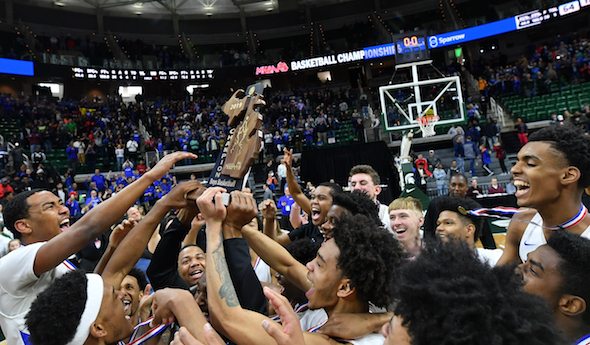
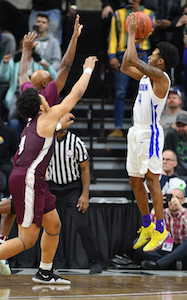
Fisher’s rebound and jumper as time expired gave the Railsplitters their first MHSAA boys hoops title with a 64-62 victory over U-D Jesuit at the Breslin Center.
"At the beginning of this game, I just told (Fisher) to be patient, your time is coming man, be patient,” Lincoln coach Jesse Davis said. “During the timeouts I said, ‘Jalen be patient, your time is coming.’ I didn’t know it was going to come like that, but I’m glad it happened to him, because I believed in him the whole time.”
The last-second shot was the first to win a championship game featuring the state’s largest schools – formerly Class A, now Division 1 – since Lansing Sexton defeated Hamtramck in overtime in Class A in 1959.
Fisher’s shot ended a dramatic final quarter, which saw Lincoln (23-4) rally from a nine-point deficit. The Railsplitters took possession of the ball in a tie game with 1 minute, 20 seconds remaining, and drained the clock to set up a final shot.
That shot was supposed to be for Bates – considered the top freshman in the country – who gathered the ball in the backcourt but was immediately doubled as he came across half court.
“We trapped him, trying to get the ball out of his hands,” U-D Jesuit coach Pat Donnelly said. “I thought they got a decent, a clean look up top, but it was forced way out. That was what we talked about going in, that we were going to double (Bates) if he caught the ball.”
Bates passed out of the double team to senior teammate Amari Frye, who launched a 3-pointer from the top of the arc. He thought it was good – he remarked he thinks every shot he takes is good – and so did Fisher, but it hit the side of the iron and caromed to a wide open Fisher who capitalized with the game-winner.
“I thought it was good, but it hit the top of the rim and came in my hands, so I just shot it and it was good,” Fisher said. “I just shot it, and when it went in, I just saw black. Then I saw people on top of me. It was a good feeling though.”
Fisher, who played all 32 minutes and finished with 16 points, fell immediately to his back after hitting the shot and was mobbed by his teammates near the Lincoln bench.
 “I talk to my kids about living in the moment, and this was a moment that nobody saw coming but us,” Davis said. “I just think it’s great to have some kids you can take and you start with them when they’re freshman – Amari, Tahj (Chatman), Jalen came when he was a junior – but I’ve been instilling a championship mentality in Tahj and Amari for four years. Then we add somebody like Jalen with exceptional speed, toughness and a will to win, then you add somebody like Emoni Bates who can carry us through tough games and make big shots, and do everything the other guys couldn’t do. It just came out so beautiful, man.”
The Cubs (25-3) led for most of the game and nearly all of the second half after taking an 11-point lead into halftime. Daniel Friday scored 19 points, while Julian Dozier added 18 and six assists to put their team in control and up 60-51 with five minutes to play.
But Lincoln fought back and went on an 11-0 run, taking a 62-60 lead on a Frye layup with 1:38 remaining. Dozier responded immediately with a layup of his own to tie the game, but the Cubs wouldn’t see the ball again in the final 1:20.
“We’re the same kind of team as them; we score points in bunches,” Davis said. “We can get on a run and score. We’re capable of making runs just like them, so I keep telling my team, ‘Hey, keep doing what we do, keep applying pressure on both ends, and some shots will go down for us.’”
Bates scored in spurts himself, finishing with a game-high 23 points despite not having his best shooting night (7-of-22 from the floor and 1-of-7 from 3-point range). He was 8-of-8 from the free-throw line, however.
The Cubs played Friday on Bates for much of the game. Friday was giving up five inches to the 6-foot-9 Bates, but had a 45-pound weight advantage. Jordan Montgomery, who was giving up more than a foot in height, also countered with strength.
“(The U-D Jesuit defense) was good, but I just wasn’t making shots today,” Bates said. “I was getting to my spots, but my shot just wasn’t falling.”
Bates also had six rebounds and three blocks for the Railsplitters, while Frye finished with 15 points.
Montgomery added nine points, all on 3-pointers, for the Cubs, while University of Massachusetts-bound senior Jalen Thomas had six points and seven rebounds.
“I want to congratulate Ypsilanti Lincoln on a tremendously hard-fought victory – they're a good team,” Donnelly said. “Coming into this game we heard all this stuff about, ‘You have to stop Emoni, stop Emoni,’ but we were a lot more concerned with more than Emoni. They have some good players out there.”
PHOTOS: (Top) Ypsilanti Lincoln celebrates its first MHSAA boys basketball championship Saturday at the Breslin Center. (Middle) Jalen Fisher launches the game-winning shot as the final seconds tick off the clock in the Division 1 Final.
Breslin Bound: 2025-26 Boys Report Post-Break
By
Geoff Kimmerly
MHSAA.com senior editor
January 5, 2026
Holiday break is showcase season for several basketball teams all over the state, and there’s plenty to catch up on as "Breslin Bound” returns for the start of calendar year 2026.

While championship hopefuls will continue to play in special events (mostly on Saturdays) over the next many weeks as well, there were 58 tournaments and one-or-several-day showcases over the last two weeks featuring Michigan boys hoops teams.
“Breslin Bound” is powered by MI Student Aid and based on results and schedules posted for each school at MHSAA.com.
Week in Review
The countdown of last week’s five most intriguing results:
1. Rockford 81, Bloomfield Hills Brother Rice 78 (2 OT) The Rams won a classic at the D Zone Showcase and remain undefeated at 8-0 while the loss was the second over three games for Brother Rice (7-3).
2. Auburn Hills Avondale 50, Grand Blanc 49 In another D Zone Showcase nail-biter, Avondale (8-1) bounced back from losing to Freeland two days before to hand Grand Blanc (8-1) its only defeat this season.
3. Grand Haven 77, Freeland 74 (OT) Grand Haven (8-1) handed Freeland (7-1) its lone defeat, during the Cornerstone University Holiday Showcase.
4. Clinton Township Chippewa Valley 69, Detroit Cass Tech 67 Chippewa Valley (7-1) has been consistently successful over several seasons, but defeating Cass Tech (5-3) at the D Zone Showcase certainly earned additional attention.
5. East Lansing 62, Bloomfield Hills Brother Rice 41 The reigning Division 1 champion Trojans (8-0) have had a few close calls this winter but impressed against one of their most highly-regarded foes.
Watch List
With an eye toward March, here are two teams in each division making sparks:
DIVISION 1
Grand Blanc (8-1) The Bobcats have won at least a District title every season this decade, and appear on the right track for another run with their only loss by a point to Avondale (see above). Grand Blanc also has navigated a one-point overtime victory over Hamtramck and three-point win over Saginaw United, and perhaps most impressively downed Clarkston 54-47 at its home Charlie Carmody Classic to begin this month. Friday’s game at Grand Haven (8-1) will be another that could shake up rankings.
Ypsilanti Lincoln (8-1) The Railsplitters have continued to roll after finishing last season 16-10 but with six wins over their last seven games including a District title clincher. After finishing fourth in the Southeastern Conference Red last winter, Lincoln is the early leader in the SEC White. Its lone loss was during the first week of December to Wayne Memorial, and the Railsplitters have four wins by one or two points.
DIVISION 2
Benton Harbor (10-0) The Tigers are among five teams statewide that have reached double-digit wins, with six of those first 10 coming during showcase games including by two over Detroit Douglass and three in overtime over Berrien Springs. Benton Harbor has several more matchups of note coming up; circle Jan. 13 at Niles Brandywine, Jan. 17 against Detroit Catholic Central at Westland John Glenn’s Rocket Classic and Feb. 7 against Warren Lincoln at Grand Rapids Community College’s 2K26 Showcase.
Grand Rapids South Christian (7-1) The Sailors are coming off a 20-5 season that included sharing the Ottawa-Kent Conference Gold title and winning their District despite opening 1-3. They’re off to a much faster start this winter, already avenging last-winter losses to Grand Rapids Christian and Grand Rapids Catholic Central – the latter which ended South Christian’s 2024-25 season. The Sailors shared last year’s league title with Grand Rapids Northview and will see the Wildcats for the first time Friday.
DIVISION 3
Beal City (7-0) The Aggies opened the new year with wins over Mason County Central and Vestaburg to win the Reed City Holiday Tournament, and total five of their seven victories have come over teams currently with winning records. Beal City handed Highland Conference rival McBain its only loss and sits tied atop the league standings with LeRoy Pine River, with their first matchup slated for Jan. 20. Beal City finished second in the league to McBain last season and ended their tournament run with a Regional Final loss to the Ramblers.
Menominee (7-1) The Maroons began this season with a defeat against Division 2 contender Freeland at Petoskey’s Sean Pollion Invitational, but haven’t lost again – a substantial bounce-back from last year’s 2-4 start on the way to a 13-12 finish. The difference in part has been wins over Negaunee, Crystal Falls Forest Park and Green Bay West (Wis.) – after losses to those opponents during last winter’s start – and it’s important to note as well that all seven wins this season have come by at least 23 points.
DIVISION 4
Dollar Bay (6-1) Although the Blue Bolts are coming off a loss to Division 1 Marquette last week, a 49-45 overtime win over Forest Park has highlighted this early run and avenged an 18-point loss to the Trojans a year ago. Dollar Bay went on last season to share the Copper Mountain Conference title and win its District, and the Blue Bolts will see the other two co-champions Wakefield-Marenisco and Ewen-Trout Creek this month, as well as Bessemer – which ended Dollar Bay’s 2024-25 season in a Regional Semifinal.
Pickford (7-0) The Panthers just missed out on a trip to Breslin last season, falling to Forest Park by two points in their Quarterfinal while finishing 23-3 overall. They’ve already avenged last year’s regular-season loss to Harbor Springs as they opened this winter with six wins by at least 18 points before handing Harbor Springs Harbor Light Christian its only loss, 59-54 last week. Undefeated Cheboygan on Jan. 17 could present another intriguing challenge.
Can’t-Miss Contests
Be on the lookout for results of these games coming up:
Wednesday – Fowler (7-0) at Pewamo-Westphalia (5-1) – The only loss between these Central Michigan Athletic Conference rivals this winter was P-W’s by two points to Division 1 Grandville.
Friday – Detroit Loyola (8-0) at Dearborn Divine Child (8-2) – The Catholic High School League AA kicks off its second half with a rematch of a season-opening 62-56 win by league leader Loyola.
Friday – Frankenmuth (7-0) at Freeland (7-1) – These two are both undefeated in early Tri-Valley Conference Red play, with the only loss between them Freeland’s to Grand Haven noted above.
Saturday – Wayne Memorial (4-0) vs. Muskegon (4-0) at East Kentwood – These are two of 10 remaining undefeated Division 1 teams, and they face off at 4:45 p.m. in the Gottagetit Classic.
Saturday – Rockford (8-0) vs. East Lansing (8-0) at East Kentwood – These are two more of the Division 1 unbeatens, and they play in the 8:15 p.m. slot at East Kentwood.
MHSAA.com's weekly “Breslin Bound” reports are powered by MI Student Aid, a division within the Department of Lifelong Education, Advancement, and Potential (MiLEAP). MI Student Aid encourages students to pursue postsecondary education by providing access to student financial resources and information. MI Student Aid administers the state’s scholarship and grant programs that help make college Accessible, Affordable and Attainable for you. Click to connect with MI Student Aid and find more information on Facebook and X @mistudentaid.
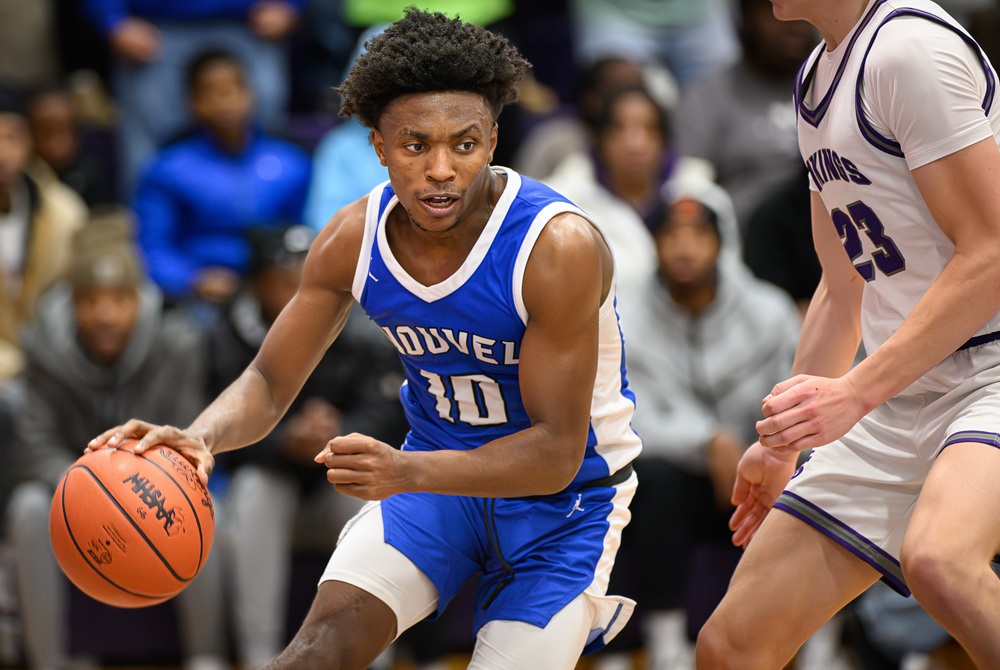
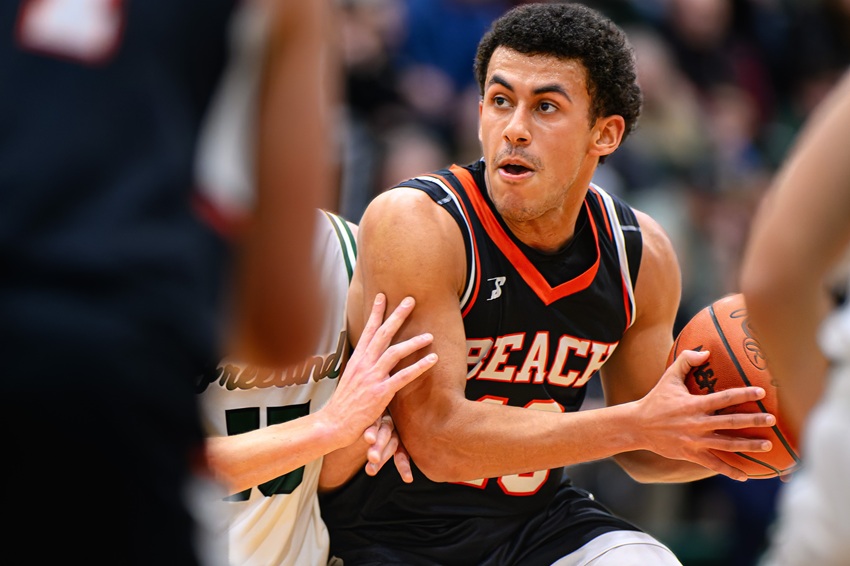
PHOTOS (Top) Saginaw Nouvel Catholic Central senior Rahmaan Kelley Jr. drives to the basket during the third quarter for two of his team-leading 20 points in the Panthers’ 44-35 victory over Saginaw Swan Valley on Dec. 17. (Middle) Harbor Beach guard Benson Harper works his way through the paint toward a second-quarter basket in his team’s Jan. 2 game against Freeland. (Photos by Kolleth Photo.)