

Little Provides Major Stride as 1st Woman to Officiate Boys Hoops Final since 1995
By
Keith Dunlap
Special for MHSAA.com
April 13, 2023
Delonda Little was already a trailblazer to many before this year’s MHSAA Boys Basketball Finals.
 But what happened last month at Breslin Center made her even more of one on a statewide level.
A referee and assigner for 20 years in the Detroit area, Little is a female boys and girls basketball official who mentors both male and female referees – no matter the gender or level, as she officiates high school and college games.
Officials often go to Little for guidance, direction and assignments, which has made her respected for years throughout Metro Detroit in the prep basketball community. Then, her status as a trailblazer grew even more.
Little was assigned as an official for the Division 3 Boys Basketball Final between Flint Beecher and Traverse City St. Francis, and she became the first female referee to officiate an MHSAA Boys Basketball Final since Traverse City’s Barb Beckett 1995.
“It was a very good feeling to know I was the one selected,” said Little, who officiated the Final with Matt Olson and Zach Porritt.
In fact, while attending a Semifinal game the Friday before the Final, Little received a phone call from an area code she didn’t recognize.
She answered, and it was Beckett.
“At first I didn’t know the name,” Little said. “I said, ‘No, I don’t know you, but that’s fine.’”
Beckett then explained she was the first female referee to be assigned a Boys Basketball Final, and just wanted to offer support to Little.
At that point, Little became excited and thankful she answered the call.
“It was very nice to hear from her because she wanted to reach out and if not pass the torch, to congratulate me,” Little said.
Little, 51, said she found out she was going to be refereeing the Division 3 boys championship game just before the start of the postseason when she received an email from the MHSAA.
“I’m looking at the email and I’m like, boys?” Little said. “I was shocked.”
But she was shocked in a good way, and obviously excited for the honor.
 Little didn’t find out until a couple of days before the St. Francis/Beecher contest that she would be officiating that specific championship game, but the Monday of boys championship week was when she really started to receive congratulations from friends and colleagues.
That’s when an article came out in the Detroit News detailing her selection, which led to countless calls, texts and congratulatory messages on social media.
“I couldn’t even (keep up with the comments),” she said. “That’s how overwhelming the actual tags were. It came from all across the state with officials, men and women, because I do women’s college (games). Some of the college ladies were reaching out. I was getting all the hoopla before the game.”
Little said she normally doesn’t get nervous for games, but not having some nerves became a bit harder once so many people knew of her achievement.
However, she settled into a normal routine quickly once the game started.
“I wanted to get it done, get it over with and do well,” she said.
Little did do well, which is no surprise to everyone who knew her before she officiated on the boys championship stage.
It was just another feather in the cap for Little, who in 2016 became the first woman to officiate a boys Detroit Public School League championship game.
“Delonda is one of the top officials in the Detroit area, and our staff doesn’t look at Delonda as a female working a boys game – we see one of the top officials in Detroit working a basketball game,” MHSAA Executive Director Mark Uyl said. “There are females officiating in the NBA and female officials in the NCAA Men’s Basketball Tournament. The aspect that made Delonda’s selection for this MHSAA championship game nearly unique will soon be the norm at all levels of athletics.”
Little graduated from Detroit Osborn in 1989 and starred on the basketball court at Wayne State, earning induction into WSU’s Athletic Hall of Fame in 2005.
Her day job is as an officer for the Michigan Department of Corrections, but her passion is officiating. She’s been an MHSAA-registered official for basketball for two decades and also was registered for volleyball for four years. This past fall she registered for football for the first time.
“I get something from it because it keeps me in shape, I love the people I work with and I like the kids,” Little said. “You are always teaching, and I like training the newer officials. I just enjoy it. I don’t know what I’d be doing if I wasn’t refereeing.”
Going forward, Little hopes her championship game assignment will now be an inspiration for other female referees.
“There aren’t very many women who would like to work boys basketball or feel comfortable,” Little said. “If that’s something they desire, I’m hoping more women are selected to work the games if they feel comfortable.”
 Keith Dunlap has served in Detroit-area sports media for more than two decades, including as a sportswriter at the Oakland Press from 2001-16 primarily covering high school sports but also college and professional teams. His bylines also have appeared in USA Today, the Washington Post, the Detroit Free Press, the Houston Chronicle and the Boston Globe. He served as the administrator for the Oakland Activities Association’s website from 2017-2020. Contact him at [email protected] with story ideas for Oakland, Macomb and Wayne counties
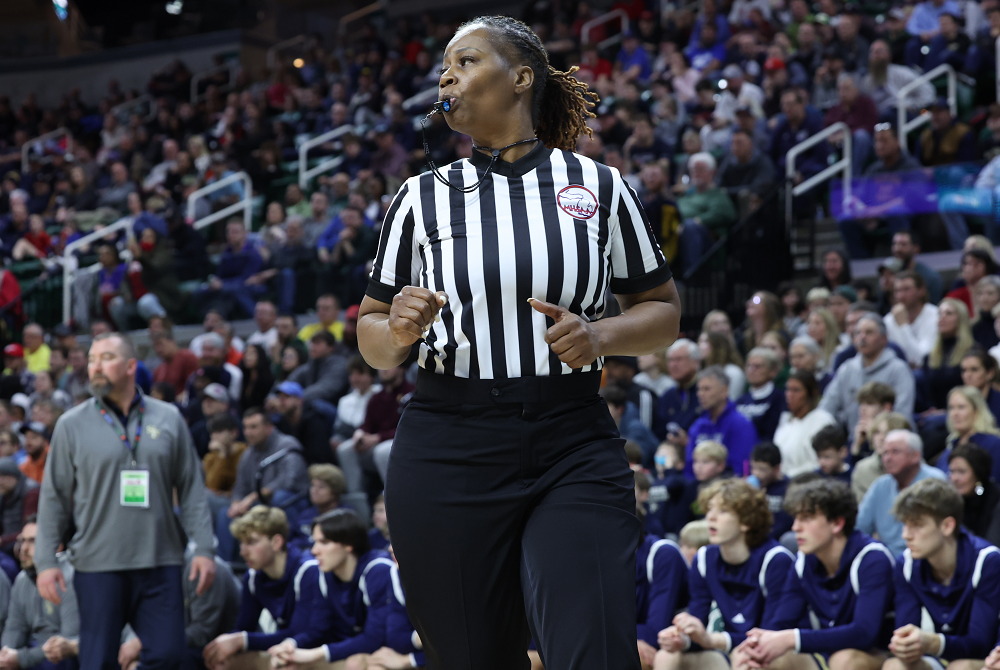
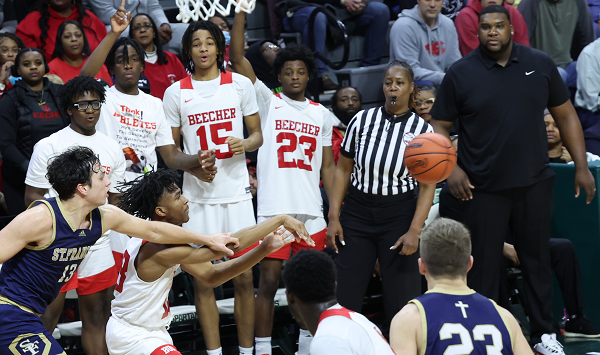
PHOTOS (Top) Delonda Little takes her position on the court during the Division 3 Boys Basketball Final on March 25 at Breslin Center. (Middle) Little monitors the action between Flint Beecher and Traverse City St. Francis.
Breslin Bound: Girls Report Week 12
February 24, 2020
By Geoff Kimmerly
Second Half editor
March is almost here, warm weather downstate has given us at least a reminder of spring, and the final week of girls basketball regular season is another indication that the most exciting part of a long winter is nearly upon us.
 Of course, there are a few championship to decide before next week’s start of the MHSAA Tournament, and a few more big-time nonleague matchups to get in as teams prepare to take their best shots at becoming Breslin Bound.
We offer a glance at some of those below. Next week we’ll come back with previews of three Districts of particular interest in each Division as we move closer to our final destination at Michigan State. “Breslin Bound” is powered by MI Student Aid and based on results and schedules posted for each school at MHSAA.com. Send corrections or missing scores to [email protected].
Week in Review
The countdown of last week’s five most intriguing results:
1. Hartland 36, Brighton 33 – The Eagles (17-1) and Miss Basketball Award finalist Whitney Sollom avenged their lone loss, 41-33 on Jan. 24, to move past Brighton (16-2) and clinch the Kensington Lakes Activities Association West championship.
2. Lake City 36, Manton 26 – The Trojans (18-1) finished a perfect run through the Highland Conference to win their first league title since 2000, downing second-place Manton and then third-place McBain two days later.
3. Port Huron 42, Grosse Pointe North 39 – The Big Reds capped a 20-0 regular season by downing North (13-6) to win the Macomb Area Conference Red/White Tournament.
4. Farmington Hills Mercy 51, Bloomfield Hills Marian 40 – After a regular-season split that led to a shared Detroit Catholic League Central championship, Mercy (17-2) clinched the Bishop Tournament title with this deciding game over the Mustangs (14-4).
5. Montague 59, Hart 46 (3OT) – The Wildcats (15-4) clinched the West Michigan Conference championship after previously losing to Hart (16-4) on Jan. 17, 39-31.
Watch List
With an eye toward March, here are two teams in each division making sparks:
DIVISION 1
East Kentwood (15-3) The Falcons are carrying an eight-game winning streak since suffering their only Ottawa-Kent Conference Red loss, 45-41 to Hudsonville on Jan. 17, and will earn a shared league title if both teams win out this week. East Kentwood is the reigning league champion and beat this week’s opponents Grand Haven and Caledonia by 37 and 43, respectively, the first time through the schedule. The Falcons’ only other losses came to two other Division 1 contenders – Detroit Renaissance by two and East Grand Rapids by seven, both in mid-December.
Hudsonville (17-1) The Eagles’ only defeat this season came to East Kentwood on Feb. 14, 53-46, and a shared league title would give them their first league championship since 2015-16. They beat their opponents for this week, Holland West Ottawa and Grandville, by 35 and 41, respectively, during the first round of league play. In addition to defeating East Kentwood in January, Hudsonville also handed recently-clinched O-K Gold champion East Grand Rapids (18-1) its only loss, on Dec. 13.
DIVISION 2
Detroit Edison (17-0) We’ve highlighted one of Edison’s wins in the above section of this report nearly every week – which is what happens when a team goes undefeated against a slate of opponents with a combined .810 winning percentage. Among those, Edison has beaten arguably the top three teams in Division 1 – Ann Arbor Huron, East Lansing and Detroit Renaissance – with its only two single-digit in-state wins to Renaissance by two and last week to reigning Division 4 champion Adrian Lenawee Christian 67-62. Standout senior Gabrielle Elliott also is one of three Miss Basketball Award candidates.
Freeland (14-4) The Falcons defeated Frankenmuth (13-5) on Friday 43-39 to clinch the Tri-Valley Conference East outright, continuing a courageous run this season after the unexpected death of highly-respected coach Tom Zolinski on Nov. 22. Freeland opened the season 3-3, but has lost only once since Dec. 18, to Division 1 Saginaw Heritage (12-6) by four. The Falcons avenged one of those early defeats by beating TVC East second-place Standish Sterling 60-54 on Jan. 28, and they also own an impressive win over Kingsley (13-6).
DIVISION 3
Flint Hamady (18-2) Last season’s Division 3 runner-up is back in tournament form and closed its regular season by clinching the Genesee Area Conference title outright with a 63-54 double-overtime win over Morrice (13-4). Hamady swept the Orioles and rival Flint Beecher (12-6) in league play, and also earned solid wins over Waterford Our Lady of the Lakes (12-6) and Grand Blanc (10-8) during the first weeks of the season. The only losses came to Division 1 Flint Kearsley (13-5) and Davison (11-7), the Davison defeat by just a point.
Springport (16-2) The Spartans have clinched the Big 8 Conference title for the second-straight season and run their league winning streak to 29 despite playing in a conference this winter with four other teams that have won at least 10 games. Total, Springport has won 10 games over teams with double-digit victories, with its only defeats to Cascades Conference co-leaders Grass Lake (16-2) and Michigan Center (15-3).
DIVISION 4
Fowler (14-4) The Eagles locked down second place in the Central Michigan Athletic Conference last week behind reigning Division 3 champion Pewamo-Westphalia. And if last season’s run to the Division 4 Semifinals was an indication, another high league finish should pay off for the Eagles. Five CMAC teams have at least 10 wins or more going into this final week, and Fowler swept the rest including Portland St. Patrick (14-4). The Eagles’ other losses were to reigning Division 4 champ Adrian Lenawee Christian (17-2) and Division 2 power Portland (16-3).
Ubly (17-1) The Bearcats have locked up the Greater Thumb Conference East title, their first league championship in at least a decade, after finishing fourth in the East and 11-11 overall last season. This winter’s run included sweeps of Sandusky (15-4) and Harbor Springs (13-5), and the only defeat came Dec. 17 to eventual GTC West champion Caro. Ubly is holding opponents to a mere 24.4 points per game.
Can't-Miss Contests
Be on the lookout for results of these games coming up:
Monday – Brighton (16-2) at Wayne Memorial (15-3) – The KLAA East champion hosts the West runner-up, with the winner playing for the overall league title Thursday against either Hartland or Dearborn.
Tuesday – Williamston (15-3) at Michigan Center (15-3) – With Friday’s one-point win over Haslett, Williamston is in position to win at least a share of the Capital Area Activities Conference Red, but first faces a Michigan Center team in the same scenario in the Cascades Conference.
Thursday – Farmington Hills Mercy (17-2) at Detroit Renaissance (17-2) – The Detroit Public School League champion Phoenix host the Catholic League Bishop champion Marlins at the annual Operation Friendship games.
Thursday – Plainwell (13-5) at Edwardsburg (17-1) – The Eddies tied for first in the Wolverine Conference South and host North champion Plainwell; Edwardsburg winning their Feb. 11 meeting.
Friday – Midland Dow (16-2) at Flint Carman-Ainsworth (15-3) – Dow from the Red and Carman-Ainsworth from the Blue will play for the overall Saginaw Valley League championship.
Second Half’s weekly “Breslin Bound” reports are powered by MI Student Aid, a part of the Office of Postsecondary Financial Planning located within the Michigan Department of Treasury. MI Student Aid encourages students to pursue postsecondary education by providing access to student financial resources and information. MI Student Aid administers the state’s 529 college savings programs (MET/MESP), as well as scholarship and grant programs that help make college Accessible, Affordable and Attainable for you. Connect with MI Student Aid at www.michigan.gov/mistudentaid and find more information on Facebook and Twitter @mistudentaid.
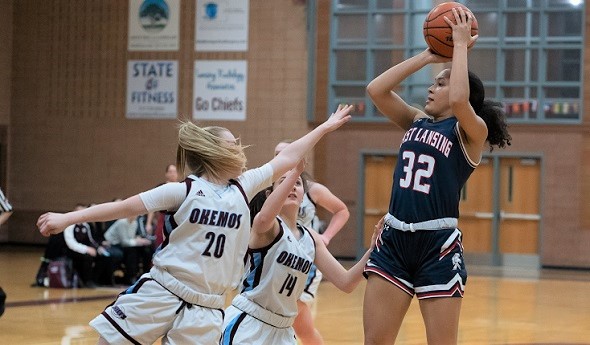
PHOTO: East Lansing’s Aaliyah Nye, a Miss Basketball Award finalist, gets a shot up over two Okemos defenders last week. (Click to see more from HighSchoolSportsScene.com.)