

Miller's Mentoring Spans Into 7th Decade
January 29, 2020
By Mike Spencer
Special for Second Half
MAPLE CITY – With the dawn this winter of the 2020s, Don Miller is coaching high school basketball in a seventh decade.
 That’s rarefied air in Michigan High School Athletic Association circles, but it’s an atmosphere the 73-year-old longtime Maple City Glen Lake basketball coach has enjoyed and plans to continue as long as his health, family and Laker nation lets him.
“I have a passion for the bouncing of balls in a gym,” said Miller, who made his coaching debut at Howell in 1969 but then spent five decades guiding the Lakers’ ship. “The worst headache I may have disappears with that sound as I walk into a gym. The blood pressure goes down and the pleasure goes up – practices or games.”
Miller, admittedly the last man on his varsity basketball team at Southfield High during his playing days, coached a lot of good teams and players at Glen Lake during his varsity tenure (1973-2004) when he posted a 523-210 record.
“I didn’t have a lot of basketball skill, but I was a basketball junkie who got the bug to coach and I got better over the years,” Miller said. “I never scored a basket over the years, but I had a lot of players who made me look good. The kids loved the game and had the passion, and we had a spinning wheel of success breeding success.”
A Michigan State University grad, Miller enjoyed watching the Spartans practice after classes, although he never could have forecasted he’d become a Basketball Coaches Association of Michigan (BCAM) Hall of Famer in 1998 or enjoy decades of leading drills.
“Basketball is all about great chemistry, and being with young people sharing a game we love is just wonderful,” Miller said. “And to be able to do it this long is a gift, not a job. I am truly blessed to be in a gym for three hours a day.”
Today, there’s just a handful of active MHSAA coaches with Miller’s experience. Ironically, one of them is Beaverton’s Roy Johnston. Miller was an assistant of Johnston’s back in the early 1970s.
 “I’m shocked to see Don still coaching,” said Cody Inglis, a former Suttons Bay athletic director/coach who worked Miller’s camps for a decade and went on to serve as athletic director at Traverse City Central and currently as an MHSAA assistant director. “But it shows that if there’s something you are good at, and something that you are passionate about, that you are never too old to do it.
“Don’s been a wonderful role model for coaching, perseverance and doing it the right way.”
Former player Todd Ciolek, who also has had a child play for Miller, concurred.
“It’s pretty amazing,” Ciolek said of Miller’s tenure. “But when you have a love for something, it makes it easy to do. For him, he’s got a love for this and I think it comes naturally.”
Miller guided the Lakers boys team to the Class D title in 1977 and runner-up finish in 1996. His teams also reached the MHSAA Semifinals twice. His teams won six Regionals, 16 Districts and 14 conference titles.
He stepped down as Glen Lake’s main man after the 2004 season due to health issues, needing a pacemaker and a stent. He continued running his summer basketball camps and became a volunteer assistant coach for former all-state player Todd Hazelton in 2007.
When Rich Ruelas became head coach in 2015, he asked Miller to be his junior varsity coach. Miller did that for three seasons and is now an assistant varsity coach.
“I was reborn!” Miller said. “I don’t eat and sleep basketball like I used to, but I love my three hours each day with these young men who share this common passion. It’s been a lifesaver.
“My role is advisor and listener,” he added. “But watching Rich, he’s me 30 years ago. I love feeding off his intensity.”
“I truly enjoy having Coach Miller as part of the program that he helped build,” Ruelas said. “There is nothing he hasn't gone through as a coach, and I have relied on him for advice over the past five years.
“He just knows the game so well and has made such an impact on the lives of his former players and campers with his ability to teach life lessons through basketball. We are lucky to have a Hall of Fame coach as part of our program, and I don't take it for granted.”
Ruelas and Miller, a retired educator, not only get together three hours in a gym daily, they routinely have “Mornings with Miller,” on the phone as Ruelas makes his 30-minute commute to school.
Ruelas said Miller has already given him some memorable moments – the unbeaten junior varsity team in 2018 that Miller coached, assistance with the Lakers’ 2018 Finals run (Glen Lake finished Class C runner-up) and an opportunity to meet MSU coach Tom Izzo.
 “What sticks out to me most is that we cannot go anywhere in the state without Don running into a former camper or player,” Ruelas said. “He has made such a lasting impact on so many, and it is evident in his relationships with his former players over the past seven decades.
“I'm not sure how long he will continue to be on the bench with me, but I know he still has a lot of fire in his belly. As long as he has permission from his wife and is able, I expect him to be there.”
One of Miller’s trademarks is teaching life lessons first and basketball second.
“Don was a unique coach,” Ciolek said. “He wasn’t a coach of basketball first; he was a coach of ethics and morals and basketball came second.
“Most coaches start with some technique, but he started with the word respect and then engrained in us that there was more beyond basketball. He instilled a set of values in us that ultimately led to victories.”
While Miller has had decades of success, some of the losses were devastating.
“You remember the losses more than the wins, and three last-second losses are forever etched in my brain,” said Miller noting a 1978 loss to Mio and Jay Smith in the Regional Final at Gaylord, a buzzer-beating in 1988 by eventual Class D champ Northport and the 1996 Semifinal loss to Wyoming Tri-unity Christian. “The pain and tears and disappointment of these three were great memories. But losses are part of the game and the boys, now men on those teams, have made me very proud ever since.”
Miller said he’s seen a lot of things change for the better since he started coaching. Players are starting younger and getting better coaching earlier, and that has led to improved talent and team play. There are also nicer gyms and uniforms, and Miller loves the idea of boys sharing the spotlight with girls programs.
His disdains, however, are that larger schools today have kids who tend to specialize in one sport earlier, and the crowd of negative parents is growing.
“Our kids play several sports, and I feel it makes them better,” Miller said. “Playing for other coaches in other sports increases competitiveness and team play. You learn to be a different role player, and that carries over into life. “
Miller said credit for his decades of success goes to his supportive wife, Sandy, and the blind luck of having Paul Christiansen as his first junior varsity coach.
“Paul was my organizer, critic, conscience and cohort for three decades,” Miller said. “He is a Hall of Fame track coach but the real wind beneath my wings. None of this happens without Paul.”
 Both Miller and Christiansen were honored by BCAM in 1998, with Miller going into the HOF and Christiansen going into the Hall of Honor.
Miller also credits a number of coaching mentors including the late Larry Glass, a former Big Ten men’s coach and girls basketball coach at Leland, and great players and coaches he recruited to help at his summer camps in Wolverine and Glen Lake.
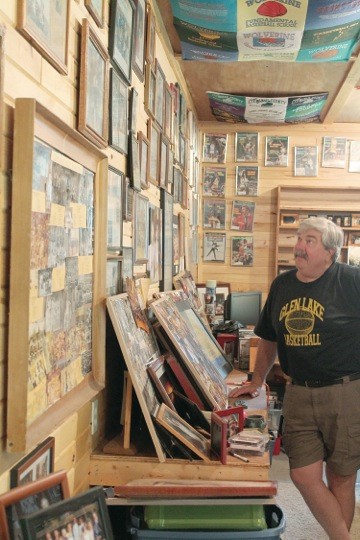
While Miller savors the friendships with other coaches, he’ll forever cherish his former players, who reciprocated their love by building him a man cave and basketball museum after he retired in 2004 and show up for weekly games of basketball at the Glen Arbor Town Hall – a 40-year-old tradition – with fellowship afterward.
“They call, email and treat me to meals out which really is too bad for my figure but great for my ego and friendships,” Miller admitted. “I love my boys (now men) and for that, I am truly the luckiest.”
“I was fortunate enough to be coached by Don when he was just starting out at Howell,” said Tom Murray, former Bay City John Glenn and Standish-Sterling Central coach. “He changed my life and many of my classmate’s lives.
“Don’s touched so many lives, it’s incredible. He instilled a lifelong love of basketball in me. He is a fantastic coach and man.”
Mike Spencer is a former MHSAA referee and sportswriter for the Bay City Times, Midland Daily News and Leelanau Enterprise and freelancer for both the Enterprise and the Traverse City Record Eagle.
Seven Decades of Miller Highlights
1960s – Last man on the Southfield High team. Watching MSU practice after class without a clue that he would coach someday. Getting hired in 1969 as the freshman coach at Howell because no else wanted the job and coaching Morey Ray, his first great player.
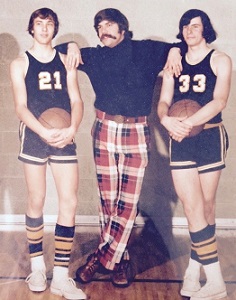
1970s – Coaching the 1977 Class D championship season and the slow evolution over the years of the front line of seniors Dave Prentice, Geof Kotila and Rick Baillergeon, who started for three years. Being down three points, without the ball and 30 seconds to go, and winning the Final by two on a shot with one second left against the No. 1-ranked team in the state, Detroit East Catholic, 70-68.
1980s – Keeping the ball rolling and seeing four of those starters – from the 1977 and 1978 teams – become captains of a college team. Reaching the quarters in 1980, the semis in 1981, 1984 and 1985. Standouts included Bob Sutherland (’80), Bill Zolman and Kevin Crinion (’81), Ron Winowiecki and Dan Witkowski (’84), and Mike Crinion and Ross Hazelton (’85). Beating No. 1 Bear Lake at Traverse City Central in front of 2,800 fans – “Loudest gym. Teamwork over talent and Mike Crinion was amazing.”
 1990s – Keeping ball rolling as elementary kids became high school stars. Reaching the quarters in 1991 and 1995 and semis in 1996. Standouts included Micah Deegan and Bryan Fosmore (’91), Todd Ciolek and Max Miller (’95), and Jamie Mazurek and Greg Aylsworth (‘96). Semifinal upset of reigning Class D champ Detroit Holy Redeemer, 81-66.
2000s – Retired in 2004, but with recent adoring memories of 2002 league and District championship team led by Chris Milliron and Steve Walker. Team showed great improvement in ability and attitude, avenging losses to Suttons Bay and Traverse City St. Francis with 24-point victories.
2010s – Returned in 2015 as assistant coach to Rich Ruelas and coached the boys junior varsity to 55-5 record over his first two seasons with three sophomores and a freshman on the varsity. Posted two 20-0 seasons.
2020 – Still coaching as an assistant.
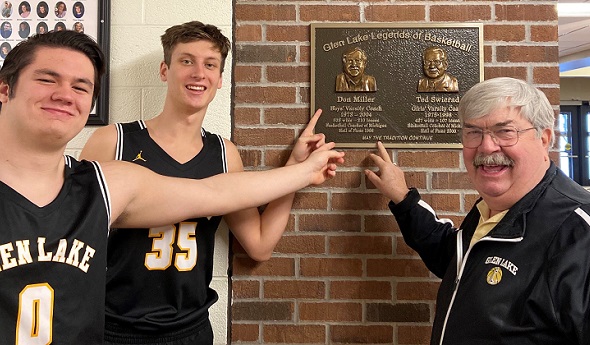
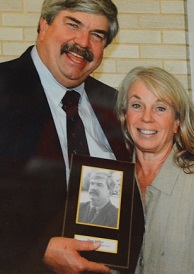
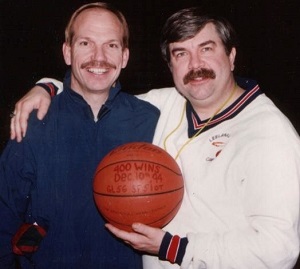
PHOTOS: (Top) Glen Lake assistant boys basketball coach Don Miller, with captains Ben Kroll (left) and Reece Hazelton, point to the plaque declaring his legendary status in the program. (2) Miller confers with a pair of players during the 1977 Class D championship season. (3) Miller and his wife Sandy. (4) Miller stands among the many mementos decorating his basketball museum built by former players. (5) Miller stands with longtime assistant Paul Christiansen, holding a ball commemorating Miller’s 400th coaching win in 1994. (Photos courtesy of Don Miller and the Leelanau Enterprise.)
Erie Mason Climbs to Championship Level
February 15, 2019
By Doug Donnelly
Special for Second Half
ERIE – When Kevin Skaggs was named the boys varsity basketball coach at Erie Mason, he immediately got on the phone and started asking questions.
 After more than two decades coaching basketball, Skaggs was about to embark on something new – high school basketball.
“All of my 22 years was in college coaching,” he said. “I reached out to a lot of different high school coaches, coaches that I had known over the years. … It’s mind-boggling how you have to fit all of the pieces together to build a program.”
Whatever those coaches told Skaggs, he should box it up and sell it.
Skaggs took over an Erie Mason program that occasionally had success but was often the team on the schedule other schools wanted to face. Those days are just a memory now. In his eighth season, Skaggs has become the school’s all-time winningest coach, recently leading the team to its first-ever outright Lenawee County Athletic Association championship. His team also is in the midst of a 13-game winning streak, the longest in school history.
What’s more is the success doesn’t appear to be a blip on the screen. Mason has had five consecutive winning seasons for the first time in school history and its top scorer – the top scorer in Monroe County – is just a junior.
“I think we are starting to make (other schools) believe,” Skaggs said. “We want to be one of those opponents that when we walk into the gym, other teams say, ‘oh, no,’ instead of ‘oh, boy.’”
Those days are here. Earlier this week, Mason knocked off Petersburg-Summerfield, 64-44, in a non-league game. The Bulldogs came into Erie with a 15-0 record and a top 10 ranking in the Associated Press poll but were handled by the Eagles.
Mason followed that win with an 89-50 victory Thursday over Hudson to clinch the outright LCAA championship, the first since they joined the LCAA in 1988.
Erie Mason has a Saturday date this week with LCAA rival Dundee with a chance to improve to 15-2 on the season. Mason hasn’t won 15 games in a season since 2003-04 and has done so only three times since the school debuted in 1961-62.
All of the wins, high-powered offenses (Mason averages 67 points a game and has made 126 3-pointers as a team) can be traced back to when Skaggs first got to Mason and, on the advice of coaching friends, started a youth basketball program, the Junior Eagles. Those first-year kids eight years ago are now the ones Skaggs sees in the huddle during timeouts.
“They are from that first group of our youth program, and you can get a sense of that,” he said. “They love basketball. That was a big step for us.”
Skaggs, 63, brought together others in the community to put together the youth program for boys and girls. While Mason has had success in other sports – the football team won the Class C championship in 1987 – basketball had lagged behind. Now, he said, that culture has changed. It happened, he said, because student-athletes started loving the game of basketball.
“What you want to teach is to teach them to have fun with the game,” he said. “If you get the kids to fall in love with the sport, they will pursue it. You want to be able to keep kids interested and with a ball in their hands.”
The program aims at teaching the game, making sure kids have fun and, then, around the fifth- and sixth-grade level, increase the competitiveness. By middle school, the basketball players are able to compete with other teams on the Mason schedule. By high school, they are used to success and hungry for more.
“Our eight-grade team had a tremendous year, and our seventh-grade team was pretty good,” Skaggs said. “It’s starting to cycle through, which is wonderful to watch.”
Skaggs also said he’s noticed that athletes aren’t leaving the district to go play for other schools like was once the case.
“We’re keeping our players in our school,” he said.
 Skaggs earned his master’s degree in sports administration and bachelor’s degree in social work at Western Michigan University, where he met coach Dick Shilts. He was directing Christian-based basketball camps in Michigan and Ohio before becoming an assistant coach at Kalamazoo Valley Community College under Shilts and enjoying monumental success. After six years there, he became head coach at Alma College from 1995 to 2001, going 53-98. His second Alma team went 14-12 and won a Michigan Intercollegiate Athletic Association tournament game for the first time in school history. After moving to Erie, Skaggs got an assistant coaching job at Owens Community College in northwest Ohio. He was an assistant five years with the Express, including three years as a volunteer coach, before becoming the head coach.
In 2011, he was named the head coach at Erie Mason, a school just north of the Ohio border that had just a handful of winning seasons in its history.
“Mason was a no-brainer. I was 55 and getting a little tired of getting on a bus and going three to four hours away for a game,” he said. “Plus, my son was playing and I was missing watching him.”
His family has been a major part of his run at Mason. Sons Isaac and Jacob have both either played or coached with him his entire time at Mason.
“What’s a better place to start than with your family?” he said.
He also found community members Tom Banachowski and Brad Liedel to serve as assistant coaches. He delegates what he calls “meaningful responsibility” to his assistants to help the workload and to build continuity in the program. One thing he doesn’t delegate is the Eagles’ offense.
“I’m greedy when it comes to offense,” he said. “That’s mine. There’s nothing like watching an offense that moves the ball and goes. It’s exciting and fun to watch.”
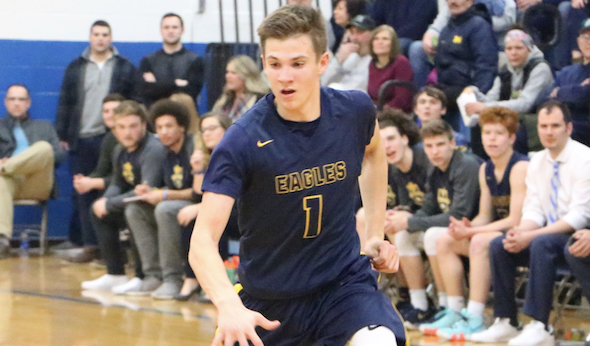
For the past couple of seasons, the Eagle most fun to watch has been Joe Liedel. The 5-foot-11 junior recently moved into second place on the school’s all-time scoring list. With 1,229 points through 16 games this season, he’s well within reach of the school’s career leader, J.P. Horne (1,455 points).
“If Joe Liedel was 6-foot-3, every Division I school would be calling on him,” Skaggs said. “He’s one of the most complete kids I’ve coached in 35 years – and I don’t say that easily.”
Liedel has been sensational this season. He’s the top scorer in the LCAA, and has had games of 41, 37, 37, 34 and 31 while shooting 51.4 percent from the floor, 86.9 percent from the free throw line and leading the team in assists and steals.
“He’s really a complete player, offense and defense,” Skaggs said. “When he thinks there is a weakness in his game, he identifies it and works on it. He’s always been good at shooting, but now he can get to the basket. It adds to his game.”
Liedel isn’t a one-man show, however. Senior Jake Trainor averages 13.6 points a game, while senior brothers Bryan Sweeney (10.6 points a game) and John Sweeney (8.3 points, 6.3 rebounds a game) have played major roles as well.
When they get to the postseason, Erie Mason will be trying to win its first District championship in 46 years. The 1972-73 team won District and Regional championships. It won’t be easy as the Division 3 District at Blissfield is loaded with talented teams, including Summerfield (15-1), perennial power Monroe St. Mary Catholic Central (11-3) and Clinton, which just knocked off 10th-ranked Quincy.
Skaggs is drawing on his college coaching days to keep his players focused on next-level goals.
“Our first goal was to win the LCAA, and we’ve done that,” he said. “Next, it’s the District. Every game we play in now is a test to get ready for the state tournament. You have to keep the focus on one game at a time. We’ve been able to do that. We’re still having fun.”
 Doug Donnelly has served as a sports and news reporter and city editor over 25 years, writing for the Daily Chief-Union in Upper Sandusky, Ohio from 1992-1995, the Monroe Evening News from 1995-2012 and the Adrian Daily Telegram since 2013. He's also written a book on high school basketball in Monroe County and compiles record books for various schools in southeast Michigan. E-mail him at [email protected] with story ideas for Jackson, Washtenaw, Hillsdale, Lenawee and Monroe counties.
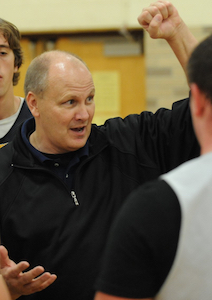
PHOTOS: (Top) Joe Liedel moved into second place on the Erie Mason all-time scoring list this season. (Middle) Coach Kevin Skaggs has led the Eagles to rare success including an outright league title this season. (Top photo by Vanessa Ray.)