

Muskegon, Mr. Basketball End Title Wait
March 22, 2014
By Bill Khan
Special for Second Half
EAST LANSING — Deshaun Thrower had this moment in mind back in November, even while the pain — literal and figurative — was still fresh from his final high school football game.
"I'll try to get healthy for basketball and try to win it in that," a banged-up Thrower said after he and his Muskegon teammates lost to Birmingham Brother Rice for the second straight year in the MHSAA Division 2 championship game at Ford Field.
Fast forward to March 22, and Thrower sat in another postgame press conference following an MHSAA championship game.
This time, he wasn't hanging his head and talking in hushed tones. Instead, he was smiling and clutching the Class A basketball championship trophy following Muskegon's 91-67 rout of Bloomfield Hills at the Breslin Center.
"It feels fake right now, because we're so used to being on the other end," said Thrower, a star quarterback in football and winner of Mr. Basketball this winter.
"This year, it's tears of joy instead of tears of sorrow. It feels good to get it for us, coach and the rest of the players who didn't get it.
"Just knowing I won my last high school game ever, won it with my teammates ... it feels good to leave on a good note."
Muskegon coach Keith Guy said Thrower's leadership was as big a key to the championship run as his numbers and physical tools.
"I don't think anybody's been in more big games than he has in football and basketball," Guy said. "He's a tough leader. He makes sure everyone is doing what they're supposed to do and holding themselves accountable. To have a leader on your team like that, everybody else follows."
 The Big Reds won their first MHSAA championship since 1937 and third overall. They also rode future University of Michigan two-sport All-American Bennie Oosterbaan to a title in the 1923 Michigan Interscholastic Athletic Association tournament; the MIAA was the predecessor to the MHSAA.
It's also the school's first MHSAA title in any sport other than football since the 1937 boys basketball team won the championship. The Big Reds have won five football championships, but took a big step toward removing the label of being just a football school. They reached the MHSAA Quarterfinals last season, losing 64-61 to Grand Rapids Christian.
The basketball team had six members of the football team.
"We want to build what they have here at Michigan State, a two-headed monster," Guy said. "(Football) coach Shane Fairfield does an excellent job. We share the kids and teach them the same message; it shows. The football team finished in the finals and the basketball team finished as champions, so I think that formula works."
Muskegon finished 28-0, joining the 2003 Rockford team (also 28-0) as one of only two unbeaten Class A champions in the last 24 years. Only two other Class A teams have had 28-0 seasons: Flint Central in 1981 and Flint Northwestern in 1985.
"They're good," Bloomfield Hills coach Duane Graves said. "We knew they were good. You can't go 28-0 and not be good. They have a good balanced attack. It had us on our heels all night."
Thrower affirmed why he was chosen Mr. Basketball as the state's top senior, scoring 21 points on 7 for 12 shooting.
Junior center Deyonta Davis may have established himself as the front-runner for next year's award, scoring 26 points on 12 for 14 shooting, grabbing 13 rebounds and blocking three shots.
"He's a different kid where he doesn't show a lot of emotion," Guy said. "There are no big moments for him. You won't see him cry. You probably won't see him smile. He's always even-keeled. Tonight he relaxed and played the way he's capable of playing. He came out with a lot of energy, and I thought he controlled the game."
The game was close for much of the first quarter, but Bloomfield Hills couldn't keep pace with Muskegon for long.
The Big Reds held an 18-15 lead when they scored nine straight points to ignite a 15-2 run that put them comfortably ahead for the rest of the game.
Muskegon built its lead to 43-22 with 24.2 seconds left in the first half and led 45-25 at halftime.
Senior guard Dylan Deitch gave Bloomfield Hills a glimmer of hope in the third quarter, hitting two 3-pointers and scoring eight points. His drive to the basket with 5:06 left in the third cut Muskegon's lead to 47-32, but the Big Reds responded with the next six points to put to rest any doubt about the outcome.
"Everything was geared toward the postseason," Guy said. "We've been trying to climb this mountain for years, and got here. These guys have the formula for success. We don't have any egos on our team. They're genuinely playing for one another. They're happy for one another. If one does better than the others tonight, they're happy as long as we get the win. It's truly a brotherhood and a family."
William Roberson Jr. had 17 points and five assists, while Joeviair Kennedy had 14 points for Muskegon, which scored a season-high 91 points.
Bloomfield Hills is a first-year school that formed when Andover and Lahser merged. Neither of the original schools ever won a regional championship, with Lahser reaching a Class A Regional Final last year under Graves' coaching before losing 65-41 to Rochester.
Xzavier Reynolds scored 21 points, going 4 for 4 from 3-point range, while Yante Maten had 13 points and three blocks for the Black Hawks (24-4).
Bloomfield Hills shot 9 for 31 (.290) in the first half before going 15 for 24 (.625) in the second.
"Shots just didn't fall," Graves said. "That happens. The ball didn't bounce our way. We couldn't make a layup in the first half — in and out, in and out. Someone forgot to take the Saran Wrap off the rim for us. Other than that, I thought the boys fought as hard as they could."
Click for the full box score and video from the press conference.
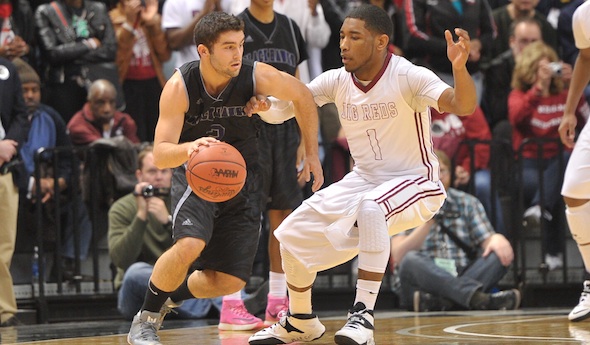
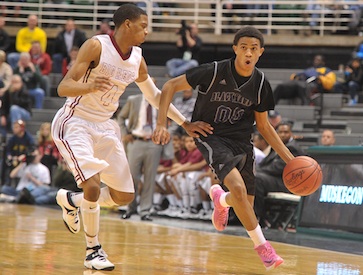
PHOTOS: (Top) Muskegon's Deshaun Thrower blocks off Bloomfield Hills' Todd Weiss during Saturday's Class A Final. (Middle) Bloomfield Hills' Cameron Dalton (00) works to get past Muskegon's Jordan Waire.
Breslin Bound: 2025-26 Boys Report Week 1
By
Geoff Kimmerly
MHSAA.com senior editor
December 8, 2025
Winter has certainly arrived in Michigan over the last few weeks – at least from a snowy standpoint – and right on the time to signal the start of boys basketball season and our first report on the annual march to Michigan State's Breslin Center.
 Big matchups already are happening, and every game against an MHSAA Tournament opponent counts toward seeding for District brackets, and once again we're diving into the results you need to know from the previous week, teams that are showing up big in each division and matchups coming up that you won't want to miss.
“Breslin Bound” is powered by MI Student Aid and based on results and schedules posted for each school at MHSAA.com.
Week in Review
The countdown of last week’s five most intriguing results:
1. Grand Rapids South Christian 75, Grand Rapids Christian 71 The Sailors (2-0) opened by adding to last season’s District Final win over Grand Rapids Christian (1-1), and after having lost to the Eagles 72-55 in their season opener a year ago.
2. Bloomfield Hills Brother Rice 71, Detroit U-D Jesuit 42 Brother Rice (2-0) enjoyed some significant payback after falling to Jesuit twice last season, during the regular season in what eventually decided the Catholic High School League Central title and then in their Regional Semifinal matchup.
3. Saginaw United 67, Detroit Catholic Central 57 The Phoenix (2-1) opened their new fieldhouse with a notable season-opening victory over the Shamrocks (2-1), who defeated United 69-55 in their opener a year ago.
4. Grand Blanc 76, Hamtramck 75 (OT) The Bobcats (2-0) opened the season with this notable win at the Horatio Williams Tip-Off Classic.
5. Warren Fitzgerald 41, East Kentwood 40 This was another exciting finish at the Horatio Williams event, again in a faceoff of teams with high aspirations this season.
Watch List
With an eye toward March, here are two teams in each division making sparks:
DIVISION 1
Grand Haven (3-0) The Buccaneers finished an opening week of road games without a loss, defeating Coopersville 65-42 and then Traverse City Central 83-71 and Traverse West 79-77 over the weekend. Grand Haven improved from 11-12 in 2023-24 to 18-6 last season and will have some opportunities to get rolling heading into the new calendar year with a Dec. 22 matchup against Freeland and its Lake Michigan Cup on Dec. 29-30.
North Farmington (2-0) The Raiders are coming off a 12-10 finish and third place in the Oakland Activities Association Red last season, and got off to a fast start under first-year coach Peter Mantyla with a 41-35 win over Canton and a 62-47 victory over Davison while hosting the Horatio Williams Tip-Off Classic. Reigning league champion Birmingham Groves is up next, on Friday, and the first matchup with Farmington – which ended the Raiders’ season last winter – is Dec. 19.
DIVISIION 2
Dundee (3-0) The Vikings appear on track to bounce way back after going 21-5 in 2023-24 but then only 5-18 last winter. They opened last week with a 12-point win over Saline Washtenaw Christian, a 47-46 victory over Milan and a 51-45 triumph over Britton Deerfield – and after losing to Washtenaw Christian by six points during the early going a year ago.
Freeland (3-0) The Falcons are coming off a 22-4 finish and run to the Division 2 Quarterfinals last winter, so a fast start isn’t a surprise. But it was still impressive; Freeland opened with a 22-point win over Bridgeport, then defeated Menominee by 22 and Petoskey by 15 at the latter’s Sean Pollion Invitational. Showcase games against Auburn Hills Avondale and Grand Haven later this month will be opportunities to impress.
DIVISION 3
Ishpeming Westwood (3-0) The Patriots reached the Semifinals last season for the first time since 2003 with Ethan Marta leading the way, and he’s doing so again to begin his senior year as Westwood opened with sizable wins over West Iron County and Hancock. They finished a perfect first week with an 83-64 victory over rival Ishpeming.
North Muskegon (3-0) The Norsemen are off to the right start as well after last season’s 23-2 finish and Regional Final run. They won all three of their games last week by at least 20 points, defeating Division 1 Walled Lake Western 64-44 in the championship game of the Will Lynch Invitational at Benzie Central. And they celebrated senior Adam Dugener reaching 1,000 points in the season-opening win over Holton.
DIVISION 4
Clarkston Everest Collegiate (2-0) A Regional finalist and 24-2 overall last season, Everest jumped 10 wins from 2023-24 and is off to a fast start again. The Mountaineers opened with a 61-42 win over Livonia Clarenceville and followed with a 59-42 victory over Flint Beecher. Clarenceville is a Division 2 team, and the great majority of Everest’s regular-season opponents play in Division 2 or 3 with a date as well against Division 1 South Lyon East on Feb. 19.
Eben Junction Superior Central (3-0) Two of last season’s first four losses came to Hannahville Nah Tah Wahsh as Superior Central went on to finish the season 9-14 – after going 16-8 in 2023-24. But the Cougars got on the right track immediately this winter with a 57-42 win over Nah Tah Wahsh to open last week before defeating Cedarville 42-41 and Mackinaw City 48-41 on successive days to win the Battle of the Bridge hosted by the latter.
Can’t-Miss Contests
Be on the lookout for results of these games coming up:
Monday – Ishpeming Westwood (3-0) at Kingsford (2-0) – These two both made it to Breslin Center last season, Westwood reaching the Division 3 Semifinals and Kingsford the same in Division 2.
Tuesday – Flint Powers Catholic (2-0) at Bay City John Glenn (1-1) – These two Division 2 hopefuls both won 20 games last season.
Friday – Grand Rapids Catholic Central (0-0) at Rockford (1-0) – The Division 1 Rams may have won their matchup last season 70-43, but the Cougars went on to finish their season in the Division 2 Semifinals.
Saturday – Warren Lincoln (1-0) vs. Arts & Technology Academy of Pontiac (0-0) at Detroit Mercy – These two also both reached Breslin Center last season, Lincoln winning the Division 2 title and ATAP finishing Division 3 runner-up, and they will face off at the U-D Mercy Showcase.
Saturday – East Lansing (1-0) vs. Detroit Martin Luther King (0-1) at Lansing Eastern – The reigning Division 1 champion Trojans should get a strong challenge at the Moneyball Tip-Off Classic from King, which made the Quarterfinals last winter.
MHSAA.com's weekly “Breslin Bound” reports are powered by MI Student Aid, a division within the Department of Lifelong Education, Advancement, and Potential (MiLEAP). MI Student Aid encourages students to pursue postsecondary education by providing access to student financial resources and information. MI Student Aid administers the state’s scholarship and grant programs that help make college Accessible, Affordable and Attainable for you. Click to connect with MI Student Aid and find more information on Facebook and X @mistudentaid.
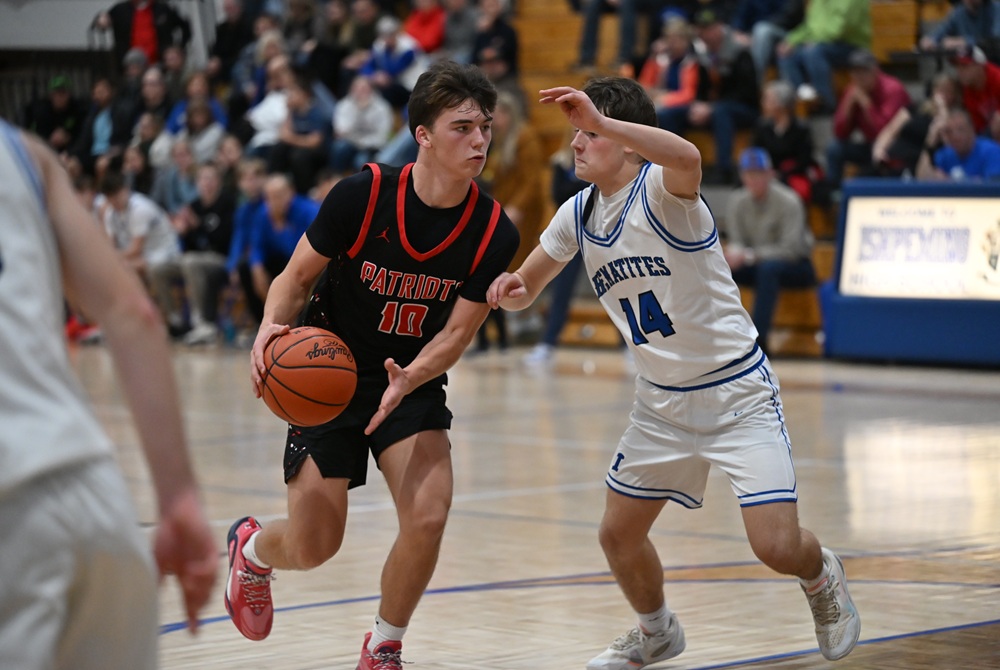
PHOTO While being defended by Ishpeming's Dax Kakkuri on Friday, Ishpeming Westwood's Ethan Marta makes a move to the basket. (Photo by Cara Kamps.)