


New Haven Locks Down, Lifts Class B Trophy
By
Paul Costanzo
Special for MHSAA.com
March 25, 2017
EAST LANSING – The New Haven boys basketball team has made a habit of lighting up scoreboards with explosive offensive performances.
But in their biggest game of the season, when pulled into a slowed-down game by Ludington, the Rockets dug deep and won with defense.
They held Ludington scoreless for the first 6½ minutes of the fourth quarter Saturday on the way to a 45-36 win to claim the Class B title at the Breslin Center. It was the first MHSAA Finals title for the Rockets, who were also making their first appearance in a boys basketball championship game.
“It was a great game, they’re a great team – they took away things that we do and played a great zone,” New Haven coach Tedaro France II said. “We kept our composure. It wasn’t a game that if you told me, we would come here and win this way. We scored the lowest point total we scored the whole year, and we found a way to win.”
The Rockets held Ludington to 11 of 49 (22.4 percent) shooting from the field, and while they were credited with just four blocks – all by sophomore Romeo Weems – the presence of shot blockers clearly caused problems for the Orioles, especially in the fourth quarter, when they shot 2 of 15 (13.3 percent) from the floor.
“You have to give a lot of credit to New Haven for that,” Ludington coach Thad Shank said. “They’re long and athletic and make it hard to finish. I thought we got a lot of great looks tonight, but that’s the game of basketball; sometimes they don’t always go in.”
Weems, who is already fielding Division I college offers, led all scorers with 19 points. He added 10 rebounds and three steals as well. Senior Eric Williams, Jr., had 14 points and seven rebounds for the Rockets (27-1), and Ashton Sherrell grabbed 11 rebounds.
Ludington was led by Calvin Hackert, who had 16 points. Sam LaDuke scored 10, and Noah Laman pulled down 10 rebounds for the Orioles. Six of Hackert’s points came in the final 1:30 on a pair of 3-pointers. Those were the only points the Orioles scored in the final quarter.
“We went with our man-to-man press trapping (in the fourth quarter), and they called a timeout because I don’t think they knew what to do,” Weems said. “I started giving everything I had left, getting scrappy, started rebounding more and got more aggressive.”
The game was played at a pace Ludington dictated, as the Orioles killed clock with long possessions and limited second-chance opportunities for the Rockets despite a massive size disadvantage. Ludington actually grabbed more offensive rebounds than the Rockets (14-10), and matched the Rockets in second-chance points (11).
Thanks to that, New Haven’s lead was just one heading into the fourth quarter.
“It was absolutely the way we wanted it to be,” Shank said. “We were hoping we would have the ability to control this game with our offense a little bit coming in. Be aggressive but patient, and really force them to guard a lot of things, and keep them from getting out in transition, and we did a pretty good job of that.”
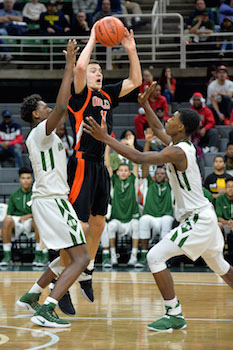 Ludington (25-3) led by as many as eight, taking a 15-7 lead in the second quarter. But a Weems 3 sparked a 16-4 New Haven run to end the first half, giving the Rockets a 23-19 lead heading into the break. The game remained tight from there until the Rockets were able to break it open in the final four minutes of the fourth quarter.
“We started off and nobody was hitting shots,” Weems said. “I just looked at (Williams) and was like, ‘He’s not in it yet,’ so I hit the shot and was like, ‘I have to hit this and let him know I have his back.’
“We started hitting shots and started going on runs, then they started going on runs. In the second half, we just took off, started playing hard, started pressuring them and got them out of their comfort zone.”
For France, a New Haven graduate, bringing home a Class B title was extra special.
“It just means a lot – you could see all the fans here – it just means so much to our school, to our town, the Village of New Haven,” France said. “This sport here is what a lot of people live through. I had a family that’s been coming to the games the last two years – they were sick, the wife is dying. He said they come to watch these kids play, and when they come they don’t feel pain, they don’t feel stress. For that hour and a half, they’re just there to watch these kids play, and it brings so much pride to them.
“Like I tell (the players), you’re not just playing for yourselves, you’re playing for more than just you, and these kids get that.”
Ludington’s season ended with its first trip to an MHSAA championship game since 1953, and one night after a buzzer-beating overtime win against River Rouge.
“It’s pretty cool to know that we made history and this team will probably never be forgotten,” Hackert said. “It’s a huge accomplishment. It’s just awesome, and we’ll never forget it.”
PHOTOS: (Top) New Haven’s Romeo Weems (23) and Ashton Sherrell (3) help surround a Ludington ballhandler during Saturday’s Class B Final. (Middle) Ludington’s Joshua Laman looks for an open teammate while being doubled by Rockets defenders.
Next Generation Chargers Make C Final
March 23, 2017
By Geoff Kimmerly
Second Half editor
EAST LANSING – Carson Meulenberg and Trenton Koole had never played a game of this magnitude before taking the Breslin Center floor Thursday.
But their dads had, and perhaps indirectly that provided them a little experience. At least it seemed like it.
Covenant Christian didn’t seem bothered by any of the usual anxieties teams face when they play during the final weekend for the first time. The Chargers – in an MHSAA Semifinal for the first time since winning Class D in 1994 – got ahead early and never slowed in downing Manton 62-35 to earn a spot in Saturday’s Class C championship game.
Koole’s dad Scott played on that 1994 team that beat Eben Junction Superior Central 79-70 in the championship game. Scott Koole also played with Dave Meulenberg on the 1993 team that beat Muskegon Western Michigan Christian 53-42 to win the Class D title that season as well.
“To just stay calm, keep your composure, play your best,” Carson Meulenberg recalled of the advice his father gave him before Thursday. “Don’t worry about a lot of things. A lot of it is worrying about nothing, so just go play your game.”
And Covenant Christian’s game this season frequently has focused on defense, which was lockdown against the Rangers and will be especially key in Saturday's 4:30 p.m. Final against Flint Beecher.
Koole blocked Manton’s first shot of the game, and Covenant Christian had three blocks during the first five minutes. The Rangers still hung in to trail only 11-7 at the end of the first quarter, but the Chargers (21-5) scored the first 19 points of the second and never led again by fewer than 20.
They held usually sharp-shooting Manton (21-5) to 22 percent success from the floor, including 16 percent from 3-point range.
“Finally,” Calvin Christian coach Tyler Schimmel said. “To be honest, since the first District game, we haven’t played that well. I told the guys before (this) game, you’re due for one, especially defensively.
 “This year, we actually have (had games like this). That’s why I kept telling my guys they’re a good team. They’re capable of doing those types of things.”
Koole led Covenant Christian with a game-high 14 points and eight rebounds, and Meulenberg and junior forward Zach Kaptein both had 10 points. Senior guard Benji Kuiper had six points, seven rebounds, six assists and five steals, and junior Tyler Cammenga had nine points and seven rebounds.
Manton’s top three scorers this season were juniors and sophomores; junior Jayden Perry led again with 13 points, and junior Hunter Ruell had eight points.
“On film, we knew they were going to be athletic just by watching them,” Manton coach Ryan Hiller said. “Once they started getting offensive boards, and the transition game, and I don’t know how many shots they blocked that first half … through the first five minutes, we saw a trend there, and we had to adapt the things we normally do, and we struggled there.”
Manton was playing in its first Semifinal since 1996. The Rangers had been eliminated in the District Finals the last three seasons, losing those games by a combined seven points.
Covenant Christian is riding a streak of 14 wins in 15 games, and now has some bragging rights at home in addition to Saturday’s opportunity.
“He talks about it all the time to me, brags and says he made it this far,” Koole said of his dad's Finals memories. “Now I can go back to him and tell him I did the same thing.”
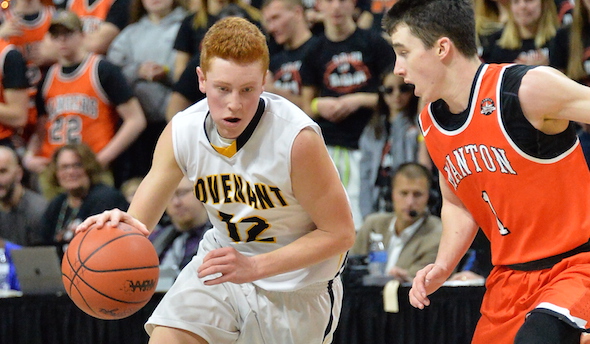
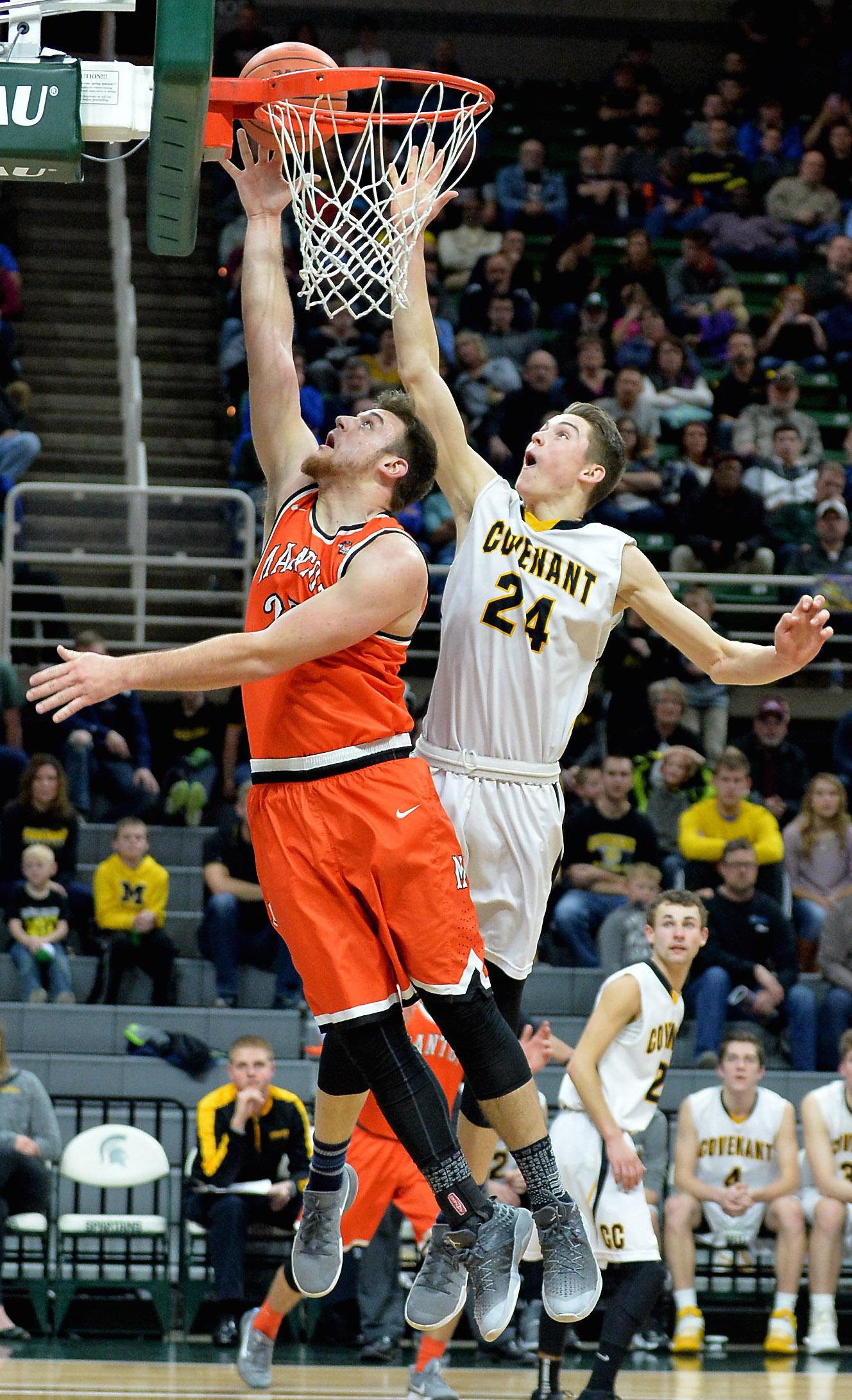
PHOTOS: (Top) Covenant Christian’s Benji Kuiper (12) works to get around Manton’s Jayden Perry during Thursday’s Semifinal. (Middle) The Rangers’ Wyatt Baker gets up a shot with the Chargers’ Carson Meulenberg (24) defending.