

Next Generation Chargers Make C Final
March 23, 2017
By Geoff Kimmerly
Second Half editor
EAST LANSING – Carson Meulenberg and Trenton Koole had never played a game of this magnitude before taking the Breslin Center floor Thursday.
But their dads had, and perhaps indirectly that provided them a little experience. At least it seemed like it.
Covenant Christian didn’t seem bothered by any of the usual anxieties teams face when they play during the final weekend for the first time. The Chargers – in an MHSAA Semifinal for the first time since winning Class D in 1994 – got ahead early and never slowed in downing Manton 62-35 to earn a spot in Saturday’s Class C championship game.
Koole’s dad Scott played on that 1994 team that beat Eben Junction Superior Central 79-70 in the championship game. Scott Koole also played with Dave Meulenberg on the 1993 team that beat Muskegon Western Michigan Christian 53-42 to win the Class D title that season as well.
“To just stay calm, keep your composure, play your best,” Carson Meulenberg recalled of the advice his father gave him before Thursday. “Don’t worry about a lot of things. A lot of it is worrying about nothing, so just go play your game.”
And Covenant Christian’s game this season frequently has focused on defense, which was lockdown against the Rangers and will be especially key in Saturday's 4:30 p.m. Final against Flint Beecher.
Koole blocked Manton’s first shot of the game, and Covenant Christian had three blocks during the first five minutes. The Rangers still hung in to trail only 11-7 at the end of the first quarter, but the Chargers (21-5) scored the first 19 points of the second and never led again by fewer than 20.
They held usually sharp-shooting Manton (21-5) to 22 percent success from the floor, including 16 percent from 3-point range.
“Finally,” Calvin Christian coach Tyler Schimmel said. “To be honest, since the first District game, we haven’t played that well. I told the guys before (this) game, you’re due for one, especially defensively.
 “This year, we actually have (had games like this). That’s why I kept telling my guys they’re a good team. They’re capable of doing those types of things.”
Koole led Covenant Christian with a game-high 14 points and eight rebounds, and Meulenberg and junior forward Zach Kaptein both had 10 points. Senior guard Benji Kuiper had six points, seven rebounds, six assists and five steals, and junior Tyler Cammenga had nine points and seven rebounds.
Manton’s top three scorers this season were juniors and sophomores; junior Jayden Perry led again with 13 points, and junior Hunter Ruell had eight points.
“On film, we knew they were going to be athletic just by watching them,” Manton coach Ryan Hiller said. “Once they started getting offensive boards, and the transition game, and I don’t know how many shots they blocked that first half … through the first five minutes, we saw a trend there, and we had to adapt the things we normally do, and we struggled there.”
Manton was playing in its first Semifinal since 1996. The Rangers had been eliminated in the District Finals the last three seasons, losing those games by a combined seven points.
Covenant Christian is riding a streak of 14 wins in 15 games, and now has some bragging rights at home in addition to Saturday’s opportunity.
“He talks about it all the time to me, brags and says he made it this far,” Koole said of his dad's Finals memories. “Now I can go back to him and tell him I did the same thing.”
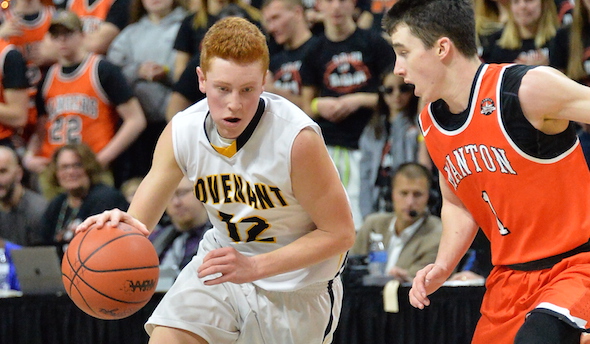
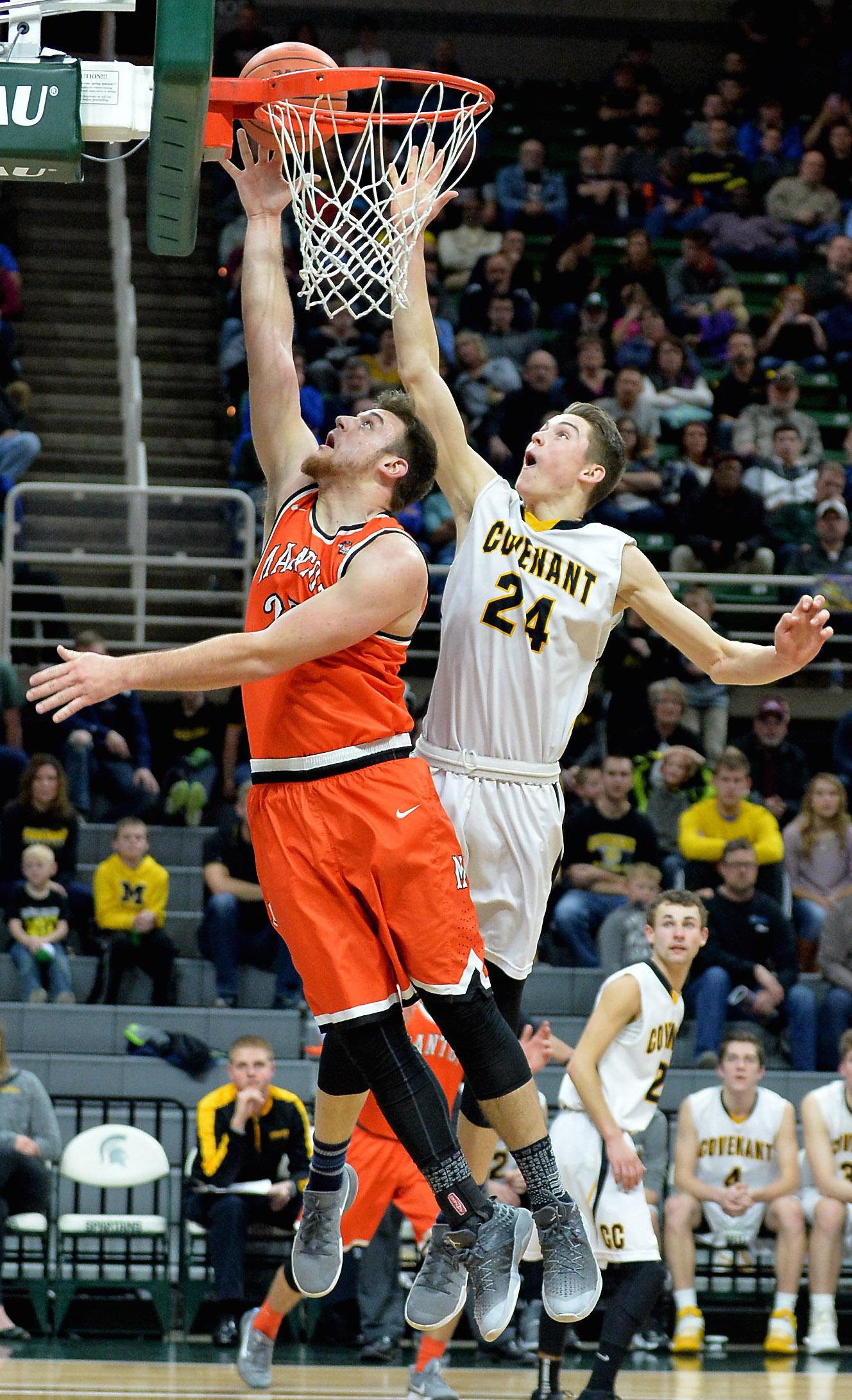
PHOTOS: (Top) Covenant Christian’s Benji Kuiper (12) works to get around Manton’s Jayden Perry during Thursday’s Semifinal. (Middle) The Rangers’ Wyatt Baker gets up a shot with the Chargers’ Carson Meulenberg (24) defending.
Breslin Bound: Boys Report Week 2
December 20, 2012
By Geoff Kimmerly
Second Half editor
As with football during the fall, Second Half tries to hit all classes and all corners of the state for these weekly boys and girls basketball reports.
But sometimes, focusing on the powers in Class A and B is simply unavoidable.
Most of this week's 10 notable performances came from some of our biggest and best-known schools. (Results and records based on those reported to Score Center at MHSAA.com)
1. Warren DeLaSalle (3-0) – The Pilots have been the Detroit Catholic League team to beat for half a decade, and that could continue this winter. DeLaSalle beat Farmington Hills Harrison 64-50 before edging Class B power Grand Rapids Christian 77-76 in double overtime.
2. Gibraltar Carlson (2-0) – The Marauders’ 70-53 win over Saginaw Buena Vista might not have earned the biggest headline from Saturday’s Metro Detroit Saginaw Valley Challenge at West Bloomfield. But given Buena Vista’s rich tradition, it was still intriguing – although Carlson is coming off a run to its Regional Final too.
3. Romulus (2-1) – I hope to avoid repeating teams on this list from week to week. But Romulus beating reigning two-time Class B champion Lansing Sexton 67-52 makes the Eagles a must again.
4. Grand Rapids Christian (1-3) – It’s been a tough go for these Eagles, who are expected to contend in Class B. But despite finishing the week with that close loss to DeLaSalle, they did beat reigning Class A runner-up Rockford 48-39 earlier on.
5. Rockford (1-2) – The Rams also opened with a couple of losses, but finished the week with a 63-53 win over Muskegon – which made this list last week and is considered a possible contender this season.
6. Bessmer (5-0) – After going 10-11 in 2011-12, Bessemer is halfway to matching that win total. Last week’s were close ones – 50-48 over Hurley, Wis., and 55-51 over Ironwood.
7. Lansing Eastern (2-1) – The Quakers have had three Division I college prospects graduate or move to schools out of state over the last two years, but keep rolling. They picked up solid wins over Williamston (68-58) and East Lansing (55-50).
8. East Jackson (4-0) – The Trojans are off to another nice start coming off a 15-win season. They opened last week beating Brooklyn Columbia Central 51-45 before doubling up Manchester 102-61 – after another high-scoring 100-94 win over Manchester a year ago.
9. Saginaw (4-0) – The reigning Class A champion is on the move again. After beating Midland 86-77 and then Saginaw Heritage 81-34, the Trojans came back Saturday to beat a strong Detroit Southeastern team 57-56 in the MDSV Challenge.
10. Flint Southwestern (3-1) – The Knights are already halfway to last season’s win total, thanks in part to victories last week over Flint Northwestern (63-59) and Flint Powers Catholic (70-39).
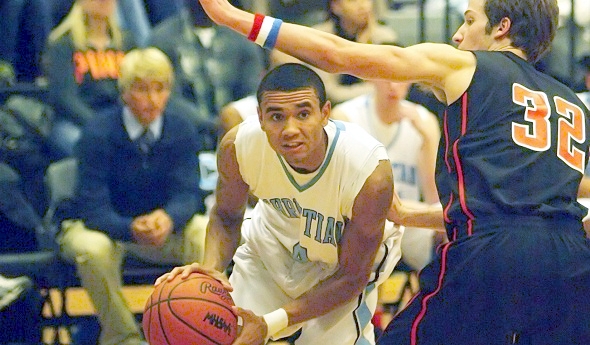
PHOTO: Grand Rapids Christian's Drake Harris attempts to drive around a Rockford defender during last week's win against the reigning Class A runner-up. (Click to see more at HighSchoolSportsScene.com.)