

No Need to Dazzle - Kent City Just Wins
March 8, 2018
By Tom Kendra
Special for Second Half
Kent City doesn’t have the star power or pizzazz normally associated with an undefeated basketball team.
 In fact, the most flashy thing about the Eagles is the loud pants worn each game by third-year head coach Dave Ingles – which were an especially gaudy half-pink and half-burgundy disaster that would have made Al Czervik from Caddyshack blush during Wednesday’s 48-38 District Semifinal win over Muskegon Western Michigan Christian at Ravenna.
“I lost a bet with the kids last year and had to wear pink pants for a game,” explained Ingles, who has guided Kent City to a 21-0 record and improbable No. 2 state ranking in Class C.
“Since then, it’s become a thing. If I wore khaki pants to a game, our crowd would boo me out of the gym. So now I spend half my coaching salary and half my time finding pants for each game.”
If nothing else, they bring a little shine to an otherwise throwback, working-class basketball team devoid of superstars that just finds a way to win every game with suffocating defense, outstanding shooting and unselfish team play.
The Eagles pulled another one out Wednesday against tradition-rich Western Michigan Christian, which slowed the game to a crawl and led 15-12 at halftime. It looked like a monumental upset might be in the works as Kent City was stone cold from the field, and its standout backcourt duo of senior Fraser Wilson and sophomore Eli Carlson was held scoreless in the first half.
 But just like they have all season, the Eagles stayed calm and found an answer.
This time it was a 10-0 run to start the second half, keyed by three steals on the defensive end and a pair of 3-pointers by Carlson, which turned the game around. KC then sealed the win by knocking down 14 of 16 free throws in the final 2:05.
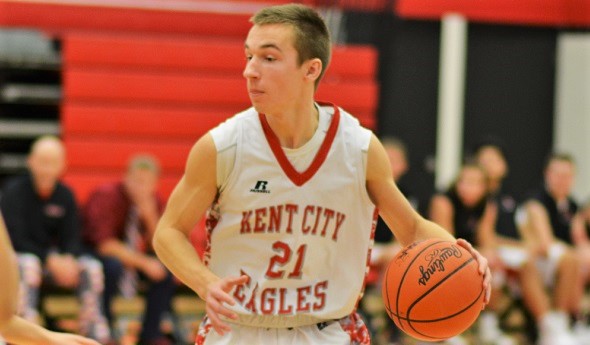
“We definitely don’t panic or yell and scream at each other,” explained Wilson, who averages 14 points per game and shoots nearly 50 percent from 3-point range. “Our shots weren’t falling, but we stayed calm. We believe in each other.”
Kent City repeated as champion of the Central State Activities Association Silver, which isn’t known as a basketball-rich conference. More impressive is the Eagles won all 10 of their nonconference games, with nine of those 10 wins coming against Class A or Class B opponents.
Ingles points to his team’s 49-44 win Feb. 3 over Class A Grand Rapids Kenowa Hills, a game played in an arena environment at the DeltaPlex before a Grand Rapids Drive game, as a key to the season. The Eagles had to rally for that victory to get to 14-0, and ever since have experienced tournament-like pressure to get to 20-0.
Since they have been dealing with the extra scrutiny and the focus on winning every game for more than a month, Carlson said the team is more prepared for March Madness.
“The pressure was getting that 20-0,” explained Carlson, who also averages 14 points and shoots better than 50 percent from the floor. “Now, we were 0-0. Everyone is 0-0, starting a new season. We don’t take it as pressure.”
The question now is how high can the Eagles fly?
Kent City will be shooting for its 13th District championship since 1950 on Friday when it takes on West Michigan Conference champion North Muskegon at 6 p.m. at Ravenna. A victory there would vault the Eagles into the MHSAA Class C Regional tournament at Beal City next week.
The Eagles have won only one Regional title since 1950, in 2004, when they made it all the way to the Class C semifinals at Michigan State University before losing to Charlevoix.
 The program has steadily improved each year since Ingles took the reins prior to the 2015-2016 season. KC finished 13-8 in 2016 and 14-7 last year, getting knocked out of the tournament both years by Muskegon Heights Academy, which is now in Class D.
The team was expected to be good this season after losing just one regular contributor off last year’s conference champion, but no one expected a quantum leap to 20-0 and a lofty state ranking.
“It’s special what this team has been able to do,” said Inglis, who is assisted by Phil Stevens and Gabe Hall. “This is not a physically impressive team in any way, shape or form. Our success starts with defense and with nobody caring about their own stats. They just want to win.”
The guard duo of Wilson and Carlson, along with senior Jace Dailey, has provided the leadership all season long. Brendan Geers, a 6-foot-3 junior, is the closest thing the Eagles have to a big man and a workhorse inside. Hunter Nelson, Cody Bowers, Gavin Mead, Miguel Arechiga and sophomore call-up Max Hudson are also key contributors.
Another key factor pushing this unbeaten team along is a rabid fan base, which has been packing “The Nest” at home games all year and is following its team in “Hoosiers”-like fashion now that the MHSAA Tournament has begun. Kent City fans packed the parking lot and gymnasium at Ravenna well before Wednesday’s 5:30 p.m. tip-off and are expected to do the same for Friday’s showdown against North Muskegon.
“There is definitely a buzz more than normal around town,” said Wilson after Wednesday’s District win. “It’s fun to be a part of it. We’ve got our perfect regular season already; now we’ll just see how long we can keep it going.”
 Tom Kendra worked 23 years at The Muskegon Chronicle, including five as assistant sports editor and the final six as sports editor through 2011. E-mail him at [email protected] with story ideas for Muskegon, Oceana, Mason, Lake, Oceola, Mecosta and Newaygo counties.
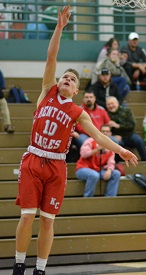
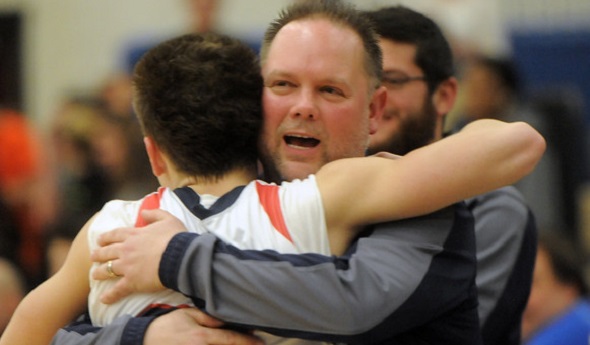
PHOTOS: (Top) Senior Fraser Wilson, who is shooting almost 50 percent from 3-point range this season, surveys the defense. (Middle) Sophomore Eli Carlson is only 5-5 but has come up big as a leading scorer for Kent City this season with 14 points per game. (Below) Third-year Kent City coach Dave Ingles wears the net after the Eagles completed a 20-0 regular season March 1 with a victory over visiting Kentwood Grand River Prep. (Photos courtesy of Kent City Basketball/Mary Wilson.)
Senior-Led Stevenson Makes Statement
By
Tom Markowski
Special for Second Half
March 22, 2016
STERLING HEIGHTS – Three times coach Rick Bye took Sterling Heights Stevenson to the MHSAA Finals in football.
 Since the mid-1980s few schools in the Metro Detroit area have a football program as successful as that at Stevenson. Since 1985, Stevenson has qualified for the football playoffs 20 times. Twelve times the Titans won 10 or more games. During one stretch they reached the Semifinals six consecutive seasons (1993-98).
The baseball program has thrived recently under coach Joe Emanuele. The Titans won the Division 1 title in 2005, reached the Semifinals twice (2011 and 2013) and went to the Quarterfinals in 2014.
But in boys basketball, the Titans have not been able to compete at nearly as high a level as football and baseball. Before this season, Stevenson had one Regional title.
Now it has two.
Stevenson (20-4) defeated Roseville, 60-44, last Wednesday in a Class A Regional Final. The Titans will face North Farmington (22-2) in tonight’s 7 p.m. Quarterfinal at Calihan Hall at the University of Detroit Mercy.
Perhaps we should have seen this coming. Coach Mark LaCombe is in his third season, and the Titans have shown improvement each winter. They were 13-8 in 2013-14 and 16-5 last season, a finish that included a Macomb Area Conference White title.
But first-round knockouts in the MHSAA Tournament didn’t sit well with the five seniors who start for LaCombe this season.
Luke Lamoreaux, a 5-foot-9 point guard and a three-year starter, is one of four returning from last season’s lineup. He was the captain on the soccer team in the fall and is the leader of this team. Lamoreaux said the difference between last season and the team this season is experience.
“We’ve gotten stronger in the weight room,” he said. “We hit the weight room a lot.
“It’s a lot of hard work. Plus it’s a senior-led team. We played a lot of tough teams in the summer. And we played a tough nonconference schedule. We played (Macomb) Dakota. We had a 15-point lead and lost in overtime. We said if we can play with the No. 2-ranked team, we can play with anybody. We’d like another shot.
“We’ve always been a good football school. We’ve wanted to make our mark in basketball. What we’re doing now is we’re making a statement with this run.”
Stevenson isn’t a tall team. Its tallest starter is Stacy Howard at 6-2. LaCombe uses a four-guard lineup and generally subs two to three off the bench. Jahi Hinson (6-3) is one of those reserves, and he’s the lone junior in the rotation.
 “We’re undersized,” LaCombe said. “The kids play harder than anyone we play. The kids that play, play at a high level.”
Three players, including Lamoreaux, average between 11 and 12 points. Mylon Weathers (6-0) and Vince Ramachi (6-1) averaged 12 points apiece, Lamoreaux 11.5. Lamoreaux has stepped up his game in the tournament. He’s averaging 15.5 in four tournament games.
“The basket looks really big to him now,” LaCombe said. “He’s getting a name for himself. He plays well on the big stage.”
Weathers is the team’s top defender and will guard the opposition’s top scoring guard. In a District Semifinal, he held Clinton Township Chippewa Valley senior Steven Lloyd to 11 points, 10 below Lloyd’s average.
Stevenson hasn’t received much publicity this season for obvious reasons. LaCombe knows a team has to earn respect, and he said that’s what his team has done. The MAC White isn’t a strong basketball division, and to prepare his team for a long run LaCombe scheduled nonleague games against Rockford, Detroit Western International, Rochester Adams, Warren DeLaSalle and Detroit Country Day. Stevenson’s four losses were to teams that won District titles.
“We weren’t quite ready last year,” he said. “Defensively they’ve executed as well as a coach could ask for. They’ve made adjustments. We trap a lot.
“The brackets were set up perfectly for us. A lot of times you set goals for the season: a league and district titles. That wouldn’t have been good enough for this group. I don’t think we’ll have a group like this come out of Stevenson for a long time.”
 Tom Markowski is a columnist and directs website coverage for the State Champs! Sports Network. He previously covered primarily high school sports for the The Detroit News from 1984-2014, focusing on the Detroit area and contributing to statewide coverage of football and basketball. Contact him at [email protected] with story ideas for Oakland, Macomb and Wayne counties.
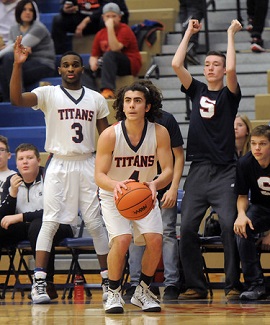
PHOTOS: (Top) Luke Lamoreaux and assistant coach Bill Szlaga share a celebratory embrace during Stevenson's Quarterfinal run. (Middle) Stacy Howard (3) prepares to signal a 3-pointer as teammate Austin Beba launches the shot. (Photos courtesy of the Sterling Heights Stevenson boys basketball program.)