

North Central Powers to D Title Game
March 26, 2015
By Geoff Kimmerly
Second Half editor
EAST LANSING – Powers North Central can play too fast. That’s what happened the last time the Jets came to Breslin Center, at the end of 2012-13.
But few teams have been able to slow them down when their clicking like they did during Thursday’s final Class D Semifinal.
North Central’s high-octane offense burned from the start en route to earning the team’s first MHSAA championship game berth since 1984 with a 71-46 win over Fulton.
The top-ranked Jets, averaging nearly 72 points per game entering the weekend, nearly hit that mark after opening on a 29-4 run that stretched more than two minutes into the second quarter. They scored only 36 points total in their last trip to Breslin, a Semifinal loss to Wyoming Tri-unity Christian two seasons ago.
“Me personally, I just learned last time we played here that we played too fast, and we were kinda nervous,” said senior Rob Granquist, also a starter as a sophomore and the team’s leading scorer in that loss. “We didn’t get our shots we wanted. But tonight we just played our game that we’ve played all year, and it worked out great for us.”
North Central (26-0) will take on Morenci in the 10 a.m. Class D Final on Saturday, seeking the second MHSAA title in program history.
Coach Adam Mercier listed off Thursday a handful of lessons he learned during that 2013 trip downstate. He wanted to get more players on the floor this time – and 11 saw minutes. And he wanted his team to come out aggressively – and they fired 17 shots in the first quarter, making nine.
 “Two years ago we came down here and we were a little awestruck, and we played pretty tentatively,” Mercier said. “What we talked about Thursday is being the aggressor, not coming out soft. We wanted to take some shots and see what happens.
“We felt whoever could throw the first punch early would have a slight advantage. … We were able to get that first punch, and it was a big punch.”
Shooting has been the strength of a Fulton team with more than 200 3-pointers this winter. But North Central – with three starters 6-foot-4 or taller – had a few inches on most of Fulton’s top players and pushed the Pirates to take some deeper shots than they likely wanted.
Fulton (21-5) made only 29 percent of their shots from the floor and just five of 24 tries from 3-point range. North Central’s size also played to a 45-35 rebounding advantage and a 40-18 edge in points scored in the paint.
“We started settling for shots early, and it just kinda snowballed as they hit some shots. And then it felt like we had to hit some 3s,” Fulton coach Todd Walden said. “That’s tough against a team that’s that good when they’re going to get a good look every possession, and when they happen to miss they’re going to battle on the boards.”
Junior guard Colton Antes was a bright spot for Fultonfrom the perimeter, making 5 of 11 shots and three 3-pointers for 15 points.
Granquist had 14 points and seven rebounds and junior center Morgan Cox came off the bench for 12 and six, respectively, for the Jets. But the most impressive performance of the day’s four Semifinals arguably came from sophomore guard Jason Whitens, who had 16 points, nine rebounds and nine assists in only 23 minutes.
Mercier mentioned how Whitens' dad is a fan of Magic Johnson, and how the 6-4 forward has patterned his game on a player he’s seen only on replay. Jason Whitens averaged 16.4 points, 6.7 rebounds and 6.1 assists per game entering this week.
“That’s what we expect out of him. It’s hard to say as a sophomore. (But) more importantly, that’s what he expects out of himself,” Mercier said. “He’s a very confident player, but at the same time he’s very humble. He could put up 20 shots a game and I’m sure score mid-20s if he wanted to, but he’s the type of player that makes other players around him better by his ability to pass it, defend and rebound.
“We expect the same thing out of him Saturday. No pressure.”
Click for the full box score and video from the postgame press conference.
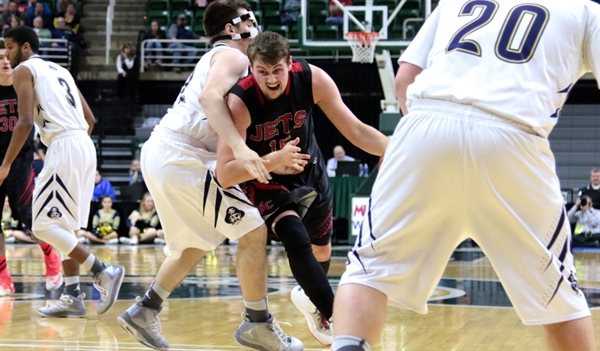
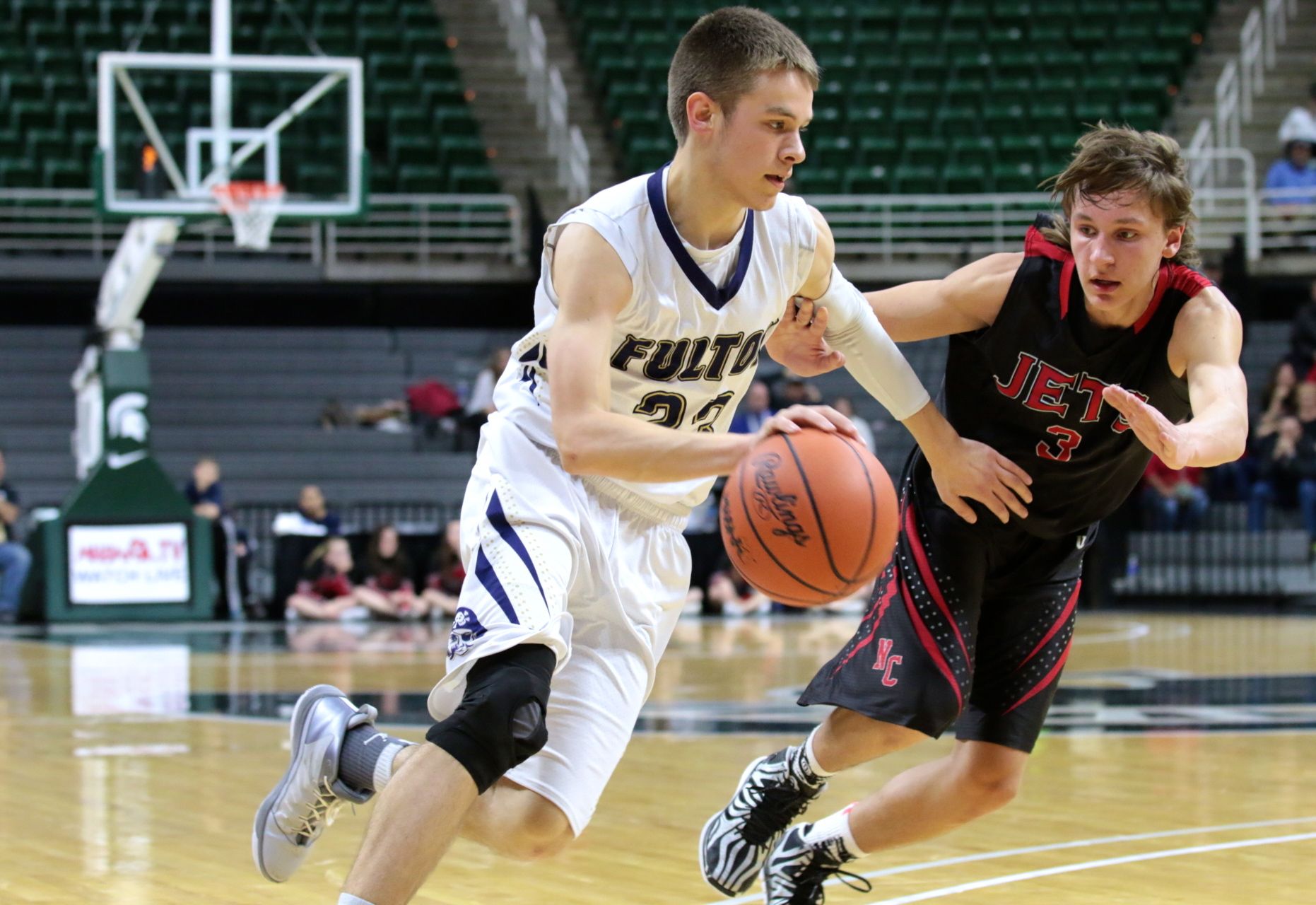
PHOTOS: (Top) Powers North Central’s Rob Granquist breaks past a defender during Thursday’s Class D Semifinal. (Middle) Fulton’s Kaleb Brunner (33) works to drive past North Central’s Marcus Krachinski.
Clarkston Earns 1st Shot at Dream Finish
March 24, 2017
By Geoff Kimmerly
Second Half editor
EAST LANSING – Dan Fife dreamed of playing for an MHSAA basketball championship at Jenison Field House while a student at Clarkston 50 years ago.
Thursday afternoon, the current Wolves made similar dreams come true – and offered their coach that opportunity he never was able to achieve as a player.
Clarkston’s 78-35 win over league rival West Bloomfield in Friday’s first Class A Semifinal earned the program its first appearance in an MHSAA boys basketball championship game.
The Wolves have had piles of success under Fife, the fourth winningest coach in state hoops history with 676 wins since taking over the program before the 1982-83 season. He’s led Clarkston to 30 District and 12 Regional titles, with Friday’s Semifinal the second during his tenure.
“Coach Fife, I don’t think he’ll admit how much it means to him. But it’s everyone’s goal at the beginning of every season; your ultimate goal is to finish out with a win,” Clarkston junior guard Foster Loyer said. “For Coach Fife, and the community of Clarkston, that would just mean the world to all of us, just motivate us to keep working even more.”
Clarkston (26-1), which entered the postseason tied for No. 3 in The Associated Press’ final regular-season Class A poll, will finish this season against Grand Rapids Christian at noon Saturday at the Breslin Center.
The Semifinal was the third ever in Wolves history. And the rare opportunity to advance to Saturday came with an even rarer opportunity to face a familiar opponent in this late round of the tournament.
Clarkston had beaten West Bloomfield (17-9) by 11 and seven during the regular season on the way to winning the Oakland Activities Association Red championship; the Lakers tied for third in the league.
And they knew what to expect from Loyer, a junior already committed to play at Michigan State. But it didn’t help much this time.
 Loyer’s first shot of the game, an attempted layup, sailed over the rim. His second shot, a 3-pointer, touched nothing but net.
Making 10 of 17 shots from the floor and 5 of 8 3-pointers, Loyer finished with 32 points, to go with seven assists. Senior forward Dylan Alderson added 27 points, and sophomore center Taylor Currie had 10 points and 16 rebounds as Clarkston hit 57 percent of its shots from the floor – including an incredible 69 percent during a first quarter that ended with the Wolves carrying a 24-13 lead.
Clarkston took an 18-point advantage into halftime.
Senior guard Kevin McAdoo led the Lakers with 22 points, but as a team they made only 22 percent of their shots from the floor, and had just one steal as Clarkston had only four turnovers but 17 assists.
“It’s a tough one to swallow today, especially with the ride we were on to get here,” said seventh-year West Bloomfield coach Jeremy Denha. “What a fun, fun time to get here with the ups and downs and the way the kids battled. We hadn’t sniffed a District Final, let alone a District title, since I’d been here – we hadn’t won one since 2003. For us to make this magical run, get to Breslin, play Clarkston a third time … yeah, the outcome is disappointing, but it’s about the journey too.”
Fife has been on a lot of these trips. So he'd likely quickly agree with his OAA colleague. And especially with how this journey has a chance to end for the first time.
“I’m not worried about what it means to me. I have an expectation; I’ve always had one no matter what I’m doing. If I’m playing something, I’m going to compete,” Fife said. “The reality is, I dreamed of playing in the state championship when I was in high school. I wanted to get to Jenison. That was always my dream, and I’m just trying to instill in the kids to have the same dream – to play basketball and get to this point. They’ll remember this day the rest of their lives, and tomorrow’s game, regardless of what happens.”
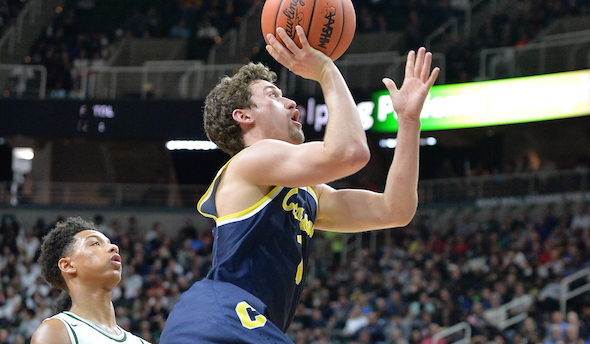
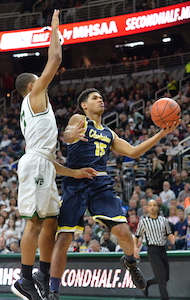
PHOTOS: (Top) Clarkston’s Foster Loyer breaks past West Bloomfield defenders to get a shot up during Friday’s first Class A Semifinal. (Middle) The Wolves’ Tieler Houston (15) gets position on West Bloomfield’s Daniel Wrack.