

'Up North' Powers Add Intrigue in Class D
March 2, 2018
By Dennis Chase
Special for Second Half
TRAVERSE CITY - Can regular-season perfection lead to postseason hardware for the Hillman Tigers?
 Will this be the last March Madness hurrah for Frankfort coach Reggie Manville?
Can Buckley, which just pulled off a rare feat, recapture the magic of last season?
Those are three of the intriguing Class D boys basketball storylines in the northern Lower Peninsula as MHSAA tournament play begins next week.
Hillman
It’s been quite a ride for coach Eric Muszynski and his Hillman Tigers.
With a win at Rudyard tonight, Hillman can clinch its second 20-0 regular season in three years.
The Tigers went 20-0 in 2015-16 and nearly equaled that feat last season before suffering a last-second setback to Lincoln Alcona in the regular-season finale.
“A banked, 3-point shot at the buzzer,” Muszynski said, recalling the 65-62 loss.
That defeat snapped Hillman’s 57-game regular season and North Star League win streaks and 43-game home win streak.
How did the Tigers respond? Well, they’ve started new streaks.
With the girls finishing the regular season 19-1, the two squads posted the best combined record among all schools in the state.
“Exciting basketball, exciting times in Hillman,” Muszynski said.
 But the girls campaign came to a sudden end Wednesday in a two-point district loss to Rogers City, a team the Tigers beat twice during the regular season.
Now it’s left to the boys to carry the torch.
The fact this team is on another run comes as no surprise. Muszynski returned four starters, plus sixth man Jared Juergens off a 24-2 team.
Four players average in double figures - Juergens (14.8), point guard Brandon Banks (14.2), forward Andrew Funk (10.7) and 6-foot-4 center Kory Henigan (10.1). The fifth starter, forward Billy Kolcan, is the jack of all trades, averaging 7.5 points and a team-leading 4.2 assists and four steals per game. Funk is a 41 percent 3-point shooter.
Henigan is the only junior.
The girls team also featured a senior-laden lineup. Coach John Kuzewski started four seniors and had six contribute – point guard and scoring leader Lyndsey Ryba, Eve LaFleche, Andrea Taratuta, Kristin Kenyon, Jozie Appelgren and Autumn Jones. Ryba, who averaged 17 points a game, signed with Concordia to play basketball and softball. Brooke Jones was the only junior in the starting lineup.
“The girls played as a team and played with a common goal,” Kuzewski said. “I think the two teams pushed each other to do their best.”
Kuzewski just finished his 12th season as head coach. He replaced Muszynski, who stayed on as the boys coach when the girls season switched to winter.
Muszynski is now in his 13th season with the boys. His teams have taken it to a new level the last five years, sporting a 109-7 record. The Tigers reached the Quarterfinals in 2015 and 2017, but ran into three-time Class D champion Powers North Central.
Muszynski is pulling double duty this winter. He also coaches the school’s third and fourth graders. His oldest son, Ty, is a third-grader.
“I’m coaching at our lowest and highest levels,” he said, laughing. “I’m going from breaking presses and running 50 different sets to teaching kids how to dribble and shoot.
“It’s been really refreshing, honestly. For me as a coach, it’s so rewarding because it allows me to go back to an age when I fell in love with the game. It’s been rejuvenating to go back to square one. I’ve even brought my (varsity) players to the (youth) practices to remind them of what it was like when they fell in love with it, too.
“And the young kids really look up to the older guys. It allows them to dream big.”
If Hillman wins its District, the Tigers would play in a regional at Traverse City Central – instead of going north as in previous years. It’s possible Hillman could face Frankfort in a Regional opener.
“They’re really good,” Muszynski said. “That league (Northwest) is such a grind every night.”
First things first, however.
The boys might be reminded about what happened to the girls this week. Hillman’s District opener is at – you guessed it – Rogers City.
Frankfort
And speaking of Frankfort, Manville is not saying publicly if this will be his last season as head coach.
“I’m still debating,” the 71-year-old insisted. “I’ll wait until the end of the season to make a decision. It’s been a fun season.”
Manville’s coached 32 years, including the last seven at Frankfort, where he’s changed the culture. After Thursday night’s 51-31 win over Onekama, Manville is 128-38 at the Northwest Conference school. His teams have won five Districts, three Regionals and three league titles, sharing the Northwest this season with Maple City Glen Lake and Buckley.
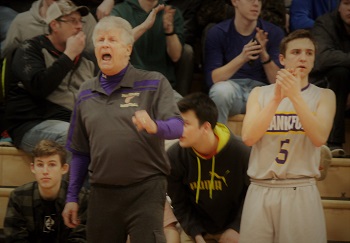 Manville spent most of his coaching career in Flint. He started as an assistant at Flint Northern in 1978, the year the Vikings won the Class A title. He would later coach Flint Southwestern for 13 seasons. His last team, featuring Mr. Basketball runner-up Charlie Bell, was ranked No. 1 in the state after the regular season.
“In Charlie’s senior year we won the Saginaw Valley (League) championship and the Flint city championship,” Manville said. “That was the first time the school had ever done that.
“That (mid-1990s) was the era of the Flintstones. There was some really tremendous basketball (played) back then in Flint.”
After that 1996-97 campaign, Manville, who had his 30 years of teaching in, retired to the Lake Michigan community of Elberta, which flanks Frankfort on Betsie Bay.
“I’m an avid fisherman,” Manville said. “I have a cottage on the Au Sable River in Grayling, where I fly fish almost all summer. Here (on Lake Michigan), I love to fish steelhead salmon. That’s what basically brought me (north) – the fishing.
“I’m either in waders or I have a whistle around my neck.”
Manville, who served as village president in Elberta for four years, has had his health issues. He’s had three heart attacks.
“I feel good right now,” he said. “I’m just getting old, that’s all. I turn 72 in June.”
This has been one of the most competitive Northwest Conference races in history. Frankfort lost twice to Glen Lake, Glen Lake lost twice to Buckley and Buckley lost twice to Frankfort.
“Go figure,” Buckley coach Blair Moss said.
Frankfort (18-2) boasts a veteran cast with five seniors in the starting lineup and two others in the rotation. Jaylon Rogers and Matt Loney, who played on varsity as freshmen, are the scoring leaders; Rogers is over 1,200 career points, Loney is closing in on 1,000.
Griffin Kelly and Matt Stefanski - who signed to play football at Northern Michigan and Grand Valley State, respectively – are key cogs as well. Kirk Meyers, the quarterback on Frankfort’s team which reached the Division 8 Regional Finals, rounds out the starting five.
“We’re talented,” Manville said. “We’ve talked about potential the whole year. Potential is great, but it’s like I’ve always said, it’s the championships you win (that define your legacy). Sometimes, talent doesn’t always win.”
The Panthers’ championship quest started Thursday night at Onekama, a team that came into that contest with five losses – two to Buckley, two to Glen Lake and one to Frankfort.
“Onekama’s a really good team,” Manville said. “There’s a misconception our league is weak (after the top three teams). It’s not.”
Frankfort, meanwhile, has proven itself outside the league, too. A month ago, the Panthers snapped McBain’s 59-game regular-season win streak. McBain was ranked No. 1 in The Associated Press’ Class C poll at the time. Back in December, Frankfort edged Traverse City St. Francis, which went on to run the table in the Lake Michigan Conference.
Manville said the team’s goal is to win at least 23 games, which would set a school record. And 23 wins would put the Panthers in the Quarterfinals, a win away from the coveted Final Four. Frankfort reached the Semifinals in 2014.
“It remains to be seen what teams (in the Northwest Conference) are peaking and have a chance to make that run to the Breslin because everybody wants to get to the Final Four,” Manville said. “That’s the big deal.”
But there are no givens.
A year ago, Frankfort had its five-year District title streak end with a two-point loss to Suttons Bay.
And if the Panthers claim a District next week, there’s a potential showdown with unbeaten Hillman in the Regional opener.
“That would be a doozy,” Manville said.
Buckley
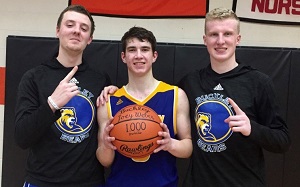
When Joey Weber went over 1,000 career points last week in a win over Kingsley, he became the third Buckley senior to accomplish that feat.
Turns out, that appears to be quite rare.
 “I’ve never heard of anything like that,” Bears coach Blair Moss said. “You get one, you might get two, but three? That’s crazy.
“I don’t know where you would look (to find out), but I don’t think it’s happened often.”
Glen Lake’s Don Miller, who has been coaching high school basketball since the early 1970s, agreed.
When asked if he could recall it happening previously, Miller responded, “Three in the same class? No.”
Denver Cade and Austin Harris had earlier eclipsed the milestone at Buckley. Cade was the school’s all-time leader with 1,704 points heading into Thursday’s game at Suttons Bay, a 95-75 win. Harris was at 1,417, Weber 1,020.
“When it’s all said and done, they’ll probably be around 4,500 points amongst the three,” Moss said.
Miller had three players on the same team surpass 1,000 career points – Mark Swierad, Rich Baillergeon and Geof Kotila in the 1970s - but Swierad was in a different graduating class.
In fact, Baillergeon (2,144) and Kotila (1,639), Miller said, once had the state record for most points by two classmates before it was broken by Saginaw Buena Vista’s Mark Macon and Shawn Randolph.
Moss scored 1,558 in his playing days at Benzie Central. He graduated in 1974 before the 3-point line was introduced. He had a classmate, Tom Drobena, go over 1,300.
Buckley was on the other end of the 1,000-career point mark Tuesday night when Manton’s Hunter Ruell hit six 3-pointers en route to a 20-point performance in the Rangers’ 75-62 win over the Bears. Ruell’s last triple put him over 1,000.
Buckley finished the regular season 15-5 with Thursday’s win, a year after the Bears went 26-1 and finished runners-up to Powers North Central in Class D.
The Bears, who returned all five starters, started slowly, dropping two games before Christmas break.
“At the beginning of the year I thought we were a little complacent,” Moss said. “Our attitude was we’re just going to show up and win. I said, ‘Gentlemen, that’s not the way it works. What we did last year is last year.’
“We set the bar, and this year everybody was shooting for us. We got everybody’s best game.”
Buckley beefed up its schedule. The losses came against Kalamazoo Hackett, McBain and Manton – all Class C teams that finished the regular season 17-3 – and twice to Frankfort (18-2). The Bears beat Manton, a Class C semifinalist last March, earlier in the season and handed Class C Glen Lake (18-2) its only losses.
“It’s made us better,” Moss said of the schedule.
The Bears are battle-tested – and not just in basketball. This same group played a pivotal role as Buckley reached the Division 4 Semifinals in soccer last fall.
 Dennis Chase worked 32 years as a sportswriter at the Traverse City Record-Eagle, including as sports editor from 2000-14. He can be reached at [email protected] with story ideas for Manistee, Wexford, Missaukee, Roscommon, Ogemaw, Iosco, Alcona, Oscoda, Crawford, Kalkaska, Grand Traverse, Benzie, Leelanau, Antrim, Otsego, Montmorency, Alpena, Presque Isle, Cheboygan, Charlevoix and Emmet counties.
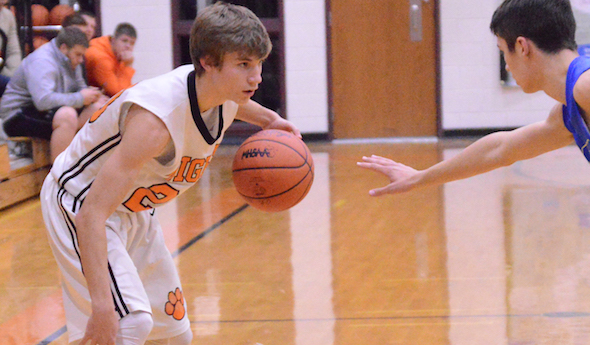
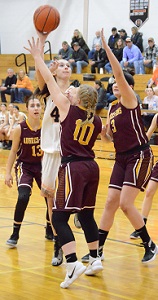
PHOTOS: (Top) Hillman’s Brandon Banks looks for an opening during a game this season. (Middle top) Hillman’s Kristin Kenyon puts up a shot over AuGres-Sims defenders. (Middle below) Frankfort coach Reggie Manville instructs his team during a game this season. (Below) Buckley’s 1,000 point scorers: Austin Harris, Joey Weber and Denver Cade. (Hillman photos courtesy of the Alpena News, Frankfort photo courtesy of Nicole Lamerson, Buckley photo courtesy of Ron Stremlow.)
All-Time Leading Scorer Allen Ready to Set Pace for Wayne Memorial's Title Pursuit
By
Keith Dunlap
Special for MHSAA.com
February 20, 2026
WAYNE — Jaylohn Allen insisted making such history wasn’t one of his goals when he started his varsity basketball career as a freshman.
 Given that, it made the moment all the more special last week.
During a game against Harvey Thornton (Ill.) on Valentine’s Day, Allen and the Wayne Memorial community loved seeing a 30-year-old record broken by Allen, who became the boys basketball program’s all-time leading scorer.
Allen surpassed the 1,748 career points scored by former Michigan State player Lorenzo Guess, who finished his career in 1996.
“To be the all-time leading scorer at Wayne Memorial High actually wasn’t one of my goals coming in as a freshman,” Allen said. “And honestly I didn’t really think I was going to pass it because 1,700 points is a lot of points, per se. To do that as a kid who grew up with many accomplishments and dreams I wanted to have was a joy. I thought 1,000 points was surreal, but the record meant so much more.”
Signed to play in college for Toledo, Allen certainly has meant a lot to Wayne Memorial over the past four years, and he hopes to make even more history for the Zebras over the next few weeks.
Allen is averaging nearly 23 points a game this season and is determined to try and get Wayne Memorial back to the Division 1 championship game, where it loss last year to East Lansing.
When the Zebras accepted the Finals runner-up trophy, they obviously had immediate reason for optimism given Allen and fellow backcourt mate Carlos Medlock – a Michigan State signee – were only juniors.
But Medlock threw a major wrinkle into Wayne Memorial’s title ambitions when he decided over the offseason to transfer to a prep school in Missouri.
“I found out maybe a week before he posted on social media,” Allen said of Medlock’s decision. “There were rumors about it, but I didn’t really think he was going to leave. It was a shock, but I was still ready to attack the senior season regardless of what happened and look forward to the senior season with or without him.”
Allen has certainly done that and more.
 Instead of pouting or looking to leave himself, Allen treated Medlock’s departure as a chance to prove he was a worthy Mr. Basketball Award candidate this winter.
Over the summer, he worked to get in terrific shape and continued to not only hone his on-court talents, but became an even more vocal leader to younger players coming back.
“It put me into a bigger role and let people see I can score the ball even more than I’ve been doing the past three years,” Allen said. “It put a fire in me and some motivation that I could be more of the man with the ball.”
One person not surprised that Allen adapted so well without Medlock was Wayne Memorial head coach Steve Brooks.
“He’s pretty much always been the man; he just hadn’t been the leading scorer all the time,” Brooks said.
Allen said there were adjustments playing without his running mate of the last three years, especially when trying to get out in transition.
“Being on the floor and not seeing (Medlock) on the other side of the court and being able to swing it to him — it was just a connection in transition or any other core set that we had,” Allen said. “(The adjustments were) just realizing he’s not on the court and having to utilize my other teammates and making sure they are getting everything they need.”
There was a major scare in December, just before the holiday break, when Allen left a game with a knee injury after he took a charge.
“We thought he was lost for the year,” Brooks said.
But the injury was only a bone bruise, and Allen missed just 13 days and has been an unstoppable force since.
To Brooks, it’s obvious who should be Mr. Basketball.
“Mr. Basketball traditionally is for what you’ve done for your career and not just for a season,” Brooks said. “Over his career, he’s at 19 points a game. Him and Medlock both had 1,000 career points before Christmas of their junior year.”
While Mr. Basketball would be nice and the scoring record is an honor, there is one main purpose for Allen, and that is to get another shot at the Division 1 title that eluded Wayne Memorial last year.
The Zebras enter tonight’s Kensington Lakes Activities Association championship game 18-3 and carrying a 10-game winning streak.
“I want them to get there more than me,” Allen said of his teammates. “I want them to show me how much they want to be there so when it comes down to it, we’re ready for it.”
 Keith Dunlap has served in Detroit-area sports media for more than two decades, including as a sportswriter at the Oakland Press from 2001-16 primarily covering high school sports but also college and professional teams. His bylines also have appeared in USA Today, the Washington Post, the Detroit Free Press, the Houston Chronicle and the Boston Globe. He served as the administrator for the Oakland Activities Association’s website from 2017-2020. Contact him at [email protected] with story ideas for Oakland, Macomb and Wayne counties.
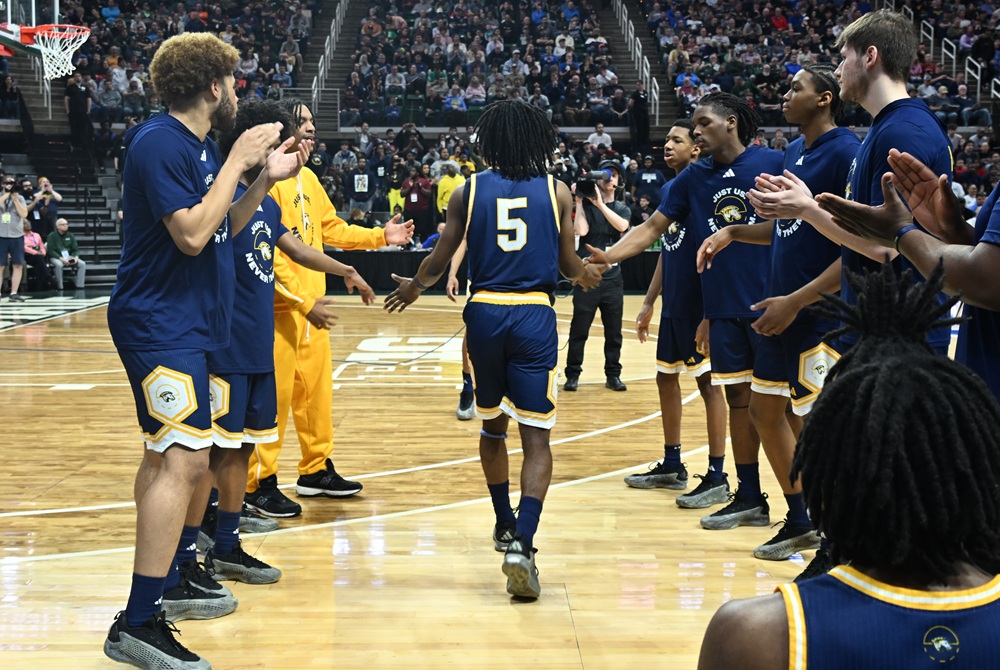
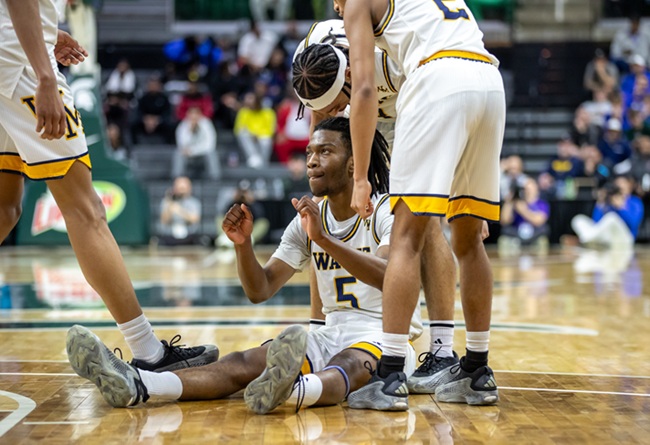
PHOTOS (Top) Wayne Memorial’s Jaylohn Allen (5) makes his way through his teammates during introductions before last season’s Division 1 Final at Breslin Center. (Middle) Teammates help Allen up from the floor during the Zebras’ Semifinal win.