

Performance: Alpena's Chris DeRocher
February 1, 2019
 Chris DeRocher
Alpena senior - Basketball
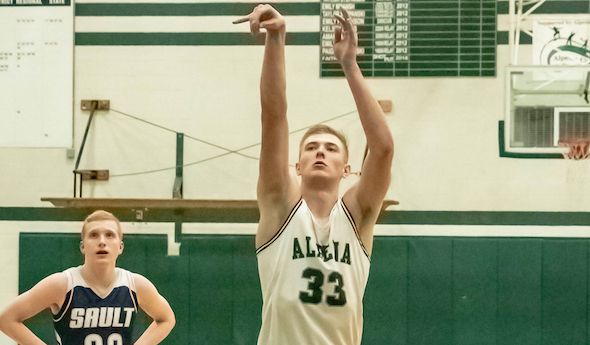
Alpena’s 6-foot-5 four-year varsity forward scored 29 points in last week’s 74-45 win over Sault Ste. Marie – and on the 29th point broke his school’s career scoring record on the way to earning the Michigan Army National Guard “Performance of the Week.”
DeRocher surpassed the record previously set in 1972 by Butch Feher, who went on to play at Vanderbilt University and for a season with the NBA’s Phoenix Suns. DeRocher sank a fourth-quarter free throw to lock up the record at 1,436 points, and he added 26 more to his running total in Thursday’s 70-55 win over Gaylord after entering the night averaging 24.3 points, 10.3 rebounds and three assists per game this season. The Gaylord victory put the Wildcats at 11-2 after the team won five games his freshman season and nine games apiece the last two winters.
 It’s been a record-setting school year for Alpena’s senior class: In addition to DeRocher’s milestone, Aidan Day set the school’s career soccer goals record, Logan Guthrie became its all-time leading career football rusher and hockey goalie Cooper Black now owns Alpena’s single-season shutout record on the ice. DeRocher also played baseball – he pitches and plays first base – and carries a 3.7 GPA. He’s unsure where he’ll attend college, but he aims to continue playing basketball and study business.
Coach John Pintar said: “I have been fortunate to have a great seat every night to watch Chris develop the last four years as both a player and a person. As a coach, you always want to see each player reach their peak potential, and Chris has certainly done that. He has started every game for us since his freshmen year. He came into the program right after we had graduated a senior class that had won two conference titles and went 41-5. There was a void in the program, and Chris was able to step right in as a freshman and instantly become a key player on the team that we could count on every night. … Any great player will tell you that winning as a team is why they play, not their statistics, and Chris has always embodied that belief. His number one goal is always the success of the team and not scoring records. The scoring has always happened within the team framework of our offense and his desire for team success. … This achievement didn't happen by accident; he has truly put in the time and effort to get to this point. He has had great support from his family and teammates along the way and I'm sure he would be the first to tell you that this couldn't have happened without them and their support. Chris has great character and is an excellent student. He has always represented himself and our school with class. I am extremely proud of what he has done and expect him to continue doing great things the rest of the season and in the future.”
Performance Point: “It was amazing, just all of the people there,” DeRocher recalled of last week’s record-setting night. “After I made that free throw, and hugging my teammates, and hugging my coaches that I've been with for four years, it was just really amazing to think about breaking a 47-year record. … Last year when I hit the 1,000-point mark, it was like, ‘All right, so if I do what I have the past two years, I should be able to do this.’ It was never something that I went out and tried to do. If it came, it came. I just went into every game trying to play the best I could for our team, and I ended up being able to do it.”
4-year varsity education: “I think I’ve just learned to not force every shot. I’ve tried to get more people more involved. Because I’ve learned if I get my teammates more involved it’s going to draw people away from me, and it’s going to be easier to get points. Just learning the game, learning defenders (and) how they play me, improving my shooting.”
 Our time to shine: “The past couple years we’ve gone through some struggles. We didn’t really have that many people ahead of us, so that wasn’t always the best thing. For two years (2015-16 and 2016-17), we only graduated two seniors. Now we’re up to our grade, and we’re showing that once you get a good group together and you have a strong core, it really does help and it really does win games. We’ve learned so much the last few years – most of our starters have started since sophomore year. It’s really showed, how well we’ve played together and how much we know each other and the chemistry we’ve had.”
Super seniors: “We have a really, really strong class, and a lot of kids are going good places. To be able to be that class that breaks all those records is really cool. You always want to win; you want to show these other schools you really are something. Our grade was always pretty good. … We’re all pretty good friends with each other, and we’re always rooting for each other.”
Putting down roots: “My family owns a couple of businesses in Alpena, so I’ll probably go into that. I’ll end up coming back home. I like it here, I like everything it has to offer. … I like the area and I want to stay here.”
- Geoff Kimmerly, Second Half editor
Every week during the 2018-19 school year, Second Half and the Michigan Army National Guard recognizes a “Performance of the Week" from among the MHSAA's 750 member high schools.
The Michigan Army National Guard provides trained and ready forces in support of the National Military Strategy, and responds as needed to state, local, and regional emergencies to ensure peace, order, and public safety. The Guard adds value to our communities through continuous interaction. National Guard soldiers are part of the local community. Guardsmen typically train one weekend per month and two weeks in the summer. This training maintains readiness when needed, be it either to defend our nation's freedom or protect lives and property of Michigan citizens during a local natural disaster.
Past 2018-19 honorees
January 24: Imari Blond, Flint Kearsley bowling - Read
January 17: William Dunn, Quincy basketball - Read
November 29: Dequan Finn, Detroit Martin Luther King football - Read
November 22: Paige Briggs, Lake Orion volleyball - Read
November 15: Hunter Nowak, Morrice football - Read
November 8: Jon Dougherty, Detroit Country Day soccer - Read
November 1: Jordan Stump, Camden-Frontier volleyball - Read
October 25: Danielle Staskowski, Pontiac Notre Dame Prep golf - Read
October 18: Adam Bruce, Gladstone cross country - Read
October 11: Ericka VanderLende, Rockford cross country - Read
October 4: Kobe Clark, Schoolcraft football - Read
September 27: Jonathan Kliewer, Grand Rapids Forest Hills Northern soccer - Read
September 20: Kiera Lasky, Bronson volleyball - Read
September 13: Judy Rector, Hanover-Horton cross country - Read
PHOTOS: (Top) Alpena's Chris DeRocher follows through on a free-throw attempt during last week's win over Sault Ste. Marie. (Middle) DeRocher controls a loose ball in the lane. (Photos by Sports in Motion.)
Breslin Bound: 2025-26 Boys District Preview
By
Geoff Kimmerly
MHSAA.com senior editor
February 23, 2026
The march to Breslin Center ramps up significantly this week as more than 700 boys basketball teams across Michigan begin a journey they hope will end in East Lansing.

We always switch up our “Breslin Bound” format once the MHSAA Tournament starts, as last week’s most intriguing results below are followed this time by glances at three District brackets of note in each division. Host sites are bolded, and teams playing in those brackets are listed by seed as determined by Michigan Power Ratings (MPR).
Everything you could want to know this week about tickets, brackets and more can be found on the Boys Basketball page. To watch any of several games online, visit the NFHS Network.
“Breslin Bound” is powered by MI Student Aid and based on results and schedules posted for each school at MHSAA.com.
Week in Review
The countdown of last week’s five most intriguing results:
1. Saginaw Heritage 73, Grand Blanc 60 The Hawks (18-4) avenged a 28-point loss to Grand Blanc (17-4) from December in this matchup of Saginaw Valley League division champions.
2. Detroit Catholic Central 64, Detroit Martin Luther King 54 The Shamrocks (15-6) won the annual Operation Friendship championship game matching the winners from the Catholic High School League and Detroit Public School League, and adding to a 54-46 overtime win over King (17-5) from December.
3. Gladwin 49, Beaverton 46 Gladwin (21-1) claimed the overall Jack Pine Conference championship with its second win this month over Beaverton (17-5).
4. Flushing 52, Goodrich 51 Flushing (18-4) held on for a second close win over Goodrich, this time in the Flint Metro League championship game, after winning their Jan. 27 meeting by four.
5. Wayne Memorial 61, Hartland 48 The Zebras (19-3) capped off their regular season by defeating the Eagles (18-4) in the Kensington Lakes Activities Association title game.
Districts at a Glance
These could be among our most competitive brackets. Host sites are in bold, and teams are listed by seed:
DIVISION 1
Detroit Cass Tech
1. Detroit Martin Luther King (17-5), 2. Detroit Cass Tech (16-6), 3. Detroit Western (19-2), 4. Grosse Pointe South (11-11), 5. Grosse Pointe North (10-12).
King and Cass Tech have met twice this season – King won the Jan. 21 matchup 60-53 that helped decide the PSL Blue title, and then 68-63 in the PSL Tournament city championship game Feb. 15. King also defeated Western, 56-36, in a league tournament semifinal, while Cass Tech and Western didn’t face each other during this regular season. Grosse Pointe North has won seven of its last nine games and defeated Cass Tech by a point in their District matchup last season, and South owns a big early win over North.
Flushing
1. Saginaw Heritage (18-4), 2. Flushing (18-4), 3. Saginaw United (13-8), 4. Flint Carman-Ainsworth (8-14), 5. Swartz Creek (11-11).
As noted by the results above, Heritage and Flushing emerged at the end of last week as the top teams from the Saginaw Valley League and Flint Metro League, respectively. Saginaw United finished second in the SVL South and split with SVL North runner-up Mount Pleasant this season, and despite losing to Heritage early should also be considered a contender. Flushing has only one loss this calendar year, to Pontiac Notre Dame Prep in overtime, and Heritage has lost only twice since Jan. 1 and defeated Mount Pleasant twice by 20 or more points to win the SVL North.
Muskegon
1. Rockford (18-3), 2. Muskegon (19-2), 3. Greenville (20-2), 4. Muskegon Mona Shores (10-10), 5. Muskegon Reeths-Puffer (6-16), 6. Cedar Springs (7-15).
Rockford and Muskegon are the anticipated matchup to decide this bracket, and they met in last season’s District Final with the Rams winning 64-62. Rockford has victories over Bloomfield Hills Brother Rice and East Kentwood but finished second to the latter in the O-K Red. Muskegon has downed Wayne Memorial and Lansing Waverly and won the O-K Green. And definitely don’t count out River Cities Alliance champion Greenville, which has two losses by a combined six points and introduced itself loudly with a December win over Grand Rapids Northview.
DIVISION 2
Comstock Park
1. Grand Rapids Catholic Central (16-6), 2. Grand Rapids Christian (16-5), 3. Grand Rapids NorthPointe Christian (17-5), 4. Wyoming Kelloggsville (14-7), 5. Comstock Park (5-17), 6. Ada Forest Hills Eastern (2-20).
Grand Rapids Christian claimed the O-K White title outright last week in part thanks to a 51-43 win over Grand Rapids Catholic Central, and they split their regular-season series as the Cougars won their Jan. 20 meeting by five. NorthPointe was second in the O-K Silver and Kelloggsville fourth, and on opposite sides of this bracket certainly could provide obstacles as the Cougars and Eagles pursue a third round.
Ludington
1. Ludington (20-2), 2. Hart (19-3), 3. Reed City (10-12), 4. Manistee (12-10), 5. Big Rapids (9-13).
Ludington finished undefeated in the West Michigan Conference Lakes and has reached Regional Finals the last two seasons. Hart was second in the WMC Rivers and is seeking a first District title since 2019. They have key mutual opponents; both lost to North Muskegon this winter, and Hart also took a loss from Fremont while Ludington swept the Packers. Manistee and Ludington played Thursday – Ludington winning 68-55 – and they could meet again in a District Semifinal if Manistee gets past Big Rapids tonight.
Yale
1. Yale (20-2), 2. Croswell-Lexington (17-5), 3. Imlay City (16-6), 4. Almont (10-10), 5. North Branch (7-15).
All five of these teams are from the Blue Water Area Conference and finished among the top six, with Yale and Croswell-Lexington sharing the championship and splitting their matchups – the Pioneers won Jan. 20 in overtime, 64-57, while Yale won the rematch Friday 60-41. Imlay City finished third in the BWAC and despite losing both games against both champs took Croswell-Lexington to overtime the second time they played.
DIVISION 3
Kent City
1. Blanchard Montabella (15-7), 2. Kent City (14-8), 3. Morley Stanwood (13-9), 4. Ravenna (13-9), 5. Lakeview (7-15), 6. White Cloud (3-19).
The top four seeds all finished second or third in their respective leagues and will look to add a trophy winning what could be one of the most tightly-contested brackets in any division. Montabella tied for second in the Mid-State Activities Conference West and has won six of its last seven games since falling to Ravenna 43-39 on Jan. 28. Ravenna, which tied for third in the WMC Rivers, has bounced back from a late rough stretch and opened this season with a win over Morley Stanwood – which finished second in the Central State Activities Association White while splitting with third-place Kent City, which won their Friday matchup by 20.
Mancelona
1. Mancelona (20-2), 2. East Jordan (20-2), 3. Indian River Inland Lakes (14-8), 4. Harbor Springs (11-11), 5. Boyne City (9-12), 6. Charlevoix (6-15).
By the numbers, Mancelona and East Jordan has been so close at the top of this District that East Jordan actually passed Mancelona in MPR during the week after seeding. East Jordan also won the Ski Valley Conference by game over Mancelona, claiming their matchups 48-38 and 45-36. Inland Lakes finished third in the Ski Valley, losing to both league title contenders twice, and Harbor Springs is coming over after finishing third in the Northern Shores Conference and losing to East Jordan by only six points, 45-39, on Thursday.
Unionville-Sebewaing
1. Harbor Beach (19-3), 2. Elkton-Pigeon-Bay Port Laker (18-3), 3. Cass City (16-6), 4. Unionville-Sebewaing (11-11), 5. Bad Axe (6-15).
There is a great deal of familiarity in this bracket as well, as Harbor Beach won the Big Thumb Conference Black and Laker and Cass City were first and second, respectively, in the BTC White. Harbor Beach saw both during the first half of the regular season, defeating Cass City by seven and Laker by three. Laker defeated Cass City by seven and nine to win their league. USA tied for fifth in the BTC White – with an eight-point win over Cass City and a four-point loss to Laker in February rematches.
DIVISION 4
Lake Linden-Hubbell
1. Dollar Bay (19-2), 2. L’Anse (15-6), 3. Baraga (15-6), 4. Lake-Linden-Hubbell (7-15), 5. Chassell (5-16).
Dollar Bay won the Copper Mountain Conference championship and L’Anse and Baraga both finished among the upper half among a strong group – in fact, Baraga defeated Dollar Bay by 11 just 10 days ago. Dollar Bay did defeat Baraga in last season’s District Final, and the Blue Bolts’ only other loss this season was to Division 1 Marquette. L’Anse is enjoying its first winning season since 2018-19 and swept Baraga during the regular season.
Rogers City
1. Hillman (19-2), 2. Posen (15-5), 3. Gaylord St. Mary (13-9), 4. Rogers City (12-9), 5. Onaway (5-17), 6. Atlanta (4-13).
Hillman and Posen shared the North Star League Little Dipper championship, splitting the regular-season series with Posen and winning their most recent matchup 57-50 on Jan. 27. They may meet again, but Hillman also took a loss from potential Wednesday opponent Rogers City before winning their rematch by 20. Rogers City also defeated Posen twice. Gaylord St. Mary is intriguing after finishing fourth in the Ski Valley Conference but, as noted above, defeating that league’s champion East Jordan earlier this month.
Three Oaks River Valley
1. St. Joseph Michigan Lutheran (17-4), 2. St. Joseph Our Lady of the Lake Catholic (13-7), 3. New Buffalo (14-8), 4. Eau Claire (11-11), 5. Three Oaks River Valley (3-17).
Michigan Lutheran finished first, Our Lady and New Buffalo tied for second, and Eau Claire finished fourth in the Berrien-Cass-St. Joseph League. New Buffalo handed Michigan Lutheran its only conference defeat in their second of two games – winning by a point – and New Buffalo and Our Lady split their two games, decided by five and two points. Michigan Lutheran also defeated New Buffalo to clinch a District championship a year ago.
MHSAA.com's weekly “Breslin Bound” reports are powered by MI Student Aid, a division within the Department of Lifelong Education, Advancement, and Potential (MiLEAP). MI Student Aid encourages students to pursue postsecondary education by providing access to student financial resources and information. MI Student Aid administers the state’s scholarship and grant programs that help make college Accessible, Affordable and Attainable for you. Click to connect with MI Student Aid and find more information on Facebook and X @mistudentaid.
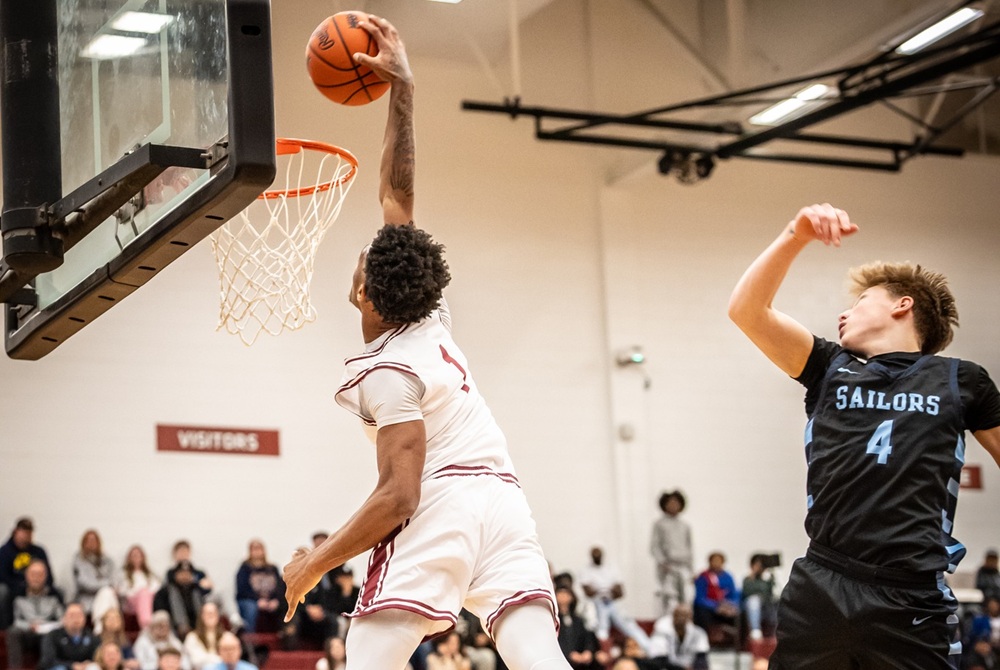
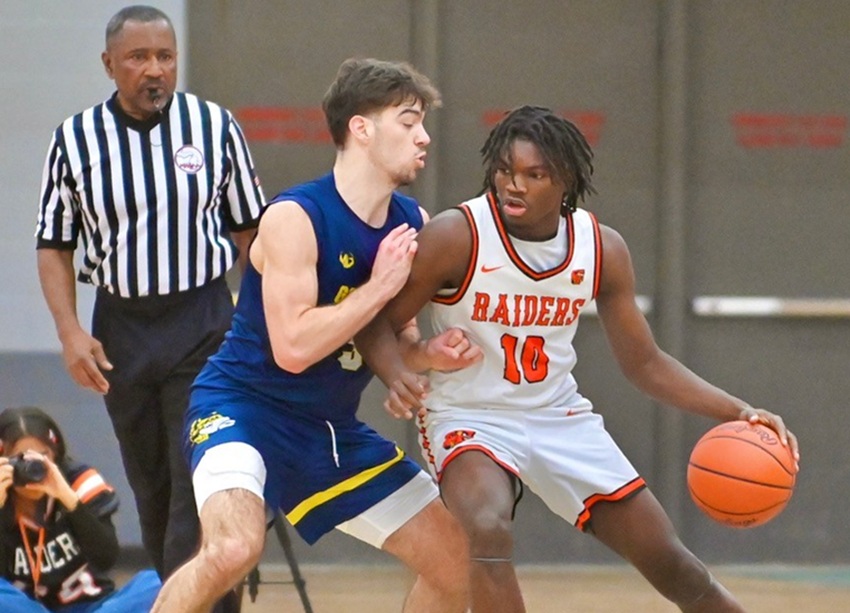
PHOTOS (Top) Muskegon’s James Martin throws down a dunk against Muskegon Mona Shores during a Jan. 30 win. (Middle) Flushing’s Raymond Neither (10) works for post position against Goodrich’s Jensen LePla during the Raiders’ 52-51 Metro League title clincher. (Muskegon/Mona Shores photo by Tim Reilly. Flushing/Goodrich photo by Terry Lyons.)