

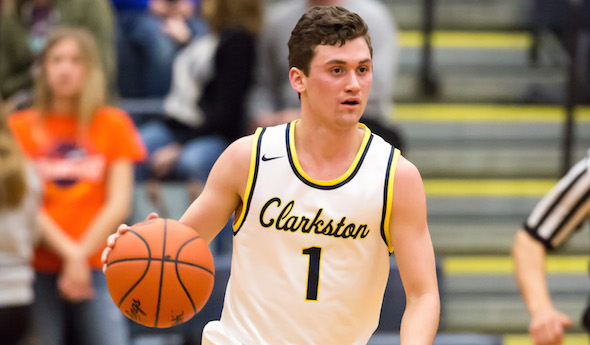
Performance: Clarkston's Foster Loyer
February 5, 2017
 Foster Loyer
Clarkston junior – Basketball
The Wolves’ junior point guard has been making good on high expectations since entering high school, and in one way he didn’t miss for nearly a year. Starting with last season’s regular-season finale against West Bloomfield, Loyer put together an MHSAA record streak of 119 straight made free throws to earn the Michigan Army National Guard “Performance of the Week” for Jan. 23-29.
Loyer’s streak came to an end when he missed his first free throw in a 59-39 win over North Farmington on Jan. 24. His record surpassed by 17 the former milestone set by Frankenmuth’s Brad Redford during the 2007-08 season and will rank second in the national record book when submitted after this season. Loyer joined the Clarkston varsity as a highly-touted freshmen two years ago and this winter has led the Wolves to a 13-0 start averaging 25.2 points, six assists and 4.4 rebounds per game, making 44 percent of his 3-point attempts and 95.6 percent of his tries from the free throw line.
 Some of the high expectations for Loyer rise from legacy; his dad John has been an assistant for four NBA teams including the Detroit Pistons, whom he led as interim head coach at the end of the 2013-14 season. Foster also has learned under the tutelage of longtime Clarkston coach Dan Fife, who took over the program in 1983 and is the fourth-winningest in MHSAA boys hoops history. Loyer – who also played baseball for a season at Clarkston – has committed to sign this fall with Michigan State University. A strong student as well, he’s looking to study business management with an eye on working in sports once his playing days are done. But first, he’ll try to lead Clarkston its first MHSAA championship after the team fell in overtime in a Class A Regional Semifinal last season to eventual semifinalist Macomb Dakota, and also by two in 2015 in a Quarterfinal to Detroit U-D Jesuit.
Coach Dan Fife said: “He shoots every day, and when he shoots, he shoots with a purpose. He’s a hard worker, he puts a lot of time in, and all the time he puts in really shows in the way he plays. … His court IQ is just incredible. He sees the game ahead of time. He has a great floor sense, where people are. As a freshman he was the same way, and one of the bigger things is when he gets upset, he doesn’t show a lot of anger when he makes a mistake. Mistakes don’t lead to two mistakes with him. He doesn’t get caught up in that stuff, he doesn’t get caught up in who he is; he just keeps his focus. And as good a player as he is, he’s just as good a kid. In the hallways, you wouldn’t know (he’s a basketball standout); he doesn’t walk like that. He’s just one of the kids.”
Performance Point: “Going into this year, I knew I’d made a bunch in a row but I had no idea what number I was at,” Loyer said of his free throws. “I didn’t pay much attention, but I think when I passed 100 some of my teammates started messing with me, letting me hear it when I missed one in practice. … I approach every free throw the same, and when the shot (that broke the streak) left my hand, I had no thought going through my mind that it wasn’t going to go in. It rolled in and out pretty bad, and when it came off the front of the rim, the thought definitely went through my head and I heard the rest of the crowd knew about it. They took a loud gasp, and that’s pretty much how I felt about it. I was definitely disappointed, but when something like that comes to an end, you move on and go on to the next play.”
Part of the arsenal: “I would consider free throw shooting a serious weapon, especially being the point guard in an end-of-game situation. At the end of the game, being able to hit free throws, especially in high school where there’s no shot clock, the game is over in my mind. I’m confident in myself and my teammates to be able to go and knock free throws down. Just being in the gym every day, it’s something you practice every day, day in and day out. It’s called a free throw for a reason; in my mind, you’re supposed to make them.”
 Thanks Dad: “If we’re watching film or being in the gym every day, my dad has been a positive influence in my life and basketball career. Just being able to take the things he says, and build off of them to make myself a better player. Every time we watch film, normally you should look not only at what you did right but also what you did wrong and can improve on. That’s been the biggest part of the game my dad has helped me improve.”
Win one for Coach: “(A Class A title) would mean the world to us guys as players, as a team, with the brotherhood we’ve built. But not only that, it would mean the world for us to win Coach Fife that state championship. Coach Fife doesn’t talk much about how much that means to him, but he’s had some difficult losses, and I think in the back of our minds it would solidify his legacy, solidify our legacy as a team, that we came in here and made our mark.”
Leading the way: “Day in and day out at practice, I pride myself in doing so, bringing leadership to the team, making sure guys are working as hard as they should be. As a leader and a point guard on a basketball team, you have to push guys not only to do what they should be doing, but it’s more than that. Going into March, we had a lot of guys in the locker room after (last season’s Regional loss), and we have a lot of guys who know what that feeling is like, and that’s a feeling we never want to go through again.”
- Geoff Kimmerly, Second Half editor
Every week during the 2016-17 school year, Second Half and the Michigan National Guard will recognize a “Performance of the Week" from among the MHSAA's 750 member high schools.
The Michigan Army National Guard provides trained and ready forces in support of the National Military Strategy, and responds as needed to state, local, and regional emergencies to ensure peace, order, and public safety. The Guard adds value to our communities through continuous interaction. National Guard soldiers are part of the local community. Guardsmen typically train one weekend per month and two weeks in the summer. This training maintains readiness when needed, be it either to defend our nation's freedom or protect lives and property of Michigan citizens during a local natural disaster.
Previous 2016-17 honorees:
Jan. 26: Nick Jenkins, Detroit Catholic Central wrestling – Read
Jan. 19: Eileene Naniseni, Mancelona basketball – Read
Jan. 12: Rory Anderson, Calumet hockey – Read
Dec. 15: Demetri Martin, Big Rapids basketball – Read
Dec. 1: Rodney Hall, Detroit Cass Tech football – Read
Nov. 24: Ally Cummings, Novi volleyball – Read
Nov. 17: Chloe Idoni, Fenton volleyball – Read
Nov. 10: Adelyn Ackley, Hart cross country – Read
Nov. 3: Casey Kirkbride, Mattawan soccer – Read
Oct. 27: Colton Yesney, Negaunee cross country – Read
Oct. 20: Varun Shanker, Midland Dow tennis – Read
Oct. 13: Anne Forsyth, Ann Arbor Pioneer cross country – Read
Oct. 6: Shuaib Aljabaly, Coldwater cross country – Read
Sept. 29: Taylor Seaman, Brighton swimming & diving – Read
Sept. 22: Maggie Farrell, Battle Creek Lakeview cross country – Read
Sept. 15: Franki Strefling, Buchanan volleyball – Read
Sept. 8: Noah Jacobs, Corunna cross country – Read
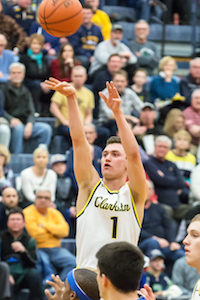
PHOTOS: (Top) Clarkston's Foster Loyer brings the ball upcourt during a game this season. (Middle) Loyer attempts a free throw; he recently capped an MHSAA record streak of 119 straight makes. (Photos by Larry Wright/WrightActionPix.com.)
Film Fills In Picture of 'Fennville Flash'
By
Ron Pesch
MHSAA historian
December 28, 2017
We’ve been here before, but not in this way.
The last time was for a retrospective, covering one of the most impressive and awe-inspiring prep careers in Michigan high school history. That time was in print, and included a handful of still images that tried to illustrate the unbelievable.
But this time, the story is in documentary form. It’s woven together from grainy, scratched, faded silent film, a format of capturing memories familiar to thousands of people from generations past, as well as a series of modern-day high-resolution interviews.
Here, the basketball life of the athlete known as the “Fennville Flash” delivers on many levels. Yes, there is a Richie Jordan.
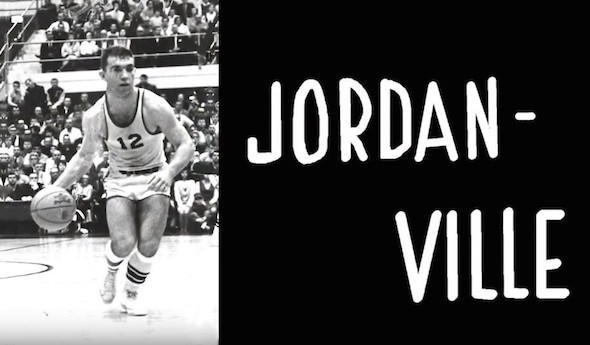
JordanVille, a documentary by John Mooy & Anne Colton, recalls a time when legend spread via word of mouth, newsprint and AM radio.
While it’s hard to comprehend for many today, the exploits of our athletic heroes were formed by “poets in the press box” who sat with pencil and paper, a typewriter, a microphone or a telephone, and described to their audience what they witnessed. On the receiving end, readers and listeners conjured up visualizations based on the facts, phrases and superlatives designed to create an image.
“Traveling left to right on your radio dial” helped listeners feel they were a member of the crowd, seated in the stands, in on the action and a witness to the mayhem. “Packed to the rafters,” reminded fans the importance of what was happening. An exciting game, presented by those with skill, created an event you longed to see. If a broadcast couldn’t be picked up on a transistor or tube radio, the final result might not be known, at the earliest, until the following day’s newspaper arrived.
I’ve told Jordan’s story via the MHSAA before; how he latched on to athletic training, weights and repetition to mold himself into a well-rounded athlete, able to leap to heights unexpected for a kid with a 5-foot-7 frame. The tales of his unfathomable accomplishments slowly leaked beyond the city limits of Fennville into Kalamazoo and greater Southwestern Michigan, then to Detroit. When Detroit Free Press writer Hal Schram relayed Jordan’s feats, the secret traveled across the state and beyond its drawn borders.
From there the legend of Jordan’s accomplishments grew. In Fennville, as in many small towns across the country, the city shut down when a game was played. The Jordan story was so enticing that thousands would travel vast distances to see him play with their own eyes. Today, his single season scoring average of 44.4 points per game during the 1964-65 campaign still remains the top mark in the MHSAA record book.
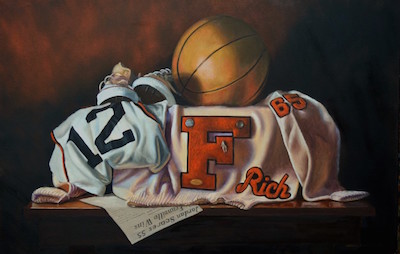 JordanVille runs just shy of a half hour. Contained within is insight into the athlete that is challenging to relay in print form. Thanks to access to home movies and a series of interviews with Jordan, former teammates, past opponents and his high school coach, the determination, dedication and drive of a kid who wouldn’t let physical size be a deterrent from achievement radiates from the screen. On display is small town America at its finest, and perspective formed over 50+ years.
For Mooy, it completes a filmmaking journey started six years ago. But the story of Jordan, in his eyes, date back to his school days. Mooy first heard about Jordan as a 7th-grader from a math teacher. A second-team all-St. Joseph Valley League selection, Mooy played at Marcellus High School and scrimmaged against Jordan and the Fennville Blackhawks.
He couldn’t believe his eyes.
“Everyone wanted to see this kid play,” said Mooy in 2011. “He was the first high school player I saw sign an autograph.
Today, with the interviews complete, and the film ready for viewing, Mooy sees more than just a sports story:
“With the benefit of years now passed, I look at the Rich Jordan story with a new respect. JordanVille created a place that was welcoming no matter who you were, or what color your skin happened to be. It was the 1960s. Rich was growing up Jewish, the Civil Rights Movement was in full swing, and the Vietnam War was on everyone's mind. And in Fennville, Michigan, from 1961 to 1965, the Jordan high school years, there were lessons beyond sports being learned by everyone that would last a lifetime. The Jordan household, under the guidance of (his parents) Tuffy and Sylvia Jordan, is where the story begins."
The film speaks of a time that has departed. Competition for our attention was less focused; phones hung on walls or sat on tabletops, communities were tighter, the training table featured peanut butter and chocolate milk instead of protein powder. A city could easily be renamed for a day.
The film also reminds us that those days were far from perfect.
If all goes as planned, the public will see the finished product come the flip of the calendar. In West Michigan, JordanVille is scheduled to show on New Year’s Day at 6 p.m. on WGVU, and will repeat on WGVU-Life at 7:30 p.m., Friday, Jan. 5.
Seek it out, and spread the word, just like in days of old.
 Ron Pesch has taken an active role in researching the history of MHSAA events since 1985 and began writing for MHSAA Finals programs in 1986, adding additional features and "flashbacks" in 1992. He inherited the title of MHSAA historian from the late Dick Kishpaugh following the 1993-94 school year, and resides in Muskegon. Contact him at [email protected] with ideas for historical articles.
PHOTOS: (Top) Richie Jordan runs Fennville's offense during his thrilling high school career in the 1960s. (Middle) Jordan memorabilia, as captured by Bill Williams.