

Performance: East Jordan’s Jordan Weber
December 15, 2015
 Jordan Weber
East Jordan senior – Basketball
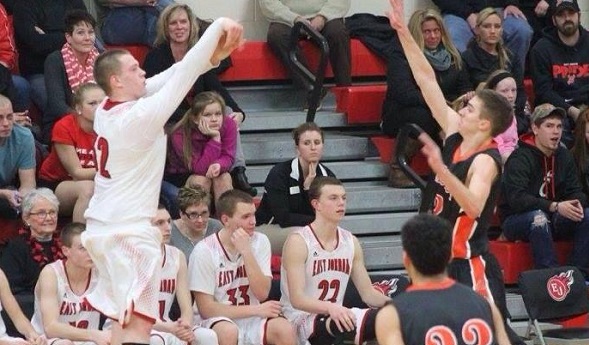
Nine seconds into his team's new season, Weber became East Jordan’s all-time leading scorer. The 6-foot senior guard drilled a deep 3-pointer on his team's first possession against opening-night opponent Mancelona to break the former record of 1,170 points set by Mike Goebel from 1983-86 and earn this week’s Michigan National Guard “Performance of the Week.” (See below for video of his history-making shot and the brief recognition that followed .) He finished with 24 points total in the 66-20 road win.
Heading into tonight’s game against Charlevoix, Weber has 1,193 points and a number of additional school records: 45 points scored in a game, 614 for one season, 91 3-pointers in one season and 208 3-pointers over his four-year varsity career. His 3-pointers last season were the 13th-most in MHSAA history, and with a similar output this winter he’ll finish among the top five on the career list. Weber has played big parts in multiple history-making team accomplishments as well. As a sophomore, he helped Class C East Jordan to its first District championship since 1997 and first Regional championship since 1953. He has a few more similar opportunities ahead. The Red Devils went a combined 36-11 over the last two seasons finishing second and then third in the Lake Michigan Conference – and this winter should again contend for a first league championship since 2000. They also are possible contenders while seeking their first MHSAA championship.
 Weber also plays baseball, and he is ranked eighth academically of 63 students in his graduating class with a 3.66 grade-point average while taking multiple Advanced Placement courses. He has opportunities to continue his basketball and academic career at multiple small colleges in Michigan and Illinois, and would like to eventually study physical therapy.
Coach (and father) Darrin Weber said: “Jordan has been fortunate to have outstanding teammates. Without the kids he’s played with, none of these accomplishments would have been possible. He has a great understanding of the game, outstanding offseason work ethic and an extremely high competitive drive. He has been the best player I have ever coached."
Performance Point: “Obviously it was an honor to get that. I was preparing for that game just like I was preparing for any other game, but it was in the back of my mind. Going in, I just wanted to win the game. I didn’t want to take over, force myself to get the record. I just let the game get to me, and it happened in the first nine seconds. If I’m open, it’s going up. To become the all-time leader in anything is a big deal, in any level of play, if they are going to stop the game and congratulate you. But it was just that I needed two more points; the dream for me (instead) would be to win the state title.
Title aspirations: “To win a conference title, it’s a lot more important than just to win the District title or anything like that. It means we’re playing better than anyone in the conference the whole year. “(In the MHSAA Tournament,) we’re like a Cinderella team, like an eight seed, nine or 10 seed in the NCAA Tournament. It motivates me just to get that spotlight on the team, small East Jordan down there making it that far.”
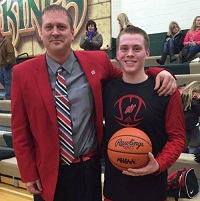 Father knows best: “I get two points of view from the same person. There’s the coaching standpoint, and then I go home and talk to him as Dad. He’s hard on me in practice, and I like that. I don’t want a soft coach. Then, to love a father figure in this game I love … he’s coached me since elementary school, and we’ve always been able to connect like that.”
He’s got game: “I’m not just going to sit in the corner and shoot. I’m going to create my shot, going to create shots for other people. I like to get my shot off quickly like (Golden State’s) Steph Curry does. I like to try to attack the rim as hard as (Oklahoma City’s) Russell Westbrook does. Try to, at least.”
Leaving a legacy: “I like to leave something like that, for kids coming up to all want to shoot like Jordan Weber. There’s a little youth program my dad holds every Saturday, and I haven’t missed a Saturday. All the kids love seeing me there … (and I like) to be a role model for little kids.”
– Geoff Kimmerly, Second Half editor
Every week during the 2015-16 school year, Second Half and the Michigan National Guard will recognize a “Performance of the Week" from among the MHSAA's 750 member high schools.
The Michigan Army National Guard provides trained and ready forces in support of the National Military Strategy, respond as needed to state, local, and regional emergencies to ensure peace, order, and public safety. The Guard adds value to our communities through continuous interaction. National Guard soldiers are part of the local community. Guardsmen typically train one weekend per month and two weeks in the summer. This training maintains readiness when needed, be it either to defend our Nation's freedom, or protecting lives and property of Michigan citizens during a local natural disaster.
Previous 2015-16 honorees
Dec. 8: Kaitlyn Geers, Kent City girls basketball – Read
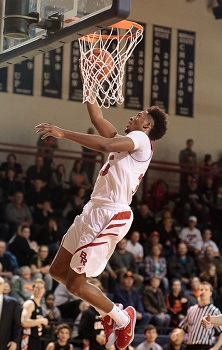
PHOTOS: (Top) East Jordan's Jordan Weber unloads a shot during a game last season; he set his school's career scoring record last week against Mancelona. (Middle) Weber, right, poses with his dad and coach Darrin Weber. (Photos courtesy of the Weber family.)
Performance: Big Rapids' Demetri Martin
December 15, 2016
 Demetri Martin
Big Rapids senior – Basketball
To finish last season, Martin led unranked Big Rapids to its first MHSAA Semifinals and within a basket of playing for the Class B championship. He began his senior campaign with another, more individual highlight; the 6-foot-4 guard scored his 1,000th point in a 65-50 win over Grant on Friday to earn the Michigan National Guard “Performance of the Week.” Martin, a four-year starter, finished with 31 points and 12 rebounds against Grant and added 24 points and 10 rebounds in Tuesday’s 63-43 win over Lakeview.
Martin also was the team’s leading scorer last season, averaging 19.5 points per game along with 8.8 rebounds before scoring a team-high 22 in a 61-60 Class B Semifinal loss to Stevensville Lakeshore. After, he was named Central State Activities Association Gold Player of the Year for the second time and made the Basketball Coaches Association of Michigan all-state team. This winter, Martin is teaming with senior Christian Hector, junior Braeden Childress and others including sophomore brother and starting point guard Dorian Martin with hopes of returning to the championship mix. Demetri Martin entered this season needing 21 points to reach 1,000 for his career, and nearly pulled off the feat in the first quarter of that first game. He worked this summer on adding a longer pull-up jumper, and he went over 1,000 swishing a pull-up 3-pointer from NBA range.
Just as impressive over his four years of high school has been Martin’s climb academically. In his words, Martin entered high school with all Ds and was barely academically eligible to play basketball as a freshman, frequently skipping school before and after that season. But he’s now pulling As and Bs and plans to study for a career either in education or sports medicine. He'll surely play college basketball at some level – most of his interest has come from Division II schools but he's also had contact from one in Division I.
Coach Kent Ingles said: “He’s obviously the best player in (our) area, and the best player we’ve had in a while … and he’s following a couple pretty good kids into the mix. He’s a multi-position player; he’s actually pretty unselfish. He’d rather pass the ball than shoot it. He’s been with me four years, and we’ve won three conference championships and been to the Quarter(finals) two times. … I told him we’ll be a good team when our best player is our hardest worker, and he’s done that too. He is a real success story. He’s a neat kid. He’s bubbly, he’s fun to talk to, he’s kinda hyper and can’t sit still. But he’s grown up a lot as a young man and as a basketball player, and we’re happy to see the total development with him."
Performance Point: “Not many people can score 1,000 points, so for me to get that, it just means a lot to me,” Martin said, “that all the hard work I put in is starting to show. I thought about (the 1,000th point) for a couple of months once I found out how far (away) I was, and I was thinking I can get this in the first quarter if I actually try. I ended up with 17 (points in the first quarter), but I was just taking it slow. If I would’ve kept that scoring streak going, I probably could’ve gotten it in the first quarter.
Breslin dreams come true: “Half the state (last season) probably didn’t even know where Big Rapids is. We weren’t ranked. We’re not in the Grand Rapids area. So it’s, where is this team from? And then we show up, and everyone probably expected a blowout. (But) in the beginning of the season, before we even started practicing, I was talking to some of my old teammates and I said, ‘We’ll probably make it to Breslin this year, you know that?’ We did. We made it. We were a lot better than what we played. … Since this is my last year, I know what we have to do to get there again, and I want to try my best to get there.”
 Preparing the future: “My freshman year, I was just a rebounder. I picked up the leadership stuff from (2014 graduates) Quinn Tyson, Jake Hayes, Austin Hayes; they passed me the torch, so sophomore year I would lead but not like last year when I was leading the team and obviously one of the go-to guys. (This season) I’m trying to tell (my teammates) what to do and what not to do, how the game should be played so they can score 1,000 points in their careers too, so they can lead other future Big Rapids teams. I don’t want to go out as just a scorer who didn’t really teach the kids anything.”
Football’s a hit: “I played football for the first time (this fall). It was pretty fun. I wasn’t the go-to player, so it was different. But blocking was probably the best – you get to slam people. Tryouts had already passed, but the night before two-a-days I had a dream, and I was like man, I’m going to go out and try out for football, and I knew coach wanted me to play. … I’m glad that I played, and I got physically stronger too.”
Continuing to make a difference: “I want to become a teacher … because my coach (assistant Blake) Thomas, when I came here and then I was struggling a little bit in classes, he’d invite me over and we’d study on this, and that brought my grades up a lot. To help someone out like that, and not even know them, I think that’s something some kids need and I want to do that. Sports medicine, I injure myself a lot, so if there is someone who has these problems like me, I would help them out.”
- Geoff Kimmerly, Second Half editor
Every week during the 2016-17 school year, Second Half and the Michigan National Guard will recognize a “Performance of the Week" from among the MHSAA's 750 member high schools.
The Michigan Army National Guard provides trained and ready forces in support of the National Military Strategy, and responds as needed to state, local, and regional emergencies to ensure peace, order, and public safety. The Guard adds value to our communities through continuous interaction. National Guard soldiers are part of the local community. Guardsmen typically train one weekend per month and two weeks in the summer. This training maintains readiness when needed, be it either to defend our nation's freedom or protect lives and property of Michigan citizens during a local natural disaster.
Previous 2016-17 honorees:
Dec. 1: Rodney Hall, Detroit Cass Tech football – Read
Nov. 24: Ally Cummings, Novi volleyball – Read
Nov. 17: Chloe Idoni, Fenton volleyball – Read
Nov. 10: Adelyn Ackley, Hart cross country – Read
Nov. 3: Casey Kirkbride, Mattawan soccer – Read
Oct. 27: Colton Yesney, Negaunee cross country – Read
Oct. 20: Varun Shanker, Midland Dow tennis – Read
Oct. 13: Anne Forsyth, Ann Arbor Pioneer cross country – Read
Oct. 6: Shuaib Aljabaly, Coldwater cross country – Read
Sept. 29: Taylor Seaman, Brighton swimming & diving – Read
Sept. 22: Maggie Farrell, Battle Creek Lakeview cross country – Read
Sept. 15: Franki Strefling, Buchanan volleyball – Read
Sept. 8: Noah Jacobs, Corunna cross country – Read
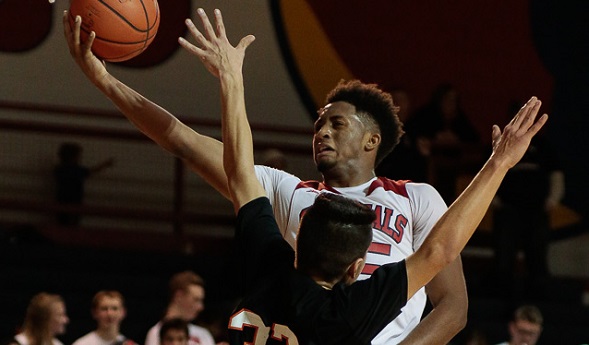
PHOTOS: (Top) Demetri Martin glides around a defender during last week’s win against Grant. (Middle) Martin drives to the hoop as Big Rapids went on to a 65-50 victory. (Photos courtesy of the Big Rapids athletic department.)