

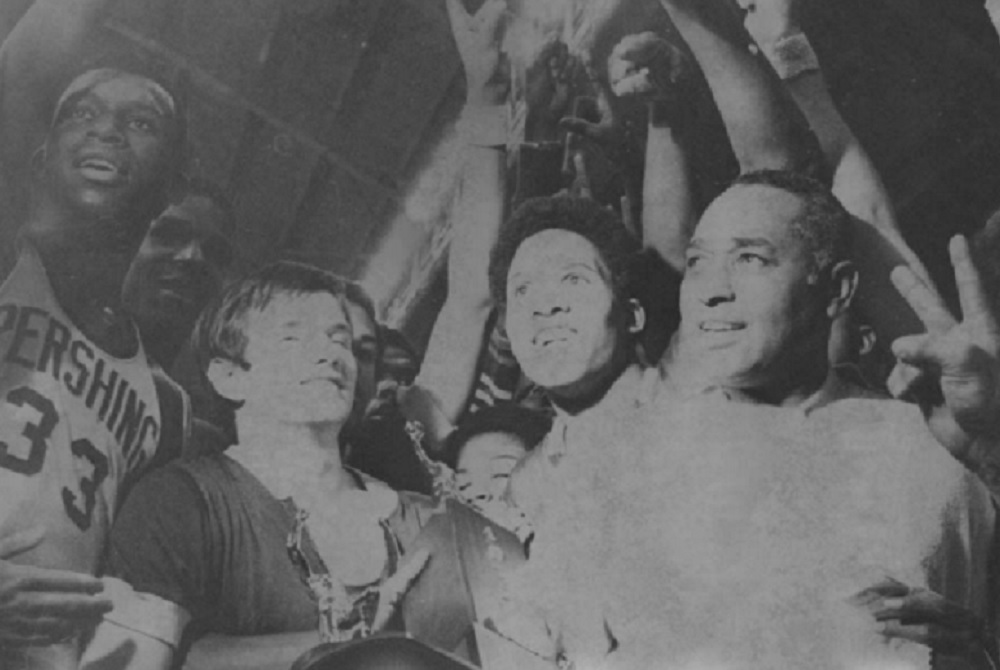
Pershing Sends Robinson Into History with Historic Title Run
By
Ron Pesch
MHSAA historian
March 4, 2021
Just 48 hours before the kickoff of the 45th annual MHSAA Basketball Finals, Illinois State University broke the news that it would hire Detroit Pershing high school coach Will Robinson as the new head of its men’s basketball team.
Before the days of Good Morning America, CNN and ESPN, there was no immediate mention that ISU and the 58-year-old North Carolina native had broken a color line.
Robinson had played high school sports in Steubenville, Ohio, where he won 14 letters in five sports. He then earned a combined 15 letters and served as captain of the football, baseball and gymnastics teams at West Virginia State College, noted the ISU student newspaper, The Vidette, and then served five years as athletic director for YMCA in Pittsburgh and Chicago.
He followed by embarking on a high school school coaching career that would include more than a quarter-century at Detroit schools before he'd move on to become, at ISU, the first African-American head coach of an NCAA Division I college program.
But before beginning that history-making tenure, he guided what remains one of the most memorable, and unexpected, championship triumphs in Michigan high school hoops history.
Coach Rob
“It was shortly after the race riots of 1943 that Warren Bow, then the superintendent of schools, lured Robinson from DuSable High of Chicago,” stated veteran sportswriter Hal Schram of the Detroit Free Press years later. With the arrival of the 1969-70 season, Robinson had spent the previous 26 years as coach in Detroit, arriving at Detroit Miller in 1944. He moved to Detroit Cass Tech in the fall of 1957 when Miller became a junior high, then to Detroit Pershing in the fall of 1961.
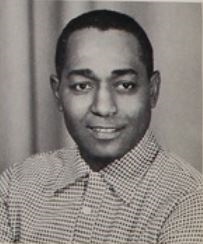 “We had plenty of applicants and interviews from nearly 100 men,” Milt Weisbecker, athletic director at ISU, told the press about the hire on Saturday, Feb. 28. “We feel Will is the man we want. He impressed us with his sincerity and his desire to succeed. We feel he’ll be an excellent recruiter.”
Robinson’s departure for the college ranks would depend on how long his Pershing team hung around the state tournament. The Doughboys had ended the 1969-70 regular season with an 8-4 record.
“Pershing is not one of the favorites,” noted Schram, “but neither was it in (1961-62) when Robinson took a team with a 4-8 record to the Class A semifinals. Then in 1967 Pershing went all the way to a State title with Spencer Haywood and Ralph Simpson as its top stars.”
Earlier in the year, Schram had reminded readers of the Detroit Public School League’s self-imposed boycott that kept city schools away from outstate competition and the MHSAA postseason tournament from 1930-1961.
“For many years, Detroit’s public schools (considered themselves) the best in Michigan,” he explained. “The boast could not be answered, because until 1961 the Detroit teams were not permitted (by school administration) to leave their area. In the years since their return to the state tournament, however, the locals have done little to support the earlier boast. With one exception (they’ve) fallen flat in the State tournament.”
That one team was Robinson’s 1967 champs.
Wealth of Talent
While, as usual, four basketball teams would finish 1970 as Finals champs, Class A was of particular interest to many around the state. The classification was packed with court talent. While the senior class included players of wide-ranging skills, a collection of incredible underclassmen would have the most impact on the postseason.
Based on Schram’s season-ending rankings, Ferndale was his pick to win it all in Class A. The Eagles had previously grabbed titles in 1963 and 1966 in the MHSAA’s classification featuring the schools with the largest enrollments. Each championship had come under current coach Roy Burkhart’s leadership.
“Ferndale has one major challenger – Pontiac Central,” said Schram. “This has been a Ferndale-Pontiac Central year in Class A,” he noted in his pre-tournament preview. “Both own 16-0 records. Providing they both survive district, regional and quarter-final eliminations these two rivals could tangle in either the semifinals or finals …”
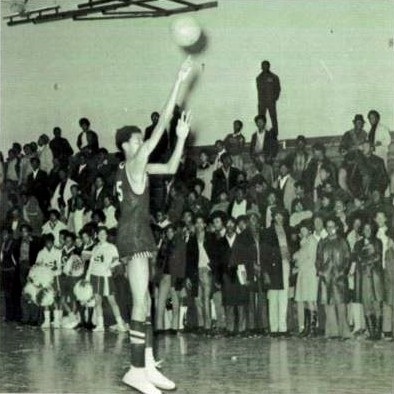 He acknowledged “second-line challengers” could be found among Birmingham Seaholm, his third-ranked team; Detroit Kettering, the top team in the PSL, led by 6-foot-4 senior Floyd Haywood (Spencer’s brother) and junior Lindsay Hairston; Detroit Martin Luther King, second in the PSL and powered by senior George ‘Twiggy’ Gervin (named one of the 50 greatest players in NBA history in 1996 - ‘The Iceman’ nickname would come later); Detroit Northeastern and star guard Mike Robinson (who would go on to set a Michigan State University all-time scoring mark and twice lead the conference in scoring despite previous doubts of if, at 5-foot-10, he could play Big Ten basketball), Battle Creek Central, with all-state selection Dave Freeman; Grand Rapids Union, featuring 6-foot-5 senior Gerald Edwards; Grand Rapids Ottawa Hills, seeking its third-straight Class A crown; and twice-beaten Flint Central, led by Mike DeCou and Bob Stone.
“A successful tournament run by any other Class A quintet,” said Schram, “would be a major upset.”
Both The Associated Press and United Press International agreed with the Free Press on the top two schools, but each named Pontiac Central, led by Campanella ‘Campy’ Russell, as the top team in Class A in their respective regular-season polls, with Ferndale finishing second in the rankings.
“Take it from a couple college coaches who should know,” wrote Bob Gross from the Lansing State Journal, “the best Class A high school basketball teams in Michigan are Pontiac Central and Detroit Kettering. Michigan State’s Gus Ganakas likes Pontiac and 6-6 junior Campy Russell while Michigan’s Johnny Orr leans toward Kettering and 6-7 Lindsay Hairston.”
“I’ve seen a lot of outstanding teams,” Ganakas told Gross, “but Pontiac is solid. In Russell, they have a player who is tremendously strong on the boards as well as scoring.”
“Kettering looks very strong to me,” noted Orr. “I haven’t seen Pontiac or Ferndale but my assistants have and they tell me both are excellent teams. … Ypsilanti and Battle Creek Central also are fine teams.”
Kettering had finished third in the AP poll, fourth according to UPI but eighth in Schram’s “Top Ten.”
Ypsilanti, noted Gross, had lost to Ottawa Hills in the Class A title game a year before, and was coming on strong. The Bearcats of Battle Creek Central, had “sailed through the Six-A League and posted a 16-1 record losing only to Ann Arbor Huron in one of the state’s biggest upsets.” The Bearcats finished the regular season at No. 3 according to UPI, and were ranked No. 4 by both the AP and the Free Press.
Change in Format
The 1970 tournament would mark the end of a three-week postseason format that had been in place since Michigan State’s Jenison Field House had opened in 1940. Beginning the following March, the playoffs would expand to a four-week schedule with the Semifinals and Final contests played over separate weekends. In addition, the annual championship games would begin alternating annually between Jenison and Crisler Arena at the University of Michigan.
“Our major interest is to use the best possible facilities,” said Allen Bush, executive director of the East Lansing-based MHSAA, no doubt smiling with his next statement. “After all, Michigan is also a state school.”
Bush had earned multiple bachelor’s degrees from Western Michigan University and his master’s in school administration from U-M.
Crisler Arena, opened in 1967, could handle a crowd of 14,000.
Typical of the era, the more than 12,000 available tickets for the pending four championship games at Jenison were already sold out or were being held for distribution to the schools competing in the finals.
Tipping Off the Tournament
The Class A casualties to favorites during the opening week of play were minimal. Seaholm, with two regular-season defeats – both to unbeaten Ferndale – departed in its playoff opener against Birmingham Groves.
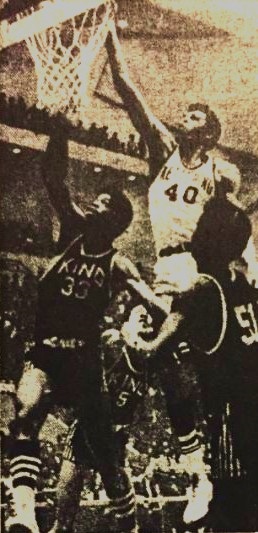 Fouls and turnovers nearly cost Ferndale its tournament life in its opener against Oak Park. With stars Tyrone Lewis and Billy Screws both in early foul trouble, the Eagles clung to a slim 35-33 lead with five minutes remaining, before escaping with a 45-39 win.
Kettering met Northeastern in a much-anticipated thriller in the District Final. Northeastern, with 15 of its 17 players now seniors, had advanced to the Class A Semifinals in March 1969. The teams had split their regular-season matchups in 1969-70. Boasting a distinct height advantage, Kettering had won by two points at Northeastern, 87-85, in mid-December with Hairston scoring 35 points, but the speedy Falcons, double-teaming Hairston, downed Kettering by eight points 86-78 at Kettering in a February rematch. Robinson scored 27 points and Mike Weaver, who later played at Michigan, notched 19 for Northeastern while Haywood tallied 27 for Kettering. Hairston was held to 14.
“We deserved to lose that game,” Kettering coach Walt Jenkins told the Free Press. “They got us to play their game instead of ours. I don’t think it will happen again ...”
Kettering blew a nine-point lead after one period but fought back to win 96-93 as Hairston scored 42 and pulled down 25 rebounds. Robinson finished with 41 points. “Northeastern’s hopes of upsetting Kettering were hampered when three players fouled out in the second half.”
Week 2
The Regional round brought much more excitement.
Ferndale escaped the Regional Semifinal “with a heart-pounding 66-64 victory” over Detroit Cooley. The Cardinals, 7-4 on the regular season, used their height advantage to create problems for Ferndale. Deadlocked at the end of both the first and second quarters, the Eagles led by 10 late in the fourth quarter before Cooley’s press interrupted things. Cooley cut the lead to two with nine seconds remaining before Ferndale was able to run out the clock. Lewis finished with 26 to lead the victors.
Ypsilanti fell on the same night, 76-70, to Detroit Catholic Central in overtime. Leading 67-64 with 16 seconds remaining, four points by DCC’s Frank Tanana Jr., including a layup with eight seconds left, knotted the score at 67-67 to force overtime. A pair of clutch field goals by Mark Barczuk in the extra frame ended Ypsilanti’s season. Tanana and Terry Frye both finished with 24 points on the night.
The Regional Final round tossed a few more favorites to the sidelines.
“Unrated and unsung … an also-ran in Public School League play, Will Robinson and his Pershing High Doughboys burst the Ferndale basketball bubble Saturday night” wrote Schram in the Free Press.
A crowd of 2,200 packed Southfield High’s gymnasium for Ferndale’s Regional Final game with Pershing.
The Eagles opened a quick 8-0 lead, and upped the lead to 10 points with three minutes to go in the first half before Pershing cut the margin to two, 41-39, at the break. By night’s end, 6-foot-4 sophomore Robert Hawkins had tallied 39 points, while 6-foot-8 junior Calvin Harper added 19 and 17 rebounds as Pershing scored a 90-88 upset.
In other Regional Final action, the Tractors of Dearborn Fordson, 17-3 on the year, held high-scoring George Gervin scoreless in the third quarter and to 17 points overall to upended Detroit Martin Luther King’s run, 64-62, while Ottawa Hills succumbed to Union. The Red Hawks had defeated the reigning champ twice during the regular season. Tradition-rich Benton Harbor upset Battle Creek Central, 88-85 in overtime.
 Also among the surprises, Flint Central, beaten by Pontiac Central by just 10 points early in the year, fell to unranked Midland 72-71 on a tip-in by Chemics senior guard John Reding with seven seconds remaining in their Regional Final. The teams had split a two-game series during the regular season.
Pontiac Central trounced Birmingham Brother Rice, 60-39 in a game filled with offensive stalls by Rice.
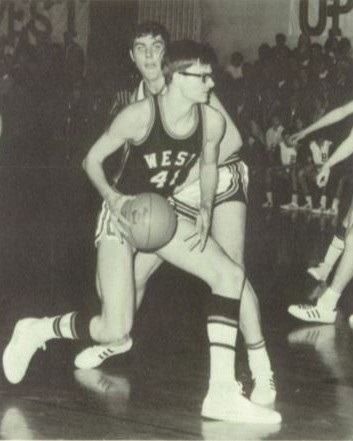
Garden City West, led by 6-foot-7½ senior Rick Drewitz, were the tournament’s heart attack kids. Undefeated during the regular season, the Tigers finished at No. 6 according to the UPI poll, ninth in the Free Press, and 10th by AP. West had advanced to the MHSAA Regional Finals in 1969 when its line-up also included Rick’s older brother Duane, but, for whatever reason, the Tigers weren’t initially mentioned as a threat in 1970.
Following an easy 62-37 win over Livonia Franklin in their District opener, indeed it seemed that it was only a matter of time before West departed from the postseason.
Drewitz poured in an eye-popping 48 points in the team’s 71-67 victory over Livonia Bentley, but it had taken overtime and a last-second field goal in regulation to get there. Drewitz’s jumper off the free throw line at the buzzer had knotted the game, 64-64.
In the District Final, with Drewitz benched with fouls, junior Dennis Leszczynski drilled a field goal and a pair of free throws over the final 32 seconds to give West a 58-55 win over Livonia Stevenson.
Garden City had opened up a 40-30 third quarter lead over Ann Arbor Huron in its Regional opener when Drewitz was whistled for his fourth personal and headed for the bench. Huron quickly grabbed the lead, 44-43 before the big center returned in the final frame. Drewitz, who ended with 19 points, sank two key free throws with 90 seconds left, allowing the Tigers a 55-52 win over the River Rats, who finished the year at 10-10.
The Tigers slipped past Detroit Catholic Central 72-71 in the Regional Final – a foul-filled contest. Drewitz, who would play his college ball at Kentucky, was held to only five field goals, but nailed 20 of 25 free throws to lead all scorers with 30 points. Tanana, dealing with a bad ankle, limped through much of the match, and was held to 10 points. West sank 38 of 52 free throws on the night as officials called 55 infractions during the contest. A total of six players fouled out.
Quarterfinals
Upwards of 75,000 fans were expected to witness the four classes of MHSAA Quarterfinals hosted at 14 centers around the state. But without question, Crisler Arena was the place to be on that Wednesday night. The lone site with two Class A contests, Pershing would face Fordson in the 4:30 opener. The dream matchup between Pontiac Central and Detroit Kettering, and “the finest two big men to come out of the state in recent years,” juniors Russell and Hairston, was set for an 8 p.m. tipoff. Separate tickets were needed for each game, and the event had been sold out since the start of the month.
The matchup, won by Pontiac Central, 76-73, was everything it was expected to be. High drama came late in the third period when Russell, who finished with 32 points – 22 in the first half – twisted an ankle. But, as Jack Saylor told Free Press readers, “it was a pair of free throws by Jerry Ratliff with 42 seconds left that provided the Chiefs with their victory margin.”
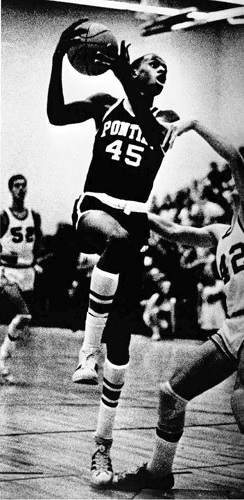 “After Ratliff’s foul shots had given Central a 74-70 lead, (Kettering’s) Floyd Haywood rammed in a rebound and completed a three-point play with a foul shot. Fifteen seconds remained, the Chiefs were out of time outs and Kettering (down by a point) was applying frantic pressure.”
Kettering’s defeat was sealed when Pontiac guard Bill Glover, boxed in following the inbound pass, spotted Russell, who had returned to action with six minutes remaining, at the other end of the Crisler court. Glover’s intended pass was off the mark, instead falling “through the hoop, fully 85 feet away.”
“Until then, the game belonged to Russell, who had a clear margin over Lindsay Hairston in the battle of junior All-Staters.” Hairston led Kettering with 18 points, followed by Joe Johnson (who would play college ball at U-M) with 11. Ratliff added 18 for the Chiefs.
The game was the last for Kettering coach Jenkins, who had played football for Will Robinson at Miller and was now moving into administration as a high school principal.
Pershing’s starters went the distance, with four of the five scoring in double figures, ending Dearborn Fordson’s run, 73-61. Harper led Pershing with 24 points. Behind an outstanding all-around performance, Fordson’s Steve Burke, a 6-foot-3½ forward, topped all scorers with 26 points.
Garden City West easily turned back Benton Harbor in the Quarterfinals, 82-66. Drewitz grabbed 19 rebounds, scored 13 of 14 from the charity stripe and totaled 39 points on the night. “Benton Harbor’s fast break and full-court press troubled West most of the first half,” stated Curt Sylvester of the Free Press, “but strength on the boards and ability to get the ball in to Drewitz for his soft left-handed jumpers finally tipped the balance for Garden City.”
“(Drewitz is) everything they said he was,” Benton Harbor coach Ace Eisner told the Benton Harbor News-Palladium. “He rebounds well, he has a nice touch and he goes to the basket. Defensively, we just couldn’t stop him …”
A 15-foot bucket with 38 seconds remaining by John Reding followed by a Jeff Paulus free throw with seven ticks left on the clock gave Midland a 71-68 upset of Grand Rapids Union. Gerald Edwards finished with 21 points for Union, while Tom Pruss’ 19 points led the Chemics. It was a season to remember for Midland, as it nearly didn’t take place. According to John Kennett, a reserve on the Chemics team and later a part-time sportswriter for the Midland Daily News “ … residents of Midland had voted down a millage proposal earlier in the year. As a result, all extra-curricular activities were to be eliminated. Fortunately, a group of citizens and students banded together to raise enough funds to maintain the extra-curricular activities.”
‘The Last Extravaganza’
“They’re calling this State Tournament the last of the great extravaganzas,” wrote Free Press sports editor and columnist Joe Falls. “It’s the last time they’re having this two-day carnival in Jenison Fieldhouse. Next year they’re changing the format, and the site. … They’re spreading the tournament over four weeks instead of three and there is going to be no Friday-Saturday climax in East Lansing.
“Half of the fun is planning a big weekend in East Lansing. The mad scene here is something else. You can feel the swirl of excitement everywhere … in the hotel lobbies, the restaurants, the hamburg stands, the bars … as everyone is talking about these kids and the games they play …
“If anything, U-M’s, facility, the gleaming new Crisler Arena, is far superior to old Jenison Fieldhouse, where the fans sit on benches rather than in seats and the game is only a rumor in some corners of the end court sections.”
The Marathon
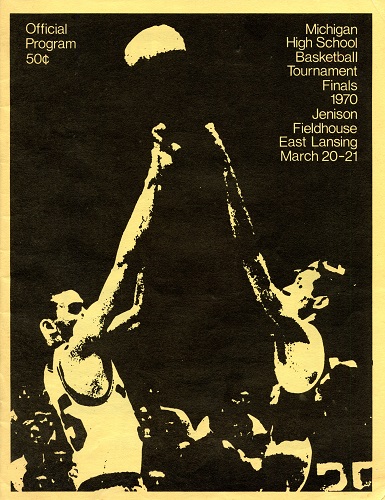 Three of the four Class A semifinalists making the trip to Jenison – Pershing, Midland and Garden City West – were unexpected guests.
“Robinson’s Pershing team and its semifinal opponent, Midland, both qualify as ‘Cinderella’ teams,” wrote John Hill of the State Journal in his tourney preview. The Chemics had also been beaten four times during the regular season. “Midland is a smart, well-disciplined team that doesn’t commit many errors.”
Pershing’s success had been a surprise to everyone. The Doughboys had lost three seniors, including their best player, Paul Seals, to January mid-year graduation. According to Coach Robinson, the current squad was his second team – his bench. The coach recognized the skills of the 15-year-old sophomore, Hawkins: “He WILL be a good ballplayer … but he’s got a long way to go yet and he’s got a lot to learn.”
In Hill’s opinion, the Pontiac Central-Garden City West showdown – the last Semifinal game of the night at Jenison – might be the tournament’s premier contest. “Not only do both bring unblemished records to the game, but each has one of the state’s top players” in Russell and Drewitz.
As it turned out, Pershing completely dominated Midland in their contest as the Chemics were “outshot, outrebounded, and out defensed,” in their 82-71 loss. Only a strong finish saved them from a worse defeat. At game’s end, Pershing had launched 82 shots to Midland’s 68, hitting on 42.7 percent to the Chemics 39.7. The Doughboys ended with a 55-40 rebounding advantage. Hawkins scored 22 points in the opening half, and finished with 31. Harper fouled out, but added 24 points and a game-leading 17 rebounds before his departure.
Robinson, however, wasn’t pleased.
“I wasn’t particularly inspired by the performance,” he said. “Calvin fouled out stupidly. … We’ve worked too long and too hard to make so many silly mistakes. We can’t make those kinds of mistakes tomorrow.”
As predicted, the Central-West matchup was a classic.
“Pontiac Central may indeed be, as a growing number of the ‘experts’ think, the best prep overall basketball team to ply its trade in Michigan since the last of the great Benton Harbor clubs,” stated the State Journal about the Chiefs’ 84-79 victory over Garden City West. “Deadly though they may be, however, the undefeated Chiefs had all they could do Friday to withstand the largely single-handed upset bid of brilliant Garden City West pivotman Rick Drewitz.”
Russell “could do little to slow Drewitz,” who scored 42 points, a Class A Semifinal mark that would hold for 13 years. With multiple ties and lead changes throughout, Garden City trailed by one, 79-78, with 1:40 left to play. But Drewitz – who had scored 15 points in the fourth quarter – picked up his fifth personal with 1:12 remaining, and “Garden City’s hopes went to the bench with him.”
Russell ended with 31 points, but dominated the backboard with 25 rebounds. Many compared the contest to the Dave DeBusschere-Chet Walker, Detroit Austin-Benton Harbor championship game match-up from 1958, won by Austin, 71-68.
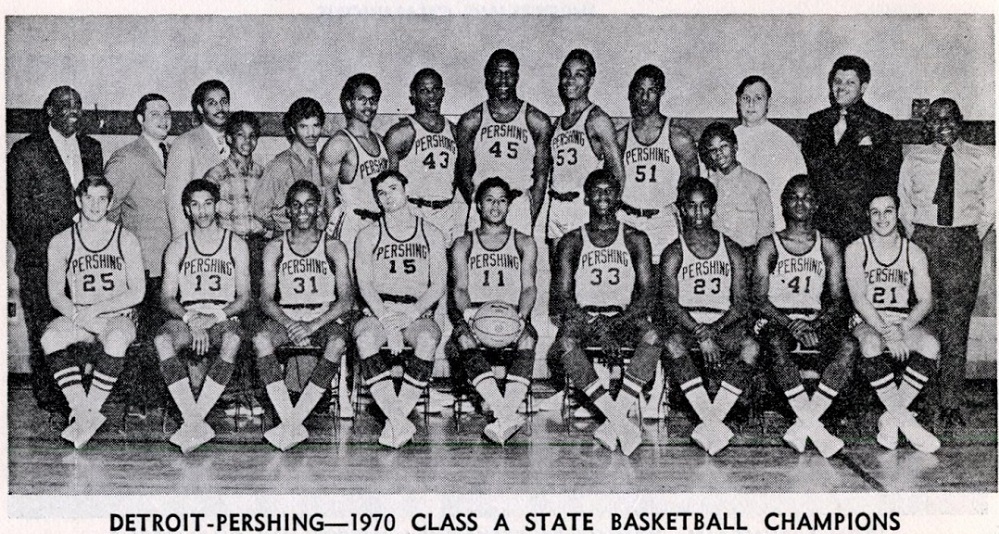 Coach Robinson and his team watched the battle, studying their opponent. The coach was impressed with Pontiac Central.
“They have more height than we do, more speed, more stamina, more poise and they’re an older team,” said Robinson. “But this is one I want.”
Circumstances made Pershing the sentimental favorite, but by all accounts, still the underdog entering the contest.
Storybook Ending
“Pershing High basketball squad staged one of the greatest upsets in Michigan high school tournament history here Saturday night before a steaming, screaming crowd of over 12,000 spectators in Jenison Field house,” exclaimed Schram in the Sunday paper.
“The Doughboys, loser of four games during the regular season, knocked off previously unbeaten Pontiac Central 86-81 in a real shocker.” The Swami, as he was nicknamed, had picked Pontiac to win.
“I know we’re the underdog. … I know few think we can win it,” Robinson had told 500 coaches at the annual banquet of the Michigan High School Coaches Association a couple of hours before tip. “But I’ve got a feeling.” Robinson was in attendance as he was being inducted into the coaches association Hall of Fame.
With the win, Pershing’s team had delivered a beautifully wrapped going away present to the coach.
“In the early going … it looked like the Chiefs would run away with it,” continued Schram. “Pontiac pounded to a 10-4 lead and Robinson called a hasty time out. Robinson sent … Harper to the low post crowding the basket and Harper started a fantastic series of easy layups, turn-around jumpers and tip-ins.” He finished with 24 points.
“Tiny (5-foot-6) but very aggressive guard Phil Paige … got them out front to stay by sparking a 23 point second period with 13 points,” noted the State Journal. The Doughboys’ captain, Paige would finish with 19 on the night.
“Late in the second period, Harper and Darrel Jeter started hitting the boards and Pershing continued to click on its shots,” continued the Free Press. “The Doughboys worked out a six-point lead, 39-33, at halftime.
“The Doughboys maintained the six-point margin in the third quarter, 64-58,” added the Detroit News. “Four times in the final quarter, however, Pontiac slashed Pershing’s lead to two points – at 70-68, 72-70, 74-72 and 76-74. With 2:23 left, Hawkins sank two free throws and … Jeter tipped in a field goal to give Pershing an insurmountable lead … 80-74.”
 A pair of free throws by Paige and two additional baskets by Hawkins capped the upset.
At the final horn, fans mobbed the team. According to Schram, the celebration “rivaled the famed Lansing Sexton – Hamtramck classic of a decade (previous) when the winning shot dropped in overtime after the buzzer.”
Following the game, Robinson, now ready to start recruiting for the future, pitched Russell for his services:
“You’re going to come down to Illinois and play for me, aren’t you? You’ll be All-American and we’ll win the NCAA.”
Illinois bound
The team chose to celebrate the title at a Big Boy restaurant. Then Robinson departed for Normal, Ill., appearing before the local Jaycees that Monday night.
“I’m glad the opportunity came along,” Robinson said before his departure. “I just wish it had come along in Michigan. I never was offered a college job here.”
Robinson had bid for several college coaching positions in the past, only to be turned down.
“I love this country. I wouldn’t want to live anywhere else in the world, I’m just sorry it has a blind spot.”
 Ron Pesch has taken an active role in researching the history of MHSAA events since 1985 and began writing for MHSAA Finals programs in 1986, adding additional features and "flashbacks" in 1992. He inherited the title of MHSAA historian from the late Dick Kishpaugh following the 1993-94 school year, and resides in Muskegon. Contact him at [email protected] with ideas for historical articles.
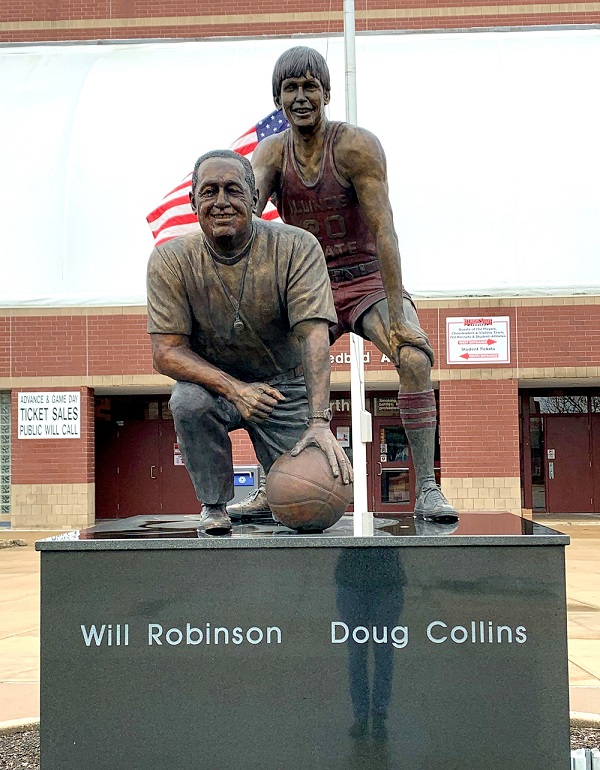
PHOTOS: (Top) Detroit Pershing players and coach Will Robinson celebrate their 1970 Class A championship win. (2) Coach Will Robinson, in 1958 while at Detroit Cass Tech. (3) Detroit King’s George Gervin, who would go on to star in the NBA. (4) Kettering’s Lindsay Hairston, who along with Campy Russell, was among the most sought-after players in the state; he would ultimately take his game to Michigan State. (5) Rick Drewitz of Garden City. The son of a junior high principal, Drewitz chose to play college ball at the University of Kentucky choosing that program over Michigan, Wisconsin, Louisville and Toledo. (6) Considered the top prospect in the nation, Campy Russell received offers from at least 100 schools before selecting University of Michigan. He had narrowed his list to Michigan, Michigan State, Minnesota and Long Beach State. (7) The game program for the final rounds of the 1970 MHSAA Boys Basketball Tournament. (8) The 1970 Detroit Pershing team photo. (9) The Will Robinson-Doug Collins statue outside the north entrance of Illinois State University’s Redbird Arena, unveiled in September 2009. Calvin Harper, Phil Paige, Robert ‘Bubbles’ Hawkins, and Darrel Jeter from Pershing would all follow Robinson to ISU. (Photos collected by Ron Pesch; statue photo by Allison Antink Meyer.)
Breslin Bound: 2025-26 Boys Report Week 1
By
Geoff Kimmerly
MHSAA.com senior editor
December 8, 2025
Winter has certainly arrived in Michigan over the last few weeks – at least from a snowy standpoint – and right on the time to signal the start of boys basketball season and our first report on the annual march to Michigan State's Breslin Center.
 Big matchups already are happening, and every game against an MHSAA Tournament opponent counts toward seeding for District brackets, and once again we're diving into the results you need to know from the previous week, teams that are showing up big in each division and matchups coming up that you won't want to miss.
“Breslin Bound” is powered by MI Student Aid and based on results and schedules posted for each school at MHSAA.com.
Week in Review
The countdown of last week’s five most intriguing results:
1. Grand Rapids South Christian 75, Grand Rapids Christian 71 The Sailors (2-0) opened by adding to last season’s District Final win over Grand Rapids Christian (1-1), and after having lost to the Eagles 72-55 in their season opener a year ago.
2. Bloomfield Hills Brother Rice 71, Detroit U-D Jesuit 42 Brother Rice (2-0) enjoyed some significant payback after falling to Jesuit twice last season, during the regular season in what eventually decided the Catholic High School League Central title and then in their Regional Semifinal matchup.
3. Saginaw United 67, Detroit Catholic Central 57 The Phoenix (2-1) opened their new fieldhouse with a notable season-opening victory over the Shamrocks (2-1), who defeated United 69-55 in their opener a year ago.
4. Grand Blanc 76, Hamtramck 75 (OT) The Bobcats (2-0) opened the season with this notable win at the Horatio Williams Tip-Off Classic.
5. Warren Fitzgerald 41, East Kentwood 40 This was another exciting finish at the Horatio Williams event, again in a faceoff of teams with high aspirations this season.
Watch List
With an eye toward March, here are two teams in each division making sparks:
DIVISION 1
Grand Haven (3-0) The Buccaneers finished an opening week of road games without a loss, defeating Coopersville 65-42 and then Traverse City Central 83-71 and Traverse West 79-77 over the weekend. Grand Haven improved from 11-12 in 2023-24 to 18-6 last season and will have some opportunities to get rolling heading into the new calendar year with a Dec. 22 matchup against Freeland and its Lake Michigan Cup on Dec. 29-30.
North Farmington (2-0) The Raiders are coming off a 12-10 finish and third place in the Oakland Activities Association Red last season, and got off to a fast start under first-year coach Peter Mantyla with a 41-35 win over Canton and a 62-47 victory over Davison while hosting the Horatio Williams Tip-Off Classic. Reigning league champion Birmingham Groves is up next, on Friday, and the first matchup with Farmington – which ended the Raiders’ season last winter – is Dec. 19.
DIVISIION 2
Dundee (3-0) The Vikings appear on track to bounce way back after going 21-5 in 2023-24 but then only 5-18 last winter. They opened last week with a 12-point win over Saline Washtenaw Christian, a 47-46 victory over Milan and a 51-45 triumph over Britton Deerfield – and after losing to Washtenaw Christian by six points during the early going a year ago.
Freeland (3-0) The Falcons are coming off a 22-4 finish and run to the Division 2 Quarterfinals last winter, so a fast start isn’t a surprise. But it was still impressive; Freeland opened with a 22-point win over Bridgeport, then defeated Menominee by 22 and Petoskey by 15 at the latter’s Sean Pollion Invitational. Showcase games against Auburn Hills Avondale and Grand Haven later this month will be opportunities to impress.
DIVISION 3
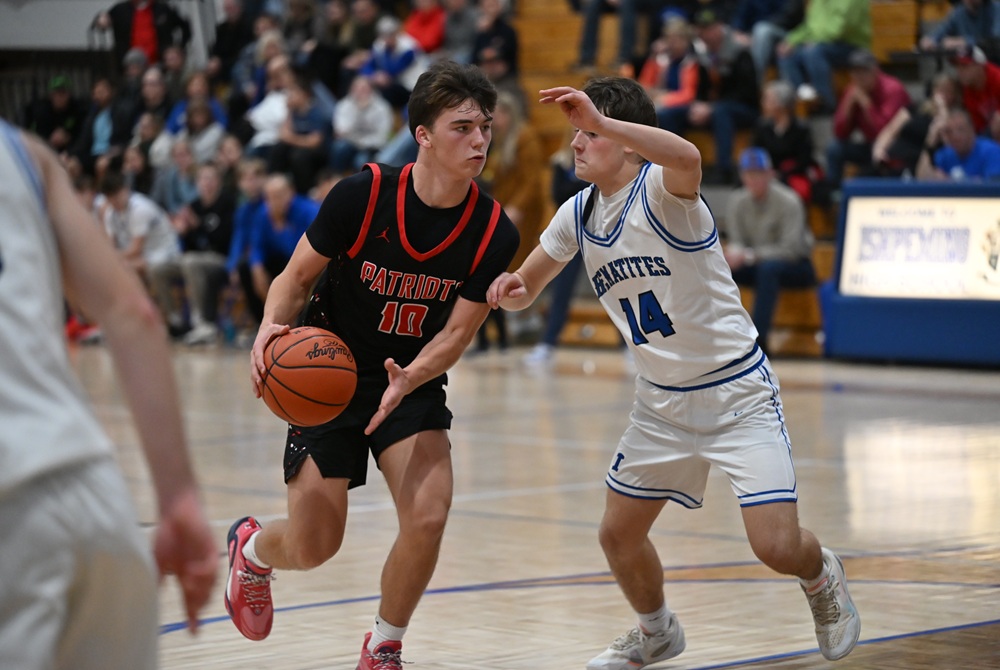
Ishpeming Westwood (3-0) The Patriots reached the Semifinals last season for the first time since 2003 with Ethan Marta leading the way, and he’s doing so again to begin his senior year as Westwood opened with sizable wins over West Iron County and Hancock. They finished a perfect first week with an 83-64 victory over rival Ishpeming.
North Muskegon (3-0) The Norsemen are off to the right start as well after last season’s 23-2 finish and Regional Final run. They won all three of their games last week by at least 20 points, defeating Division 1 Walled Lake Western 64-44 in the championship game of the Will Lynch Invitational at Benzie Central. And they celebrated senior Adam Dugener reaching 1,000 points in the season-opening win over Holton.
DIVISION 4
Clarkston Everest Collegiate (2-0) A Regional finalist and 24-2 overall last season, Everest jumped 10 wins from 2023-24 and is off to a fast start again. The Mountaineers opened with a 61-42 win over Livonia Clarenceville and followed with a 59-42 victory over Flint Beecher. Clarenceville is a Division 2 team, and the great majority of Everest’s regular-season opponents play in Division 2 or 3 with a date as well against Division 1 South Lyon East on Feb. 19.
Eben Junction Superior Central (3-0) Two of last season’s first four losses came to Hannahville Nah Tah Wahsh as Superior Central went on to finish the season 9-14 – after going 16-8 in 2023-24. But the Cougars got on the right track immediately this winter with a 57-42 win over Nah Tah Wahsh to open last week before defeating Cedarville 42-41 and Mackinaw City 48-41 on successive days to win the Battle of the Bridge hosted by the latter.
Can’t-Miss Contests
Be on the lookout for results of these games coming up:
Monday – Ishpeming Westwood (3-0) at Kingsford (2-0) – These two both made it to Breslin Center last season, Westwood reaching the Division 3 Semifinals and Kingsford the same in Division 2.
Tuesday – Flint Powers Catholic (2-0) at Bay City John Glenn (1-1) – These two Division 2 hopefuls both won 20 games last season.
Friday – Grand Rapids Catholic Central (0-0) at Rockford (1-0) – The Division 1 Rams may have won their matchup last season 70-43, but the Cougars went on to finish their season in the Division 2 Semifinals.
Saturday – Warren Lincoln (1-0) vs. Arts & Technology Academy of Pontiac (0-0) at Detroit Mercy – These two also both reached Breslin Center last season, Lincoln winning the Division 2 title and ATAP finishing Division 3 runner-up, and they will face off at the U-D Mercy Showcase.
Saturday – East Lansing (1-0) vs. Detroit Martin Luther King (0-1) at Lansing Eastern – The reigning Division 1 champion Trojans should get a strong challenge at the Moneyball Tip-Off Classic from King, which made the Quarterfinals last winter.
MHSAA.com's weekly “Breslin Bound” reports are powered by MI Student Aid, a division within the Department of Lifelong Education, Advancement, and Potential (MiLEAP). MI Student Aid encourages students to pursue postsecondary education by providing access to student financial resources and information. MI Student Aid administers the state’s scholarship and grant programs that help make college Accessible, Affordable and Attainable for you. Click to connect with MI Student Aid and find more information on Facebook and X @mistudentaid.
PHOTO While being defended by Ishpeming's Dax Kakkuri on Friday, Ishpeming Westwood's Ethan Marta makes a move to the basket. (Photo by Cara Kamps.)