

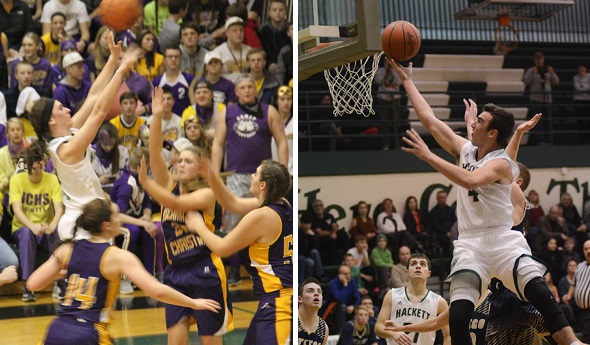
Prestons Lead Hackett to Perfect Starts
By
Pam Shebest
Special for MHSAA.com
January 19, 2016
KALAMAZOO — Dane Preston has had plenty of fun jamming the basketball through the hoop in practice, but never had the confidence to do it in a game.
 That all changed earlier this season when the 6-foot-3 senior streaked down the court and brought the cheering crowd to its feet with a two-handed dunk in Kalamazoo Hackett Catholic Prep’s game against Otsego in December.
“I’ve had a lot of opportunities before where I just didn’t feel comfortable doing it,” he said. “You want to make sure you score.
“I saw pictures from last year where I was so far above (the rim) and I was like, why didn’t I just try to dunk it? You’ve just got to get it in your mind to do it.”
Preston, who averages a team-high 19 points per game, is one reason why the Irish are off to a 6-0 start on the season. But he’s not the only hoops whiz in the family.
His sister, Sydney, 5-foot-9, averages a team-high 16 ppg on the girls team that, at 9-0, is off to its best start in years.
That makes for some rather interesting “can you top this” discussions at home.
“Every single game we played, we get home and she’s like, ‘I scored 18 points,’ and I’m like, ‘I had 20,’” Dane Preston said, laughing. “It’s just like a battle; it’s vicious.”
The pair have a hoop outside at home, and “he usually beats me, but I beat him in H-O-R-S-E a couple times,” his sister said. “Good competition. He doesn’t go easy on me.”
The two may be extremely competitive in basketball, but off the court they have a close relationship forged by a catastrophic event early in their lives.
Their father, Gary, died from a heart attack when Dane was 4 and Sydney 1½.
“I wore number 22 at the Courthouse (Athletic Center, for youth basketball), 14 in 7th and 8th grades, but when I got to high school I decided to wear number 4 because there’s a meaning behind it,” Preston said, referring to his age when he lost his father. “It’s always good to put a meaning behind something that means a lot to you.”
Although his sister was younger when they lost their father, she wears the same number.
“Dane picked 4 a long time ago, and I kinda wanted to be like him,” she said.
Runs in the family
The two come by their basketball prowess naturally.
Their mother, Amy Reisterer Preston, was on the seventh grade team at Kalamazoo St. Mary’s when she was in fifth grade. She played at Comstock High School and one year at Hope College before concentrating on track her four years there.
 When her daughter was in third grade, Preston started coaching her team and has moved up the ranks with her.
After coaching the junior varsity girls last year, Amy is currently the assistant varsity coach, working with her uncle, head coach Nib Reisterer.
That’s not a problem for her daughter — usually.
“I like it for the most part,” Sydney said. “You can let go to my mom because she’s a woman, so it’s easier to talk to her (than a male coach). I think it’s fun to have her on the team.
“My family’s always been some sort of my coach in basketball. Sometimes I don’t like it, but most of the time I do.”
Fridays make life a lot easier for the family.
That’s when both teams play at the same venue. Tuesdays they play at opposite sites.
“I get to have my game with Sydney, then relax and watch Dane,” their mother said of Fridays.
“The balancing act has been a little bit of a struggle for me,” Amy Preston added. “Dane’s a senior this year, so I don’t want to miss half his season, but yet I’m torn.
“I feel like my role with the girls is important, for all the girls, not just Sydney. If I’m not at the games, I feel like there’s a missing link there. I told Dane if there are any games he really needs or wants me to be at on a Tuesday night, I will be there. He just needs to let me know.”
Sizable advantages
At 6-3, Dane Preston isn’t close to being the tallest player on his Class C Southwestern Athletic Conference team.
Senior Riley Gallagher and junior Teddy Oosterbaan are both 6-7 and lead the team in dunks.
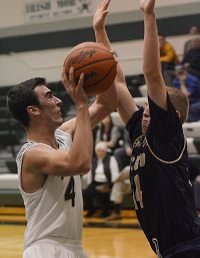 “Riley’s had three, and Teddy’s had three,” Dane said. “Teddy’s athletic and Riley’s just really tall. It’s easier for them.”
In addition, 6-1 senior starter Jack Dales is second in team scoring with 16 ppg.
“Me, Jack and Riley have been together since first grade,” Dane said. “We have some chemistry together. Our offense is really explosive.”
The offense exploded Friday in the fourth quarter in a matchup of unbeatens with Hackett eking out a hard-fought 54-48 win against crosstown rival Kalamazoo Christian.
Said Gallagher: “We have what every team needs: a person at every position that can help.
“Teddy at the center. He’s one of the biggest kids in the league. Me at forward, (sophomore) Jacob (Niesen) or (sophomore) Casey (Gallagher) at three and Dane and Jack at point guard.”
Dales said everyone contributes and “Dane brings extreme scoring and hard work to the team.”
Mark Haase, who coached at Three Rivers, Otsego and Berrien Springs before taking over at Hackett this season, added: “In 17 years of coaching, this is probably the best chemistry I’ve ever had. They enjoy themselves, they enjoy each other. You can tell they’re having fun.
“They’re very unselfish and have very good chemistry and obviously some good players, too. I’ve coached at two Class B schools, and these four (Preston, Dales, Riley Gallagher, Oosterbaan) could play at any one of them.”
Haase said Preston is the serious one.
“Not in a bad way,” he quickly added. “Jack and Riley and Teddy are a little more loose. Dane has always wanted to be a good player, and he’s become a good player. Basketball means a lot to him.
“If there’s a big shot, he’s probably the guy who’s going to take it. He’s a good team player. He understands when to shoot and when not to shoot. A great scorer, a pretty good passer and he’s developed into a better defender.”
Andrew Marshall, A.J. Estes, Bryant Neal and Kieran O’Brien are the other seniors on the team.
Juniors are T.J. Krawczyk, Adam Wheaton, Donovan Kelly and Luke DeClercq.
One of Preston’s goals is to reach 1,000 career points. He has 716 so far.
Another is to end the season playing for an MHSAA title, something the Irish haven’t accomplished in 80 years.
Strength despite low numbers
Although there are just nine players on the girls varsity, “All the players we have are really good,” said captain Maura Gillig, the only senior on the team. “Our bench can come in and be really good.”
Two players top Sydney Preston’s 5-9 height. Junior Hope Baldwin is 5-11 and Gillig 5-10. Sophomore Savannah Madden measures 5-8.
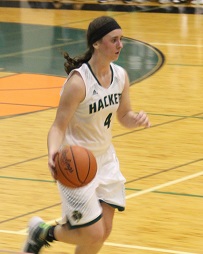 “We have a really strong defensive team,” Preston said. “We have some key shooters. We have a good mix of girls.
“Savannah went to St. A’s (St. Augustine) and I went to St. Monica, so we played against each other (before high school). Last year we finally got to play with each other (on junior varsity). We really clicked, then she got moved up to varsity.”
Said Gillig: “Sydney brings a lot of intensity. She loves to play and brings a lot of energy onto the court.
“She’s always one of the players that if we ever need a steal or a play to bring us back in the game, she’s the one who will get it. She’s competitive, but she’s really encouraging to everyone.”
Juniors on the team are Emily Matthews, Cierra Barker, Naomi Keyte and Molly Panico. The other sophomore is Jessie Wenzel.
With just one senior this year, “I think we’ve got a really bright future here,” Reisterer said.
Amy Preston, who took a break from coaching to earn her master’s degree in exercise science, rejoined the coaching ranks when her daughter was in third grade.
“Being the mom part, I know my daughter’s potential,” she said. “I tend to be a little tougher on her and have higher expectations because I know what her potential is.
“That’s probably hard for her because she probably feels I’m picking on her more than the other girls. It’s kind of a fine line. It’s important for me not to show favoritism, too.”
Reisterer played basketball at Hackett, graduating in 1972, and coached Amy in seventh and eighth grades at St. Mary’s school.
Talking about his great niece, Reisterer said: “Sydney gives us a player who can finish at the backboard, and she can hit an outside shot. She can drive, she makes her free throws, so she’s got a well-rounded game.
“Her rebounding has improved dramatically and her defense is getting better. She’s discovering what she can do on the court. She’s like a sponge. She’s soaking it all in.”
 Pam Shebest served as a sportswriter at the Kalamazoo Gazette from 1985-2009 after 11 years part-time with the Gazette while teaching French and English at White Pigeon High School. She continues to freelance for MLive.com covering mainly Kalamazoo Wings hockey and can be reached at [email protected] with story ideas for Calhoun, Kalamazoo and Van Buren counties.
PHOTOS: (Top) Sydney Preston, left, fires a shot against Kalamazoo Christian, while brother Dane Preston gets a look against Otsego. (Head shots) Sydney Preston, Dane Preston, Amy Preston. (Middle) Dane Preston looks for an opening. (Below) Sydney Preston brings the ball upcourt. (Girls photos and head shots by Pam Shebest; boys photos by Scott Dales.)
All-Time Leading Scorer Allen Ready to Set Pace for Wayne Memorial's Title Pursuit
By
Keith Dunlap
Special for MHSAA.com
February 20, 2026
WAYNE — Jaylohn Allen insisted making such history wasn’t one of his goals when he started his varsity basketball career as a freshman.
 Given that, it made the moment all the more special last week.
During a game against Harvey Thornton (Ill.) on Valentine’s Day, Allen and the Wayne Memorial community loved seeing a 30-year-old record broken by Allen, who became the boys basketball program’s all-time leading scorer.
Allen surpassed the 1,748 career points scored by former Michigan State player Lorenzo Guess, who finished his career in 1996.
“To be the all-time leading scorer at Wayne Memorial High actually wasn’t one of my goals coming in as a freshman,” Allen said. “And honestly I didn’t really think I was going to pass it because 1,700 points is a lot of points, per se. To do that as a kid who grew up with many accomplishments and dreams I wanted to have was a joy. I thought 1,000 points was surreal, but the record meant so much more.”
Signed to play in college for Toledo, Allen certainly has meant a lot to Wayne Memorial over the past four years, and he hopes to make even more history for the Zebras over the next few weeks.
Allen is averaging nearly 23 points a game this season and is determined to try and get Wayne Memorial back to the Division 1 championship game, where it loss last year to East Lansing.
When the Zebras accepted the Finals runner-up trophy, they obviously had immediate reason for optimism given Allen and fellow backcourt mate Carlos Medlock – a Michigan State signee – were only juniors.
But Medlock threw a major wrinkle into Wayne Memorial’s title ambitions when he decided over the offseason to transfer to a prep school in Missouri.
“I found out maybe a week before he posted on social media,” Allen said of Medlock’s decision. “There were rumors about it, but I didn’t really think he was going to leave. It was a shock, but I was still ready to attack the senior season regardless of what happened and look forward to the senior season with or without him.”
Allen has certainly done that and more.
 Instead of pouting or looking to leave himself, Allen treated Medlock’s departure as a chance to prove he was a worthy Mr. Basketball Award candidate this winter.
Over the summer, he worked to get in terrific shape and continued to not only hone his on-court talents, but became an even more vocal leader to younger players coming back.
“It put me into a bigger role and let people see I can score the ball even more than I’ve been doing the past three years,” Allen said. “It put a fire in me and some motivation that I could be more of the man with the ball.”
One person not surprised that Allen adapted so well without Medlock was Wayne Memorial head coach Steve Brooks.
“He’s pretty much always been the man; he just hadn’t been the leading scorer all the time,” Brooks said.
Allen said there were adjustments playing without his running mate of the last three years, especially when trying to get out in transition.
“Being on the floor and not seeing (Medlock) on the other side of the court and being able to swing it to him — it was just a connection in transition or any other core set that we had,” Allen said. “(The adjustments were) just realizing he’s not on the court and having to utilize my other teammates and making sure they are getting everything they need.”
There was a major scare in December, just before the holiday break, when Allen left a game with a knee injury after he took a charge.
“We thought he was lost for the year,” Brooks said.
But the injury was only a bone bruise, and Allen missed just 13 days and has been an unstoppable force since.
To Brooks, it’s obvious who should be Mr. Basketball.
“Mr. Basketball traditionally is for what you’ve done for your career and not just for a season,” Brooks said. “Over his career, he’s at 19 points a game. Him and Medlock both had 1,000 career points before Christmas of their junior year.”
While Mr. Basketball would be nice and the scoring record is an honor, there is one main purpose for Allen, and that is to get another shot at the Division 1 title that eluded Wayne Memorial last year.
The Zebras enter tonight’s Kensington Lakes Activities Association championship game 18-3 and carrying a 10-game winning streak.
“I want them to get there more than me,” Allen said of his teammates. “I want them to show me how much they want to be there so when it comes down to it, we’re ready for it.”
 Keith Dunlap has served in Detroit-area sports media for more than two decades, including as a sportswriter at the Oakland Press from 2001-16 primarily covering high school sports but also college and professional teams. His bylines also have appeared in USA Today, the Washington Post, the Detroit Free Press, the Houston Chronicle and the Boston Globe. He served as the administrator for the Oakland Activities Association’s website from 2017-2020. Contact him at [email protected] with story ideas for Oakland, Macomb and Wayne counties.
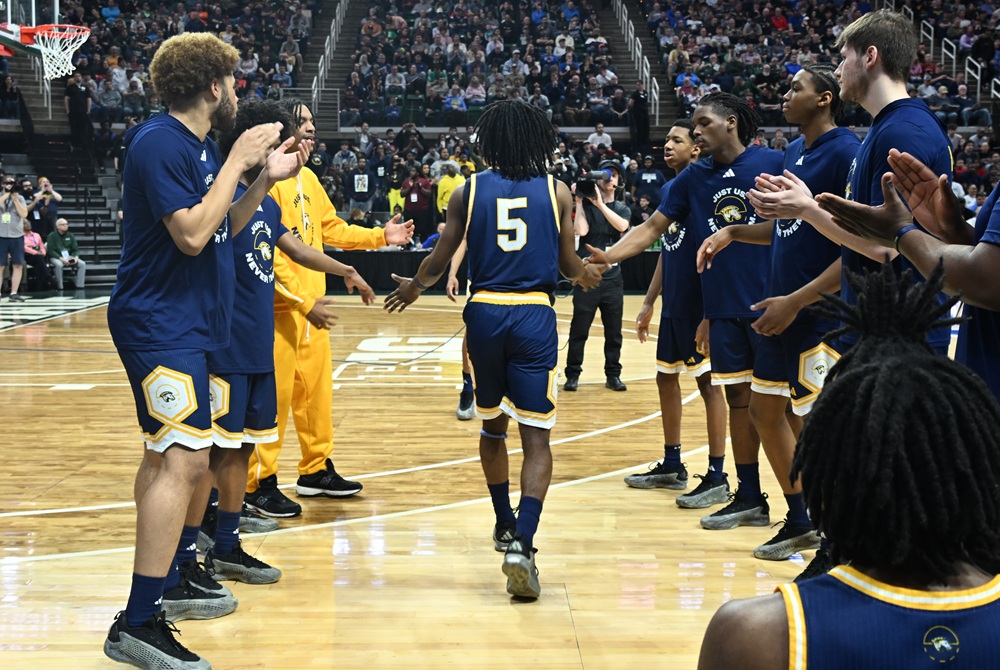
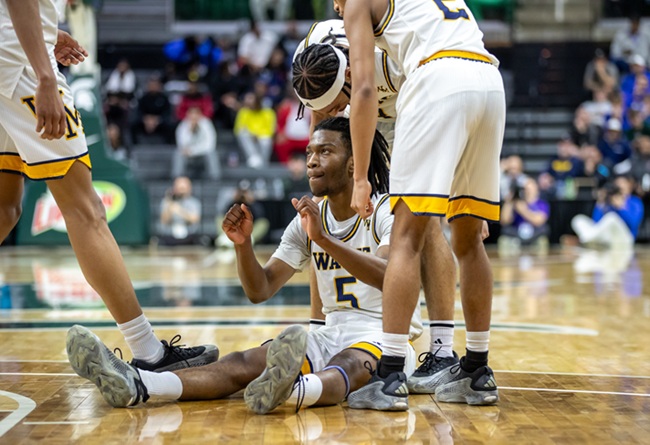
PHOTOS (Top) Wayne Memorial’s Jaylohn Allen (5) makes his way through his teammates during introductions before last season’s Division 1 Final at Breslin Center. (Middle) Teammates help Allen up from the floor during the Zebras’ Semifinal win.