

Promise Kept, Dream Continues for Morenci
March 26, 2015
By Geoff Kimmerly
Second Half editor
EAST LANSING – Every summer, Morenci boys basketball coach Jim Bauer comes up with a catchy, aspiration-filled slogan for his kids basketball camp T-shirts.
Pathway to Breslin. Small Town, Big Time. “Breslin is on every shirt,” Bauer said, “but deep down, you’re thinking, am I ever going to get there?”
Three years ago, a freshman named Austin Sandusky made a promise he and his teammates kept Thursday. And now they’ve got an opportunity to carry it one step farther.
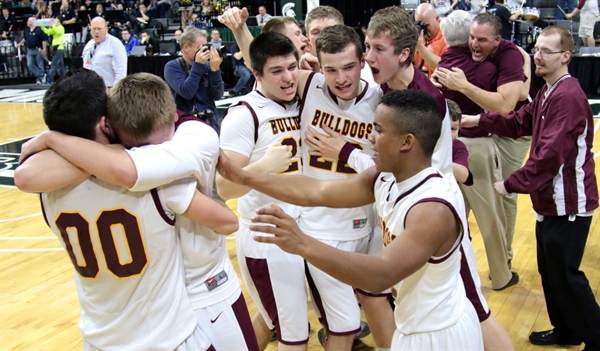
Morenci will play for its first MHSAA championship after handing Waterford Our Lady its only loss this season, 53-52, in a Class D Semifinal on Michigan State University's home floor.
“We started in fourth grade, and it seemed every tournament we’d be in the championship game,” Sandusky said. “Every year our coaches told us it wasn’t for this championship game, it’s for when we’re juniors and seniors on the varsity level trying to get to the (MHSAA) championship game. We knew they wouldn’t say that unless they truly believed it.”
Morenci (25-2), unranked when this tournament began, will face top-ranked Powers North Central in the 10 a.m. Final on Saturday.
Bauer has coached four 20-win teams over two tenures measuring a decade at Morenci, with this year’s his second straight to reach that milestone win total. But he’s also had three teams finish with sub-.500 records, including only two seasons ago.
 No Morenci player measures taller than 6-foot-3, and senior guard Alex Thomas said he and his teammates always knew they’d be a little smaller than their opponents. But the Bulldogs returned four starters after falling to eventual MHSAA runner-up Adrian Lenawee Christian in last season's District Final. Two weeks ago, Morenci won its first Regional title since 1954, and the Semifinal was the first in the program’s history.
But the run nearly ended there – even though the Bulldogs led Thursday for all but 3 minutes and 55 seconds.
They were ahead from the middle of the first quarter until Our Lady senior Nick Robak hit a go-ahead jumper to make the score 38-37 with 7:08 to play.
Morenci took the lead back and pushed it to six points three times, including with 14 seconds remaining. But Robak hit another big shot – a 3 pointer to cut the deficit in half with eight seconds left – and after a steal by junior teammate Adam Kline was fouled on another 3-point attempt with less than a second to go in regulation.
Robak was faced with making all three free throws to tie the score. An 86-percent free-throw shooter, he connected on the first two – but missed the third.
“Layups and free throws, they matter. And they probably came back to bite us in the end,” said Our Lady coach Paul Robak, also Nick’s uncle. “Thirty-two minutes were played, and we lost our opportunity a long time before (the final second). We would’ve never gotten here without the efforts of Nick. … There are lessons in everything, and although we came here to win and not get a lesson, I hope we can find that lesson down the road.”
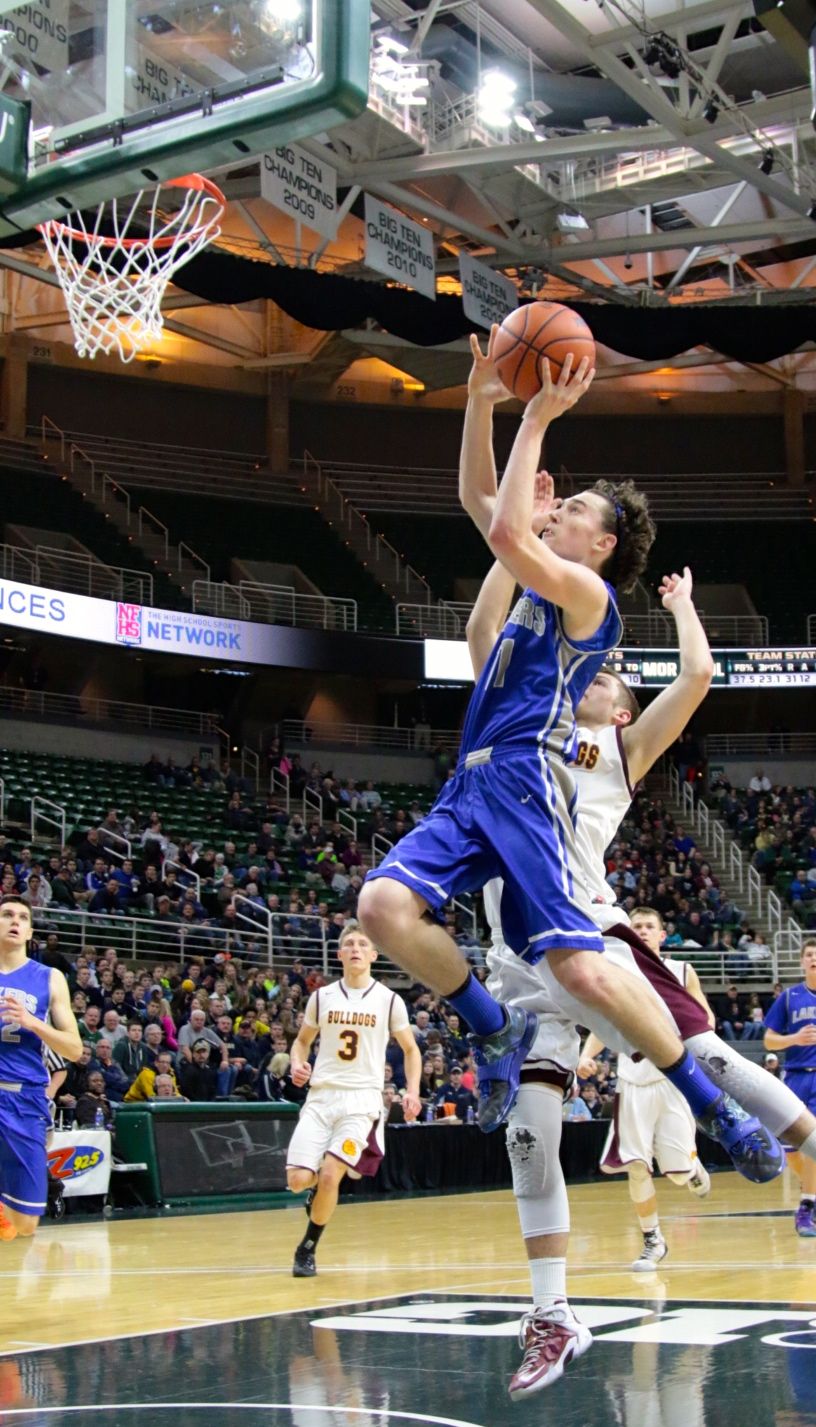
Robak scored a game-high 21 points and grabbed 11 rebounds to go with four assists. Kline added 12 points and five assists and junior forward Clay Senerius had nine points, 11 rebounds and four assists. But the team made only 6 of 14 free throw attempts and missed some shots from the lane that usually have fallen.
The Semifinal was Our Lady's first since 1993. The Lakers finished with a school record for wins in ending 25-1.
Thomas had 19 points and seven rebounds as the only player in double figures for Morenci. Sandusky added seven points, five rebounds and five assists as all five Bulldogs starters scored at least six points, and eight players saw at least nine minutes of action.
They didn’t play an opponent this season that received votes in the final Associated Press rankings. But they did avenge both of their losses and had won all of their tournament games by at least 12 points before Thursday’s nail-biter made what might’ve seemed like an unrealistic Sandusky dream continue to come true.
“You never discourage a kid from having a dream,” Bauer said. “You go along with it and hope for it.
“That’s what I wanted too.”
Click for the full box score and video from the postgame press conference.
PHOTOS: (Top) Morenci players celebrate their first MHSAA championship game berth. (Middle) Waterford Our Lady’s Nick Robak gets past a defender for an open look Thursday.
Data Dig Continues for Hoops Histories
March 7, 2017
By Ron Pesch
Special for Second Half
There is a list – well actually two – that sit, unfinished, among the “1,001 Projects I’d Like to Complete Before I Die.”
I became the caretaker of these lists back when I inherited the title “Historian for the MHSAA” in 1993.
The original lists contained the scores of all MHSAA Quarterfinal, Semifinal and Final round games for the MHSAA boys and girls basketball tournaments since their origin.
From the 1930s into the late 1960s, the MHSAA tournament game-day program was generally nothing more than a single sheet document, containing tournament brackets and team rosters for the qualifiers.
 In 1969, the program saw a redesign by Lansing sports personality Tim Staudt and premiered at the MHSAA Tournament. Sold for 50 cents, it included a list of “Past Michigan State Champions” containing the names of the winning teams and those schools’ basketball coaches for each of the four classes. The publication also included a couple of articles from Dick Kishpaugh, the author of the champions list. Kishpaugh was identified as “Sports Information Director at Kalamazoo College and … perhaps the most knowledgeable historian on Michigan high school basketball.”
With the start of the Girls Basketball Tournament in 1973, a similar program design was followed.
Those lists were faithfully updated and published in the game-day programs in the same format until the 1987-88 school year, when the souvenir publications were expanded. For the first time, a list containing opponents and final scores of the boys and girls championship games was now available to the general public.
Among the first tasks I chose to approach when I assumed the duties of MHSAA historian was to chase more information.
Since Kishpaugh’s lists had game scores for the three final rounds of the tournament, and names of the championship coaches, I thought I would try to leave my mark. I began chasing down the names of coaches for the runner-up, as well as final win-loss records for both schools. And while I was at it, I decided to see what I could find for teams that made the Quarterfinals and Semifinals.
Hundreds of hours have gone into adding to and maintaining the lists, and much progress has been made. Yet, some 20+ years later, I’m still trying to fill holes in the data.
The Basketball Coaches Association of Michigan helped spread the word, notifying its membership of the project. Web pages were created for both the boys and girls to show teams still missing information.
 The pursuit has led to friendships, and fascinating stories, documents and images. The late Walter Michael, who had attended the MHSAA Finals for more than 60 years, donated a cache of MHSAA tournament programs from the 1940s through the 1960s that filled in the names of many high school coaches. Del Newell, a sports writer from the Kalamazoo Gazette, knocked out most of the Kalamazoo schools early in my search. Bill Khan, then of the Flint Journal sports department, filled in a large number of missing names and records from the Flint area. The recently retired “Son of Swami,” better known as Mick McCabe, contributed by including the win-loss records of the quarterfinalists in his annual tournament prognostication columns for the Detroit Free Press.
Numerous coaches around the state sent e-mails and letters with the names and records for their predecessors. Prep basketball fans and former players sent along offerings. Rob Madsen from Mt. Pleasant became a huge contributor, and sent regular updates to both lists. He focused on some of the state’s smallest schools, including many from the Upper Peninsula.
Leon Westover sent the win-loss record for little Marlette, 1951 Class C runner-up, as well as one of my favorite photos from that golden era of prep sports. Marlette had “waltzed through the Mid-Thumb League and district, regional and quarter-final tournament games,” wrote Fred J. Vincent of the Port Huron Times-Herald. Marlette slipped past Stanton 41-37 to advance to the Class C title game against unbeaten Detroit St. Andrew.
“Just one game too many …,” continued Vincent, writing from East Lansing’s Jenison Field House following the title game. “That just about explains the one-sided beating Marlette absorbed in the state class C high school basketball final here Saturday afternoon. The final score was 52-26. … One of the smallest teams, physically, in the tournament, it seemed that the Raiders were just worn out.”
Yet, that night, the team was celebrated like the hometown heroes they really were.
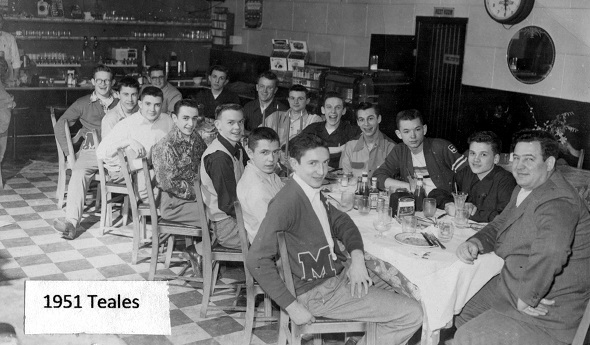
 Westover’s photo shows the Red Raiders on the night of the Final, gathered at Teale’s Restaurant in Marlette. The clock indicates its 11:30. The owner, George Teale, has opened up his restaurant for the team to cook them steaks in honor of their achievement. Coach Nieland "Tommy" Thompson and his 22-2 squad look happy, ready to celebrate a long season.
At tournament time, these lists help answer media requests that arise.
Question: When was the last time two undefeated teams met for an MHSAA Finals championship?
Answer: 2003-Class A for the girls. Detroit Martin Luther King topped Flint Northern 58-53. 1971-Class C for the boys. Shelby downed Stockbridge 71-57.
Question: What coach had the longest span between championship game appearances?
Answer: Eddie Powers, coach of Detroit Northern, went 34 years between his Class A championship team in 1930 and his runner-up squad in 1964. The mark is asterisked, however, as the Detroit Public School League chose to stop participation in the annual state tournament from 1931 through 1961. Saginaw’s Larry Laeding went 20 years between winning the 1942 Class A championship and his squad’s 1962 Class A title. Maple City Glen Lake coach Don Miller went 19 seasons between the school’s 1977 Class D title and its 1996 runner-up finish, also in Class D.
For the girls, both Mary Cicerone at Bloomfield Hills Marian and Carl Wayer at Ashley went 16 seasons between appearances. While Cicerone’s Marian teams have made seven visits to the Finals and have won six Class A titles, 16 years elapsed between Marian’s 1998 and 2014 Class A championships. Marian then captured a second consecutive title in 2015. Coach Wayer advance two teams to the title game. Ashley finished as runner-up in Class D in 1980 and again in Class D in 1996. The loss in 1996 came in overtime, and was the only defeat for Ashley that season.
Michigan’s high school basketball tournaments are an experience shared, mostly unchanged, since their beginnings. At the end of the regular season, everyone qualifies for the madness. Yet in the end, only four teams finish as champions. The path mimics the magical trail taken by fathers, grandfathers and great grandfathers, mothers and grandmothers. Qualifying for the Quarterfinals is still a huge triumph, as the round brings together only 32 teams from a field of more than 700 boys teams and more than 650 girls teams.
In my eyes, these lists emphasize that remarkable, undiluted achievement. In a world consumed with trophies and the number “1,” perhaps it is time to step back and celebrate this rare journey.
Click for Ron Pesch's data "Needs Lists" for girls basketball and boys basketball.
 Ron Pesch has taken an active role in researching the history of MHSAA events since 1985 and began writing for MHSAA Finals programs in 1986, adding additional features and "flashbacks" in 1992. He inherited the title of MHSAA historian from the late Dick Kishpaugh following the 1993-94 school year, and resides in Muskegon. Contact him at [email protected] with ideas for historical articles.
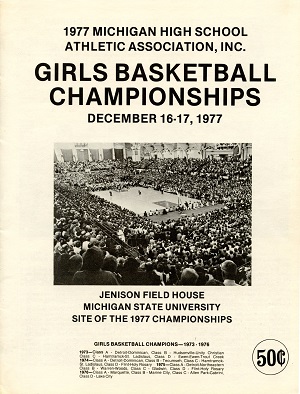
PHOTOS: (Top) Marlette's 1951 boys basketball team gathers for dinner at a local restaurant after the Class C Final. (Middle top) The 1969 Boys Finals saw the addition of updated tournament programs. (Middle below) The 1977 Girls Finals program told of the teams that would meet at Jenison Field House. (Below) The 1947 Boys Finals program was among many that helped fill in data gaps from the early years of the tournament. (Photos provided by Ron Pesch.)