

Record-Setting Scorer Kerby Eager to Take Frankfort on Another Tournament Run
By
Tom Spencer
Special for MHSAA.com
February 7, 2025
Three months ago, Carter Kerby’s football season ended by injury – and it left him and his coaches wondering about his basketball future.
 But now everyone clearly knows the outcome – and it’s everything they could have desired.
Kerby immediately underwent surgery following the practice injury that prevented him from fulfilling his role as the starting quarterback for Frankfort in the MHSAA Football Playoffs. The injury was a clean break of his left collarbone. Seven pins and a plate were implanted into his shoulder.
He was told he could start shooting a basketball four weeks after surgery. Fast-forward to today, and the right-handed Kerby is shooting with surgical precision – and with high hopes of leading Frankfort to Breslin Center for the Divisions 4 Final.
Frankfort, which plays at Gaylord on Saturday, sports a strong supporting cast for Kerby, and younger players have gained invaluable experience.
“We have a pretty well-stacked team, and we have some young sophomores and juniors,” Frankfort coach Dan Loney said. “They’re getting a ton of experience, and I think that’s going to pay off down the stretch for us.”
Kerby, a 6-foot-3 guard, is ready to finish off the regular season and begin his fourth postseason run with the Panthers. Last year Frankfort fell 44-42 in the District Final to Maple City Glen Lake, which went on to reach the Quarterfinals. In Kerby’s sophomore year, the Panthers reached the Semifinals, and his freshman season ended in the Regional.
“The goal is to go back to the Bres,” said Kerby, who tied the single-game school record of 46 points last month. “I try not to look too far ahead. We have finish off the regular season before anything, and it’s all going to come down to defense, rebounding and just grit.”
Frankfort is 9-7 and out of the Northwest Conference race this season. But the Panthers are well-known for their ability to make a playoff run.
They’re coming off a 49-37 win over Brethren on Thursday during which Kerby had 13 points and 10 rebounds. Tristin Griffin, who averages 12 points per game, added eight and collected 10 rebounds as well.
“It’s the same thing that happens most years, if I am being honest,” acknowledged Kerby, who is averaging 21 points per game. “We’re not always a regular-season team.”
 Loney, in his seventh season as the Panthers head coach, agrees with his senior star. Win-loss records don’t accurately show the strength of his team, he notes.
“Our conference is tough,” Loney said. “I think we have the pieces to string together some postseason wins.”
Frankfort’s tournament run will begin and possibly end in Suttons Bay. The Panthers’ District features Buckley and Leelanau St. Mary – teams with similarly-strong histories of recent postseason runs. Add in Traverse City Christian, which is eyeing a potential first District championship, and the ever-improving host Norsemen.
The Panthers are anxiously awaiting the Feb. 16 release of District pairings.
“It’s a tough District,” Looney noted. “We’re definitely going to have to come to play. That’s why we’re trying to work the kinks out, get on a roll and figure out what we have to do to win these tight games.”
Four of Frankfort’s losses were by six points or fewer, including two four-point setbacks to Benzie. The Panthers won one and lost one to Glen Lake. St. Mary topped Frankfort by 10. The other loss was a lopsided one courtesy of Division 2 Grand Rapids South Christian December after the Panthers had started 5-0.
“Our record doesn’t quite show what we really are,” Loney said. “We need to find a way to win those close games down the stretch.”
Kerby, who would trade his individual school record for another deep postseason run, hasn’t ruled out topping his 46-point effort. He’s had 43 in a game this year as well.
“I would love to go for more, and it feels great putting in the time and effort and seeing things come out of it,” said Kerby, who also reached 1,000 points for his career in late January. “But I just want us to get rolling and get in a good groove – I’d give anything up for that.”
Kerby scored 28 points in a 62-52 season-opening win over Suttons Bay after being cleared the night before. He hadn’t even seen the practice floor.
The injury happened as the Panthers were practicing a potential trick play prior to their football playoff opener. Kerby was hurt attempting to catch a pass. He had surgery two days later, on his birthday.
“The ball was just a little overthrown, and the ball hit me in the hands and hit the ground,” Kerby recalled. “I stepped on the ball and flipped, landing shoulder first.”
The Panthers faced Beal City, a familiar football postseason opponent, but without their starting QB. Beal City won that matchup 47-0 and went on win the Division 8 championship four weeks later.
Loney recalls getting the message his star shooter had been injured in football practice, and that his ability to play basketball this winter had become uncertain.
“It’s definitely not the text message I wanted to see the last week of football,” Loney said. “After surgery, we started sizing up when he would be back, and we were at peace with it.”
 Tom Spencer is a longtime MHSAA-registered basketball and soccer official, and former softball and baseball official, and he also has coached in the northern Lower Peninsula area. He previously has written for the Saginaw News, Bay County Sports Page and Midland Daily News. He can be reached at [email protected] with story ideas for Manistee, Wexford, Missaukee, Roscommon, Ogemaw, Iosco, Alcona, Oscoda, Crawford, Kalkaska, Grand Traverse, Benzie, Leelanau, Antrim, Otsego, Montmorency, Alpena, Presque Isle, Cheboygan, Charlevoix and Emmet counties.
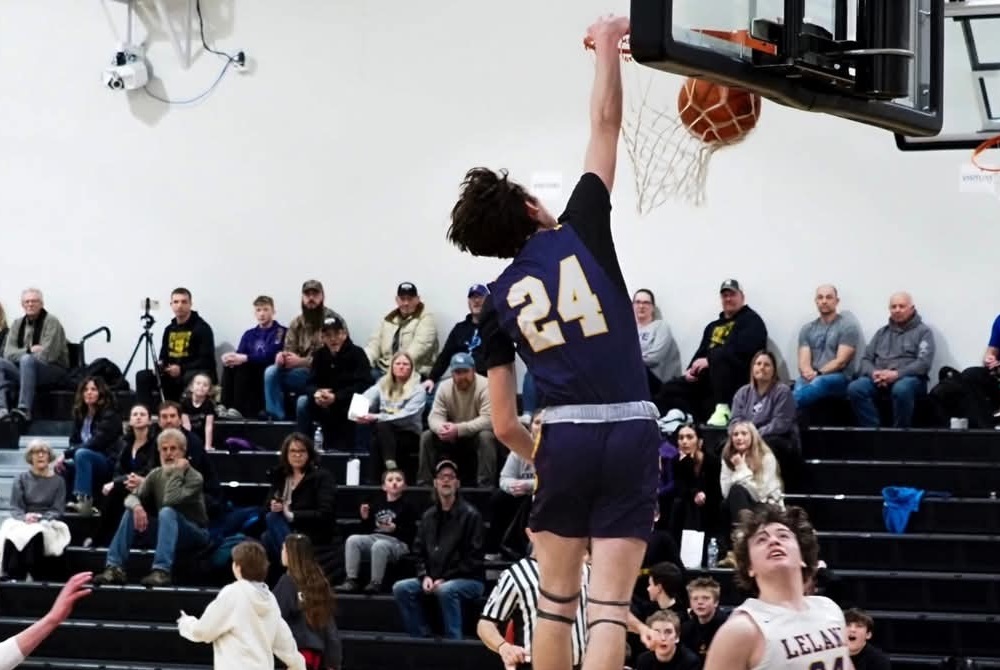
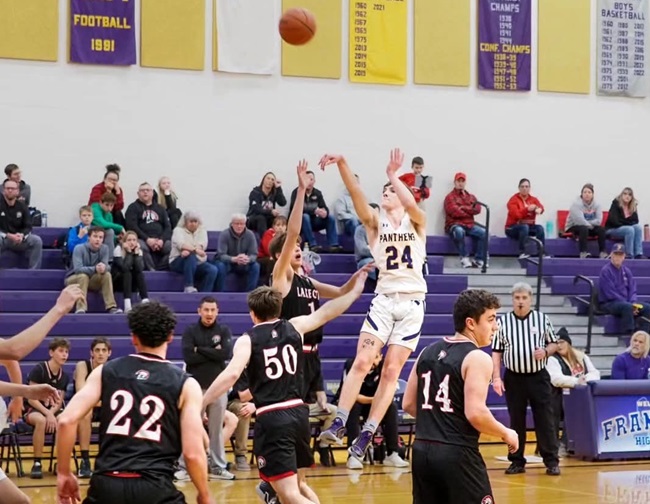
PHOTOS (Top) Frankfort’s Carter Kerby throws down a dunk against Leland. (Middle) Kerby (24) launches a jump from the top of the key against Lake City. (Photos by Nick Cooper.)
Tri-Unity Avenges Season-Opening Loss, Earns Retiring Coach Another Finals Win
By
Jeff Bleiler
Special for MHSAA.com
March 15, 2025
EAST LANSING — The Wyoming Tri-unity Christian High School boys basketball team was not about to end its season the way it started – with a loss to Fowler.
The Defenders also were not going to let legendary coach Mark Keeler ride off into the sunset after a 38-year career without another Division 4 championship.
On the strength of suffocating defense and two double-digit scoring runs, along with frigid Fowler shooting during the first half, Tri-unity defeated the Eagles 49-32 on Saturday at the Breslin Center to claim its second-straight title and third over the last four years.
Keeler, who announced his retirement earlier this season, departs with his seventh MHSAA Finals championship. Fowler was making its first appearance in the championship since 2002 – when the Eagles also lost to Tri-Unity.
“This is not going to be a good time for me because I’m pretty emotional,” Keeler said. “I’m so stinking proud of them. Was that good defense? I think that was good defense. We played a great team. I thought we didn’t quit.”
 Keaton Blanker led Tri-unity (27-2) with 12 points, followed by Noah Silverton with 11, all in the first half.
“Our biggest emphasis was playing 32 minutes,” Blanker said. “We don’t stop fighting until that final buzzer, and we did that. I’m just so happy for all us players.”
Tri-unity graduated eight seniors from last year’s championship team, with only Blanker and Joey Mellon seeing significant playing time, so another Division 4 title wasn’t necessarily a sure thing, especially after the loss to Fowler on opening night at home.
“I don’t think a lot of people thought that we could do this,” Blanker said. “We just fought. Every day at practice was a straight grind.”
Tri-unity’s defense was smothering all season – holding teams to an average of 39 points per game, the lowest of Keeler’s tenure – and it was downright sterling Saturday.
The first Fowler basket was a 3-pointer by Jacob Halfmann more than five minutes into the contest after Tri-unity scored the game’s first 11 points. That was quickly followed by another 3-pointer by Aaron Simon, but that was all the Eagles could muster as Tri-unity led 11-6 after the first quarter.
Six quick points from Tri-unity – aided by Fowler turnovers – pushed the lead back to 11 less than two minutes into the second quarter. At that point, Fowler had three times as many turnovers (six) as field goals (two).
The lead stretched to 16 halfway through the second quarter, prompting a third Fowler timeout.
A Jacob Halfmann 3-pointer at the 3:15 mark ended another lengthy Fowler scoring drought – and a 13-0 Defenders run – and made the score 24-9. He finished with a team-high 11 points.
The Eagles (25-4) struggled in the first half to find an answer for Silverton, who eclipsed double figures in points before they did.
“Today we just started a little slow. It took a little bit for us to settle in,” an emotional Fowler coach Kam Riley said. “We kept talking about, we got to settle in and be ourselves, and I thought we did that as the game progressed. Against a good team like Tri-unity, you dig a hole, it’s going to be tough to get out of it.”
An Alex Halfmann layup with 2:05 to play in the first half was the first Fowler field goal inside the 3-point arc. Despite a solid finish to the half by Fowler, the Defenders carried a 28-16 lead into the break.
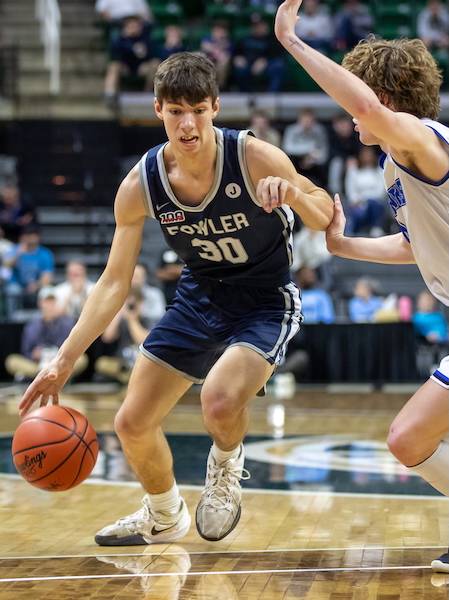 The Eagles cut the lead to seven late in the third quarter as Tri-unity suddenly appeared mortal.
“They came back at us at the start of the second half, and we knew they would,” Keeler said. “I just thought my guys played great defense. I was more excited about our defense.”
A Clayton Rowlader 3-pointer pushed the lead back to double figures. Fowler pulled within 39-30 with 3:48 to play before Tri-unity closed the game with a 10-2 run boosted by two more 3-pointers by Rowlader. The Defenders finished 4-of-10 from long range after making only one of 23 attempts combined during Regional Final and Quarterfinal victories.
Keeler said this championship was different than the others because it’s his last, and that despite the loss of so many upperclassmen from last year’s team, he had a feeling this team could win it all.
“The competitive part of me, I wanted to win and I knew we could because I’ve watched these guys mature,” Keeler said. “I love defense. It’s the old adage, if you can do offense, you’ll win games, but if you play good defense, you’ll win state championships.”
Keeler finished his career with a 721-218 varsity coaching record, his wins ranking third in MHSAA boys basketball history.
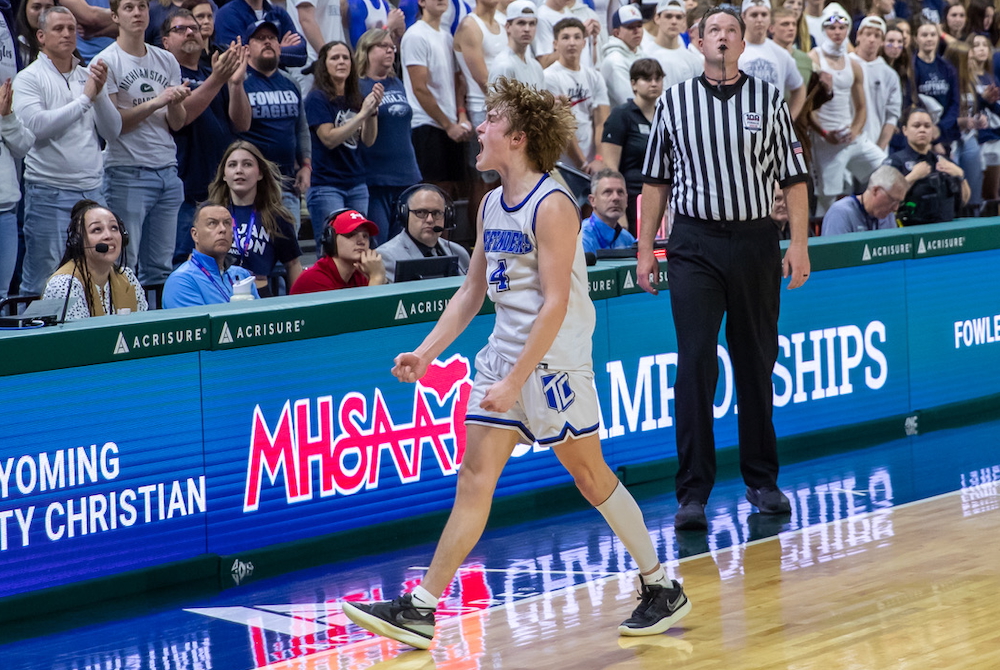
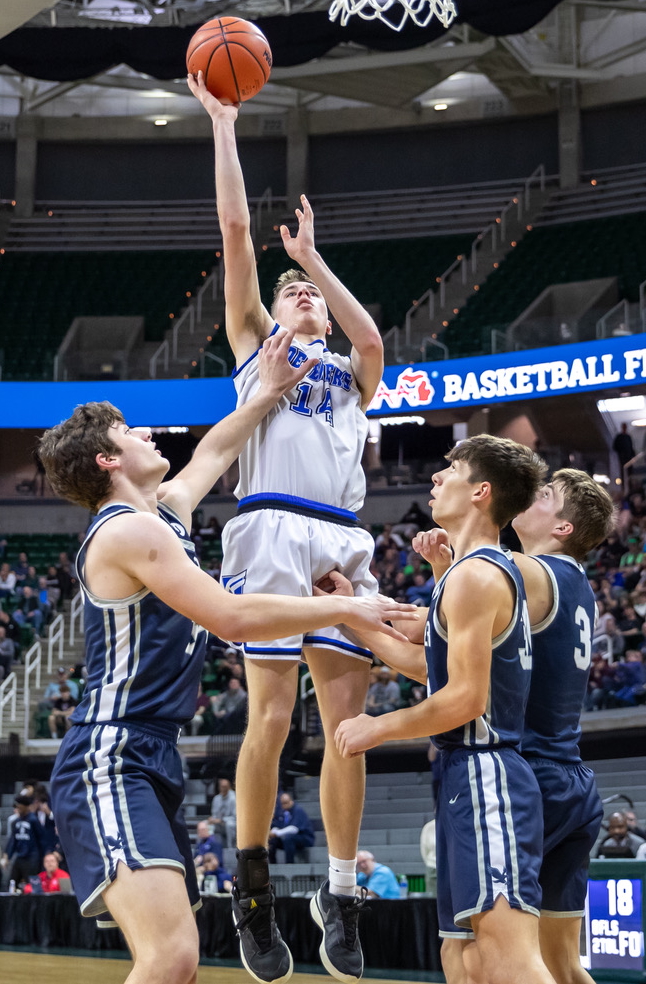
PHOTOS (Top) Tri-unity Christian’s Keaton Blanker (4) exits the game in celebration during his team’s Division 4 Final win Saturday at Breslin Center. (Middle) The Defenders’ Cody Osbun elevates above three Fowler players to put up a shot. (Below) Fowler’s Aaron Simon (30) makes a move into the lane. (Photos by Adam Sheehan/Hockey Weekly Action Photos.)