

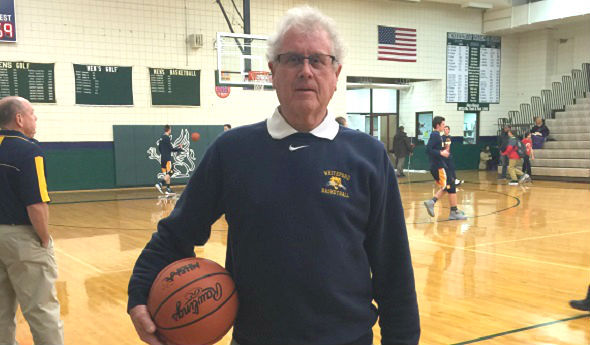
Rice Comes Home to Whiteford Bench
January 22, 2016
By Doug Donnelly
Special for Second Half
John Rice thought he found the perfect match for his two passions in life – fishing and basketball. By day, he could spend hours fishing off the Florida coast. When the afternoon rolled around, he would hit the gymnasium to coach basketball.
“I would have been perfectly satisfied doing that this winter,” Rice said.
That is, until Rice’s seventh-grade granddaughter Emma called.
“It was last March and we were in Florida and she was back home in Ottawa Lake,” Rice recalls. “She calls me up and says, ‘Grandpa, my team has a tournament that we are playing in and I want you to come watch me. And, I want you to coach my team next year.’”
Rice hung up the phone and told his wife, Sandy, they were headed home.
“We packed our stuff and went home,” Rice said. “It was a couple of weeks earlier than we had planned, but we got home in time for her tournament.”
A couple weeks later, after he agreed to become the seventh-grade girls basketball coach at Whiteford for the 2015-16 season, Bobcat varsity boys coach Jim Ross resigned. Athletic Director Nate Gust – who played for Rice when he was coaching at Whiteford in the early 2000s, asked Rice if he was interested in the varsity job. He decided to take it and is back at the helm of the Bobcats this season – 13 after ending his 30-year coaching career at Whiteford.
“Coaching basketball is something I love to do and, health-wise, I think it keeps me young,” said Rice, who celebrated his 70th birthday last summer. “I still love the game. When Emma asked me to coach her team, I couldn’t say no.”
Rice also couldn’t say no to coaching the varsity boys and helping to return the team to prominence. Whiteford went an uncharacteristic 4-17 in 2014-15 but is off to a 6-4 start under Rice.
“It’s a challenge, but I love challenges,” Rice said. “I enjoyed my time at Whiteford before, and I’m enjoying it now.”
This is his second stint as the head coach of Whiteford, having coached the Bobcats from 1974 to 2003, when he amassed 400 wins and collected eight District and eight league championships.
“The big thing was just getting acclimated to the kids here,” said Rice during a break in practice recently. “Being away so long, I was not able to follow these kids as they progressed through junior high or junior varsity basketball. I had to get to know them, and they have to get to know me. They’ve responded well, but we are still getting to know one another.”
Rice grew up in Bladensburg, Ohio, where he was an honorable mention all-state guard in Ohio’s smallest division in 1961. He was a factory worker, then college student who got his first varsity coaching job in 1969 at Dansville (Ohio) High School. He spent two years there, moved on to Mount Vernon Bible College – known now as Mount Vernon Nazarene – before moving north into Michigan.
He made Whiteford his home – especially the gymnasium just off exit 3 of US-23. His Bobcats won their first District title in his third year and their first Tri-County Conference title in his seventh. By the early 1980s, Rice had a Class D powerhouse. His 1981-82 team went 21-2, and he was named the Class D Coach of the Year by The Associated Press. His Bobcats won five league titles and four District crowns alone during the 1980s. He’s also had a good run of coaching all-state players – no fewer than six Bobcats that he coached earned first or second-team all-state honors.
Rice coached the Bobcats through the 2002-03 season, which happened to be the best in school history. Whiteford won its first 23 games, finished 23-1 and ended the season ranked among the top Class C teams in the state. Soon after the season ended, Rice resigned with 410 wins at Whiteford.
“I just felt the time was right for me to step aside and let someone else coach,” Rice said. “It was time. I felt good about what I had accomplished, and I was leaving the program in good shape. It was a good time.”
Just because Rice wasn’t at Whiteford, however, didn’t mean the coaching bug left him. In the dozen seasons since, he’s coached 11 of them. That includes varsity stints at Ann Arbor Gabriel Richard, Flat Rock and Toledo Bowsher. He’s been the junior varsity head coach at Toledo Woodward, the JV coach at Sylvania Southview and a varsity assistant at Lake Worth Christian in Boynton Beach, Fla., about 45 minutes north of Fort Lauderdale on Florida’s east coast. The only time Rice didn’t coach was one season during which he had back surgery.
“I started the season as an assistant, but decided to focus on my health,” he said. “I went to a specialist and found I needed surgery. Every other year, I’ve coached in some capacity. I’ve coached with a lot of different guys and observed lots of different styles.”
His return to Whiteford has kept him busy. He is officially head coach of both Bobcats middle school girls teams and the varsity boys. Some days, he has practices from 3 p.m. until 7 p.m. He also stops by the girls varsity practice when he can, which itself is nothing new. In addition to all of his years with the Bobcats boys program, he coached the Whiteford JV girls for 32 seasons and the varsity girls for three.
“I’ll practice four straight hours some days,” he said. “It’s a tough transition going from seventh-grade girls to varsity boys. You have to adjust your voice.”
In the first half of the season, the Bobcats have beaten arch-rival Summerfield in overtime, beaten Blissfield and have already passed last season’s team win total despite starting the season with just three seniors and a host of underclassmen – including five sophomores – on the roster.
“One of my philosophies has always been to bring up the underclassmen and build the team that way,” Rice said. “It has worked out very well for my teams at Whiteford and at other schools. When the younger kids get experience, it usually pays off in the end.”
He also has continued his typical high-tempo offense with pressing and trapping on defense.
“That’s the type of basketball that I like to play,” he said. “I haven’t changed my philosophy much. You have to adapt from year-to-year, depending on the kids you have, but the philosophy stays the same.”
The middle school girls start games later this month.
“It’s keeping my young again,” he said.
Rice’s return has been welcomed by the community, especially several of his former players who have stopped by the old gym to catch five minutes of the practices they remember so well or to just say hi before a game. A lot of former players have left comments on Facebook, too. Among the players on his roster now are Cody and Jesse Kiefer. During his first stint at Whiteford, Rice coached both the Kiefers’ parents.
“I’m having fun,” Rice said. “I’m comfortable here. I feel back at home. This has energized me.”
Rice by the numbers
|
VARSITY HEAD COACH |
YRS |
W |
L |
|
|
Danville (Ohio) |
2 |
27 |
12 |
|
|
Ottawa Lake Whiteford |
30 |
410 |
247 |
|
|
Ann Arbor Gabriel Richard |
2 |
13 |
28 |
|
|
Flat Rock |
1 |
4 |
17 |
|
|
Toledo Bowsher (Ohio) |
2 |
9 |
29 |
|
|
Ottawa Lake Whiteford |
1 |
6 |
4 |
* |
|
TOTALS |
38 |
469 |
337 |
|
|
*Through Jan. 21, 2016 |
Breslin Bound: Boys Report Week 1
December 16, 2019
By Geoff Kimmerly
Second Half editor
This boys basketball season needed just a few hours of opening night to satisfy the anticipation that’s been building since last season’s MHSAA Finals finished a little more than eight months ago.
 We’ll bank on that first week as an indication of what’s to come.
Below is our first “Breslin Bound” report of the boys season, powered by MI Student Aid and based on results and schedules posted for each school at MHSAA.com. Those results have become much more vital this winter – for the first time, there will be limited seeding of the top two teams at the District level based on their Michigan Power Rating (MPR). Check out how every team in the state ranks, and send corrections or missing scores to [email protected].
Week in Review
The countdown of last week’s five most intriguing results:
1. River Rouge 63, Ypsilanti Lincoln 53 – This high-profile matchup started the week and season, as reigning Division 2 runner-up Rouge handed reigning Division 1 champion Lincoln an opening defeat at Eastern Michigan University’s Convocation Center.
2. Grand Blanc 80, Detroit Douglass 77 – This Horatio Williams Showcase headliner featured one of the state’s best sophomores and juniors and two teams that should be making pushes in March in Divisions 1 and 2, respectively.
3. Saginaw 88, Saginaw Arthur Hill 76 – After scoring 101 points in its opener, Saginaw put up another big number in its first matchup of the season with the rival Lumberjacks.
4. Ferndale 66, Flint Beecher 55 – The Eagles also posted an impressive win at the Horatio Williams event, getting past a Beecher team looking toward contending in Division 3 again after making the Quarterfinals last season.
5. Ypsilanti Arbor Prep 48, Detroit U-D Jesuit 47 – Division 3 Arbor Prep started its season with a one-point win over the reigning Division 1 runner-up.
Watch List
With an eye toward March, here are two teams in each division making sparks:
DIVISION 1
Ann Arbor Huron (2-0) Last season’s 13-8 record was a bit deceptive; two losses were one-pointers and its District defeat came in overtime. The River Rats are starting out on the positive end of those close games this winter, with their first win 53-50 over returning Division 3 semifinalist Detroit Edison.
Marquette (2-0) For the second straight season, Marquette opened with wins over Brighton and Petoskey – this time by eight and three points, respectively. Last season, that start turned into a 19-4 finish with league and District championships.
DIVISION 2
Detroit Communication Media Arts (2-0) CMA improved five wins from 2017-18 last winter to get to 11-10, and may be on its way toward taking another step. The Pharaohs opened with a 74-48 win over Pershing to avenge last season’s one-point loss to the Doughboys, then got past Farmington in overtime 70-68 after Farmington had opened with an impressive win over Wayne Memorial.
Imlay City (3-0) The Spartans are coming off two straight sub-.500 seasons but did improve two wins last winter to 10-12. The Harry Moore Tournament at Capac gave them an opportunity for three wins during the first week, and Imlay City capitalized by defeating Deckerville in the championship game.
DIVISION 3
Burton Bendle (2-0) The Tigers are halfway to equaling last season’s 4-17 success thanks to double-digit wins over Flint Southwestern and Flint New Standard Academy. The 84-74 win over Southwestern avenged last season’s one and 11-point losses to the Jaguars.
Farwell (2-0) The Eagles haven’t won more than five games in a season since 2013-14, and tied that high of five last winter. But they are 2-0 for the first time in at least a decade, opening with a 65-64 win over Remus Chippewa Hills after losing to the Warriors by 17 a year ago.
DIVISION 4
Mayville (2-0) The Wildcats over the last six seasons have gradually climbed, progressing to an 8-14 finish a year ago. Last week gave them their best start in at least a decade, as Mayville stacked double-digit wins over Akron-Fairgrove and Caseville.
Three Oaks River Valley (3-0) The Mustangs doubled their success last season from 2017-18, going from 6-15 to 13-9 and despite a 1-3 start. River Valley opened last week with double-digit wins over Decatur and White Pigeon and then avenged a pair of losses from last season to Marcellus Howardsville Christian.
Can't-Miss Contests
Be on the lookout for results of these games coming up:
Tuesday – Sanford Meridian (1-1) at Beaverton (2-0) – Three wins over Beaverton last season played significant parts in Meridian winning the Jack Pine Conference title and reaching the Division 3 Quarterfinals.
Tuesday – Grand Rapids Catholic Central (1-0) at Grand Rapids Christian (2-0) – GRCC won the regular-season and District matchups between these two last season, the latter on the way to a Division 2 Regional Final.
Thursday – Pittsford (1-1) at Bellevue (1-0) – These two both won divisions of the Southern Central Athletic Association last season; Bellevue won their regular-season meeting and the rematch in the Division 4 Regional Final.
Friday – Kalamazoo Central (1-0) at Benton Harbor (2-0) – These annual southwestern powers are meeting for the first time since the 2014-15 season.
Saturday – Detroit U-D Jesuit (1-1) at Detroit Edison (1-1) – As noted above, both ended last season at Breslin Center, Jesuit in the Division 1 Final and Edison in the Division 3 Semifinals.
Second Half’s weekly “Breslin Bound” reports are powered by MI Student Aid, a part of the Office of Postsecondary Financial Planning located within the Michigan Department of Treasury. MI Student Aid encourages students to pursue postsecondary education by providing access to student financial resources and information. MI Student Aid administers the state’s 529 college savings programs (MET/MESP), as well as scholarship and grant programs that help make college Accessible, Affordable and Attainable for you. Connect with MI Student Aid at www.michigan.gov/mistudentaid and find more information on Facebook and Twitter @mistudentaid.
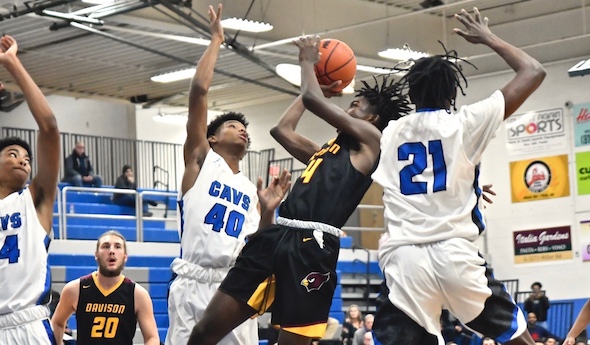
PHOTO: Flint Carman-Ainsworth opened the season last week with an 81-45 win over Davison. (Photo by Terry Lyons.)