

Rivals Unite for 'Never Forgotten Games'
January 24, 2018
By Dean Holzwarth
Special for Second Half
FENNVILLE – The small West Michigan towns of Fennville and Saugatuck are separated by less than 10 miles, thus sparking a longstanding rivalry that has played out in various sports through the years.
 However, for one night, a special event brought the two communities together to help support a worthy cause.
The seventh-annual “Never Forgotten Games” between the neighboring communities were played Friday night at Hope College in honor of Wes Leonard, who died unexpectedly in 2011 after making the game-winning basket in overtime against rival Bridgman.
Leonard, a 16-year-old junior at the time, died from sudden cardiac arrest due to an enlarged heart.
To open the night, Saugatuck’s girls defeated Fennville 55-40. Then, in a back-and-forth affair typical of a rivalry game, Fennville’s boys edged Saugatuck 48-46 and improved to 8-2 on the season.
But Fennville boys basketball coach Joe Rodriguez said the final result paled in comparison to the impact the game had on both schools.
“We circle that game on the calendar because it’s an opportunity to focus your energy on something bigger than us,” he said. “It’s not just a conference game; it’s not just another basketball game or Friday night game. It’s bigger than the game of basketball itself. It’s one of our former players that we look forward to tributing.
“Everyone was there for one reason, and that was to celebrate the legacy of Wes Leonard and to support the cause.”
The two schools joined forces to help make the night a success, including meeting in the days prior to discuss game preparations.
“Some Fennville kids came over to our school and met with some of our kids before to go over cheer and signs and just how we could help out,” Saugatuck boys basketball coach Andy Diaz said. “Our kids showed up early to help set up and help Jocelyn (Leonard, Wes' mother), so it was a real collaborative effort.”
This year Fennville’s student section, recalling some of their experiences taking part in the MHSAA’s “Battle of the Fans” the last two years, invited Saugatuck’s student section to join forces for some cheers during the game. Last week, Fennville student section leaders Kamryn Vandyke, Clay Rosema and Isabella Marquez strategized with Saugatuck’s Reece Schreckengust, Sydney Ayres and Alexa Phillips, designing and planning cheers they could do together.
The schools’ band teachers – Fennville’s Paul Andrews and Saugatuck’s Andrew Holtz – also met and planned the combined bad that played together in the same section for the entirety of Friday’s game.
“Although rival schools, both student bodies have embraced the idea that the cause is an opportunity to be a part of something greater than the game itself,” Fennville athletic director Frank Marietta said. “Both schools are very competitive on the field of play, but there is a positive and strong relationship between the students as a whole. The spirit and heart of the students from each school is what makes it such a great rivalry.”
 The close-knit ties between the schools run deep.
“They know each other very well,” Diaz said. “They work at the same places during the summer, and they cross paths all the time. I have a lot of friends in Fennville.”
Rivalry games often are intense and emotional, but this one is different due to the greater significance the night holds.
“That’s the unique part of it,” Rodriguez said. “As a coach you want to talk about how it’s your rivalry game, but this one is a little different. It’s all about the events, and they play a big part in helping.”
“They are our neighbors, and when we went through (Leonard’s death) they showed a lot of support as a community to Fennville, and I think it’s awesome that they are a part of this game as well.”
Rodriguez said competing against another team in that setting just wouldn’t seem fitting.
“Because we are so close it would be weird if it was another community that we were playing,” he said. “It would feel manufactured, where this is more genuine.”
Diaz said the rivalry took on a different meaning after Leonard’s untimely passing.
“I feel very fortunate to be a part of the best small-school rivalry in the state of Michigan,” he said. “That’s our personal opinion, and when Wes passed, it definitely changed the perspective and narrative of the rivalry, especially on that game night.”
Shortly after Leonard’s tragic death, The Wes Leonard Heart Team was formed. The foundation raises money for automated external defibrillator (AED) awareness and donates AEDs to schools throughout the state.
The mission of the foundation is to honor Wes’s life using a team approach, combining the efforts of his loved ones and other existing foundations in the pursuit of a common goal. The foundation “is committed to honoring the children who have lost their lives to Sudden Cardiac Arrest and preventing other families and friends from feeling the pain of losing their loved ones. With this team approach, we feel we can give others a chance at ‘just one more game.’”
More than 260 AEDs have been put into schools through the foundation, and another 4-6 will be donated with money raised Friday.
The Never Forgotten Game hits close to home for Diaz, whose mother survived a scare almost seven years ago.
“My mom was saved by an AED,” Diaz said. “She had a heart attack in church, and one was used to revive her. They had to shock her twice, and without an AED, she’d be gone.”
Diaz, a Saugatuck graduate who coached against Leonard in football and basketball, hopes the money raised by the game can help others who may encounter the same situation.
“I gave my mom a big hug before that game because an AED saved her life, and maybe this game buys the right AED for a school that saves someone else’s life,” Diaz said. “It just put things into perspective. Obviously, we always want to win the game, but at the end of the day what really matters is the cause and Wes.
“We talked before the game about how this game is bigger than any of them. It’s not about us; it’s not about them. It’s about the entire state of Michigan at this point because of the importance of saving lives.”
 Dean Holzwarth covered primarily high school sports for the Grand Rapids Press and MLive for 16 years and more recently served as sports editor of the Ionia Sentinel and as a sports photojournalist for WZZM. Contact him at [email protected] with story ideas for Allegan, Kent and Ottawa counties.
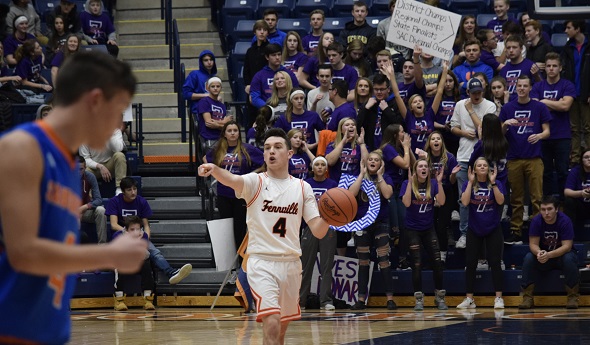
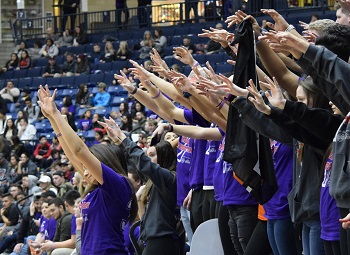
PHOTOS: (Top) Fennville's students cheer as a classmate brings the ball upcourt against Saugatuck on Friday. (Middle) Fennville's student section worked with Saugatuck's to cheer together during the games at Hope College. (Photos by Isabela Marquez/Fennville High School.)
Hudsonville Earns Historic Win with Signature Skill
By
Jason Schmitt
Special for MHSAA.com
April 7, 2021
EAST LANSING – Hudsonville head coach Casey Glass is beyond the point where he’ll mince words — particularly when it comes to his team’s defensive play.
He knows how good his Eagles are.
“It’s not a secret anymore, but I think we’re one of the best defensive teams in the state of Michigan,” Glass said. “We’ve got kids that come out every day ready to play and D it up.”
That was the case for Glass and his team during their Division 1 Semifinal game against Midland Dow Wednesday at the Breslin Center in East Lansing. Hudsonville put on a defensive clinic, holding the Chargers scoreless for the first 6½ minutes of the fourth quarter and limiting them to just 14 second-half points during a 49-35 victory which catapulted the Eagles into the championship game, where they’ll face Detroit Renaissance.
“You get Alaina (Diaz) and Eva Joldersma on their two best players, and we really just tried to use a little bit of extra height and athleticism to shut down their two best players and I thought we did a really good job of that,” Glass said.
Dow’s top two scorers, Alexa Kolnitys and Jada Garner, came into the game averaging a combined 30.6 points per contest. But they were limited to just 14 against the Eagles.
“I feel like most of our game is (about) defense, and every day at practice we push ourselves to play defense,” said Diaz, who finished with eight points, seven rebounds and a pair of steals. “We play against each other and push each other to play harder.”
Hudsonville led by seven after one quarter and upped its lead to 17-8 moments into the second. But Dow went on a 10-0 run, fueled by a pair of 3-pointers by juniors Kennedy Caldwell and Abby Rey, a putback by Kolnitys and a pair of free throws by Rey, to take an 18-17 lead with 4:32 left in the first half.
 “We make our run in the second quarter, when we hit a few 3s and you get on a roll and take a lead. Then in the second half, we go 0-for-9 from beyond the 3-point line,” Dow coach Kyle Theisen said. “All year long, we’ve said that when we’re making shots, we can beat anybody, and when we’re missing shots, anybody can beat us. That’s what the second half was. We were missing shots. We got good looks at 3s and they didn’t go down for us.”
For the game, Dow shot just 12 for 46 from the field, including 4 for 15 from 3-point range.
“We don’t usually shoot that poorly,” Theisen continued. “We got the shots we wanted, but sometimes they just don’t go down. I absolutely loved the effort of our girls. I loved the all-out hustle on every play and never giving up.
“Diaz did a good job. We tried to get some switches on ball screens and she did a really good job of getting over the top or underneath on those ball screens. We were trying to attack some of their bigs with our guards, and she made it difficult. She’s a really good defender on the ball.
“When you have that much height protecting the rim on the help side, there were no easy points to be had.”
Rey led Dow with 13 points, including a pair of 3-pointers. Kolnitys had 10 points and 11 rebounds for the Chargers, who finished their season 22-1.
“Got to give (Midland Dow) credit, they’re well coached,” Glass said. “Those girls gave everything they had. Fortunately for us tonight, we had a little bit more in the tank.”
Hudsonville sophomore Maddie Petroelje led her team with 15 points. Junior Jaci Tubergen had seven points and a team-best 11 rebounds, while senior Emmalynn Costen added six points and 10 rebounds. The Eagles (22-1) will now take on Renaissance (13-4) in Friday’s Division 1 championship game, a first-time appearance in the finale for Hudsonville. The Phoenix defeated Wayne Memorial, 75-72, in Wednesday’s first Semifinal.
“Renaissance is a team that puts a lot of pressure on you,” Glass said. “We’re fortunate to have kids on our team that can handle that pressure. We’ll get back to Hudsonville, watch some film and get back to the drawing board and come up with a game plan for Friday.”
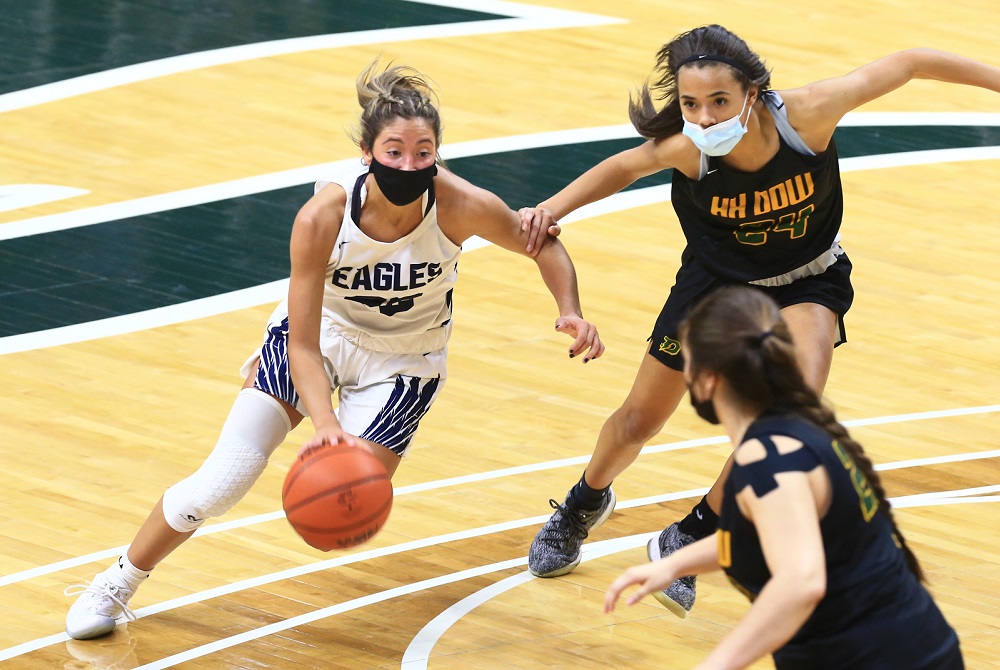
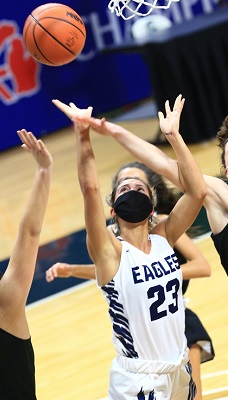
PHOTOS: (Top) Hudsonville's Alaina Diaz (23) makes her move as Dow's Jada Garner defends Wednesday at Breslin Center. (Middle) Diaz works to grab a loose ball while surrounded by Chargers.(Click for more from Hockey Weekly Action Photos.)