

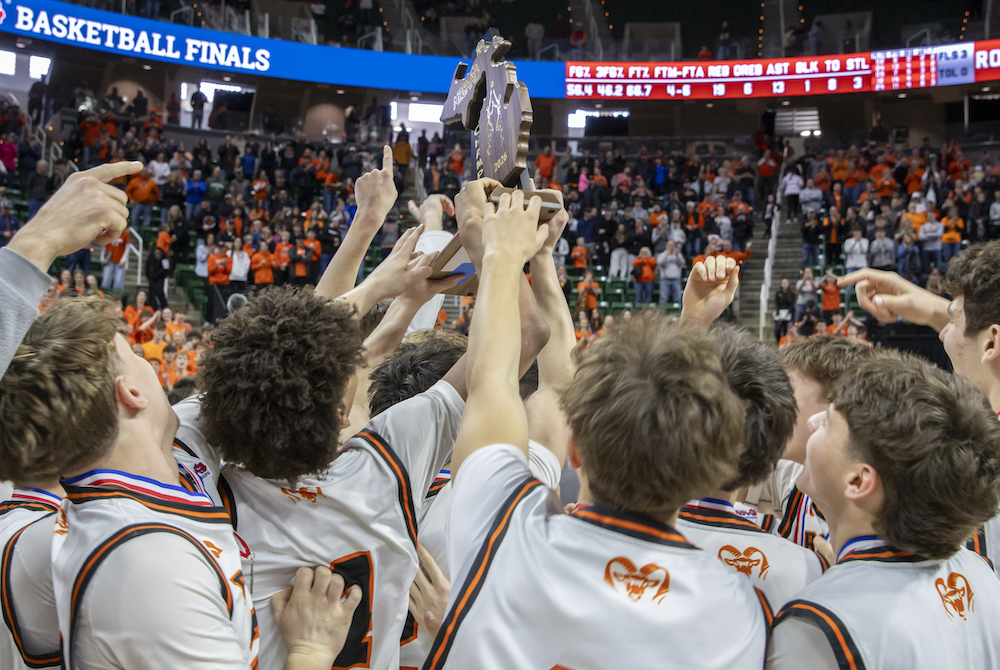
Rockford Adds to Program Legends in Claiming 1st Finals Title Since 2003
By
Paul Costanzo
Special for MHSAA.com
March 14, 2026
EAST LANSING – When Kyle Clough took over the Rockford boys basketball program 10 years ago, he called his shot.
Clough had a state championship shirt printed, leaving little doubt about his aim for a program that had not won a Finals title since 2003. He didn’t put a timeframe on it however, with “20??” following the lofty declaration.
Now he can replace those question marks with a two and a six.
Clough’s Rams defeated East Lansing 54-50 on Saturday in the Division 1 Boys Basketball Final at the Breslin Center, putting their program back on top for the first time in more than 20 years.
“I was confident going into that interview, and I thought I needed to be in that place,” Clough said. “All of us remember 2003 and 2012 (when Rockford finished runner-up), and Steve Majerle and Ryan DeKuiper and Michael Redell – those guys are legendary in this state. So, when you get the job in a place like Rockford, you walk in and see the state championships everywhere, there is a pressure. There’s a pressure on these kids.
“We’ve kind of been knocking on the door here of making a run here these last couple years and fell short for one reason or another. This year, these guys were really determined. These guys are some of the greatest kids this school’s ever had. For them to be now in the great part of Rockford basketball history and Rockford athletic history makes me awfully proud.”
Rockford (25-3) now has two titles in program history, as it ended East Lansing’s bid for a championship repeat in a game that came down to the final seconds.
It wasn’t until Jace Opoku-Agyeman broke free for a lay-up with one second to play that it was wrapped up, and the orange half of the capacity crowd at Breslin erupted in celebration.
“At first, I looked at Josh (Bascom) and I was setting up my guy to go to the opposite hoop, then I saw Josh and he called me over to come get the ball,” Opoku-Agyeman said. “I saw the clock with three, four seconds left and I made the lay-up to (go) up two scores so we had the advantage.”
 Opoku-Agyeman was one of three Rams in double figures, scoring 13 points. He was joined by the Bascom brothers, Josh (14) and Jake (11), at the tip of an incredibly balanced Rockford scoring effort.
Dylan Gross added eight, and Eli Wolfe had seven, including the go-ahead layup with 56 seconds remaining.
Wolfe, a sophomore guard who holds scholarship offers from multiple schools in the state, including Central Michigan, has spent much of this season dealing with injuries and will have surgery on his hips in the offseason.
“What he did for us this year is absolutely incredible,” Clough said. “Two torn labrums in his hips, he rolled his ankle in the Regional Semifinal against Saginaw, and he just wouldn’t take any time off. Even at times when we asked him to sit out during practice, he knew he had to be in there with his teammates. He’s one of the best guards in the whole state, period. This year he played incredibly limited. It’s an incredible commitment to his team. He could have stopped early, had the surgery and been back for AAU, but he loves these guys. And what he did deserves a lot of attention, because it was absolutely selfless and incredible.”
While Wolfe’s shot put the Rams ahead and Opoku-Agyeman’s sealed the game, it was their team defense in between that won the game.
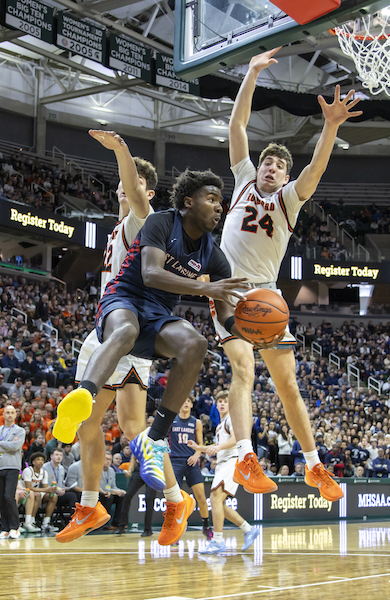
Rockford would not let Mr. Basketball Award winner KJ Torbert get a look at the basket, running a second defender to him every time he got the ball. East Lansing called a pair of timeouts to try and set something up, but Rockford continued to force the ball out of Torbert’s hands or deny him all together.
Clough credited his coaching staff and a morning walkthrough for preparing his team to deny Torbert his chance.
Nearly 50 seconds passed after Wolfe's go-ahead basket, but eventually the Trojans (27-2) did find an open shot from the baseline. But it didn't fall.
“I said, ‘Somebody else is going to have to make a play,’” East Lansing coach Ray Mitchell said. “Obviously they’re doubling KJ, we tried to draw up a scheme to get the ball for an open shot, and actually we got an open shot, but couldn’t knock it down.”
Torbert did finish with 28 points on the day, adding five rebounds in his final game for East Lansing. He will continue his career at Bowling Green, where he’ll be a conference rival of Rockford’s Jake Bascom, who is headed to Central Michigan.
“What can you say about KJ Torbert?” Clough said. “Maybe one of the best players in this state in quite a while, and he stuck here with us in the state. As a coach in this state, I appreciate a guy so much like that. He’s got such a talent level that it brings that kind of a crowd like that into the Breslin Center.”
Kingston Thomas added 10 points for the Trojans, while Tyree Anthony had seven.
PHOTOS (Top) Rockford players raise their championship trophy after winning the Division 1 championship Saturday at Breslin Center. (Middle) Jake Bascom (24) and Drew Ferwerda (22) wall off East Lansing’s KJ Torbert under the basket. (Photos by Adam Sheehan/Hockey Weekly Action Photos.)
Breslin Bound: 2024-25 Boys Report Week 11
By
Geoff Kimmerly
MHSAA.com senior editor
February 10, 2025
One of the most anticipated moments of every basketball season is coming up Sunday, when the MHSAA will publish this winter's Boys Basketball District brackets, this season for the first time with all teams seeded based on Michigan Power Ratings (MPR).
 MPR is calculated using wins and losses for games played between teams entered into the MHSAA Tournament. Scores of games, margin of victory and location of games are not included in the MPR formula. The final MPR number is 25 percent of the team's winning percentage, plus 50 percent of its opponent's winning percentage, plus 25 percent of its opponent's opponent's winning percentage – the total rewarding both success and strength of schedule.
We're still seeing plenty of movement up and down our statewide MPR lists, and more is sure to come as teams continue to finish off regular-season schedules and play in league tournaments that will conclude over the next seven days (including three we've noted below).
“Breslin Bound” is powered by MI Student Aid based on results and schedules posted for each school at MHSAA.com.
Week in Review
The countdown of last week’s five most intriguing results:
1. Warren Lincoln 66, Detroit U-D Jesuit 65 It wouldn’t be stunning to see both of these teams playing at Breslin Center next month, and Lincoln (15-4) can build on this boost as it plays for a Division 2 title repeat.
2. East Lansing 62, Lansing Waverly 60 East Lansing (17-1) made a major move toward securing the Capital Area Activities Conference Blue, adding to an earlier 10-point win over the Warriors (15-3) to take a two-game lead with three to play.
3. Marquette 76, Detroit Cass Tech 59 This has to be Marquette’s most significant win on a statewide stage in some time, as the Sentinels (15-2) met Cass Tech (16-2) at the Northern Michigan Showcase at Traverse City St. Francis and showed they’re capable of contending in Division 1.
4. Pewamo-Westphalia 56, Grand Blanc 39 P-W (16-2) opened a three-game week by putting more distance between itself and second-place Fowler in the Central Michigan Athletic Conference and closed it with this big win over the Division 1 Bobcats (11-7).
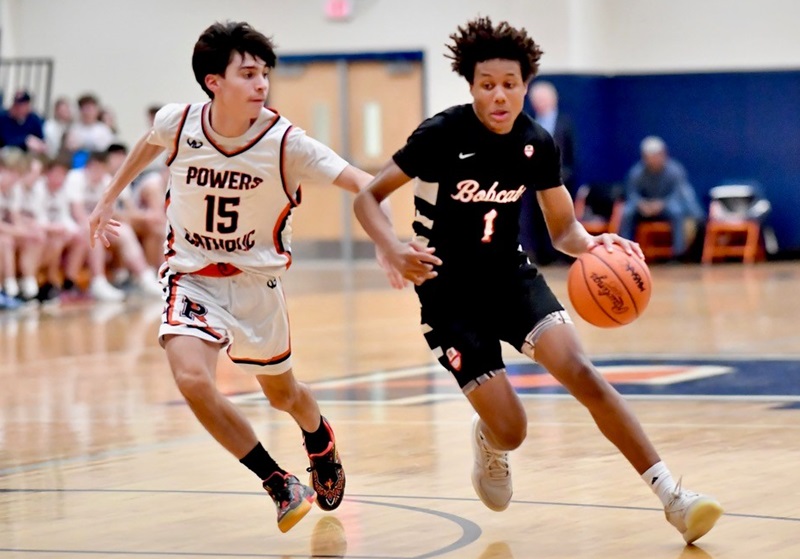
5. Grand Blanc 71, Flint Powers Catholic 69 Before the loss to P-W noted above, Grand Blanc moved into a tie for first in the Saginaw Valley League by handing Powers (15-1) its only defeat.
Watch List
With an eye toward March, here are two teams in each division making sparks:
DIVISION 1
Orchard Lake St. Mary’s (12-6) Despite losing Mr. Basketball candidate Trey McKenney to injury Jan. 9, St. Mary’s has climbed to No. 3 in statewide Division 1 MPR and gone 5-2 since the injury (not counting the team’s loss in the game during which he was injured). The two losses during that time were by one point to East Lansing (17-1) and two points to Bloomfield Hills Brother Rice (18-1), and the Eaglets face Brother Rice again Tuesday in a Catholic High School League Bishop Tournament semifinal. The third in-state loss was to Detroit U-D Jesuit, a potential Bishop championship game opponent. St. Mary’s handed Rockford (18-1) its only loss, Wayne Memorial (16-2) one of its two, and also downed Grand Rapids Northview (14-4) and Auburn Hills Avondale (12-7) among others.
Wayne Memorial (16-2) The Zebras have won 12 straight, losing only to St. Mary’s and Birmingham Groves (14-5) both in December. Wayne can clinch a share of the Kensington Lakes Activities Association East title against Westland John Glenn on Tuesday and has two wins over Dearborn (15-3) and a first over Belleville (14-4) in league play with that rematch coming up Friday. The Zebras also are coming off a 69-60 win over Traverse City West (14-3) at the Northern Michigan Showcase and will close the regular season with a crossover (and potentially overall KLAA championship game) against a counterpart from the KLAA West.
DIVISION 2
Grand Rapids South Christian (14-4) The Sailors opened this season 1-3 but have only one loss since mid-December – 57-55 to Grand Rapids Northview on Jan. 23. Northview leads the Ottawa-Kent Conference Gold and South Christian is just a game behind, with the rematch scheduled for Feb. 18. The Sailors most recently downed Belleville (14-4) at the Battle in the Igloo at Portage Northern, 58-46, and also owns wins over Pewamo-Westphalia (16-2), Holland Christian (12-6) and Grand Rapids Catholic Central (12-6). A possible District opponent is Grand Rapids Christian (11-7), which defeated South Christian in the season opener. The other losses came to Hudsonville Unity Christian (18-1) and Byron Center (13-6).
Standish-Sterling (16-2) The Panthers have clinched a share of a third-straight league championship, this time in their first season in the Jack Pine Conference Division 1 and thanks to last week’s 75-68 win over second-place Gladwin (15-3). Standish-Sterling is undefeated in league play, with its losses both during the first half of December to Ithaca (14-4) by two points and Saginaw Nouvel Catholic Central (12-5). The Panthers also have wins over Alcona (14-2) and Pinconning (15-3) and will see the JPC Division 2 champion Feb. 18. Gladwin also is in the District bracket Standish-Sterling will host.
DIVISION 3
Iron Mountain (16-2) The Mountaineers have a half-game lead in the Western Peninsula Athletic Conference East standings thanks to a split with second-place Ishpeming Westwood (14-5); Iron Mountain lost the first meeting 61-56 but won the rematch 58-32. The other loss was in December to Division 1 Marquette (15-2), and there are several strong wins including over Norway (14-4), Kingsford (13-5) and Negaunee (13-5). Iron Mountain has the opportunity to finish the regular season with plenty of momentum as well with rematches against Kingsford and Negaunee and a Feb. 20 meeting at Houghton (16-3) coming up.
McBain (15-1) The Ramblers are rolling again after missing out on the Division 3 championship game last season by a three-point overtime loss to eventual champion Niles Brandywine. Last week’s 79-64 win over Beal City pushed McBain into first place alone in the Highland Conference after the Aggies won their first meeting 57-48 on Dec. 13. McBain also finished a regular-season sweep of Evart (16-3) on Friday and has a second league game coming up against LeRoy Pine River (15-3) after winning the first one big Jan. 17. All 15 of McBain’s wins have come by at least 15 points, but the Ramblers could see Evart again in District play.
DIVISION 4
Battle Creek St. Philip (14-4) The Tigers have equaled last season’s 14 wins and lead the Southern Central Athletic Association West by a half game on Bellevue after finishing second to Bellevue last year. They’ve split their regular-season series, St. Phil winning the first game and Bellevue (11-3) the rematch, and they could see each other again at the District the Tigers are hosting. St. Phil also has a strong win over East Jordan (15-3) and a pair over third-place Colon (13-5) have provided a boost, as did a victory over Burr Oak (11-7) with that rematch coming up. The other losses were to Bronson, Union City (12-5) and Hillsdale Academy (14-4).
Clarkston Everest Collegiate (17-1) The Mountaineers have clinched their first league championship since 2021-22, in the CHSL Intersectional 1, and in a few weeks will attempt to add to a string of four straight District titles. The only loss this season came to Division 3 Jackson Lumen Christi (17-2), and 13 of Everest’s wins were by double digits – with one of the close ones a double-overtime victory over Division 2 Dearborn Divine Child. Everest will play in the CHSL St. Anne Tournament with Waterford Our Lady of the Lakes (12-6), Royal Oak Shrine Catholic (9-9) and Grosse Pointe Woods University Liggett (8-7) and also could see host Our Lady in District play.
Can’t-Miss Contests
Be on the lookout for results of these games coming up:
Tuesday – Freeland (15-2) at Bay City John Glenn (16-2) – John Glenn won the first meeting 70-65 on Jan. 14, and the winner of this rematch will be a massive step closer to claiming the Tri-Valley Conference Red title.
Friday – Catholic High School League Bishop Final at Detroit Mercy – Bloomfield Hills Brother Rice (18-1), Orchard Lake St. Mary’s (11-6), Detroit U-D Jesuit (17-2) and Warren De La Salle Collegiate (6-13) will play in Tuesday semifinals with a chance to advance.
Friday – South Haven (15-2) at Bridgman (12-5) – These two are both 7-1 in the Southwestern Athletic Conference Lakeshore with two league games to play and after Bridgman won the first meeting 55-53 in overtime.
Saturday – Charter School Conference Final at Schoolcraft College – Detroit Old Redford (16-1), Arts & Technology Academy of Pontiac (14-0), Romulus Summit Academy North (18-2) and Detroit University Prep (15-5) play semifinals Tuesday to reach the final.
Sunday – Detroit Public School League Final at Wayne State – Cass Tech (16-2), Martin Luther King (16-3), Renaissance (12-7) and Central (15-3) play in Thursday semifinals with hopes of advancing to the title game.
MHSAA.com's weekly “Breslin Bound” previews and reviews are powered by MI Student Aid, a division within the Department of Lifelong Education, Advancement, and Potential (MiLEAP). MI Student Aid encourages students to pursue postsecondary education by providing access to student financial resources and information. MI Student Aid administers the state’s scholarship and grant programs that help make college Accessible, Affordable and Attainable for you. Connect with MI Student Aid at www.michigan.gov/mistudentaid and find more information on Facebook and Twitter @mistudentaid.
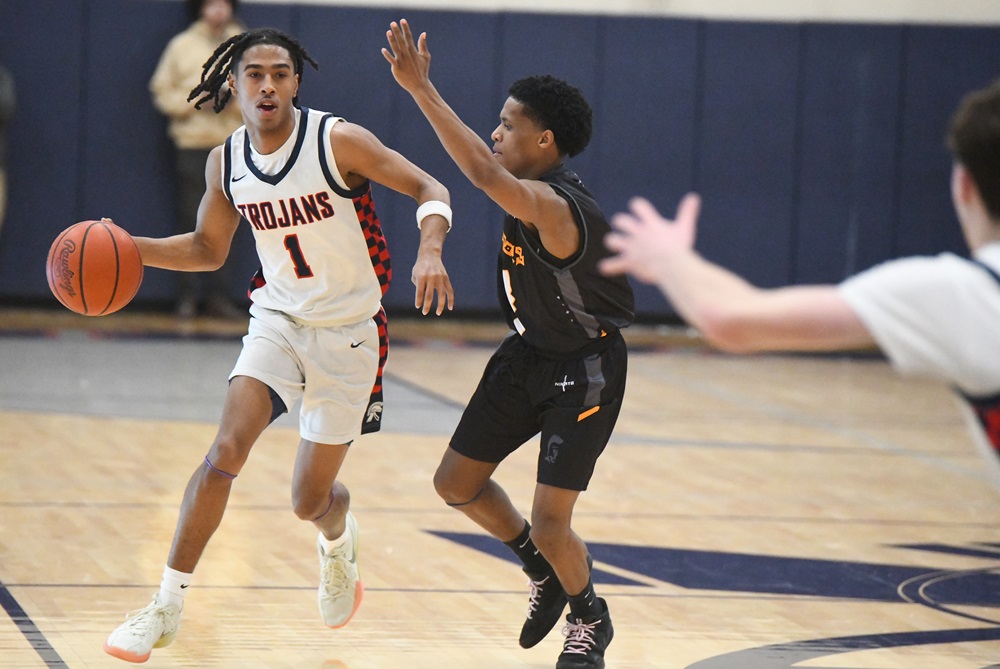
PHOTOS (Top) East Lansing's BJ Windham (1) prepares to pass to a teammate during his team's win over Lansing Waverly. (Middle) Grand Blanc's Isaiah McCree (1) makes a move toward the lane against Flint Powers Catholic. (East Lansing/Waverly photo by John Johnson. Grand Blanc/Powers photo by Terry Lyons.)