

As Roles Change, Hardy Continues to Shine
By
Tom Markowski
Special for Second Half
February 2, 2017
FARMINGTON HILLS – No matter the role or circumstances, Amauri Hardy finds a way to fit in.
 Hardy, a 6-foot-1 senior guard from North Farmington, has been a starter since his freshman year and is one of the state’s top players. But his journey has not always been smooth.
He averaged 10 points per game his freshman season at Southfield High, then missed all but four games his sophomore season after suffering a strained knee ligament. The injury sidelined Hardy for four months, and in October of his junior year he transferred to North Farmington.
Known as a shoot first, pass second type of player, Hardy would have to change his style to fit into an experienced team that was not short on talent and players who could score.
“I didn’t have to score,” Hardy said. “We had more talent than when I played at Southfield. I had to swallow my ego. It’s something I had to do. (The North Farmington players) knew my game. I knew theirs.
“I was a combo guard last year. I tried to do what was needed. I shared things with Billy (Thomas).”
Hardy and Thomas, a senior last season, teamed to form one of the state’s top backcourts. And their ability to mesh didn’t happen by accident. The two had been friends since elementary school. When they entered high school each went his separate way, but reunited last winter their play (Hardy averaged 22 points ppg; Thomas 18) was instrumental in the Raiders’ run to the school’s first Class A Final appearance.
“We had a great talk when he came to us,” North Farmington coach Todd Negoshian said. “We talked about his goals, where he wanted to get. He didn’t want special treatment. To this day he’s always asking questions. He’s not questioning what we do. He just wants to get better. He really listened, watched and learned.”
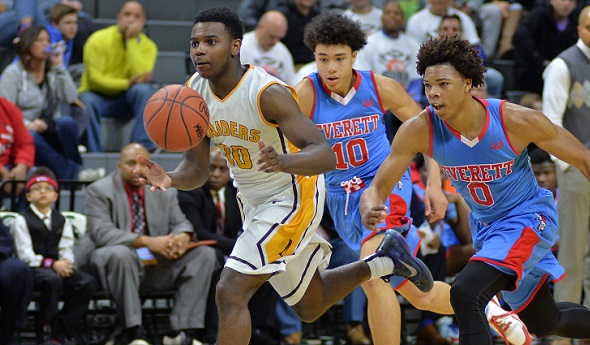
Hardy said every day he thinks about what he and his teammates accomplished last season. Their 55-48 victory over host Orchard Lake St. Mary’s in a District Final was a big hurdle on their way to the Breslin Center.
As talented and balanced a team as North Farmington was last season, this season’s has little experience. Hardy is the lone starter returning and the Raiders have been inconsistent, a trait many young teams confront.
 Once again Hardy had to switch gears. In order for his team to be competitive, and as successful as possible, he’s had to assert himself more offensively and be the leader. Hardy is averaging 28.5 points and seven assists per game from the point guard spot, but in most games it hasn’t been enough. What makes those numbers even more impressive is that North Farmington averages just 55 points per game.
North Farmington (4-7) did defeat Southfield Arts & Technology, 76-70, on Jan. 26 for its first victory in the Oakland Activities Association Red. Hardy scored 35 points and had help this time as the other starting senior, Karl Patrick, had 19.
Overall, the Raiders have had a difficult time competing for 32 minutes. In some games they play well for three quarters, then run out of steam leaving Hardy to do much of the heavy lifting. He scored his team’s first 15 points in a 63-58 overtime loss to West Bloomfield on Jan. 20. Hardy finished with a career-high 46.
“I give him credit, the way he leads our guys,” Negoshian said. “He’s toughed through it.
“That’s what I like about him. He’s become a leader. Jacob Joubert and Alex Darden were our leaders last year. He watched and learned.”
Hardy does more than watch. He dedicated himself to the weight room in the offseason and has become a much stronger player, particularly when he goes to the basket. He’s able to ward off defenders more effectively and exhibits great body control.
And it doesn’t hurt that he’s left-handed and gives opponents a less familiar look as they try to lock him down.
Hardy was one of two players from Michigan (along with Jamal Cain of Detroit Cornerstone Health & Technology) and 64 finalists nationally for the McDonald’s All America team (no Michigan players were among 24 eventually chosen). Hardy also has signed with Oklahoma State University and is a possible candidate for the 2017 Mr. Basketball Award.
But on the way to those future opportunities, he’s filling the necessary roles as North Farmington works to elevate from its slow start.
“He’s a great teammate,” Negoshian said. “He cares about the team and the program.”
 Tom Markowski is a columnist and directs website coverage for the State Champs! Sports Network. He previously covered primarily high school sports for the The Detroit News from 1984-2014, focusing on the Detroit area and contributing to statewide coverage of football and basketball. Contact him at [email protected] with story ideas for Oakland, Macomb and Wayne counties.
PHOTO: North Farmington's Amauri Hardy (10) pushes the ball upcourt during last season's Class A Semifinal victory over Lansing Everett.
Breslin Bound: 2025-26 Boys Report Week 2
By
Geoff Kimmerly
MHSAA.com senior editor
December 15, 2025
The calendar year may be drawing to a close, and schools soon shutting down for break. But there will be little rest for basketball fans seeking to see several of the state’s title contenders in action over the next three weeks.

Several leagues have either started play or will over the next few days, and this weekend starts full schedule of boys hoops showcases that will see many teams across the state playing at least once over the holidays before the regular-season schedule falls into routine in January.
“Breslin Bound” is powered by MI Student Aid and based on results and schedules posted for each school at MHSAA.com.
Week in Review
The countdown of last week’s five most intriguing results:
1. Arts & Technology Academy of Pontiac 60, Warren Lincoln 59 Last season’s Division 3 runner-up Lions (2-0) earned one of their most impressive wins over the last two winters by edging reigning Division 2 champ Lincoln (2-2) at the Best of Michigan Tournament at Detroit Mercy.
2. East Lansing 41, Detroit Martin Luther King 40 The reigning Division 1 champion Trojans (4-0) answered their closest call of the early season to win one of the most notable matchups at the Moneyball Tip-Off Classic at Don Johnson Fieldhouse.
3. Ishpeming Westwood 59, Kingsford 54 These two both made Semifinals at Breslin Center last season, and Westwood (5-0) came back from 17 points down to avenge a seven-point loss from last year to the Flivvers (3-1).
4. Lansing Sexton 86, Detroit Cass Tech 81 Sexton (2-1) opened this season with a loss at East Lansing but has rebounded to make a statement about its potential to build on last season’s Division 2 Quarterfinal run with this win over the Division 1 Technicians (3-1) at Don Johnson.
5. Grand Rapids Northview 50, Grand Rapids Catholic Central 44 The Wildcats (3-1) returned to The Invite at Calvin University and downed the Cougars (0-2), also Division 2 semifinalist last season.
Watch List
With an eye toward March, here are two teams in each division making sparks:
DIVISION 1
Auburn Hills Avondale (4-0) Winners of 16 games both of the last two seasons and runners-up in the Oakland Activities Association Red last winter, the Yellow Jackets may have more in store after this solid start including a 69-51 win over West Bloomfield on Thursday. Avondale’s holiday break slate is loaded with notable matchups against Freeland, Grand Blanc, Detroit Mumford and Hamtramck.
Jackson (3-0) The Vikings are off to a solid start as they look to build on last season’s 12-12 finish and tie for second in the Southeastern Conference White. Jackson opened league play Friday with a 60-47 win over Tecumseh, one of the other two teams that also tied for second in the league last season, and will get a first look at reigning champion Adrian on Friday.
DIVISION 2
Ludington (5-0) The Orioles’ fast start has included handing Spring Lake it’s only loss, 55-46 on Dec. 4, and delivering a first defeat to Fremont on Friday, 73-67 in overtime. Ludington lost to Spring Lake twice last season on the way to finishing 16-9, and the Orioles also are the early leaders in the West Michigan Conference Lakes after finishing second to Whitehall last winter.
Romulus Summit Academy (6-0) Last season’s Division 2 runner-up has not slowed down a bit, with a 35-29 win over Warren Fitzgerald on Saturday adding to a 65-59 overtime win over Detroit Edison and 65-54 victory over Detroit U-D Jesuit among notables during a busy but successful opening two weeks. Friday’s home game against Arts & Technology Academy of Pontiac could end up deciding the Charter School Conference Gold title.
DIVISION 3
Gobles (4-0) The Tigers have improved from four, to nine, to 12 wins over the last three seasons and could add to that climb after four double-digit victories to open this one. The team’s fast start included last week a 55-45 win over Bloomingdale – avenging a last season loss – and a 50-36 victory over Delton Kellogg, with which Gobles split Southwestern Athletic Conference Central meetings last winter.
Onsted (4-0) The Wildcats have won at least 18 games every season this decade and finished 21-2 in sharing the Lenawee County Athletic Association title with Adrian Madison last winter. Onsted split with Madison last season and won their first meeting again this time, 45-38 on Friday, with the rematch Jan. 29. Also worth noting: Onsted is in Division 3 this season after previously playing in Division 2 and Class B before that.
DIVISION 4
Concord (5-0) A 53-51 win over Bronson on Friday kept Concord perfect to start this season, with that also their first single-digit game of this winter. The Yellow Jackets finished the last one 17-10 and tied for second in the Big 8 Conference, and the Bronson win also avenged a December loss from a year ago – as did the 67-57 victory over Battle Creek St. Philip on Dec. 5. Concord will see reigning league champion Stockbridge for the first time Jan. 8.
Traverse City Christian (5-0) The Sabres finished 23-3 last winter, when they also started 5-0 before running into Lake Leelanau St. Mary. Those two faced off Friday, and this time TC Christian handed St. Mary its first loss, 55-36. Onekama and Bellaire were the other teams to defeat the Sabres last season, and neither is on the regular-season schedule this time – but matchups against Mount Pleasant Sacred Heart on Jan. 19, Traverse City St. Francis on Feb. 6 and Lake Leelanau St. Mary again Feb. 10 should be circled.
Can’t-Miss Contests
Be on the lookout for results of these games coming up:
Dec. 18 – Detroit Cass Tech at Detroit Martin Luther King (1-2) – They finished a combined 40-10 last winter, splitting their regular-season meetings. With Cass Tech defeating reigning champ Detroit Renaissance on Friday, this matchup could weigh much more heavily on the Detroit Public School League Blue title chase.
Dec. 20 – Grand Rapids Catholic Central (0-2) vs. Ann Arbor Huron (5-0) at Hazel Park – Arguably the top matchup at the D Zone Showcase will feature two teams that won Regional titles last season.
Dec. 28 – East Lansing (4-0) vs. Bloomfield Hills Brother Rice (5-0) at Ferndale – This Motor City Roundball Classic matchup will feature two of the favorites in Division 1.
Dec. 29 – Schoolcraft (2-1) vs. Grand Rapids South Christian (3-1) at Cornerstone University – These two are joined by Grand Rapids Forest Hills Northern and Paw Paw in the Green bracket.
Jan. 3 – Clarkston (4-0) at Grand Blanc (3-0) – This matchup might be the best of a strong slate at the annual Carmody Classic.
MHSAA.com's weekly “Breslin Bound” reports are powered by MI Student Aid, a division within the Department of Lifelong Education, Advancement, and Potential (MiLEAP). MI Student Aid encourages students to pursue postsecondary education by providing access to student financial resources and information. MI Student Aid administers the state’s scholarship and grant programs that help make college Accessible, Affordable and Attainable for you. Click to connect with MI Student Aid and find more information on Facebook and X @mistudentaid.
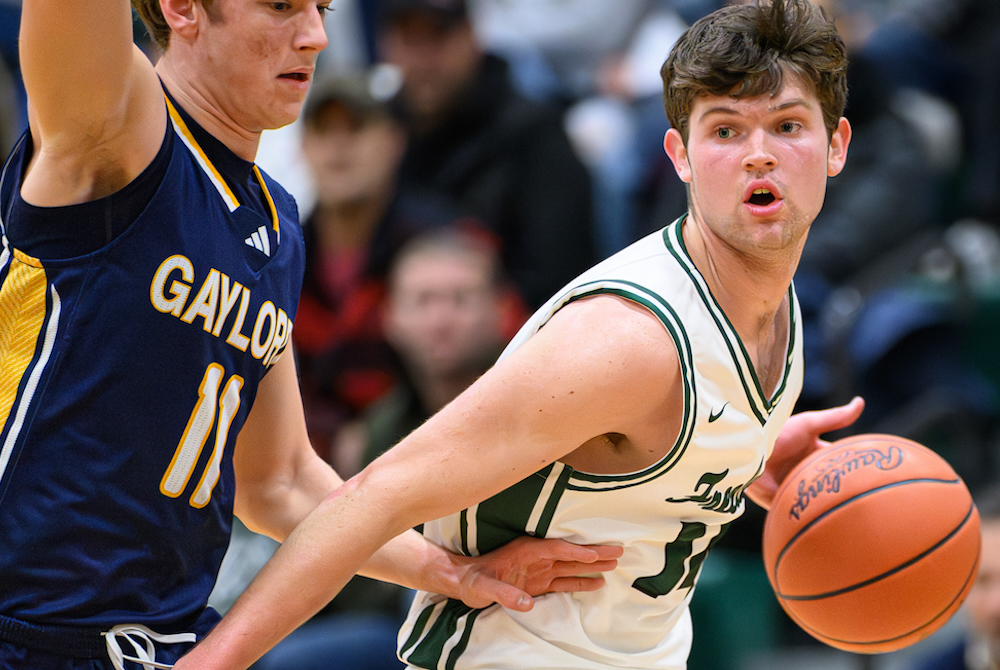
PHOTO Freeland senior forward Wilson Huckeby, right, navigates around a defender during the first quarter of last week's 70-47 Falcons win over Gaylord. (Photo by Kolleth Photo.)