

Rough Start Turns into Breslin Ending
March 22, 2013
By Geoff Kimmerly
Second Half editor
EAST LANSING – Some may consider it ironic that Detroit Community will play for the Class B championship Saturday despite nine losses this season.
But the Hurricanes are the first to explain those losses are why they’ll play in their first MHSAA Final.
Community advanced to the final game for the first time with a 58-37 win over Wyoming Godwin Heights in a Semifinal on Friday at the Breslin Center.
And now senior Byron Zeigler and his teammates will face No. 1 Detroit Country Day – although they won’t be intimidated after facing and falling to the likes of Romulus, Detroit Pershing, Cass Tech, Southeastern and others during the regular season.
“We’ve played all the top teams in the state, so there’s nothing we haven’t seen before,” Zeigler said. “Any situation we came to, we knew we had to stick together, play hard, and we knew we’d have a good outcome.”
Saturday’s Final tips off at 6:30 p.m. Community (18-9) entered the tournament unranked – but given this outcome, likely wouldn’t have scheduled any other way.
The Hurricanes found themselves at 6-5 just after the midpoint of the season. In three of their defeats – to Pershing, Southeastern and reigning Class D champion Southfield Christian – they led going into the final minutes.
During this run they’ve won three games by six or fewer points.
“I think that helped us out going down the stretch. We’re closing those games out now,” Community coach Venias Jordan, Jr., said. “Playing in every holiday tournament and not closing those games out, I guess we can’t help but get better.”
 Closing out wasn’t a worry Friday. The Hurricanes took a 10-point advantage three minutes into the second quarter and led by double digits the rest of the way.
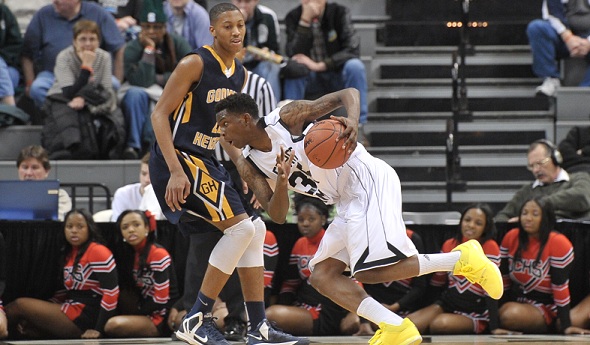
Zeigler, a 6-foot-6 forward headed to South Florida after graduation, said he wanted to be aggressive early and remind his teammates they’d reached the big stage. He scored 10 of his 17 points in the first quarter, and also finished the game with 12 rebounds. Godwin Heights coach Chad Conklin said Zeigler was the best his team had faced this season.
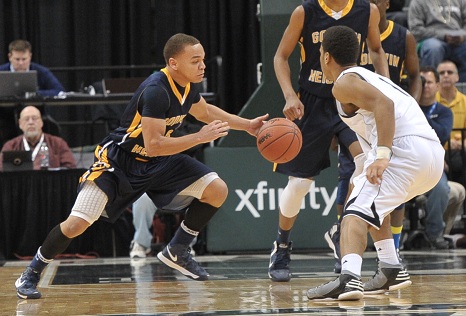
Meanwhile, the Hurricanes worked to keep Godwin Heights’ standout guards out of the lane. Plugging the middle worked – the Wolverines’ point total was their lowest this season by 10. Three Godwin Heights guards entered the week averaging more than 10 points per game, but none scored more than four Friday.
“It’s a double-edged sword. If you’re not making your shots on the perimeter, and then go inside and your shots are blocked … to score 37 points like this is disappointing,” Conklin said. “I thought we got some decent shots outside, but they didn’t go in. We tried to attack the glass, but they did a good job of blocking (us).”
Community junior Jason Buyck grabbed 10 rebounds in just 11 minutes as his team outrebounded Godwin Heights 46-37.
Junior center Markese Mayfield led the Wolverines with 13 points and seven rebounds.
Conklin explained to his players after that they’d put Godwin Heights hoops on the statewide map. His teams were a combined 66-8 over the last three seasons including 23-3 this winter.
Jordan no doubt can say the same to his Community players, regardless of what happens Saturday.
“Over the last three years, we’ve been through a lot, faced a lot of obstacles,” Community senior Ramell Robinson said. “This last year, we have to take it all the way. Our first practice goal was March 23, and not to just get to the championship (game), but to win the championship.”
PHOTOS: (Top) Detroit Community's Byron Zeigler (35) tries to drive past Wyoming Godwin Heights' Markese Mayfield during Friday's Class B Semifinal. (Middle) Godwin Heights' Jamal Bland pushes the ball upcourt against a Community defender. (Photos by Hockey Weekly Action Photos.)
Breslin Bound: Boys Report Week 8
January 28, 2013
By Geoff Kimmerly
Second Half editor
Eight weeks of success is enough to expect that any team still undefeated – like our top team among last week's high performers – should keep making noise over the month and a half to come.
But there's something to be said about starting anew on Jan. 1. And we've got a few on this week's list as well that have surged since the calendar year got a new start.
Remember, results and overall records below are those listed in our MHSAA Score Center. Are either incorrect? Please help us out after filling in this brief registration.
1. Big Rapids (11-0) – The Cardinals have won 20 straight regular-season games dating back to the mid-point of last winter and lead the Central State Activities Association.
2. Rochester Adams (10-1) – The Highlanders’ lone loss came against Oxford all the way back on Dec. 14; they’ve won four straight by double figures and are just two wins from equaling last season’s total.
3. Zeeland East (10-2) – The Chix are in first place by a win over two others in the O-K Black and have won four straight including beating league favorite Muskegon 67-61 on Friday.
4. Allen Park Inter-City Baptist (10-2) – Before Saturday’s 14-point loss to Detroit Country Day, the Chargers had won three straight and earlier this month edged reigning Class D champion Southfield Christian by a point.
5. Lansing Waverly (9-2) – The Warriors opened this season with losses to Holt and Jackson Lumen Christi by a combined five points, but since have won nine straight including avenging that loss to the Titans on Friday.
6. Bessemer (10-1) – The Speedboys are undefeated in-state, with their only loss to Washburn, Wis., after winning 10 games total last season.
7. Crystal Falls Forest Park (6-3) – The Trojans opened this winter with two losses, but are on a roll and edged 2012 Class D Semifinalist Carney-Nadeau on Friday, 70-67.
8. Pittsford (9-2) – The Wildcats hit a rough patch from Jan. 11-15, when they lost two games; otherwise, they’re undefeated this season.
9. Temperance Bedford (8-1) – Despite losing to Sylvania Southview of Ohio on Saturday, the Kicking Mules opened with eight straight wins and beat Ann Arbor Pioneer 56-54 the night before.
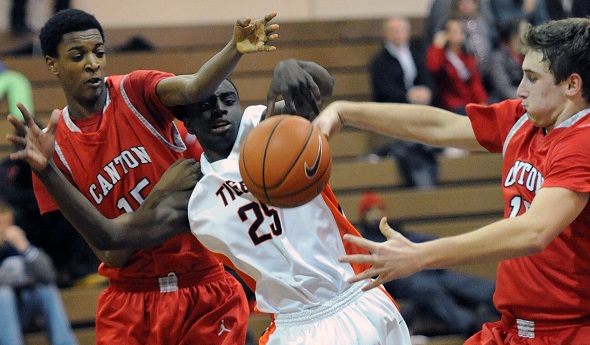
10. Canton (7-5) – The Chiefs also are running well in January with five straight wins including Friday’s 55-50 victory over Westland John Glenn which avenged their last lost before the run, 53-48 to John Glenn on Jan. 4.
PHOTO: Canton players (in red) try to gather a loose ball during a game against Cincinnati Withrow on Dec. 28 at Detroit County Day. (Click to see more at HighSchoolSportsScene.com.)