

Small Schools, Big Northern Lights Finish
By
John Vrancic
Special for MHSAA.com
February 29, 2016
HANNAHVILLE — Not too many high school conferences in Michigan have their own basketball tournament.
 The Northern Lights League in the Upper Peninsula, however, is one of the exceptions to the rule.
Each year the league’s eight schools meet at Hannahville for their annual tourney.
“This is such a great tournament for our conference,” said Maplewood Baptist boys coach Steve May. “What an opportunity for small schools. These are the types of things these kids will never forget. This is their chance to shine. They get to experience March Madness, although it comes a little early.”
The tournament, traditionally held in late February, showcases all the talent these schools have to offer.
This year’s girls tourney featured the league’s first all-U.P. player in senior Hannah May, a second-team selection a year ago.
“This is really a nice tournament,” Hannah said. “All the small schools come together and make some new friendships. This is the highlight of the year. This gives us something to shoot for.”
Hannah May showed why she’s all-U.P. in the championship game Feb. 20, sinking a buzzer-beating 20-foot jumpshot from the right wing to force overtime in Maplewood’s 79-70 triumph over Wilson Nah Tah Wahsh.
She scored 35 points, and classmate Harmony Bailey added 24.
“We enjoy this tournament,” said Maplewood girls assistant coach Caroline May. “We look forward to it every year.”
 Senior Selena Williams, looking to play ball at Gogebic Community College in Ironwood next season, led Hannahville with 26 points. Sophomore Cecilia Beaver added 23.
“I love our team,” said Beaver. “We all get along. We’re also real good friends with Maplewood Baptist, and we get along with the other teams. We’ve developed a lot of friendships.”
The Maplewood Baptist boys also captured the league tourney crown in a 73-54 conquest of Hannahville.
Senior Patrick Gomes scored 19 points for the Kinross-based school, which placed four in double-digits. Senior Cody Meshigaud paced the defending champs with 24.
The tournament provides plenty of opportunity for team bonding and camaraderie among all the teams.
“I like it and the kids enjoy it,” said Ojibwe Charter girls coach Ashley Bishop. “You see the upsets and victories. It’s nice to see all the teams get together. All the schools are very small, and I think the kids make better friends this way. At the motel we stayed at in Escanaba, we had kids and coaches from 4-5 schools hanging out together.”
Ojibwe boys coach Brandon Kerfoot believes the tournament is part of the learning process for a team with no seniors.
“I think being able to end the season with schools about our size is a big stepping stone for the kids,” he said. “It’s a different game once you hit the tournaments. Anything can happen once you reach this point.”
The Ojibwe boys started two juniors and a sophomore, freshman and eighth-grader in a 69-46 semifinal loss to Maplewood Baptist.
Ojibwe’s girls started two juniors, two sophomores and an eighth-grader in a 56-34 loss to Hannahville in the semifinals.
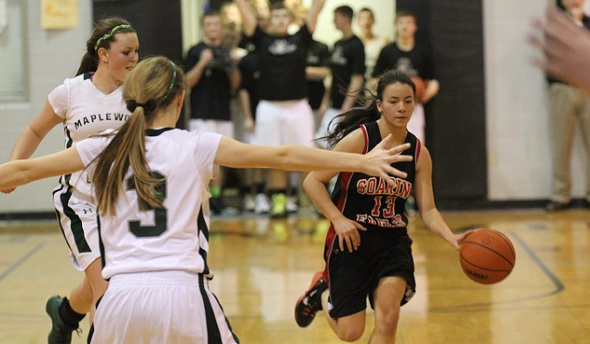
PHOTOS: (Top) A pair of Kinross Maplewood Baptist defenders surround a Wilson Nah Tah Wahsh player bringing the ball upcourt during the Northern Lights League Tournament. (Middle) A Maplewood defender works to wall off a Bay Mills Ojibwe Charter guard. (Photos by Paul Gerard.)
Film Fills In Picture of 'Fennville Flash'
By
Ron Pesch
MHSAA historian
December 28, 2017
We’ve been here before, but not in this way.
The last time was for a retrospective, covering one of the most impressive and awe-inspiring prep careers in Michigan high school history. That time was in print, and included a handful of still images that tried to illustrate the unbelievable.
But this time, the story is in documentary form. It’s woven together from grainy, scratched, faded silent film, a format of capturing memories familiar to thousands of people from generations past, as well as a series of modern-day high-resolution interviews.
Here, the basketball life of the athlete known as the “Fennville Flash” delivers on many levels. Yes, there is a Richie Jordan.
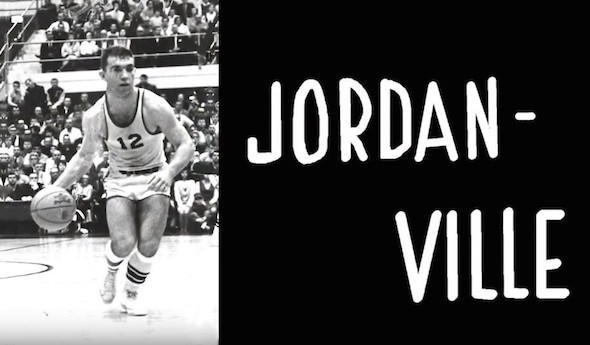
JordanVille, a documentary by John Mooy & Anne Colton, recalls a time when legend spread via word of mouth, newsprint and AM radio.
While it’s hard to comprehend for many today, the exploits of our athletic heroes were formed by “poets in the press box” who sat with pencil and paper, a typewriter, a microphone or a telephone, and described to their audience what they witnessed. On the receiving end, readers and listeners conjured up visualizations based on the facts, phrases and superlatives designed to create an image.
“Traveling left to right on your radio dial” helped listeners feel they were a member of the crowd, seated in the stands, in on the action and a witness to the mayhem. “Packed to the rafters,” reminded fans the importance of what was happening. An exciting game, presented by those with skill, created an event you longed to see. If a broadcast couldn’t be picked up on a transistor or tube radio, the final result might not be known, at the earliest, until the following day’s newspaper arrived.
I’ve told Jordan’s story via the MHSAA before; how he latched on to athletic training, weights and repetition to mold himself into a well-rounded athlete, able to leap to heights unexpected for a kid with a 5-foot-7 frame. The tales of his unfathomable accomplishments slowly leaked beyond the city limits of Fennville into Kalamazoo and greater Southwestern Michigan, then to Detroit. When Detroit Free Press writer Hal Schram relayed Jordan’s feats, the secret traveled across the state and beyond its drawn borders.
From there the legend of Jordan’s accomplishments grew. In Fennville, as in many small towns across the country, the city shut down when a game was played. The Jordan story was so enticing that thousands would travel vast distances to see him play with their own eyes. Today, his single season scoring average of 44.4 points per game during the 1964-65 campaign still remains the top mark in the MHSAA record book.
 JordanVille runs just shy of a half hour. Contained within is insight into the athlete that is challenging to relay in print form. Thanks to access to home movies and a series of interviews with Jordan, former teammates, past opponents and his high school coach, the determination, dedication and drive of a kid who wouldn’t let physical size be a deterrent from achievement radiates from the screen. On display is small town America at its finest, and perspective formed over 50+ years.
For Mooy, it completes a filmmaking journey started six years ago. But the story of Jordan, in his eyes, date back to his school days. Mooy first heard about Jordan as a 7th-grader from a math teacher. A second-team all-St. Joseph Valley League selection, Mooy played at Marcellus High School and scrimmaged against Jordan and the Fennville Blackhawks.
He couldn’t believe his eyes.
“Everyone wanted to see this kid play,” said Mooy in 2011. “He was the first high school player I saw sign an autograph.
Today, with the interviews complete, and the film ready for viewing, Mooy sees more than just a sports story:
“With the benefit of years now passed, I look at the Rich Jordan story with a new respect. JordanVille created a place that was welcoming no matter who you were, or what color your skin happened to be. It was the 1960s. Rich was growing up Jewish, the Civil Rights Movement was in full swing, and the Vietnam War was on everyone's mind. And in Fennville, Michigan, from 1961 to 1965, the Jordan high school years, there were lessons beyond sports being learned by everyone that would last a lifetime. The Jordan household, under the guidance of (his parents) Tuffy and Sylvia Jordan, is where the story begins."
The film speaks of a time that has departed. Competition for our attention was less focused; phones hung on walls or sat on tabletops, communities were tighter, the training table featured peanut butter and chocolate milk instead of protein powder. A city could easily be renamed for a day.
The film also reminds us that those days were far from perfect.
If all goes as planned, the public will see the finished product come the flip of the calendar. In West Michigan, JordanVille is scheduled to show on New Year’s Day at 6 p.m. on WGVU, and will repeat on WGVU-Life at 7:30 p.m., Friday, Jan. 5.
Seek it out, and spread the word, just like in days of old.
 Ron Pesch has taken an active role in researching the history of MHSAA events since 1985 and began writing for MHSAA Finals programs in 1986, adding additional features and "flashbacks" in 1992. He inherited the title of MHSAA historian from the late Dick Kishpaugh following the 1993-94 school year, and resides in Muskegon. Contact him at [email protected] with ideas for historical articles.
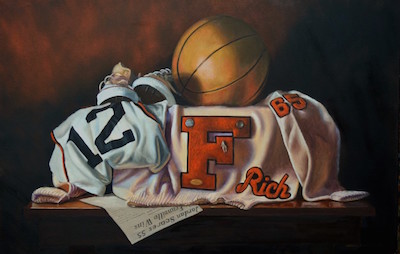
PHOTOS: (Top) Richie Jordan runs Fennville's offense during his thrilling high school career in the 1960s. (Middle) Jordan memorabilia, as captured by Bill Williams.