


Stuck Family Success Lives On at Charlevoix
February 3, 2017
By Dennis Chase
Special for Second Half
CHARLEVOIX – Elise Stuck burst on to the scene with a 21-point, 11-rebound effort in Charlevoix’s season-opening win over Petoskey.
 That was two months ago, but it was a harbinger of things to come.
Stuck, an athletic 6-foot-1 freshman, has registered seven double-doubles and one triple-double for the 9-4 Rayders, who are trending toward their best season since a 21-win campaign in 2008-09. Charlevoix was 3-19 a year ago.
The Rayders are achieving this with a lineup that features two freshmen and three juniors. Stuck – who “plays everywhere,” including the point – is the leader, averaging 18.7 points and 11 rebounds per game. She had 10 assists in a win over Gaylord last month.
“She’s the real deal,” Charlevoix coach Liz Shaw said. “She’s so fun to watch. She plays well beyond her years. One of her great attributes is passing. She sees the court so well. She makes everybody around her better. As a team, I think that’s why we’ve been so successful. And not only is she a great player, but she’s a great kid.”
Stuck struggled with her shot Wednesday in a 53-47 setback to Class A Traverse City Central. She still finished with 18 points (all in the second half) and eight rebounds. The Rayders could not contain Central junior guard Margot Woughter, who tossed in 27.
Shaw said Stuck’s struggle was an aberration.
“All players struggle, but great players figure it out,” she said.
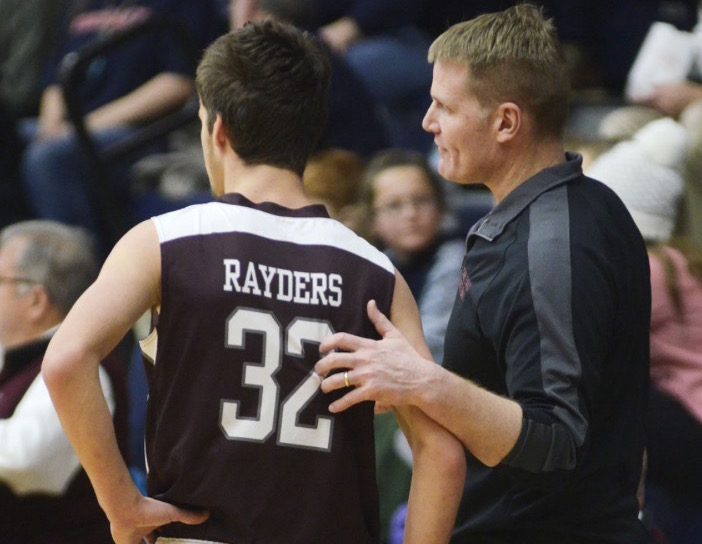
Stuck, who turned 15 on New Year’s Eve, comes from a basketball family. Her parents, Erica (Hall) and Matt, combined to score nearly 4,100 points during their all-state careers at Manton. In fact, Matt is seventh in MHSAA career scoring with 2,449 points. He went on to play four years at Oakland University and two years professionally overseas. He’s now in his first season as the Charlevoix boys varsity coach. Erica’s 1,649 points rank second all-time at Manton. She’s in the MHSAA record book twice for hitting 15 free throws in a game.
But those feats are seldom discussed now. Their focus is on the present – and their kids.
And the kids keep them busy playing multiple sports. In addition to basketball, Elise competes in volleyball (honorable mention all-state), soccer and track. Her twin brother, Luke, who’s been battling injuries, plays basketball, football and baseball. Caleb, a seventh-grader, is also a basketball player, although baseball is his preferred sport.
“We always wanted them to love sports,” Erica said. “We’re super excited that they share that same passion.
“Otherwise,” she added with a laugh, “I don’t know what we would do.”
Elise is an emerging talent on the court. She’s a difference-maker, even though she’s still learning the nuances of the game. The more experience she gains, the more she’ll improve, her father said.
“I’m a dad and a coach so I always say she’s doing well, but she has a long way to go,” Matt said. “She has a very good athletic skill set. She’s tall, can run, can jump. She’s a good athlete who’s becoming a good basketball player.”
She’s also a leader.
That’s a role Matt didn’t have to take on when he was a freshman at Manton. Although he was a double-digit scorer on a team that reached the Class C Quarterfinals that season, the Rangers’ roster was stocked with strong senior leadership in Jeff Spalding, Cage Butcher and Chris Herndon. Spalding was an all-state guard.
By contrast, Charlevoix has just one senior on its girls roster this season.
“For me, the transition was easier,” Matt said. “I could just go play. Elise has had a bigger impact (as a freshman).”
Others have taken notice. Ron Stremlow, who coached Erica at Manton, compares Elise’s court presence to two former area standouts who went on to play at Michigan State.
“Elise is a Liz Shimek, Jasmine Hines type player,” Stremlow said. “She plays a different position, but she catches your eye as soon as the game starts.”
Stremlow saw Stuck play in a loss last month to unbeaten Kalkaska. He was not the only one impressed.
“Explosive,” Kalkaska coach Dave Dalton said in describing Stuck. “She can drive the ball, take it the length of the court, left or right. She’s big, strong, fast. She can play with her back to the basket. And she’s a really good passer.”
 That’s why Shaw utilizes her all over the court, including the point.
“I don’t want to handcuff her,” she said.
Stuck’s game is still a work in progress, particularly on the perimeter. She acknowledges that.
“Coming into the season I had never played point guard or on the outside,” she said. “I was an inside player, and in crunch time I go to my inside game because that’s what I’m used to.
“I worked this summer on being able to take (defenders) one-on-one off the dribble. My outside shooting, shooting off the dribble, shooting under pressure, can definitely get better. That’s something I want to work on.”
Now that her players are settling into roles, Shaw said the Rayders “are getting better and better every game.” Abby Cunningham, a 5-11 freshman, has taken over at center, joining juniors Olivia Jeakle and sisters Rachel and Natalie Nesburg in the lineup. Shaw said last week’s 57-35 win over East Jordan was the team’s most “in sync” game of the season. Jeakle hit two 3-pointers early en route to a 14-point night. Natalie Nesburg chipped in eight points, six rebounds, five steals and five assists while Rachel added seven points, eight rebounds and five assists.
Cunningham is a close friend of Elise’s, and they have helped each other make the transition from middle school to varsity basketball.
“It’s fun to watch them have this kind of success together,” Erica said. “They love their team.”
Shaw is hoping this nucleus can help put Charlevoix girls basketball back on the map.
Charlevoix finished runner-up in the 2004 MHSAA Class C Final to Detroit St. Martin dePorres. That team was coached by Keith Haske, Shaw’s mentor. Haske is now at Traverse City St. Francis, where he led the Gladiators to the Class C Final last season.
Meanwhile, Matt, who runs his own construction company, took over the varsity boys job this season.
“I thought if I can help or contribute in any way,” he said, “why not?”
First, he had to make sure the added responsibilities wouldn’t drastically take away time from watching his kids play.
“Schedule-wise we decided as a family that it would work, that I wouldn’t miss any more games than I would have if I wasn’t coaching,” he said. “On Tuesday nights in our league (Lake Michigan Conference), the boys go one way, the girls the other. We were going to have to divide and conquer anyway.”
Stuck inherited a team short on varsity experience. The Rayders dropped to 3-8 after Wednesday’s night’s 58-45 loss to Gaylord.
But the coach sees improvement. He’s continually stressing fundamentals in practice, giving his players a base to become a better team.
Charlevoix has nine juniors on the varsity, plus a solid group at the JV level, so the future looks promising.
Luke, who has been dealing with kneecap tracking issues and a sprained LCL, returned to JV practice this week. The kneecap problem, he suffered last March, severely curtailed his baseball and football seasons. He was ready to go for basketball, but then sprained his LCL (lateral cruciate ligament) in gym class.
“He’s had a long year,” Matt said.
At 6-2, 210 pounds, Luke is a solidly built forward, whose strengths are rebounding and defense.
“He’s a pretty good leader on the court, too,” his father said. “He knows where everybody needs to be – and he’s pretty vocal. About four or five of those guys play travel ball together. It’s a good group.”
Luke was eager to get back in action.
 “It was interesting to see the other side of the game (sitting out while injured),” he said. “But it was really (disappointing) to not participate, knowing that you could be out there (contributing).”
Matt and Erica have coached their kids over the years. Both coached the girls 8th grade team last year. Then, Matt and Boyne City’s Randy Calcaterra, a Wayne State grad who played against Matt in college, coached 7th and 8th grade AAU teams that their sons played on.
Getting a handle on that dynamic is not as easy as it sounds, Matt said.
“That’s the hard part of having parents that have played and are coaches,” he said. “Randy and I would always say that coaching is hard, parenting is harder and being a parent-coach is hardest.”
As a parent, Stuck said he’s applies a rule he learned from his father.
“I ask my kids: Do you want me to tell you one thing that you need to work on?” he said. “That’s the rule my dad had when I was going through school. If you want to hear it, I’ll tell you. I apply that same rule. If they want to open it up for more, we discuss more.”
Do they ask?
“They do,” he said.
“Sometimes they might regret it,” he added with a chuckle.
Stuck averaged 24.7 points a game in his 99 varsity starts at Manton. He was coached by Rene LaFreniere.
LaFreniere said the 6-4 Stuck was more than a scorer and rebounder.
“The thing people didn’t realize is that he was such a good passer,” LaFreniere said. “He would get double- and triple-teamed and would always find the open man.”
For as good a ballplayer as he was, LaFreniere said Stuck’s an even better person.
“Special person, incredible parents,” he said. “Humble, never gloated. It was like, ‘I’ve got a job to do.’ And he did it.”
Whereas Matt could use his size in the paint, Erica made her mark from the perimeter.
“She could shoot,” Stremlow said. “Her range was about 25 feet.
“Good upbringing, a coachable player, a team player who understood the game and really pushed herself. When I watch her daughter, I see those similarities.”
Erica, a math teacher in the Ellsworth school system, said the value of hard work was preached when she played.
“People always told me the harder you work, the more determined you are, that will determine how good you end up being,” she said.
The gym is still a home away from home for the Stucks. Countless hours are spent there on a daily basis.
It’s a lifestyle that works for the family. And they wouldn’t want it any other way.
“We don’t think anything of it,” Matt said. “We think of it as a regular day. We enjoy it. That’s all there is to it.”
 Dennis Chase worked 32 years as a sportswriter at the Traverse City Record-Eagle, including as sports editor from 2000-14. He can be reached at [email protected] with story ideas for Manistee, Wexford, Missaukee, Roscommon, Ogemaw, Iosco, Alcona, Oscoda, Crawford, Kalkaska, Grand Traverse, Benzie, Leelanau, Antrim, Otsego, Montmorency, Alpena, Presque Isle, Cheboygan, Charlevoix and Emmet counties.
PHOTOS: (Top) Charlevoix’s Elise Stuck blocks a shot this season, her first in high school. (Middle) The versatile Stuck brings the ball upcourt. (Below) Matt Stuck, right, is Elise’s father and the Charlevoix first-year boys coach. (Photos courtesy of the Petoskey News-Review.)
1,000-Point Pair Pacing Another John Glenn Contender
By
Paul Costanzo
Special for MHSAA.com
March 3, 2021
Abi Tarrant knew how close Carly McCrum was to 1,000 career points and wanted to make sure her Bay City John Glenn teammate’s accomplishment was celebrated.
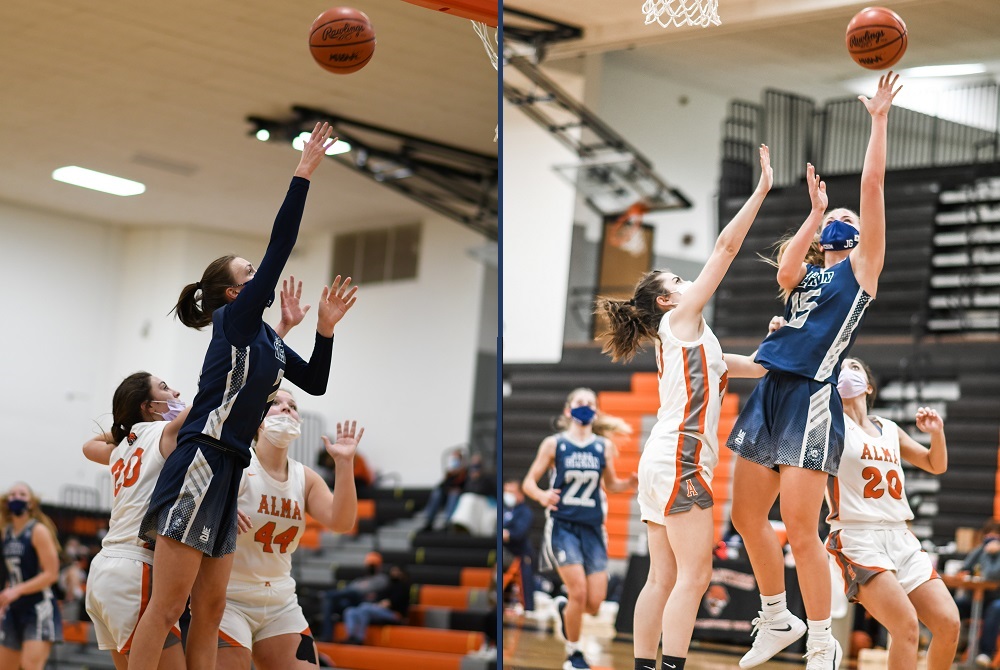
 On Feb. 17, when McCrum achieved the milestone in a victory against Alma, the John Glenn fans in attendance cheered the moment while waving homemade signs, which they had been carrying thanks in large part to an effort spearheaded by Tarrant.
“Last year, I broke the (school career) rebound record, and all of the student section, everybody made posters, and it was a huge moment for me,” Tarrant said. “I knew she was getting her 1,000 points that week, so I wanted her to have the same type of environment. Even though the student section wasn’t there, she could still have that kind of energy from the crowd when she hit it.”
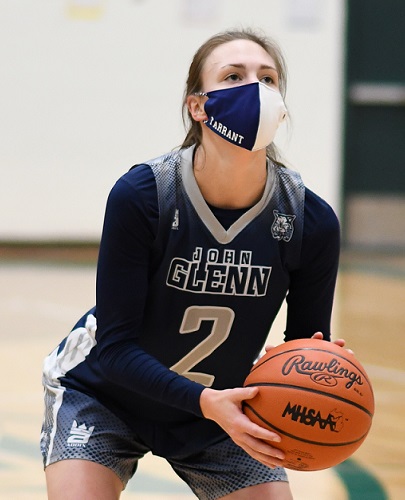
It was only after the celebration for McCrum subsided that Tarrant realized just how close she was to the same milestone: 16 points.
“I knew exactly where she was because I had been planning the poster thing,” Tarrant said. “(One thousand points) kind of snuck up on me. I didn’t know I was that close to her. But in the game it happened, I knew.”
Tarrant achieved her own milestone the next time out, a John Glenn victory on Feb. 19 against Birch Run, giving the Bobcats a pair of 1,000-point scorers in the same class.
McCrum now sits at 1,053 career points and Tarrant has 1,046 as they have led the Bobcats to a 7-1 start to the season and a top-five ranking in The Associated Press Division 2 poll. Their lone loss came in double overtime against Frankenmuth, another top-five team.
 “I just thought it was a really cool experience,” McCrum said. “We’ve both been on varsity since our freshmen year, and we’ve played with each other on the same travel team, so it was very cool that we hit it in the same week. We both feel like this team is really special, and our goal is to win a state championship.”
Tarrant and McCrum became the seventh and eighth players in school history to hit the 1,000-point mark. It’s the second time John Glenn has had classmates reach the milestone, joining 2016 graduates Jenai LaPorte (1,547 points) and Cassidy Boensch (1,403). Boensch did play her first two seasons at Au Gres-Sims.
“I’ve been really spoiled,” John Glenn coach Cory Snider said. “Three of those 1,000-point scorers (LaPorte, Boensch and 2017 graduate Kalle Martinez) were all on the same team. The five kids I’ve had (reach 1,000 points) have all been on the same teams, so that’s a really unique situation. You don’t hear of that a whole lot. They make me look way smarter than I am.”
McCrum and Tarrant are both four-year varsity players for Snider, and for McCrum, it was clear early on that she would become another of the school’s great scorers. She was the team’s leading scorer during her freshman (14 points per game) and sophomore (14.2) seasons.
“Carly has been the steady, calm influence on our team for four years,” Snider said. “It’s pretty incredible to be able to come in as a freshman and give us (14.2) points per game when she was (the focus) on everybody’s scouting report her freshman year.”
McCrum said it was a role she was comfortable with, as she had taken it on through middle school as a travel player.
“It wasn’t something really new for me,” said McCrum, a 5-foot-10 guard who has signed with Ferris State. “Probably my freshman year, I did feel some pressure and it got in my head, but it’s gotten a lot better, and I’ve gotten more comfortable with that.”
While she’s thrived in that role, and has established herself as a strong outside shooter, McCrum would rather be the one setting up teammates.
“She has such a high basketball IQ,” Snider said. “She’s more of a true playmaker than a natural scorer. She has a super high basketball IQ and loves to find the open player. She enjoys making an assist as much as she enjoys scoring a basket.”
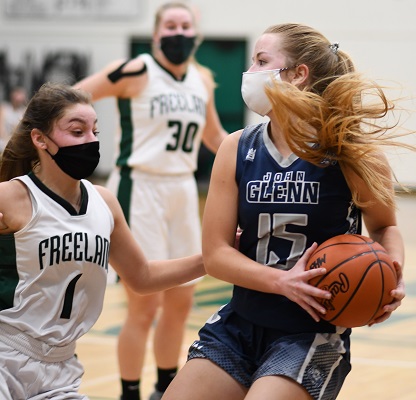 While McCrum was filling up the scoresheet early on, Tarrant had to find a different way to make an impact for the Bobcats. Despite her size – she's 5-7 now – that wound up being rebounding.
“Freshman year, I was just kind of in the right place at the right time, and I think that’s a lot of it,” said Tarrant, who is committed to Hope College. “A lot of those are rebounds that the posts don’t want to get, like running out of bounds. I would sneak up behind people to get them – I just always find myself somewhere near it. My dad told me that if you’re not going to score, then you have to do something. I guess I just picked that.”
Tarrant has done that better than anyone in school history, racking up 732 career rebounds.
“She just played with such a high motor, and she had such a desire to be really good,” Snider said. “Her growth as a player has been incredible from her freshman year to now as a senior. It’s more growth than I’ve seen from any other player. It’s unbelievable.”
Tarrant’s scoring picked up in a big way a year ago, as she averaged 19.4 points per game, setting a junior-year record for points at John Glenn.
“I think we molded more as a team,” Tarrant said. “We started playing a lot better together. At first, I think it was hard. Freshman year, Carly was the best player through and through, then sophomore year I stepped up my game a little bit. Junior year, we figured out how our games complement each other. This year, we’re playing amazing together.”
With a strong supporting cast surrounding them, McCrum and Tarrant hope to take John Glenn back to the heights it reached not long ago. The Bobcats were a Class B semifinalist in 2016 but have had their season ended by Freeland every year since, including in the District Final the past three seasons.
But they feel this could be the year they add some team trophies to the individual successes they’ve been able to rack up.
“It would mean a lot,” McCrum said. “Abi and I have been on the same team since freshman year. Some of the girls, we have been together since sophomore year. We’ve all been together for a long time. First of all, we want to win Districts. We’ve lost three years in a row to Freeland. I think it would be so awesome. We’ve all been together for so long, and we’ve always talked about going so far.”
 Paul Costanzo served as a sportswriter at The Port Huron Times Herald from 2006-15, including three years as lead sportswriter, and prior to that as sports editor at the Hillsdale Daily News from 2005-06. He can be reached at [email protected] with story ideas for Genesee, Lapeer, St. Clair, Sanilac, Huron, Tuscola, Saginaw, Bay, Arenac, Midland and Gladwin counties.
PHOTOS: (Top) Bay City John Glenn’s Abi Tarrant, left, and Carly McCrum make strong moves to the hoop against Alma this season. (Middle) Tarrant focuses for a free throw. (Below) McCrum maintains possession against Freeland. (Photos by Jodi Stopyak.)