

Stunner Sends Ludington to Saturday
March 24, 2017
By Geoff Kimmerly
Second Half editor
EAST LANSING – If older brother is right, Joshua Laman might not remember much of the aftermath of his first 3-pointer this season.
But it’s a shot Ludington – and probably River Rouge – will never forget.
Laman, a sophomore center, had missed all nine of his tries behind the arc entering Friday’s Class B Semifinal. But as the seconds ticked down in overtime, Orioles senior and older brother Noah Laman had the instinct to pass to Joshua stationed in the left corner.
What he tossed up was something of a right shoulder heave, a little like a shot put. But as the final second clicked off the clock, Joshua Laman’s 3-pointer dropped through the net, sending Ludington to its first Class B championship game since 1953 with a 51-50 win over River Rouge.
“I don’t even know if he is thinking right now,” Noah Laman said a few minutes later from the postgame press conference. “I don’t think words can describe what’s going through any of our heads right now."
“He’s thinking that when I get back in that locker room,” Ludington coach Thad Shank added, “he’s going to look Coach Shank in the eye and say, ‘Told you coach I should be shooting these 3s all year long.’ I know that’s what he’s thinking.”
Ludington (25-2) will take on New Haven at 6:30 p.m. Saturday in the season’s final game at the Breslin Center. The Orioles have never won an MHSAA boys basketball title, falling to St. Joseph 60-51 in that lone appearance more than 60 years ago.
This was their first Semifinal since 1971, and they weren’t going to let the opportunity slip by even if they were perceived to be a slight underdog ranked No. 8 heading into the postseason while River Rouge came in No. 2.
It looked for most of the game like the poll was accurate. Although Ludington put together a few runs to keep the game knotted midway through the third quarter, the Panthers (24-2) gradually opened up a lead that reached nine points with 1:48 to play in regulation.
That’s when the first set of heroics came into play. Senior guard and leading scorer Calvin Hackert made two 3-pointers and a free throw, and Noah Laman added the other bucket as the Orioles closed the fourth quarter on a 9-0 run to send the game to overtime.
River Rouge got up by five again midway through the extra period. But Ludington closed on a 7-1 run, with Joshua Laman’s winning shot coming after a Rouge turnover with 30 seconds to play and then two missed shots and offensive rebounds by the Orioles, who otherwise were outrebounded for the game 24-20.
 That turnover to set up the final possession was in addition to two more Panthers turnovers during the closing run of regulation. And Ludington pulled off the final charge after Hackert fouled out with his team still trailing by four.
“A couple times I told them hey, if on November 15 when we walked in this gym and we were down four or five points in the state Semifinal to River Rouge, would you take it?” Shank said. “We’ve gotta keep our heads up, and we’ve gotta keep fighting here.
“We are a pressure defensive team, and we have a lot of respect for Rouge and their quickness, and we haven’t played a team with that level of quickness to this point. So we didn’t really aggressively go after River Rouge like we do most teams. But the fact that that’s part of our package I think was huge down the stretch of the game, that that’s what we’re comfortable doing. It wasn’t something we were just throwing out, full court pressure that we’d never used before.”
River Rouge coach Mark White – who previously led Detroit Renaissance to Class A titles in 2004 and 2006 – could sense Ludington was working toward a dramatic end.
He said it was his Panthers’ worst game this season – and obviously the worst time for it. But how Ludington pulled off its last-second success wasn’t lost on him.
“Well, luck is something that’s created. We got a defensive stop, and we teach and emphasize that defense isn’t over until we get the rebound,” White said. “And we didn’t finish the defensive possession. We got them to miss a couple shots, and there were a couple loose balls. It went down to that determination factor, and Ludington wanted it, by their behavior, more than we did … and again, when you give as much as they did, the basketball gods are on your side because you deserve and that happens in March.”
Sophomore Darian Owens-White led River Rouge with 19 points, and junior Jayvien Torrance added 10.
Hackert led Ludington with 20 points, and Joshua Laman had 11. Also worth noting, junior center Will Sadler had seven points, making all three of his shots including his only 3-pointer this winter as well.
Laman’s final shot led to a pile of Orioles players in Breslin’s southwest corner, right in front of a sea of orange-clad fans taking up nearly three full sections of the lower bowl.
“We can tell how big a deal it is just by the support of the community,” Hackert said. “The crowd was electric tonight, and it shows how much they revolve around us and really support us. And to be playing in the state championship, it’s just awesome. I can’t even explain it.”
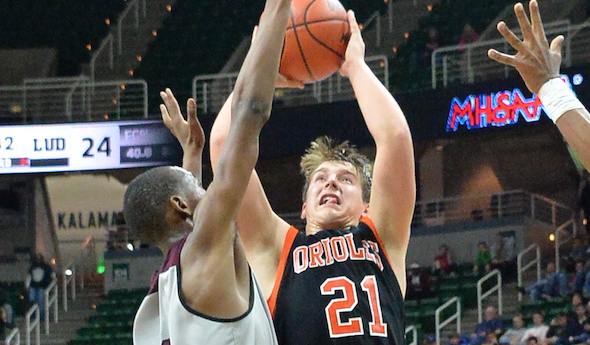
PHOTOS: (Top) Ludington’s Calvin Hackert puts up a shot as a River Rouge defender works to block his path. (Middle) Rouge’s Darian Owens-White goes up for a layup on the way to scoring 19 points.
Breslin Bound: 2025-26 Boys Report Week 2
By
Geoff Kimmerly
MHSAA.com senior editor
December 15, 2025
The calendar year may be drawing to a close, and schools soon shutting down for break. But there will be little rest for basketball fans seeking to see several of the state’s title contenders in action over the next three weeks.

Several leagues have either started play or will over the next few days, and this weekend starts full schedule of boys hoops showcases that will see many teams across the state playing at least once over the holidays before the regular-season schedule falls into routine in January.
“Breslin Bound” is powered by MI Student Aid and based on results and schedules posted for each school at MHSAA.com.
Week in Review
The countdown of last week’s five most intriguing results:
1. Arts & Technology Academy of Pontiac 60, Warren Lincoln 59 Last season’s Division 3 runner-up Lions (2-0) earned one of their most impressive wins over the last two winters by edging reigning Division 2 champ Lincoln (2-2) at the Best of Michigan Tournament at Detroit Mercy.
2. East Lansing 41, Detroit Martin Luther King 40 The reigning Division 1 champion Trojans (4-0) answered their closest call of the early season to win one of the most notable matchups at the Moneyball Tip-Off Classic at Don Johnson Fieldhouse.
3. Ishpeming Westwood 59, Kingsford 54 These two both made Semifinals at Breslin Center last season, and Westwood (5-0) came back from 17 points down to avenge a seven-point loss from last year to the Flivvers (3-1).
4. Lansing Sexton 86, Detroit Cass Tech 81 Sexton (2-1) opened this season with a loss at East Lansing but has rebounded to make a statement about its potential to build on last season’s Division 2 Quarterfinal run with this win over the Division 1 Technicians (3-1) at Don Johnson.
5. Grand Rapids Northview 50, Grand Rapids Catholic Central 44 The Wildcats (3-1) returned to The Invite at Calvin University and downed the Cougars (0-2), also Division 2 semifinalist last season.
Watch List
With an eye toward March, here are two teams in each division making sparks:
DIVISION 1
Auburn Hills Avondale (4-0) Winners of 16 games both of the last two seasons and runners-up in the Oakland Activities Association Red last winter, the Yellow Jackets may have more in store after this solid start including a 69-51 win over West Bloomfield on Thursday. Avondale’s holiday break slate is loaded with notable matchups against Freeland, Grand Blanc, Detroit Mumford and Hamtramck.
Jackson (3-0) The Vikings are off to a solid start as they look to build on last season’s 12-12 finish and tie for second in the Southeastern Conference White. Jackson opened league play Friday with a 60-47 win over Tecumseh, one of the other two teams that also tied for second in the league last season, and will get a first look at reigning champion Adrian on Friday.
DIVISION 2
Ludington (5-0) The Orioles’ fast start has included handing Spring Lake it’s only loss, 55-46 on Dec. 4, and delivering a first defeat to Fremont on Friday, 73-67 in overtime. Ludington lost to Spring Lake twice last season on the way to finishing 16-9, and the Orioles also are the early leaders in the West Michigan Conference Lakes after finishing second to Whitehall last winter.
Romulus Summit Academy (6-0) Last season’s Division 2 runner-up has not slowed down a bit, with a 35-29 win over Warren Fitzgerald on Saturday adding to a 65-59 overtime win over Detroit Edison and 65-54 victory over Detroit U-D Jesuit among notables during a busy but successful opening two weeks. Friday’s home game against Arts & Technology Academy of Pontiac could end up deciding the Charter School Conference Gold title.
DIVISION 3
Gobles (4-0) The Tigers have improved from four, to nine, to 12 wins over the last three seasons and could add to that climb after four double-digit victories to open this one. The team’s fast start included last week a 55-45 win over Bloomingdale – avenging a last season loss – and a 50-36 victory over Delton Kellogg, with which Gobles split Southwestern Athletic Conference Central meetings last winter.
Onsted (4-0) The Wildcats have won at least 18 games every season this decade and finished 21-2 in sharing the Lenawee County Athletic Association title with Adrian Madison last winter. Onsted split with Madison last season and won their first meeting again this time, 45-38 on Friday, with the rematch Jan. 29. Also worth noting: Onsted is in Division 3 this season after previously playing in Division 2 and Class B before that.
DIVISION 4
Concord (5-0) A 53-51 win over Bronson on Friday kept Concord perfect to start this season, with that also their first single-digit game of this winter. The Yellow Jackets finished the last one 17-10 and tied for second in the Big 8 Conference, and the Bronson win also avenged a December loss from a year ago – as did the 67-57 victory over Battle Creek St. Philip on Dec. 5. Concord will see reigning league champion Stockbridge for the first time Jan. 8.
Traverse City Christian (5-0) The Sabres finished 23-3 last winter, when they also started 5-0 before running into Lake Leelanau St. Mary. Those two faced off Friday, and this time TC Christian handed St. Mary its first loss, 55-36. Onekama and Bellaire were the other teams to defeat the Sabres last season, and neither is on the regular-season schedule this time – but matchups against Mount Pleasant Sacred Heart on Jan. 19, Traverse City St. Francis on Feb. 6 and Lake Leelanau St. Mary again Feb. 10 should be circled.
Can’t-Miss Contests
Be on the lookout for results of these games coming up:
Dec. 18 – Detroit Cass Tech at Detroit Martin Luther King (1-2) – They finished a combined 40-10 last winter, splitting their regular-season meetings. With Cass Tech defeating reigning champ Detroit Renaissance on Friday, this matchup could weigh much more heavily on the Detroit Public School League Blue title chase.
Dec. 20 – Grand Rapids Catholic Central (0-2) vs. Ann Arbor Huron (5-0) at Hazel Park – Arguably the top matchup at the D Zone Showcase will feature two teams that won Regional titles last season.
Dec. 28 – East Lansing (4-0) vs. Bloomfield Hills Brother Rice (5-0) at Ferndale – This Motor City Roundball Classic matchup will feature two of the favorites in Division 1.
Dec. 29 – Schoolcraft (2-1) vs. Grand Rapids South Christian (3-1) at Cornerstone University – These two are joined by Grand Rapids Forest Hills Northern and Paw Paw in the Green bracket.
Jan. 3 – Clarkston (4-0) at Grand Blanc (3-0) – This matchup might be the best of a strong slate at the annual Carmody Classic.
MHSAA.com's weekly “Breslin Bound” reports are powered by MI Student Aid, a division within the Department of Lifelong Education, Advancement, and Potential (MiLEAP). MI Student Aid encourages students to pursue postsecondary education by providing access to student financial resources and information. MI Student Aid administers the state’s scholarship and grant programs that help make college Accessible, Affordable and Attainable for you. Click to connect with MI Student Aid and find more information on Facebook and X @mistudentaid.
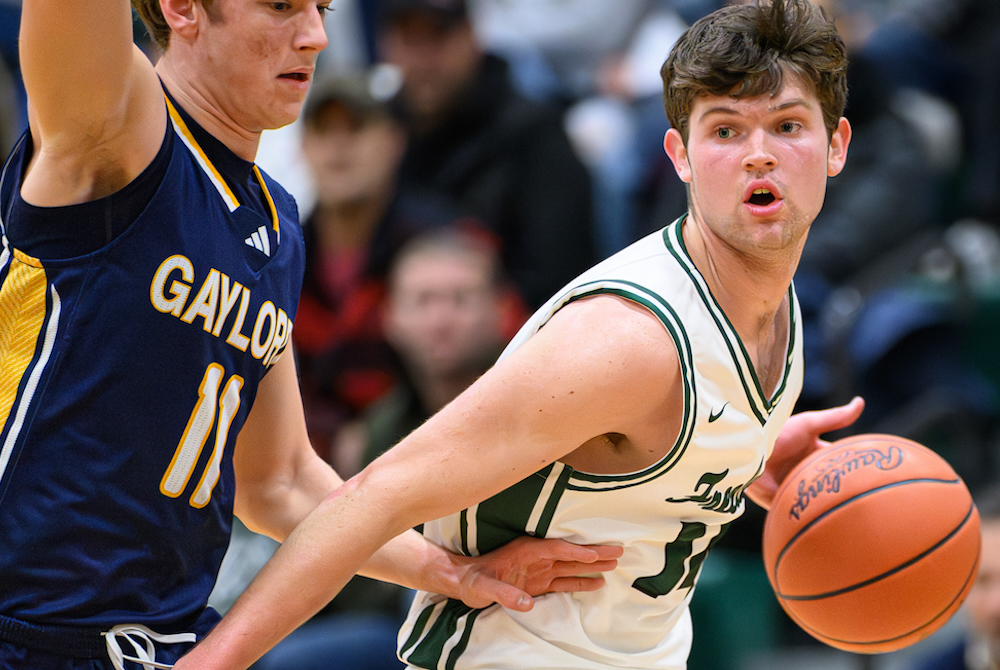
PHOTO Freeland senior forward Wilson Huckeby, right, navigates around a defender during the first quarter of last week's 70-47 Falcons win over Gaylord. (Photo by Kolleth Photo.)