

Taratuta Tops Hillman's Leaderboard, Striving to Take Tigers on Title Pursuit
By
Tom Spencer
Special for MHSAA.com
January 5, 2024
A lot of has been written about Hillman senior point guard Trenton Taratuta.
 And Taratuta has re-written pretty much every basketball record in the Hillman history book as well.
He would trade everything, though, for a shot at the Breslin Center and playing in the Division 4 Boys Basketball Final.
Taratuta entered this season with 1,612 career points, leaving him only 68 away from the school scoring record.
“First things first, I am just a competitor – I want to win,” Taratuta said of his Breslin goal. “The personal accolades come along with it, but winning is everything.”
Eric Muszynski, the Tigers’ boys basketball coach for the past 19 years, guarantees his four-year starter and most decorated player in Hillman history would give up every one of his records for the chance to win at Breslin.
“The beauty of Trenton is I know he would sacrifice these individual accolades to get down to the Breslin Center,” Muszynski said. “It’s a real treat to coach him.
“You tell kids, ‘If you put the time in and hard work in, results happen,’” Muszynski continued. “It has been awesome to be able to use him as an example to a lot of our youth basketball players and some of our current players that have seen the work he’s put in and the results he is getting.”
Taratuta is the only starter returning from last year’s team that lost a 59-57 heart-breaker to Frankfort in the Quarterfinals. He did become the highest scorer in Hillman’s history during a 57-56 overtime win over Oscoda on Dec. 7. He set the mark within his team’s first bucket of the game and then won it with a buzzer-beating 3-pointer that allowed him to again tie the school record for the most points in a single game with 41.
The 6-foot-4 guard, who has scored 41 three times during his career, wants to ride the community support the entire 200-plus miles in March to Breslin. Last year’s run remains bigger to Taratuta than all his current individual records.
“My favorite memory so far is our postseason run last year,” he said. “The support we got from our community was overwhelming.
“It was fun to see everyone come support us and the crowds we got,” he continued. “It was a great atmosphere for all the playoff games.”
Hillman is off to a 6-2 start after winning its North Star League Little Dipper opener Thursday night over Posen, 72-51, as Taratuta led with 30 points. The Tigers’ only losses this winter have been to Division 2 schools, Gaylord and Ogemaw Heights.
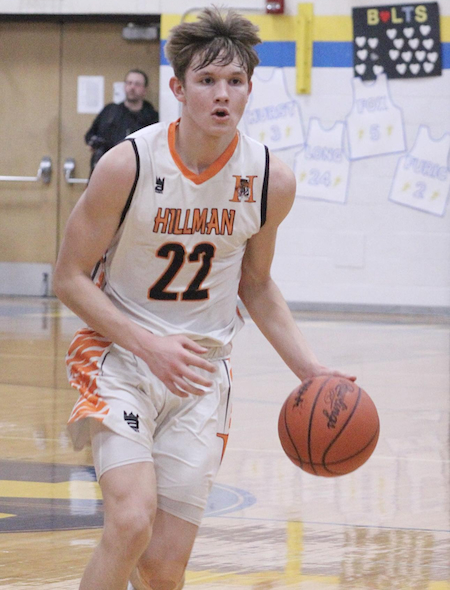 Taratuta now has 1,858 points for his career and set his sights on reaching 2,000. His coach thinks it is highly likely he’ll be able to do that and then climb toward the total accrued by the leading scorer in Michigan high school history, Jay Smith, from 1975-76 through 1978-79.
That said, Taratuta, who is averaging more than 30 points per game this season, is unlikely to challenge Smith’s 2,841 career points – but both Taratuta and his coach also look to the record with pride as Mio is less than 40 miles down the road from Hillman.
Only 45 others in MHSAA boys hoops history have reached 2,000 career points.
“The 2,000-point mark would be pretty special,” Taratuta acknowledged. “It would be pretty cool.”
Hillman, which will host the District tournament this year, expects to ride Taratuta’s success a long way this postseason. Atlanta, Fairview, Hale, Mio and Posen are the Tigers’ potential District opponents.
“There is a lot of season left and a lot of work to be done,” Taratuta said. “I am looking forward to the rest of the season.
“I’m focused on the team’s overall success, not thinking about the points,” he continued. “Coming into this year, there were a lot of doubters and the guys have stepped up well.”
Senior center Blake Kennard is averaging 11.1 points per game and chipping in more than seven rebounds and almost three blocks. Junior 3-point specialist Brenden Rouleau is also averaging double-digit scoring.
Taratuta – who is from a family of high-scoring Hillman graduates – had his sights set on the career points record for quite a while. He was at the game in 2015 when Mason VanPamel broke Paul Bennett’s longstanding scoring record set in 1986.
“He comes from a pretty good pedigree of athletes,” Muszynski said. “His uncles Greg, Jeff and Tim Jones are all thousand-point scorers in our school, and they’re in our Hall of Fame.
Taratuta also just may be a one-of-a-kind, talented, hard-working team player, his veteran coach noted.
“Not only can he score it, he is top-five in our school’s history in every major statistical category going into his senior year,” Muszynski continued. “He is one of those guys where you’re not sure if you’re going to see somebody of that caliber again in your career.
“I was pretty fortunate to have a couple of other guys that were pretty solid, and it’s built the tradition of our basketball program to where Trenton is at.”
 Tom Spencer is a longtime MHSAA-registered basketball and soccer official, and former softball and baseball official, and he also has coached in the northern Lower Peninsula area. He previously has written for the Saginaw News, Bay County Sports Page and Midland Daily News. He can be reached at [email protected] with story ideas for Manistee, Wexford, Missaukee, Roscommon, Ogemaw, Iosco, Alcona, Oscoda, Crawford, Kalkaska, Grand Traverse, Benzie, Leelanau, Antrim, Otsego, Montmorency, Alpena, Presque Isle, Cheboygan, Charlevoix and Emmet counties.
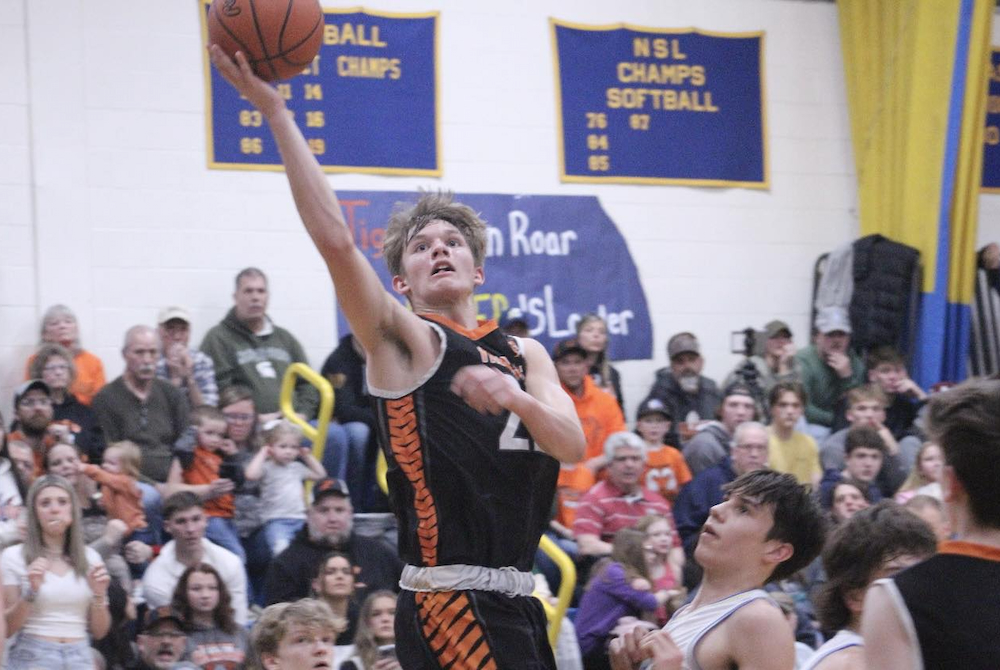
PHOTOS (Top) Hillman’s Trenton Taratuta (22) gets to the basket as the crowd anticipates two points. (Middle) Taratuta considers his next move during a game against Mio. (Photos courtesy of Jonny Zawacki.)
'Scott Hancock Court' Celebrates JV Coach's 50 Years Building Up Cheboygan Hoops
By
Tom Spencer
Special for MHSAA.com
December 19, 2025
It’s been a remarkable season so far for the Cheboygan boys basketball players and coaches.
The undefeated varsity Chiefs are looking ahead to the new calendar year and their next opponent, Northern Shores Conference rival Elk Rapids. They also have the District tournament they’ll be hosting in February in their sights.
But Scott Hancock is already looking ahead to the classes of 2035, 2036, 2037 and 2038. And nobody can blame him.
Hancock, a 1976 graduate of Cheboygan, has no intentions of ending his coaching career soon. He’d like to make it long enough to coach his youngest grandson Lincoln Hancock, who is already playing youth basketball in Cheboygan.
And while the Chiefs are finding success this year with the foundation Hancock helped build, the veteran coach can’t help but dream about his youngest grandson playing at Cheboygan High School.
“As a kindergartner he’s in Saturday basketball, and he loves the game,” Hancock said. “God willing, I plan to be there for him.”
Hancock is his 50th season in Cheboygan program. He enjoyed the opportunity to coach his two sons Nick and Brian, both school record holders. He’s also enjoyed coaching his grandson, Landon Gahn, the Chiefs’ junior point guard. Gahn played junior varsity for Hancock his freshman year and moved up to the varsity his sophomore season.
All but two of Hancock’s season were spent as the JV coach. He took the varsity job on an interim basis when current Cheboygan varsity coach, Jason Friday, was playing for the Chiefs in the late 1990s.
On Dec. 9, the Chiefs officially named their home court the Scott Hancock Court. His family was on hand as well as current and former Northern Michigan coaches.
Hancock’s JV team lost that night to Alpena in overtime. The score was 50-50 when the fourth quarter buzzer sounded.
“Looking back, we should have just called the game at the end of regulation,” Hancock admitted. “I got a bunch of great kids this year. and it was a tough loss because it was an overtime loss.”
 It was the only loss the Chiefs’ JV team has encountered so far this year. But wins and losses are not the focus of Hancock’s level of the program.
“I don't get too carried away with the wins and losses — I know what I'm there for,” Hancock explained. “I'm there to teach the kids to get them ready for the varsity.”
Hancock is considered by many to be the best coach in Cheboygan history. No counter argument can be found among the current varsity players and their head coach.
“He's the best coach that I've ever had — no bias because he's my grandfather,” acknowledged Gahn, who was found cheering from the bench as the Chiefs secured the victory earlier this week at Kingsley. “He teaches everything about basketball, but he doesn't really preach as much as he demonstrates being a good person. Just looking at him and what he does every day, you can just tell he's the guy that's doing everything right, even though nobody's watching.”
Senior Carson Kiefer helped lead the way for Cheboygan's varsity at Kingsley. He scored 12 points, with two 3-pointers. Kiefer credits Hancock for helping him improve his confidence on the court.
“I think he cares more about the person individually outside of sports,” said Kiefer, who is averaging 16 points per game. “It's fitting that he's a JV basketball coach, helping build players’ skills and confidence.”
Kiefer’s twin brother, Andrew, singled out Hancock’s commitment to the school.
“He's not just a school figure,” said Andrew Kiefer, who is averaging just under 12 points per game. “He is not just the coach. He is a community guy all-around.”
The Chiefs varsity is getting strong contributions from their juniors this season. Nolan Schley is averaging 12 points per game, and he’s second on the team in rebounding. And Gavin Smith is leading the team in rebounds and assists, collecting almost 10 boards and four dishes per game.
The Kiefers, Smith and Schley are part of the reason Friday is not surprised by the 6-0 start and seeking a District title for the first time since 2015. The last time Cheboygan won a conference championship was 2020, playing in the Straits Area Conference during Friday’s first season as boys head coach after previously coaching the girls varsity.
 “We knew that our junior and senior classes had some talent in there,” Friday noted. “The boys really want to win a District championship, as well as a conference championship. The boys put a ton of time in the offseason to do everything they can to get over that hump and get both a conference and District championship.”
Cheboygan will host a Division 2 District tournament this season after falling 50-48 in last year’s Division 3 District Final – also at home. The Chiefs face a field including league foes Grayling, Kalkaska and Kingsley as well as Ogemaw Heights and Sault Ste. Marie. Cheboygan topped the Sault 67-43 earlier this year and will play a home-and-home series with Grayling in January.
For now, though, the Chiefs are thinking only about Elk Rapids. Cheboygan started 7-0 last year before falling to the Elks to start the new year.
“We're approaching 7-0 again, so having them coming up here on the schedule, we’re definitely going to be practicing a little harder and watching maybe a little more film and just preparing for the game more seriously,” Gahn said. “Coach Friday was saying last year that he can't remember the last time the team started off 8-0, and it was our eighth game that we lost to Elks. So we're hoping to beat them next time we play.”
The court naming did not come as a surprise to Hancock. He was informed in a meeting with Marty Mix, Cheboygan principal. He thought he had some papers to sign and was surprised his family was waiting in the office.
“He was completely shocked, and Coach Hancock doesn't like attention,” said Friday, who is also the school’s athletic director and was in the notification meeting. “Scott always likes to be in the background, and he handled it quite well.”
And while his signature was placed on the court opening day this year, he points out the Hancock legacy started way before him.
“I'm more proud of the Hancock name on there more than the Scott part of it,” said Hancock, who also serves as the city’s as the parks and recreation director. “Believe me, my dad was a Chief through and through. He passed in 2006. I know he was there in spirit with us looking down.”
Tom Spencer is a longtime MHSAA-registered basketball and soccer official, and former softball and baseball official, and he also has coached in the northern Lower Peninsula area. He previously has written for the Saginaw News, Bay County Sports Page and Midland Daily News. He can be reached at [email protected] with story ideas for Manistee, Wexford, Missaukee, Roscommon, Ogemaw, Iosco, Alcona, Oscoda, Crawford, Kalkaska, Grand Traverse, Benzie, Leelanau, Antrim, Otsego, Montmorency, Alpena, Presque Isle, Cheboygan, Charlevoix and Emmet counties.
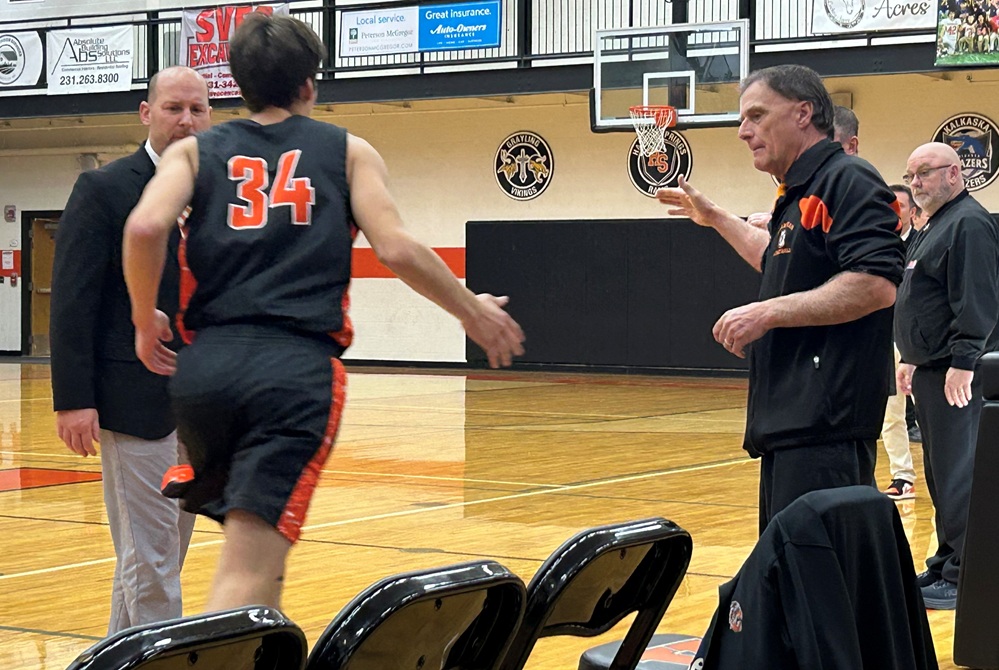
PHOTOS (Top) Longtime Cheboygan boys basketball JV coach Scott Hancock sends Andrew Kiefer (34) onto the floor during introductions before a game against Kingsley. (Middle) The Hancock family takes a photo with Scott’s newly-added signature on the floor. From left: Landon Gahn, Brian Hancock, Olwyn Hancock, Scott Hancock, Marjean Hancock, Lincoln Hancock and Nick Hancock. (Below) Scott Hancock shakes hands with Kingsley assistant coach Steve Acre. (Family photo courtesy of Chris Murdick. Other photos by Tom Spencer.)