
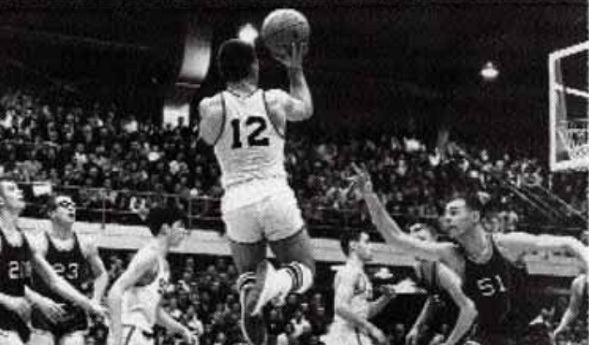
#TBT: 'Fennville Flash' Scores 60

By Geoff Kimmerly
MHSAA.com senior editor

March 12, 2015

"Jordan shoots. He scores."

This week marks the 50th anniversary of one of the most incredible feats in MHSAA basketball history. On March 11, 1965, Fennville's Richie Jordan scored 60 points in a Class C Regional Final against Bridgman, a point total that remains an MHSAA Tournament record. 

The 5-foot-7 "Fennville Flash" became Michigan's fourth inductee into the National Federation of State High School Association's Hall of Fame in 2001. Below is a video compilation or Jordan clips, with audio from that Regional Final, followed by a report from MHSAA historian Ron Pesch written in 2001. 


By Ron Pesch
MHSAA historian

Not long ago, I came across an article written by Hal Schram, the legendary prep journalist for the Detroit Free Press. It was penned during the winter of 1977, and Schram had decided to look back at the history of Michigan high school basketball and pick his top 20 high school players from the past quarter century.

“The Swami” had followed the high school circuit since the 1940s. Schram began with a larger list, paring the roster from 44 to 20. The sportswriter went one step further and decided to single out one member of the squad for the ultimate honor – “the greatest of them all.”

As one would expect, final selections included many of the state's most memorable names: Earvin “Magic” Johnson, Dave DeBusschere, Chet Walker, Spencer Haywood, Ralph Simpson, Rudy Tomjanovich, Campy Russell. Their exploits are legendary, and even the most casual fan of basketball could agree they belong on the list.

However, looking back from the millennium, Schram's choice for state's greatest player is stunning.

“The Swami” himself admitted at the time that his No. 1 pick would surprise many. Hal's top pick never played professionally in either the NBA or ABA. That can be overlooked, as the criteria was simple – the state's greatest prep player. But when I state that Schram's selection played ball at a Class C school, that his teams never advanced to the final rounds of the tournament, and that he stood a mere 5-7½ and weighed only 160 pounds in his prime, most basketball fans shake their heads in disbelief.

But those are only physical attributes. Ask Richie Jordan himself.

Schram's pick as the state's greatest high school ballplayer, Jordan will tell you that it doesn't matter what race, religion or how tall you are. He'll state that anything is possible with imagination and hard work.

Many may dispute Swami's selection, but few will debate Jordan's talents as an all- around athlete. A four-sport star at Fennville High School, he earned 16 letters during his prep career. He is considered by many to be the finest student-athlete ever turned out by the state of Michigan.

The family lived in Bangor when Jordan started school. On the playground one day, Richie wandered over to a high jump pit, where the older kids were practicing their leaps during recess. Much to his delight, he was offered the chance to jump by one of the older kids. The bar was lowered, and Jordan took his shot.

“I easily jumped over the bar and the older kids made comments on how easy I jumped. They kept moving the bar up until it was as high as my head. A crowd started to gather and I cleared the bar. The older kids made me feel real special.”

Before he entered the third grade, the Jordan family moved to Fennville, a small town in west Michigan.

 “Fennville was a wonderful place to grow up, and I have the best of memories,” recalled Jordan. “We had a group of kids who played together and loved each other from the 3rd grade on.”

Like so many kids, he imagined himself duplicating the feats of his idols. Many have similar dreams, but few worked as hard as Richie to achieve them.

By the time he reached high school, Jordan had evolved into a stellar all-around athlete. His drive to excel worked around the clock. Through the years he accumulated new sports heroes and studied their movements in his mind.

“I was at the 1962 finals game where (Saginaw High School's) Ernie Thompson scored 42 points against Benton Harbor. I went home and worked on my double clutch for days after that. I loved all those guys and respected their talent,” said Jordan, “but I wanted to be better than all of them.”

His hard work paid off with stellar athletic performances. An all-state halfback in football in his junior year, Jordan averaged a whopping 35.6 points in 16 basketball contests and was a unanimous first-team all-state selection at guard in the winter of 1963. In the spring he excelled on the baseball diamond and in track and field.

Jordan continued his rigid regime of weightlifting and working out. Word of his athletic exploits trickled out of Fennville.

In the fall of 1964 he rushed for 1,246 yards on 86 carries, and tallied 25 touchdowns, to cap an outstanding gridiron career. His total of 5,132 career rushing yards was tops in the state at that time, and the mark still ranks in the top 10.

Again, he reaped all-state accolades. But the basketball court was where the Jordan legend was defined.

His vertical jump was phenomenal, and he could dunk with both hands. Scouts reported that he was lightning fast and excellently coordinated. Early in 1965, the Kalamazoo Gazette sent a photographer to Fennville to snap photos of Jordan for a feature article on the Black Hawks' upcoming cage contest in Kalamazoo against Hackett High School. Fennville entered the game with a 3-1 mark, the only mar a 95-93 loss to Saugatuck in which Jordan scored 54 points.

The newspaper printed a shot of Richie dunking the basketball, and the image caught the imagination of many. An overflow crowd packed the 2,200-seat Irish Gymnasium to watch the matchup. Jordan and his teammates trounced the favored Irish 99-73, as Richie scorched the nets for 47 points. In April of his senior year he was named prep All-American by Coach  & Athlete magazine, earning the distinction of “smallest” on the squad. “Weep not for him, however,” stated the article, announcing the honor, “as he can dunk the ball, and with his 44.4 season's scoring average, he has scholarship offers from 58 colleges and universities.”

Richie finished out his unbelievable prep career by batting .550 on the baseball field, and by leading his track team to a third-place finish at the state meet.

On May 20, 1965, the city of Fennville honored the prep hero and his teammates for their outstanding athletic careers and their contribution to the community. Jordan spent two years with the Michigan State basketball program, earning a letter in 1967, then walked away from basketball to concentrate on baseball with the Spartans. Following graduation, he landed a contract with the Pittsburgh Pirates, but a shoulder injury ended his pursuit of a major league career.

Today, the “Fennville Flash” is known as “Mr. Jordan” by his students at Cardinal Mooney High School in Sarasota, Fla. A strength and conditioning coach, daily he preaches the merits of weight training and the benefits of hard work to his students.

Married and the father of three, he has enjoyed coaching and watching his children participate and excel in athletics. He cherishes the memories of his youth and the friends he made along the way.

“All my teammates and I felt very special,” said Jordan, now 53, “but we also were very humbled by the admiration we were shown. We all felt an obligation to our community to conduct ourselves in a way that would reflect kindly on our small town.

 I'm still very proud that we all understand that.”

Hoops History Filled with District Stunners

By Ron Pesch
MHSAA historian

March 9, 2018

The opinions expressed in the following are those of MHSAA historian Ron Pesch, and are not, necessarily, those of the folks who grant Pesch the chance to express them.

You are advised.

Life, sometimes, is unfair.

Despite healthy eating habits, lots of exercise, plenty of sleep, appropriate amounts of water, brain teasers, and blood pressure medicine – all those things that should, hopefully, extend a life – occasionally, our last breath arrives before the awarding of the gold watch or a trip to Disneyland.

The MHSAA Boys Basketball Tournament, sometimes, is like life. And that’s the way it should be.

The postseason is where all teams across the state are rewarded with a second chance, regardless of regular season win-loss record. In the thrilling one-and-done playoffs, highly ranked foes can be next-door neighbors or distant strangers; known only via rumor, newspaper rankings, or in these high-tech times YouTube clips. A knockout punch, ousting a team from the tournament, is most often delivered by a “worthy” opponent.

From time to time however, the end of the road arrives when least expected, via defeat by a less talented team vying for a cherished brand. “Underdog,” “Long Shot,” “Dark Horse” and “Cinderella” are the Nike®, Addias®, Reebok®, and Under Armour® of the unknown and under-achieving. Each brand is worn with pride. Everyone, including sportswriters, loves a sleeper.

In Michigan, with minor alterations, the MHSAA basketball postseason functions much as it always has operated. Champions are rare – by design, only four teams can finish the season with victory. Logistics and economics mean a team’s toughest opponent might arrive anywhere along the path. Districts are established based on schools of similar enrollment size found in logical geographic boundaries. District champions advance to play opponents in defined regions, and Regional winners move on to the final three rounds to determine those four statewide MHSAA champions. The state’s largest schools battle for the Class A title, while the smallest chase the Class D crown.

Therein lies the beauty. The playoff experience for today’s athletes is very much the same as it was for their fathers, their grandfathers and their great-grandfathers. The next opponent is luck-of-the-draw, based on a district line, and beyond a team’s control. Come game time, a blown breakaway, a bricked or air-balled jumper, or a rimmed shot that doesn’t fall can mean dreams of trophies, medals and glory, vanish from view. Tournament time does not discriminate. End game can happen to anyone.

Just like in daily life.

Sometimes, the toughest challenges arrive quicker than we feel they should. Within can be heartbreak, and, often, our greatest lessons.

Beware – the tournament tipped off again this week, and more than 120 District titles will be up for grabs tonight.


The MHSAA Tournament pre-dates Disneyland by 30 years. After assuming administrative control of high school sports in the fall of 1924, the Association made a move to expand the annual boys basketball tournament from three classifications to four with the addition of Class D in 1926.

Five years later, beginning in 1931, the public schools from the city of Detroit exiled themselves from the tournament. A year later, the schools in the Upper Peninsula did the same. Those moves, recent research shows, came from a general philosophy by local and national education authorities that there was an over-emphasis on competitive athletics. In the city of Detroit, the move meant a departure from statewide competition that would last for more than 30 years.

“The elimination of Upper Peninsula schools from state competition was the recommendation of its two (seats) on the (MHSAA representative) council,” came the report from the Lansing State Journal. “They deplored the long distances involved in sending teams from that section to the state tournament.”

Certainly, the depth of the nation’s Great Depression was a force that also insured distinct peninsula tournaments, at least in the earliest years of the separation. So, from 1932 through 1947, the MHSAA sponsored both Upper and Lower Peninsula tournaments, and crowned titlists on both peninsulas.

In 1941, and for nearly 20 years, the state’s smallest schools christened their own Class E champion. By far, the overwhelming majority were located in the vast Upper Peninsula, so it was a U.P.-only tournament.

Thereafter, a few twists of fate combined with population demographics to alter the shape of the event.

The number of schools, as well as their enrollments, played into the scheduling of action. For many years, Class A schools (as well as Class B schools for a few seasons), didn’t begin tournament play until the Regional round. Classifications were based on enrollment, with the state’s largest schools playing in Class A. Since there were relatively few Class A schools, when compared to Class C or Class D, fewer postseason games were required to identify a state champion for schools in the upper classifications. During the 1953-54 school year, there were 75 Class A schools, all in the Lower Peninsula. In Class B, there were 180 schools, (including 17 in the U.P.), while Class C included 246, (18 across the Straits). There were 181 Class D schools in the Lower Peninsula, (with 21 schools each in Class D and Class E in the U.P.). Hence, the path to a crown was, at least statistically speaking, more challenging for a smaller school.

With the post-war baby boom, and the growing size of the suburbs around the state, the first Class A Districts were held 60 years ago, in 1958. With that, the chase became more equal.

In 1961, for the first time, a Class A District tournament was held above the Straits. Played at Sault Ste. Marie, it included four teams, “with two U.P. teams, Sault and Escanaba, competing against two Lower Michigan quintets, Alpena and Traverse City,” according to the Ironwood Daily Globe.

In 1962, Detroit Public Schools ended their self-imposed exile and rejoined tournament play. With the return of those 20 schools, the first statewide prep tournament in 32 years now included 749 teams. Class A included schools with 900 or more students, Class B with between 400 and 899 pupils, Class C 200 to 399 and Class D for schools with enrollments of fewer than 200 students.

Beginning with the 2018-19 school year, basketball will move to divisions versus classifications, where the number of schools competing for a division title is uniform.


No. 1 Goes Down

Devastating District Defeats

It doesn’t happen often, but it does happen. Every now and then, Michigan’s top-ranked teams fall in the opening round of the MHSAA tournament.

1952 – Class C - Muskegon Western Michigan Christian 39, Muskegon St. Mary 36

Given little chance of surviving opening night Class C District play at Fremont High School, Muskegon Western Michigan Christian “had to do it the hard way, coming from behind with a last ditch rally that had the overflow throng on the edge of their seats.”

Twice beaten by St. Mary during the regular season, the Warriors opened a surprising 13-5 lead through the first quarter, behind the shooting of Gordon DeKruyter and Dave Bolema. The two seniors would end the game with high-scoring honors at 14 points apiece.

“I don’t remember much,” said the 83-year-old DeKruyter, laughing at the thought that Christian’s 39-36 victory over heavily favored Muskegon St. Mary was being recalled some 65 years later. “I’ve always thought it was hard to beat a team three times in a season. I guess that’s still the same today.”

“We had some real good contests in the old 4C Parochial League,” added DeKruyter. The league included Christian, and three Muskegon-area Catholic schools – St. Jean, St. Joseph and St. Mary. “We didn’t have our own gym back then, so we practiced on a short court at Muskegon’s Froebel School. Our coach, Elmer Wolcott, went on to win a number of state championships.”

Christian’s early lead, however, evaporated as the game quickly evolved into a real battle. St. Mary closed the gap to a point, 18-17, before the intermission, and then appeared to grab control of the game, 25-18, following the break.

“The game has seen quite a transition since those days of the set-shot,” said DeKruyter, who later played at Calvin College, then refereed for 27 years. “The biggest is the 3-point shot. It’s amazing how much it has changed the game.”

Another Christian rally knotted the contest at 31-31. The Warriors then grabbed the lead 35-33, but again lost it, trailing St. Mary 36-35 with two minutes to play. Bolema responded with a basket, and combined with a stop on St. Mary’s next possession, the stage was set for a stall by WMC for the victory. However, an errant pass, stolen with 18 seconds remaining, put the game on the line. In the vanishing seconds, filled with the pressure, intensity and noise of a win-or-go-home tournament March, St. Mary’s layup, likely separating victory and defeat, rimmed the basket and fell out.

DeKruyter snared the rebound and added an insurance basket just before the final whistle.

The celebration would last until the Regional Final. Along the way, WMC vanquished White Cloud, another surprise survivor of opening day District madness, by a point, and Lansing O’Rafferty by three, before falling by eight points to Holt.

1955 – Class B – Buchanan 60, St. Joseph 57

“It took two years but Jim Letcher got sweet revenge for a foul committed late in the district final in 1953 which gave the Bears a one point victory,” wrote Ed Lukas in the St. Joseph Herald Palladium. “Last night at the Buchanan gym, Letcher poured in 30 points to lead his Buck teammates to a 60-57 upset win over the highly touted St. Joseph Bears …”

The top rated team in Class B by the Detroit Free Press, St. Joseph had beaten Buchanan in both regular-season meetings. The winner of this matchup was expected to emerge as District champion. Indeed, Buchanan did just that, but barely, with a 47-45 win over Dowagiac. The Bucks rode the victories to the state finals, their first trip to the title game since 1928, before falling to River Rouge, 51-48, ending the year with a 17-7 mark.

1965 – Class C – Fowlerville 59, Portland 58

“Fowlerville, which did not have a winning record during the regular season, came up with the first major upset of the state high school basketball tournament Thursday night by edging previously unbeaten and top-ranked Portland, 59-58, in a Class C district … at Sexton,” wrote Ernie Boone for the Lansing State Journal. “Greg Braun, who only had six points all night and just one in the final period when Fowlerville took over the lead, sank a free throw with five seconds remaining to provide the winning margin.”

Fowlerville’s tournament run ended that Saturday as Williamston sank six free throws in the last two minutes of the District Final to emerge with a 48-46 win.

1969 – Class D – Detroit All Saints 62, Wyandotte Mt. Carmel 60, OT

“A perfect season and dreams of a state Class D basketball title went up in smoke Wednesday night before 3,000 fans for Wyandotte Mt. Carmel,” said Hal Schram in the Detroit Free Press. “Winner of 15 straight games and rated No. 1 among state powers in its division, Mt. Carmel bowed to old tormentor All Saints, 62-60, in a frenzied overtime period.

“Mt. Carmel has lost only three games in two seasons. All three losses came at the hands of the Saints.”

Detroit All Saints, reigning Class C state champ and ranked No. 3 by Schram, grabbed the District title before falling in the opening round of the Regionals to unranked Ypsilanti St. John, 65-62. Bob Sutton led all scorers with 21 for St. John in what was the upset of the tournament to that point. The Saints finished the year at 18-2.

1979 – Class A – Detroit Northeastern 95, Detroit Murray-Wright 91, OT

“Crash!! Murray-Wright High became the first big casualty of the 1979 state basketball tournament Tuesday night when the highly favored Pilots of coach George Duncan fell before underdog Northeastern, 95-91, in overtime at Highland Park High,” wrote Schram in the Free Press, describing the mayhem of the opening round to the District.

“Murray-Wright went into the game champion of Detroit’s Public School League and rated Michigan’s No 1 Class A team. But its 19-game winning streak ended when Joe Rodgers hit four straight free throws in the final 25 seconds of overtime to give the Falcons their most prized victory of the season.

“The Northeastern victory rubbed out another whirlwind comeback by Murray-Wright, which had to score 34 points in the final period to tie the game. … With 1:11 left in regulation, Northeastern led, 85-78, but the Pilots tied it with seven seconds left on Anthony White’s basket.”

The likelihood of a rocky road to the title game for Murray-Wright was identified by Schram earlier in his write-up that accompanied his final regular-season ‘Top Ten’ rankings, a feature of the Free Press that dated back to the late 1940s. “There’s a dozen or so teams in Class A who could wind up with the big trophy. … Murray-Wright just might not get out of its own District where it has to meet and beat the likes of Northeastern, Highland Park or Northwestern.”

Much to the surprise of all the state’s prognosticators, unheralded Detroit Mackenzie, sporting a lackluster 13-7 regular-season mark, and preparing to celebrate its 50th graduating class that June, also got to celebrate its first basketball state title by downing Pontiac Central, 72-64, for the Class A crown.

1982 – Class C – Orchard Lake St. Mary 63, Redford St. Mary 55

“Orchard Lake St. Mary held off a late Redford St. Mary rally Monday night to defeat the No. 1 rated team in Class C, 63-55, in the first game of district play,” said Mick McCabe from the Free Press.

“Orchard Lake … jumped out to a 26-21 halftime lead despite the Rustics’ domination of the boards in the first half. Late in the third quarter, the Eaglets built up a 19-point lead but failed to deliver the knockout punch by missing a pair of wide open lay-ups before Redford scored the final five points of the period.”

Despite two losses – to Birmingham Brother Rice and Harper Woods Bishop Gallagher – The Associated Press and Detroit Free Press had ranked Redford St. Mary No. 1 in the state. With three losses – including a 79-77 defeat to Class A Detroit Cooley decided during the final 25 seconds – Orchard Lake St. Mary sat No. 2 in the Free Press’ final poll, while AP had the Eaglets at No. 4.

Orchard Lake led by 14 midway through the final frame, but Redford went on a 9-0 run to pull within five before running out of steam. Chris Howze scored 20 points on 8 of 12 shooting from the field to lead Orchard Lake to victory. Following the win, the Eaglets tore through Class C mostly uncontested until the Semifinals. Trailing by as many as 17 in the first half, Grand Rapids South Christian, a final four contestant in the previous two years, capitalized on the loss of Howze to fouls with 5:57 to play. Able to cut the margin to three with 21 seconds remaining, the Sailors couldn’t complete the furious comeback, and fell, 66-63. Orchard Lake coasted to the crown Saturday, thumping unranked Reed City, 76-48.

1995 – Class D – Detroit Holy Redeemer 75, Detroit East Catholic 66

“Hamtramck St. Florian will host the state’s second-best (opening round District) game when Detroit East Catholic (No. 1 in Class D) and Detroit Holy Redeemer hook up again,” noted McCabe in his pre-tournament column in the Free Press. “In the (Detroit) Catholic League semifinals, East Catholic got off to a huge lead against Redeemer and then hung for the victory.”

 (The state’s top District opener, referred to by McCabe, ended as expected. Detroit Country Day, ranked No. 1 in the Free Press Class B rankings, rolled to an easy 55-48 victory over Orchard Lake St. Mary, the state’s No. 3 team. Sophomore Shane Battier scored 28, grabbed 11 rebounds and blocked three shots.)

McCabe had noted Redeemer’s senior guard Jimmy Reyes hadn’t played that well in the Catholic League final. Reyes certainly had his game in the rematch as he scored 20 points, including 13 in the fourth quarter, to lead the No. 6-ranked Lions to victory. Sophomore guard Armelius Parker added 17 as Holy Redeemer began its march to the Class D title.

The rivalry between the schools would continue in the coming years. Redeemer would again knock East Catholic out of the postseason in the District Final in 1996. East Catholic extracted some revenge in 1997, downing the Lions in the second round of the District, en route to its eighth and final MHSAA basketball championship. Both schools would close following the 2004-05 school year.

1997 – Class C – Benzie Central 73, Manton 70

In the opening game of the District 91 doubleheader, played at Benzonia, senior Nate Myers bagged eight 3-pointers, including the game winner with eight seconds remaining, as Benzie Central downed unbeaten and top-ranked Manton in the Class C District opener, 73-70. Benzie had lost an 11-point lead over the final four minutes.

“The gym was unbelievably full,” recalled Bill Lynch, a former coach at Benzie Central. “Just a great crowd. As I recall, Manton didn’t come down early to practice in the gym. I thought that was a mistake.”

Following the victory, Benzie Central cruised to the Semifinals before falling to Three Oaks River Valley in a frenzied 67-65 thriller. Trailing by 14, River Valley rallied back and was up three, 65-62, when Myers again bagged a clutch triple with just 11 seconds remaining to knot the game. But Zac Robinson would emerge as the game’s hero with a lay-up with 3.1 seconds remaining that hung on the rim “for an agonizing split second” before dropping through the net, ending Benzie Central’s dream run.

2004 – Class A – Grosse Pointe North 66, Detroit Denby 51

“Out of all the teams, that was the one team I was really concerned with,” said Detroit Denby coach Ray Reeves to McCabe about the draw of his team’s opponent prior to its Class A District opener with No. 9 Grosse Pointe North. “We beat them last year by 14, but it was a tough game. We made them play our style, and it wore them down.”

His concerns were warranted. Trailing by six to open the final quarter, North’s Mark Bramos scored 15 of his 25 points in the fourth as North toppled No. 1 Denby, 66-51, in Class A opening round District action.

“We saw them play Renaissance at Cobo, and that helped us a lot,” said guard Bryan Bennett, who scored 11 points for North. The Norsemen won the District, downing two more PSL squads Southeastern and Finney, but lost to eventual quarterfinalist Utica Eisenhower, 56-52, in their Regional opener.

Ron Pesch has taken an active role in researching the history of MHSAA events since 1985 and began writing for MHSAA Finals programs in 1986, adding additional features and "flashbacks" in 1992. He inherited the title of MHSAA historian from the late Dick Kishpaugh following the 1993-94 school year, and resides in Muskegon. Contact him at [email protected] with ideas for historical articles.

PHOTOS: (Top) Benzie Central’s Nate Myers drives between Three Oaks River Valley defenders in 1997. (Middle top) Muskegon Western Michigan Christian’s Gordon DeKruyter in 1952. (Middle) Buchanan’s Jim Letcher in 1955. (Middle below) Fowlerville’s 1965 team. (Below) Detroit Northeastern’s Joe Rogers puts up a shot in 1979. (Photos courtesy of Ron Pesch.)