

#TBT: Sticks’ Record 50 Still Stands
April 10, 2014
By Geoff Kimmerly
Second Half editor
Last month marked the 58th anniversary of the longest-standing individual record in MHSAA Basketball Finals history.
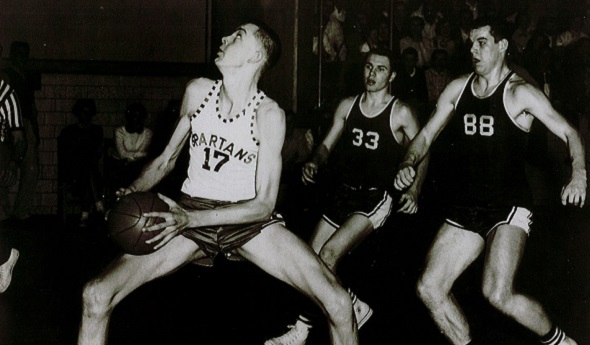
In 1956, Battle Creek Lakeview center Bob “Sticks” Bolton scored 50 points in a Quarterfinal against Kalamazoo State High School. His points remain the most scored during the final round of the tournament – Quarterfinal-Semifinal-Final.
What follows are edited excerpts from a piece in the MHSAA archives written by former Battle Creek Enquirer reporter Allen Palmeri:
The date was March 21, 1956, and seating capacity in the Hastings High School gymnasium had been expanded to 2,000 this Wednesday night in anticipation of a marvelous Class B Quarterfinal basketball game between two sizzling teams.
New bleachers beckoned behind both goals as Battle Creek Lakeview, 18-2 with a 16-game winning streak, prepared to battle Kalamazoo State High, 19-2 with a 17-game winning streak.
The bleachers weren’t sufficient. About 2,500 fans were able to shoehorn their way in, ringing the court and leaving others in the school’s hallways and out on the sidewalk as one of the most spectacular individual efforts in MHSAA Boys Basketball Tournament history was about to unfold.
In one corner was Lakeview center Bob “Sticks” Bolton, a 6-9 rod of fury. In the other corner was State High’s mountain range of a front line, with peaks standing 6-6, 6-6 and 6-5.
“We looked forward to the game with quite confidence, because we really respected them for the tremendous team they had,” Bolton recalled in 1996. “We knew it was going to be a battle royale because of their size.”
The game within a game of one-on-three was no contest as Bolton simply pulverized the peaks. He poured in 50 points in a 90-73 Lakeview victory, setting a final round record for single game scoring that has withstood decades of assaults by the likes of Ralph Simpson, Spencer Haywood, Earvin Johnson, Jay and Sam Vincent, Antoine Joubert, Jay Smith, Mark Brown and Chris Webber.
***
(He scored) 12, 20, 10 and 8 points through four quarters against State High. He was particularly impressive in the second quarter, when he wound up scoring 20 of his team’s 21 points. Overall, he sank 17 of 27 shots from the field and 16 of 20 from the free throw line.
Though State High took the brunt of Bolton’s blows during the tournament, his effort throughout Lakeview’s run was just as spectacular. ... When Marshall tried to stall away the district opener, Bolton had to settle for 18 points in 40-20 victory. In an 80-58 win over Albion for the district championship, he punched in with a 34-point effort.
In carrying Lakeview to its first regional title, Bolton went ballistic, pumping in 42 points against Three Rivers and a school-record 46 points against an East Lansing team coached by Gus Ganakas. He then went out and topped that in the quarterfinal.
In the semifinals two days later, Bolton was whistled to the sideline with 25 points with a little over half the game played, fouling out in a 74-69 loss to eventual champion Stephenson. Opposing center Mel Peterson, who went on to play for Wheaton College and the NBA’s Baltimore Bullets, had scored 21 points when Bolton fouled out.
Though the memory of that game is painful, he fondly recalls his five-game scoring spree as “lifting my game to a higher level as the competition got tougher and tougher. Praise the Lord for that!”
***
Bolton went on to play collegiately at Western Michigan University, where he cracked the 1,000-point barrier, set a school rebounding record and outscored future NBA Hall of Famer Nate Thurmond on two of three occasions. After his college career, in a semi-pro championship game, he managed to outplay another Hall of Fame center, Walt Bellamy.
But his passion for basketball was never the same after high school. His dedication, vigor and enthusiasm gradually shifted towards the ministry.
At the time of this writing, Bolton served in Marquette, as pastor and administrator of Bethesda Baptist Church and Bethesda Baptist School. He died in 2008.
PHOTO: Bob "Sticks" Bolton dropped 46 points on East Lansing in a 1956 Class A Regional championship game. He followed that with a record 50 points in the Quarterfinal.

Breslin Bound: Boys Report Week 5
January 9, 2017
By Geoff Kimmerly
Second Half editor
How quickly can a lackluster season become a distant memory?
 Ask a few of the teams we’ve highlighted in this week’s Breslin Bound Boys Report, powered by MI Student Aid.
Two of the eight on our “Watch List” this week have already won more games this winter than in all of 2015-16, and a third team could equal last season’s total by the end of this week.
Week in Review
The countdown of last week’s five most intriguing results:
1. Clarkston 60, Flint Carman-Ainsworth 47 – The Wolves remain undefeated at 8-0 after handing Carman-Ainsworth its first loss (and later in the week doing the same to Walled Lake Western).
2. Detroit U-D Jesuit 71, Romulus 58 – The Cubs finished nonleague play at 5-2 and with one more solid win over a Class A power heading into the Detroit Catholic League schedule.
3. Ann Arbor Skyline 74, Belleville 71 – Skyline is tied for the lead in the Southeastern Conference Red, but handing Belleville its first loss may have surprised a few even though Skyline has broken 70 points five of the last six games.
4. Grand Rapids Forest Hills Central 55, Grand Rapids Forest Hills Northern 51 – This neighborly rivalry game hadn’t meant this much in a while, with both now in the Ottawa-Kent Conference White and Central handing Northern its first loss of the season.
5. Holt 59, Okemos 49 – This gave the Rams an early co-lead with East Lansing in the Capital Area Activities Conference Blue and added to a 4-2 start with those losses by a combined seven points.
Watch List
With an eye toward March, here are two teams in each class making sparks:
CLASS A
Davison (6-1) – After watching the football team make a nice jump in the fall, the basketball team is doing the same coming off a 5-16 finish. The only defeat was to one-loss Carman-Ainsworth.
Bloomfield Hills (6-1) – The Black Hawks are two wins better than at this point a year ago, with their only loss to Orchard Lake St. Mary’s. They should provide a nice challenge to Clarkston in the Oakland Activities Association Red.
CLASS B
Hillsdale (6-0) – The Hornets are always in the mix, and got off to another fast start this winter after ending last year’s 18-win campaign with a three-point loss in their first District game. Last week’s double-overtime win over Onsted might be the best so far.
Wyoming Kelloggsville (5-0) – The Rockets could be in the midst of another of the most significant turnarounds in the state this winter, going 7-15 a year ago but most recently handing a one-point loss to reigning Class C runner-up Grandville Calvin Christian.
CLASS C
Maple City Glen Lake (5-0) – The Lakers opened this season by avenging last year’s season-ending loss to Traverse City St. Francis, and since they’ve played to a first-place tie in the Northwest Conference with rival Frankfort. Thursday opponent Buckley will provide another major test.
Munising (6-0) – After finishing 11-10 and falling in its first postseason game last winter, Munising is more than halfway to a better finish. This start included an avenging of that season-ending loss to Rock Mid-Peninsula and three victories total by five or fewer points.
CLASS D
Bellevue (4-0) – The Broncos have been riding a nice run the last few seasons, winning 18 games a year ago. They already own a win over Climax-Scotts, the team with which they shared the Southern Central Athletic Association West title last winter.
Marcellus (4-1) – The Wildcats also are on the rebound, having already surpassed last season’s three wins. The lone loss was a three-pointer to Constantine during the season’s first week.
Can't-Miss Contests
Be on the lookout for results of these games coming up:
Tuesday – Grand Rapids Christian (4-0) at Wayland (4-1) – These two and Wyoming look like the contenders in the O-K Gold, with Christian one to chase both in the league and Class A statewide.
Tuesday – Bellaire (5-1) at Gaylord St. Mary (5-1) – These two are contenders in the Ski Valley Conference, but also stand to be among Class D’s best from just below the bridge.
Friday – Saginaw (6-1) at Saginaw Arthur Hill (4-2) – One of the oldest rivalries in state history remains one of the best, with this and the Feb. 3 matchup likely to decide the Saginaw Valley League North title winner.
Friday – Holt (4-2) at East Lansing (6-0) – The Trojans have high hopes in Class A this season, but first comes taking care of the CAAC Blue and a strong field including the Rams (also mentioned above).
Saturday – Detroit East English (5-0) vs. Kalamazoo Central (5-0) at Grand Rapids Ottawa Hills – Arguably the top matchup of the Floyd Mayweather Classic, this one pits two of the best in Class A.
PHOTO: Grand Rapids Christian, driving to the basket, downed Holland West Ottawa on Dec. 28 as part of its 4-0 start. (Photo by Tim Reilly.)