

Their Place, Forever
By
Geoff Kimmerly
MHSAA.com senior editor
February 9, 2012
It’s surreal, Terry Reid said, humbling and overwhelming every time he sees his name hanging on Marlette’s gymnasium wall.
A little more than a month has passed since the school dedicated one of its most visible buildings to the longtime basketball coach. Thing is, Reid added, those honors usually are bestowed after a person has died – not while he’s still working the sideline, as Reid has done for Raiders teams over the last 40 years.
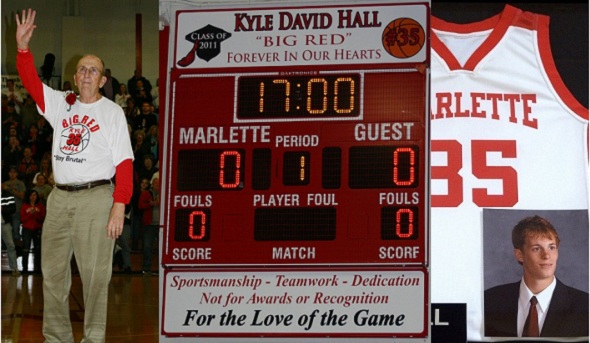
On the opposite wall hangs a new scoreboard, also dedicated Dec. 28. At the top is the name “Kyle Hall,” one of Reid’s eight grandchildren, a standout player who graduated last spring. Below hangs a photo of number 35, palming a basketball, gazing across the floor where Reid guides his junior varsity team through the same drills he’s been teaching for decades – and where he helped his grandson earn an opportunity to play at the college level.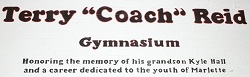
“Every practice, … there’s a picture of him. And those eyes. I look up, and it kinda chokes me up,” Reid said.
“We’ve been blessed with grandkids who have let you know their feelings for them. ‘Hey Grandpa, see ya, I love ya.’ Those were the last words I heard from him, the day before he died.”
Reid wasn’t sure if he could return to coaching after that day, July 16, when during the early morning hours a car crash claimed Hall’s life as he drove home from a friend’s house.
Reid’s wife of 52 years, Jackie, convinced him to go back – both for himself, and for his grandson. And it seems just right they will be remembered in a place that has meant so much to both.
The plan comes together
Reid, 72, grew up in Redford Township, coached at Redford and then Detroit Benedictine for a short time before moving to Marlette in 1972. He’s coached a variety of teams, including the girls varsity for 21 seasons and the boys for 12 over two tenures, and hundreds of athletes including his daughter and Kyle’s mom Tammi, and currently Kyle’s little brother Dakota.
Kyle Hall got serious 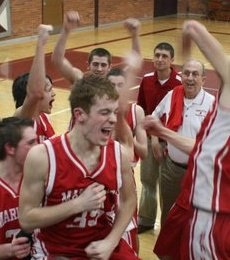 about the game as a junior. At 6-foot-5 and at a Class C school, he was a post player – but realized he’d need better perimeter skills to play after high school. Reid never officially coached Kyle – Hall skipped Reid’s JV team to join the varsity as a sophomore. But that summer before senior year, Grandfather and Grandson got to work, a few hours three days a week, through tough times and good ones that come in part with coaching one’s child, or in this case, grandchild.
After earning all-league and all-area honors in his final high school season, Hall was slated to join the Alma College men’s basketball team this fall – in fact, the Scots wear his initials on their pre-game warm-up shirts. Alma College also recently acquired a new scoreboard, and Kyle “told me one time … I’m going to light that sucker up,” Reid remembered.
That was Hall. He’d visit potential colleges with Tammi and his father Mike, and coaches would ask Kyle to list his strong point. Answer: Confidence. Weak point? Same answer. “He went out every game with the plan to win,” she said.
She recalled Kyle’s big feet: “He could run down the floor in three leaps.” Sports were his obvious first love. A three-sport athlete every year of high school, Kyle played football in fall, track and later golf in the spring. Every inch of his bedroom wall was covered either with pictures or clips from newspapers, his workout plan, and the terminology he was learning for nursing. Hall had passed his certification test to work as a nurse assistant two weeks before the crash. He had plans to pursue jobs at the hospitals in Marlette and Alma, and after getting his bachelor’s degree head to University of Michigan or Ferris State University for his master’s in nurse administration.
“When Kyle got something in his head, that’s what he’s going to do,” Tammi Hall said.
‘You just knew that he cared’
Terry Reid is an old-school basketball coach. Fundamentals rule. Defense first. Life has been basketball, golf, and family. He’s Marlette to the core – after all, the dog’s name is Red Raider Reid.
Prior to the gym dedication, the Huron Daily Tribune reported Terry’s various successes: a 315-149 girls varsity record, 100-98 with the boys varsity, and a combined seven District and five league championships. He also led the baseball team to a league title, coached in the football program and was athl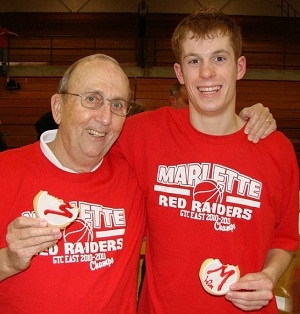 etic director for 18 years on top of teaching a variety of subjects.
The branches of his coaching tree spread throughout Michigan’s Thumb, and further. Reid estimates at least 40 former players have gone on to run their own teams. Brown City boys basketball coach Tony Burton and Bad Axe girls coach Brent Wehner both played for Reid, as did Kentucky Wesleyan College co-women’s coaches Caleb and Nicole Nieman. Closest to home, former players Chris Storm and his wife Cathy Storm now run Marlette’s boys and girls varsities, respectively.
“You just knew that he cared. … At the time you don’t realize it, but he becomes a true friend shortly after high school and throughout your career,” Chris Storm said.
“You always live through the tough times as well as the good times of teams. He’s been one who has persevered over the years. Everyone certainly goes through it; there are certain teams that don’t accomplish what they should, and that falls on the coach. But he’s always been able to keep his focus on the kids. That’s what we’re here for, and they know it.”
Like any grandparent, Reid takes pride in all of his grandchildren. An athletic bunch, he can recognize basketball potential – even in those who have chosen to play that other winter sport, hockey, instead.
But admittedly, Reid’s relationship with Hall took on another level because of their time together on the court. Storm’s son Alex teamed with Hall in 2010-11 and now plays at Rochester College in Rochester Hills, and Chris Storm recognized the similar tensions to his coaching his son.
But, “there’s certainly no question the time (Reid) spent with him and put in paid off for Kyle,” Storm said. “It was kinda neat they were able to share in that success at the end.”
He will be remembered
Reid said between 30 and 40 people came to the Halls’ home the night Kyle died.
His showing at the funeral home was scheduled to run from 1-9 p.m., but went until 10:20. After a small private funeral, the family went to the gym for a community ceremony – and found it packed.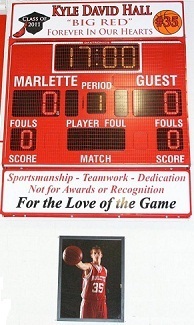
“I really found out I wouldn’t want to be anywhere else. The support we received at that time, and to the present, has just been unreal,” Reid said. “They stuck with Mike and Tammi, and they still do.”
For the dedication, Kingston agreed to have its varsity girls and boys teams play at Marlette on the same night, instead of the usual JV/varsity doubleheader. Every Kingston player came into the stands and hugged Mike and Tammi. The Raiders boys team has had a bit of a tough one this winter coming off last season’s 17-5 finish – it was just 6-8 heading into Friday – but beat Kingston that night by 20.
In a small town, Storm said, something like Hall’s death brings somberness to the entire community. And, of course, it still hits the family hardest. But Reid is back coaching his junior varsity, with no plans to stop.
And after Dakota is done playing for the JV, Mike and Tammi stick around for the boys varsity games. They watch and support the friends and community that have supported them – and now in the building where they are surrounded by reminders that will continue to live on.
“He was so much fun to watch. I realize he was my own, so obviously I think higher of him. … But it was just so much fun to watch him play,” Tammi said.
“My husband and I talked quite a bit, and that’s where he’ll be remembered, on the basketball court. He packed a lot in those 19 years. ... I think he would think that’s pretty cool.”
PHOTOS courtesy of Reid and Hall families.
TOP: Terry Reid waves to the crowd during the Marlette gym dedication Dec. 28. (Middle) The scoreboard dedicated to Kyle Hall hangs on the eastern wall of the gym. (Right) Hall's retired jersey also hangs at the high school.
MIDDLE (1): A sign honoring Reid and remembering Hall hangs on the western wall of the gym.
MIDDLE (2): Hall (jumping) celebrates his team's outright league championship in 2011. Grandfather Terry Reid is among those pictured behind him.
MIDDLE (3): Reid (left) and Hall posed for a shot during the postgame celebration of that championship win.
BELOW: The full scoreboard, plus a photo of Hall, also were dedicated on Dec. 28.
Breslin Bound: 2025-26 Boys Report Week 2
By
Geoff Kimmerly
MHSAA.com senior editor
December 15, 2025
The calendar year may be drawing to a close, and schools soon shutting down for break. But there will be little rest for basketball fans seeking to see several of the state’s title contenders in action over the next three weeks.

Several leagues have either started play or will over the next few days, and this weekend starts full schedule of boys hoops showcases that will see many teams across the state playing at least once over the holidays before the regular-season schedule falls into routine in January.
“Breslin Bound” is powered by MI Student Aid and based on results and schedules posted for each school at MHSAA.com.
Week in Review
The countdown of last week’s five most intriguing results:
1. Arts & Technology Academy of Pontiac 60, Warren Lincoln 59 Last season’s Division 3 runner-up Lions (2-0) earned one of their most impressive wins over the last two winters by edging reigning Division 2 champ Lincoln (2-2) at the Best of Michigan Tournament at Detroit Mercy.
2. East Lansing 41, Detroit Martin Luther King 40 The reigning Division 1 champion Trojans (4-0) answered their closest call of the early season to win one of the most notable matchups at the Moneyball Tip-Off Classic at Don Johnson Fieldhouse.
3. Ishpeming Westwood 59, Kingsford 54 These two both made Semifinals at Breslin Center last season, and Westwood (5-0) came back from 17 points down to avenge a seven-point loss from last year to the Flivvers (3-1).
4. Lansing Sexton 86, Detroit Cass Tech 81 Sexton (2-1) opened this season with a loss at East Lansing but has rebounded to make a statement about its potential to build on last season’s Division 2 Quarterfinal run with this win over the Division 1 Technicians (3-1) at Don Johnson.
5. Grand Rapids Northview 50, Grand Rapids Catholic Central 44 The Wildcats (3-1) returned to The Invite at Calvin University and downed the Cougars (0-2), also Division 2 semifinalist last season.
Watch List
With an eye toward March, here are two teams in each division making sparks:
DIVISION 1
Auburn Hills Avondale (4-0) Winners of 16 games both of the last two seasons and runners-up in the Oakland Activities Association Red last winter, the Yellow Jackets may have more in store after this solid start including a 69-51 win over West Bloomfield on Thursday. Avondale’s holiday break slate is loaded with notable matchups against Freeland, Grand Blanc, Detroit Mumford and Hamtramck.
Jackson (3-0) The Vikings are off to a solid start as they look to build on last season’s 12-12 finish and tie for second in the Southeastern Conference White. Jackson opened league play Friday with a 60-47 win over Tecumseh, one of the other two teams that also tied for second in the league last season, and will get a first look at reigning champion Adrian on Friday.
DIVISION 2
Ludington (5-0) The Orioles’ fast start has included handing Spring Lake it’s only loss, 55-46 on Dec. 4, and delivering a first defeat to Fremont on Friday, 73-67 in overtime. Ludington lost to Spring Lake twice last season on the way to finishing 16-9, and the Orioles also are the early leaders in the West Michigan Conference Lakes after finishing second to Whitehall last winter.
Romulus Summit Academy (6-0) Last season’s Division 2 runner-up has not slowed down a bit, with a 35-29 win over Warren Fitzgerald on Saturday adding to a 65-59 overtime win over Detroit Edison and 65-54 victory over Detroit U-D Jesuit among notables during a busy but successful opening two weeks. Friday’s home game against Arts & Technology Academy of Pontiac could end up deciding the Charter School Conference Gold title.
DIVISION 3
Gobles (4-0) The Tigers have improved from four, to nine, to 12 wins over the last three seasons and could add to that climb after four double-digit victories to open this one. The team’s fast start included last week a 55-45 win over Bloomingdale – avenging a last season loss – and a 50-36 victory over Delton Kellogg, with which Gobles split Southwestern Athletic Conference Central meetings last winter.
Onsted (4-0) The Wildcats have won at least 18 games every season this decade and finished 21-2 in sharing the Lenawee County Athletic Association title with Adrian Madison last winter. Onsted split with Madison last season and won their first meeting again this time, 45-38 on Friday, with the rematch Jan. 29. Also worth noting: Onsted is in Division 3 this season after previously playing in Division 2 and Class B before that.
DIVISION 4
Concord (5-0) A 53-51 win over Bronson on Friday kept Concord perfect to start this season, with that also their first single-digit game of this winter. The Yellow Jackets finished the last one 17-10 and tied for second in the Big 8 Conference, and the Bronson win also avenged a December loss from a year ago – as did the 67-57 victory over Battle Creek St. Philip on Dec. 5. Concord will see reigning league champion Stockbridge for the first time Jan. 8.
Traverse City Christian (5-0) The Sabres finished 23-3 last winter, when they also started 5-0 before running into Lake Leelanau St. Mary. Those two faced off Friday, and this time TC Christian handed St. Mary its first loss, 55-36. Onekama and Bellaire were the other teams to defeat the Sabres last season, and neither is on the regular-season schedule this time – but matchups against Mount Pleasant Sacred Heart on Jan. 19, Traverse City St. Francis on Feb. 6 and Lake Leelanau St. Mary again Feb. 10 should be circled.
Can’t-Miss Contests
Be on the lookout for results of these games coming up:
Dec. 18 – Detroit Cass Tech at Detroit Martin Luther King (1-2) – They finished a combined 40-10 last winter, splitting their regular-season meetings. With Cass Tech defeating reigning champ Detroit Renaissance on Friday, this matchup could weigh much more heavily on the Detroit Public School League Blue title chase.
Dec. 20 – Grand Rapids Catholic Central (0-2) vs. Ann Arbor Huron (5-0) at Hazel Park – Arguably the top matchup at the D Zone Showcase will feature two teams that won Regional titles last season.
Dec. 28 – East Lansing (4-0) vs. Bloomfield Hills Brother Rice (5-0) at Ferndale – This Motor City Roundball Classic matchup will feature two of the favorites in Division 1.
Dec. 29 – Schoolcraft (2-1) vs. Grand Rapids South Christian (3-1) at Cornerstone University – These two are joined by Grand Rapids Forest Hills Northern and Paw Paw in the Green bracket.
Jan. 3 – Clarkston (4-0) at Grand Blanc (3-0) – This matchup might be the best of a strong slate at the annual Carmody Classic.
MHSAA.com's weekly “Breslin Bound” reports are powered by MI Student Aid, a division within the Department of Lifelong Education, Advancement, and Potential (MiLEAP). MI Student Aid encourages students to pursue postsecondary education by providing access to student financial resources and information. MI Student Aid administers the state’s scholarship and grant programs that help make college Accessible, Affordable and Attainable for you. Click to connect with MI Student Aid and find more information on Facebook and X @mistudentaid.
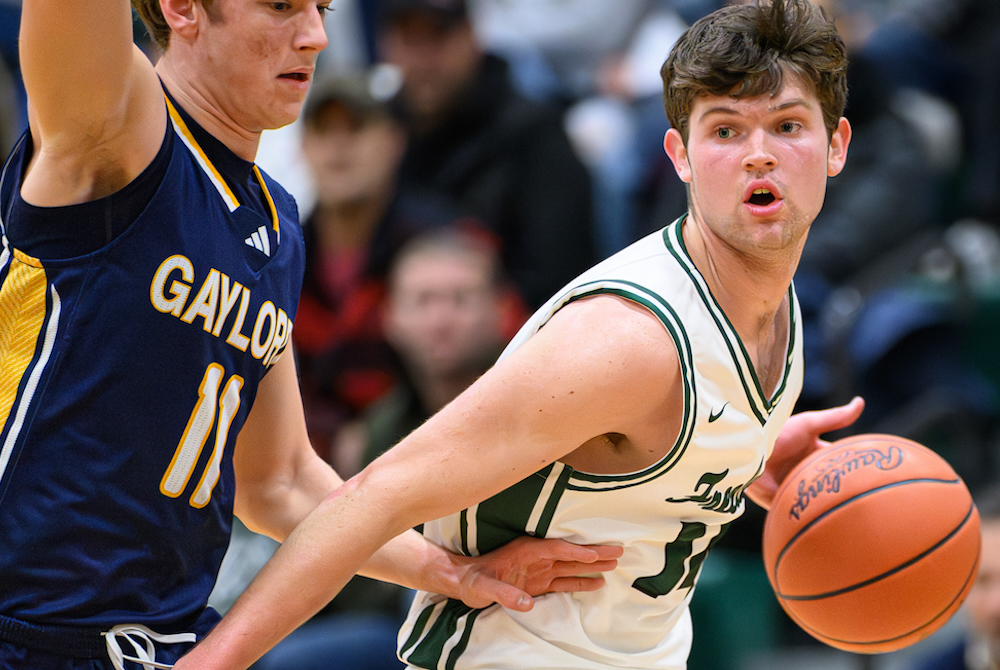
PHOTO Freeland senior forward Wilson Huckeby, right, navigates around a defender during the first quarter of last week's 70-47 Falcons win over Gaylord. (Photo by Kolleth Photo.)