

Tradition-Rich Kingston Adding to Legacy
By
Paul Costanzo
Special for MHSAA.com
January 31, 2018
Camryn MacGuire remembers watching Kingston varsity basketball games and dreaming about the day she could be on the court.
 Evan Neff enjoyed going to games so much as a kid, he kept coming back even after his family moved away for a few years while he was in middle school.
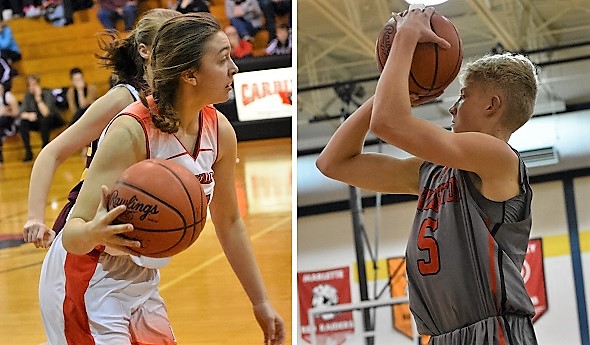
Now both are leading the way for the Cardinals on the court as the Kingston girls and boys basketball teams are inspiring another group of youngsters in their small town.
“I know a lot of little kids come to our games and are huge fans,” said Neff, a sophomore on the boys team. “I know I’ve talked to a couple eighth graders, and they say they can’t wait to play on varsity with me their sophomore year. I think a lot of the littler kids can’t wait to be a part of it.”
Basketball is king in Kingston, and this winter, Cardinals fans have plenty to cheer about. The girls team was 12-0 heading into Wednesday night’s game against Croswell-Lexington, and ranked No. 1 in Class D by the Detroit Free Press and No. 2 by The Associated Press.
The boys started the season on a nine-game winning streak, and are 11-2.
“I think it’s the same thing wherever you’re going to: if you’re winning, if you’re putting a good product out there, you’re going to see a lot of people there,” boys coach Dave Lester said. “In our little town, it seems like everybody is there for the girls games and guys games. We’ve got a great, great student body. Our home games are electric. It’s a fun atmosphere. It’s fun to coach, and it’s gotta be fun to play.
“It’s what high school sports are all about. I think that atmosphere attracts your younger athletes to want to be a part of it. If they’re there and seeing us win, that’s contagious.”
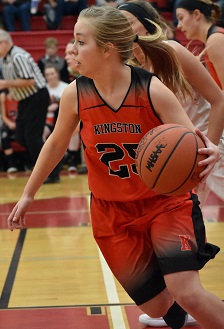 Lester and girls coach Jay Green have been part of it for the better part of the past three decades, first as players for Kingston and now as coaches.
They played together in the late 1980s, and in Green’s senior year, he helped the boys team reach the MHSAA Quarterfinals.
Green returned to coach the girls team and win four District titles in four years – along with his brother, Dave – during the late 90s. Lester took over the girls program in 2003 and coached the team to the Quarterfinal. The Greens came back to the program in 2011, and Lester took over the boys team midway through the 2013-14 season.
“I think there’s probably a little more passion toward what you do, and what you’re trying to instill into the girls and the boys because you are an alumni,” Jay Green said. “I think both of us could say we were successful alumni in the past. And we both learned under coach Leon Westover when we played, then developed our own ideas, and we have that pride of seeing both the boys and girls doing well.”
Green credits his team’s current success, in part, to the parents in the program, who have taken the time to get their girls to the gym for years and been supportive throughout.
MacGuire agreed.
“My parents, and a bunch of the girls on my team’s parents were always pushing us, and always getting us to play as much as we could,” the point guard said. “They were always telling us that big things were coming. Our starting five is all juniors, and we’ve been playing together since the fourth grade or third grade.”
Kingston’s girls aren’t focused too much on the rankings, or the record, but more on preparing themselves for the postseason. They’ve already scored a win against Class C power Sandusky, and the game against Cros-Lex will provide a test against a strong Class B program. A game against another Class B school, Yale, was postponed because of weather this past Monday.
“I love playing bigger schools,” MacGuire said. “It gives you more competition, and you get to push yourself even more; then it’s even better if you come out with the win. It’s going to benefit us in the tournament.”
Their classmates are providing plenty of support to both teams. MacGuire said there’s been a buzz in the hallways all season, and both she and Neff said their teams make sure to cheer each other on whenever their schedules allow.
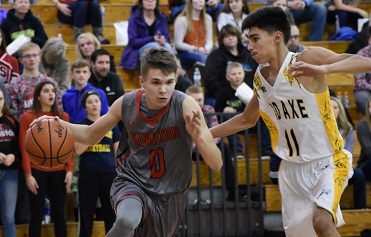 “I never really watched girls basketball until seventh or eighth grade when we moved back to Kingston,” Neff said. “I remember watching those teams, and I was really impressed. My eighth grade year, they had like four or five freshmen on varsity, and I knew they were going to be outstanding. Those girls work really hard, and they’re great athletes.”
“We try to make it to as many (boys) games as we can, even the road games,” MacGuire said. “We support each other both ways. It’s a good atmosphere.”
No Kingston team has ever been beyond the Quarterfinals, but the conference and District championships have piled up through the years. And as dedicated players keep walking into the program, it could just be a matter of time before a group of them breaks through.
“It’s just a tradition here, and our kids know it,” Lester said. “When you walk into our gym, there’s tons and tons of basketball banners. We really talk about tradition and how it would be great to continue that tradition and put up more banners.
“Obviously, we would like to make a long run. At some point, you want to win a state championship, but it’s a process. We’ve got some kids who were playing a lot of basketball, putting a lot of time into it. They want to win, and they want to be a part of that tradition.”
 Paul Costanzo served as a sportswriter at The Port Huron Times Herald from 2006-15, including three years as lead sportswriter, and prior to that as sports editor at the Hillsdale Daily News from 2005-06. He can be reached at [email protected] with story ideas for Genesee, Lapeer, St. Clair, Sanilac, Huron, Tuscola, Saginaw, Bay, Arenac, Midland and Gladwin counties.
PHOTOS: (Top) Kingston’s Carley Smith, left, pushes the ball upcourt while junior Nathan Cloyd, right, launches a shot. (Middle) Gerilyn Carpenter looks for open teammates during a game this season. (Below) Sophomore Evan Neff works to get around a Bad Axe defender. (Photos by Spot On By Shari.)
Performance: Alpena's Chris DeRocher
February 1, 2019
 Chris DeRocher
Alpena senior - Basketball
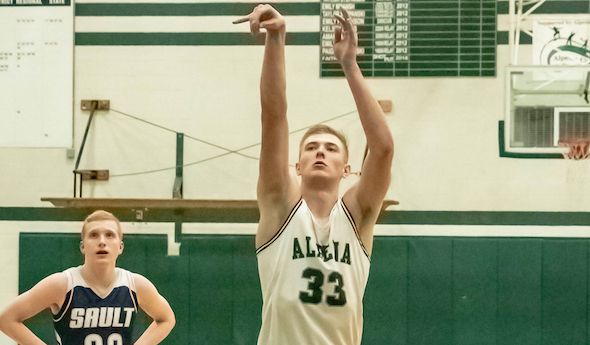
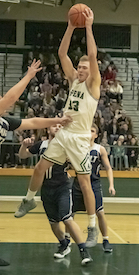
Alpena’s 6-foot-5 four-year varsity forward scored 29 points in last week’s 74-45 win over Sault Ste. Marie – and on the 29th point broke his school’s career scoring record on the way to earning the Michigan Army National Guard “Performance of the Week.”
DeRocher surpassed the record previously set in 1972 by Butch Feher, who went on to play at Vanderbilt University and for a season with the NBA’s Phoenix Suns. DeRocher sank a fourth-quarter free throw to lock up the record at 1,436 points, and he added 26 more to his running total in Thursday’s 70-55 win over Gaylord after entering the night averaging 24.3 points, 10.3 rebounds and three assists per game this season. The Gaylord victory put the Wildcats at 11-2 after the team won five games his freshman season and nine games apiece the last two winters.
 It’s been a record-setting school year for Alpena’s senior class: In addition to DeRocher’s milestone, Aidan Day set the school’s career soccer goals record, Logan Guthrie became its all-time leading career football rusher and hockey goalie Cooper Black now owns Alpena’s single-season shutout record on the ice. DeRocher also played baseball – he pitches and plays first base – and carries a 3.7 GPA. He’s unsure where he’ll attend college, but he aims to continue playing basketball and study business.
Coach John Pintar said: “I have been fortunate to have a great seat every night to watch Chris develop the last four years as both a player and a person. As a coach, you always want to see each player reach their peak potential, and Chris has certainly done that. He has started every game for us since his freshmen year. He came into the program right after we had graduated a senior class that had won two conference titles and went 41-5. There was a void in the program, and Chris was able to step right in as a freshman and instantly become a key player on the team that we could count on every night. … Any great player will tell you that winning as a team is why they play, not their statistics, and Chris has always embodied that belief. His number one goal is always the success of the team and not scoring records. The scoring has always happened within the team framework of our offense and his desire for team success. … This achievement didn't happen by accident; he has truly put in the time and effort to get to this point. He has had great support from his family and teammates along the way and I'm sure he would be the first to tell you that this couldn't have happened without them and their support. Chris has great character and is an excellent student. He has always represented himself and our school with class. I am extremely proud of what he has done and expect him to continue doing great things the rest of the season and in the future.”
Performance Point: “It was amazing, just all of the people there,” DeRocher recalled of last week’s record-setting night. “After I made that free throw, and hugging my teammates, and hugging my coaches that I've been with for four years, it was just really amazing to think about breaking a 47-year record. … Last year when I hit the 1,000-point mark, it was like, ‘All right, so if I do what I have the past two years, I should be able to do this.’ It was never something that I went out and tried to do. If it came, it came. I just went into every game trying to play the best I could for our team, and I ended up being able to do it.”
4-year varsity education: “I think I’ve just learned to not force every shot. I’ve tried to get more people more involved. Because I’ve learned if I get my teammates more involved it’s going to draw people away from me, and it’s going to be easier to get points. Just learning the game, learning defenders (and) how they play me, improving my shooting.”
 Our time to shine: “The past couple years we’ve gone through some struggles. We didn’t really have that many people ahead of us, so that wasn’t always the best thing. For two years (2015-16 and 2016-17), we only graduated two seniors. Now we’re up to our grade, and we’re showing that once you get a good group together and you have a strong core, it really does help and it really does win games. We’ve learned so much the last few years – most of our starters have started since sophomore year. It’s really showed, how well we’ve played together and how much we know each other and the chemistry we’ve had.”
Super seniors: “We have a really, really strong class, and a lot of kids are going good places. To be able to be that class that breaks all those records is really cool. You always want to win; you want to show these other schools you really are something. Our grade was always pretty good. … We’re all pretty good friends with each other, and we’re always rooting for each other.”
Putting down roots: “My family owns a couple of businesses in Alpena, so I’ll probably go into that. I’ll end up coming back home. I like it here, I like everything it has to offer. … I like the area and I want to stay here.”
- Geoff Kimmerly, Second Half editor
Every week during the 2018-19 school year, Second Half and the Michigan Army National Guard recognizes a “Performance of the Week" from among the MHSAA's 750 member high schools.
The Michigan Army National Guard provides trained and ready forces in support of the National Military Strategy, and responds as needed to state, local, and regional emergencies to ensure peace, order, and public safety. The Guard adds value to our communities through continuous interaction. National Guard soldiers are part of the local community. Guardsmen typically train one weekend per month and two weeks in the summer. This training maintains readiness when needed, be it either to defend our nation's freedom or protect lives and property of Michigan citizens during a local natural disaster.
Past 2018-19 honorees
January 24: Imari Blond, Flint Kearsley bowling - Read
January 17: William Dunn, Quincy basketball - Read
November 29: Dequan Finn, Detroit Martin Luther King football - Read
November 22: Paige Briggs, Lake Orion volleyball - Read
November 15: Hunter Nowak, Morrice football - Read
November 8: Jon Dougherty, Detroit Country Day soccer - Read
November 1: Jordan Stump, Camden-Frontier volleyball - Read
October 25: Danielle Staskowski, Pontiac Notre Dame Prep golf - Read
October 18: Adam Bruce, Gladstone cross country - Read
October 11: Ericka VanderLende, Rockford cross country - Read
October 4: Kobe Clark, Schoolcraft football - Read
September 27: Jonathan Kliewer, Grand Rapids Forest Hills Northern soccer - Read
September 20: Kiera Lasky, Bronson volleyball - Read
September 13: Judy Rector, Hanover-Horton cross country - Read
PHOTOS: (Top) Alpena's Chris DeRocher follows through on a free-throw attempt during last week's win over Sault Ste. Marie. (Middle) DeRocher controls a loose ball in the lane. (Photos by Sports in Motion.)