

U-D Jesuit Continues Tourney Dominance
March 15, 2019
By Geoff Kimmerly
Second Half editor
EAST LANSING – Only three Detroit U-D Jesuit players have seen action in all 27 of their team’s games this winter.
Friday was further evidence of what the Cubs had been missing for parts of this season.
Now together and in game shape after injuries and illnesses, Jesuit has won its seven tournament games by an average of 28 points, adding a 63-25 Division 1 Semifinal win over Okemos to earn its second championship game appearance in four seasons.
The Cubs’ closest postseason win over the last three weeks was by 11 over league rival Warren DeLaSalle in the Regional Semifinal.
Total, Jesuit has won 19 straight games since its last defeat.
“It’s great being on the floor when we’re playing well like this,” Jesuit senior guard Daniel Friday said. “Everybody’s clicking and playing for each other and playing together. It’s really been a pleasure being with these guys on the floor. It’s been translating to blowouts; hopefully we keep that up.”
Jesuit (25-2) will take on Ypsilanti Lincoln in Saturday’s 12:15 p.m. Final at the Breslin Center, seeking its second championship to go with the Class A title won in 2016. Okemos finished 23-3.
Of course, it took only a few minutes into Friday’s press conference for the first questions to come about defending Lincoln’s freshman sensation Emoni Bates. Defense has been the Cubs’ strength as it’s worked through this season’s player absences, adding to the intrigue of Saturday’s matchup.
 Jesuit has kept teams to 50 or fewer points 13 times this winter, including four times during the postseason. The Cubs held a usually strong-shooting Okemos team to 21 percent from the floor and outrebounded the Chiefs 34-24 including 28-7 on Jesuit’s side of the court.
The Cubs scored the game’s first seven points and led by double digits for good by 1:35 to go in the first quarter. They made 55 percent of their shots from the floor for the game, including 7-of-8 during a second quarter that saw them extend the lead from 13 to 21 points.
“They’re a really deep team. They have a lot of threats outside and inside, and we never really played a team that big before,” said Okemos senior forward Evan Thomas, who led the Chiefs with 13 points and six rebounds. “It was definitely a big challenge to stop them inside, then they’d start hitting outside shots too and it just piled on. I think we worked hard and did what we could.”
Eleven players scored for Jesuit, with senior guard Jordan Montgomery leading with 17 points. Senior center Jalen Thomas added 15 points on 7-of-9 shooting and 11 rebounds, and senior guard Daniel Friday made 5-of-6 shots for 10 points.
Five Cubs had at least three assists.
“It’s been a very interesting year in terms of starting lineups and who we’ve had available off the bench,” Jesuit coach Pat Donnelly said. “This stretch … we’ve had that opportunity to build chemistry, and that’s what I like. I remember looking down at the stat sheet in the first half and we had 15 field goals on 10 assists. These guys are unselfish. They play the right way.
They move the basketball. They don’t care who’s scoring.”
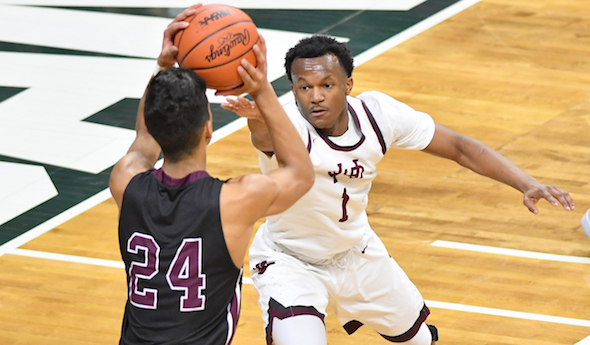
PHOTOS: (Top) U-D Jesuit’s Julian Dozier defends Okemos’ Evan Thomas during Friday’s second Division 1 Semifinal. (Middle) The Cubs’ Jordan Montgomery (3) and Chiefs’ Mason Kaczmarek go after a loose ball.
Breslin Bound: Boys Report Week 8
January 29, 2018
By Geoff Kimmerly
Second Half editor
We’ve crossed the midpoint of this boys basketball season, and the week to come might end up one of the most memorable of the winter.
 But looking into the future is just one part of the “Breslin Bound” report, and this week’s in particular includes a number of teams that have bounced back or taken another step to impress over the last two months.
Breslin Bound is powered by MI Student Aid and based on results and schedules posted for each school at MHSAA.com. To offer corrections or fill in scores we’re missing, email me at [email protected].
Week in Review
The countdown of last week’s five most intriguing results:
1. Detroit U-D Jesuit 64, Warren DeLaSalle 45 – The Cubs moved into first place alone in a Detroit Catholic League Central with four teams including the second-place Pilots at 8-4 or better.
2. Saginaw Heritage 58, Mount Pleasant 56 – The Hawks moved to 8-4, one win shy of last year’s total, and handed Mount Pleasant its first loss to knock the Oilers out of the Saginaw Valley League lead.
3. Clinton Township Chippewa Valley 67, Macomb Dakota 57 – The Big Reds won this rivalry game for the first time since 2013-14, and in the process handed Dakota its first Macomb Area Conference Red loss.
4. Coloma 58, Kalamazoo Christian 52 – The Comets’ perfect start (now 11-0) got another highlight as they handed Kalamazoo Christian (10-1) that lone defeat.
5. Brimley 62, Cedarville 56 – The 10-2 Bays avenged a seven-point loss to the Trojans on Dec. 7 to move into a first-place tie with them atop the Eastern Upper Peninsula Athletic Conference.
Watch List
With an eye toward March, here are two teams in each class making sparks:
CLASS A
Rochester (10-2) – The Falcons have risen from 0-20 three seasons ago to 9-12, then 11-11, and now first place in the Oakland Activities Association Blue. They’ve won seven straight and five of those by double digits, including a 16-pointer over Berkley (now 10-2) on Jan. 16 that was the Bears’ first defeat.
Sterling Heights Stevenson (8-3) – Stevenson switched from the MAC White to the MAC Red last season and dropped from 20-4 overall to 8-13. But the Titans have bounced back nicely and lead Dakota by a half-game in the standings after losing to the Cougars on Jan. 16. The rematch is Friday.
CLASS B
Big Rapids (9-1) – A first-round District exit to end last season combined with an early-January loss to Fremont might have quieted any Big Rapids talk, but the Cardinals sit tied with Fremont atop the Central State Activities Association Gold standings with six of their wins coming by double digits.
River Rouge (12-0) – The Panthers have seen only two games get to single digits – overtime wins over Detroit Osborn and West Bloomfield – and they lead the Michigan Metro Athletic Conference Blue after handing Harper Woods its lone defeat. The early run puts River Rouge at a combined 36-2 since the start of 2016-17, which finished two points from making the Class B Final.
CLASS C
Johannesburg-Lewiston (9-1) – Last season’s 6-15 finish is becoming a memory as the Cardinals have run off nine straight wins to take a two-game lead in the Ski Valley Conference. Eight of those nine wins have come by double digits. The lone loss came to Boyne City (now 8-3).
Kent City (11-0) – The Eagles have finished first or second all three of their seasons in the CSAA Silver, coming in runner-up a year ago. But none of those finishes started like this; Kent City leads the league thanks to a 30-point win over second-place Morley Stanwood on Jan. 12, and can equal last season’s win total with three more.
CLASS D
Fowler (9-1) – Class C powers Dansville and Pewamo-Westphalia were expected to battle it out for the Central Michigan Athletic Conference title, with another Class C foe Laingsburg pushing them. Instead, Fowler sits atop the league and among the most impressive teams in Class D, coming off a 41-40 win over the Wolfpack on Friday.
Munising (9-1) – Powers North Central’s winning streak may be over, but the U.P. still has its share of Class D power especially with Munising sliding to this class from Class C last year. The Mustangs lead the Skyline Central Conference large schools division, their only loss to Rapid River (now 8-1).
Can't-Miss Contests
Be on the lookout for results of these games coming up:
Tuesday – Clarkston (11-1) at Hazel Park (11-0) – What might be one of the top regular-season games this season pits the co-leaders of the OAA Red and also two of the chief contenders in Class A.
Tuesday – Richmond (8-3) at Capac (10-1) – A dream turnaround season for Capac (8-15 a year ago) could hit a new level with a win in this matchup of Blue Water Area Conference co-leaders.
Tuesday – Detroit U-D Jesuit (9-3) at Orchard Lake St. Mary’s (8-4) – Jesuit is the only undefeated team in the Catholic League Central, but needs to be cautious after defeating the Eaglets by just a point Jan. 12.
Friday – Flint Beecher (6-5) at Flint Hamady (9-2) – Beecher loads up the schedule with top teams from all over the east side of the Lower Peninsula, but got a major challenge in a one-point win over local and league rival Hamady on Dec. 19.
Friday – Spring Lake (11-2) at Grand Rapids Catholic Central (9-1) – League leader GRCC won big in the first meeting, by 41, but that remains the only O-K Blue loss for the second-place Lakers.
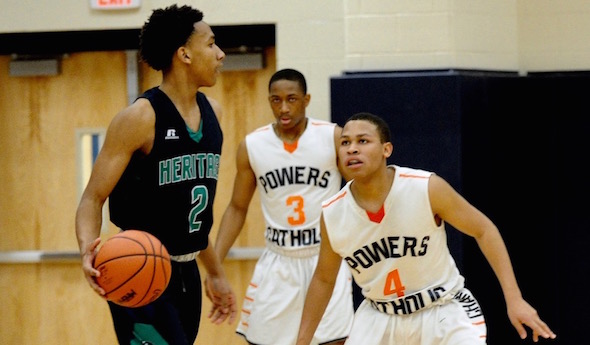
PHOTO: Saginaw Heritage, here against Flint Powers Catholic, dealt Mount Pleasant its first loss of the season last week. (Photo by Terry Lyons.)