

U-D Jesuit Continues Tourney Dominance
March 15, 2019
By Geoff Kimmerly
Second Half editor
EAST LANSING – Only three Detroit U-D Jesuit players have seen action in all 27 of their team’s games this winter.
Friday was further evidence of what the Cubs had been missing for parts of this season.
Now together and in game shape after injuries and illnesses, Jesuit has won its seven tournament games by an average of 28 points, adding a 63-25 Division 1 Semifinal win over Okemos to earn its second championship game appearance in four seasons.
The Cubs’ closest postseason win over the last three weeks was by 11 over league rival Warren DeLaSalle in the Regional Semifinal.
Total, Jesuit has won 19 straight games since its last defeat.
“It’s great being on the floor when we’re playing well like this,” Jesuit senior guard Daniel Friday said. “Everybody’s clicking and playing for each other and playing together. It’s really been a pleasure being with these guys on the floor. It’s been translating to blowouts; hopefully we keep that up.”
Jesuit (25-2) will take on Ypsilanti Lincoln in Saturday’s 12:15 p.m. Final at the Breslin Center, seeking its second championship to go with the Class A title won in 2016. Okemos finished 23-3.
Of course, it took only a few minutes into Friday’s press conference for the first questions to come about defending Lincoln’s freshman sensation Emoni Bates. Defense has been the Cubs’ strength as it’s worked through this season’s player absences, adding to the intrigue of Saturday’s matchup.
 Jesuit has kept teams to 50 or fewer points 13 times this winter, including four times during the postseason. The Cubs held a usually strong-shooting Okemos team to 21 percent from the floor and outrebounded the Chiefs 34-24 including 28-7 on Jesuit’s side of the court.
The Cubs scored the game’s first seven points and led by double digits for good by 1:35 to go in the first quarter. They made 55 percent of their shots from the floor for the game, including 7-of-8 during a second quarter that saw them extend the lead from 13 to 21 points.
“They’re a really deep team. They have a lot of threats outside and inside, and we never really played a team that big before,” said Okemos senior forward Evan Thomas, who led the Chiefs with 13 points and six rebounds. “It was definitely a big challenge to stop them inside, then they’d start hitting outside shots too and it just piled on. I think we worked hard and did what we could.”
Eleven players scored for Jesuit, with senior guard Jordan Montgomery leading with 17 points. Senior center Jalen Thomas added 15 points on 7-of-9 shooting and 11 rebounds, and senior guard Daniel Friday made 5-of-6 shots for 10 points.
Five Cubs had at least three assists.
“It’s been a very interesting year in terms of starting lineups and who we’ve had available off the bench,” Jesuit coach Pat Donnelly said. “This stretch … we’ve had that opportunity to build chemistry, and that’s what I like. I remember looking down at the stat sheet in the first half and we had 15 field goals on 10 assists. These guys are unselfish. They play the right way.
They move the basketball. They don’t care who’s scoring.”
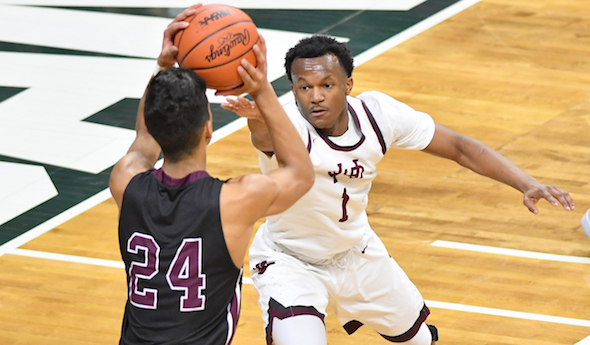
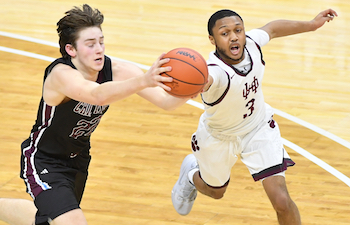
PHOTOS: (Top) U-D Jesuit’s Julian Dozier defends Okemos’ Evan Thomas during Friday’s second Division 1 Semifinal. (Middle) The Cubs’ Jordan Montgomery (3) and Chiefs’ Mason Kaczmarek go after a loose ball.
Performance: Jesuit's Cassius Winston
March 31, 2016
 Cassius Winston
Detroit U-D Jesuit senior - Boys Basketball
Winston said his team's trip last weekend to the Breslin Center was like a final exam for his high school career – and he earned a perfect score. Winston led the Cubs to their first MHSAA basketball championship and the final victories of a 28-0 season to earn the Michigan National Guard Performance of the Week.
The 6-foot-1 guard, who earlier in the week received the state's Mr. Basketball Award as the top senior in Michigan, scored 27 points and dished 12 assists in a Semifinal win over then-undefeated Macomb Dakota to send U-D Jesuit to its first championship game. He had 31 points in the Final, making 14 of 16 shots to go with nine assists in the 69-49 win over North Farmington.
 For the season, Winston averaged 21.9 points and 7.5 assists per game and also started on the U-D Jesuit teams that reached the Semifinals his sophomore and junior seasons. He has signed to continue his career at Michigan State University, and as the Detroit Free Press reported earlier this season carries a 3.5 grade-point average while taking a number of honors classes.
Coach Pat Donnelly said: "Nothing Cassius does surprises me. He's been doing this for four years. He was 14 of 16 from the floor, and a lot of that is great shot selection. He's one of the most unselfish players I've ever coached, if not the (most unselfish). The reason he shoots such a high percentage is he's talented, and he also takes great shots; he doesn't force things. If he does get double-teamed or there's help, he finds the open man."
Performance Point: "(Saturday) was definitely one of those days where I knew I had to have my best performance. It was going to be my last high school game, last chance at winning a state championship. I was just kinda zoned in, focused and ready to go. ... We've been working for this moment right here."
Hot hand: "I just do what I can. I was scoring the basketball. My teammates, they kept going to me. They kept ball-screening for me every time. If I was open, I was getting the ball because I was making shots. So they provided for me."
Openings and opportunities: "Last year we didn't have as many dudes that could score the basketball, so everyone would just be waiting in the paint for me. This year, we had Scotty (Nelson) have 13, 14 points - he's been hot from the 3-pointers. We've got Ike (Eke) and Greg (Eboigbodin) down there who would be making plays. The defense couldn't just focus on me. There's a lot out there that they have to focus on. So it was kinda easier for me to get to the basket."
 Perfect finish: "Everything that you want in a basketball team, we had. Matt Schearer, I don't think he shot a shot (Saturday), maybe one if that, but he doesn't mind. He's going to play defense, he's going to rebound, he's going to do whatever you need to do. We got Ike and Greg averaging 10 points, 10 rebounds. We've got dudes that come off the bench. Everything that you would like in your basketball team, we had this year, and that's how we became successful."
Green and White: "It's just a good feeling knowing I'm going to step into that huge family that's going to support me. I know there's probably a lot of Spartan fans out there who are coming out to support me and watch me do what I do. I just want to say thank you to the Spartan family."
– Geoff Kimmerly, Second Half editor
Every week during the 2015-16 school year, Second Half and the Michigan National Guard will recognize a “Performance of the Week" from among the MHSAA's 750 member high schools.
The Michigan Army National Guard provides trained and ready forces in support of the National Military Strategy, and responds as needed to state, local, and regional emergencies to ensure peace, order, and public safety. The Guard adds value to our communities through continuous interaction. National Guard soldiers are part of the local community. Guardsmen typically train one weekend per month and two weeks in the summer. This training maintains readiness when needed, be it either to defend our nation's freedom, or protecting lives and property of Michigan citizens during a local natural disaster.
Previous 2015-16 honorees
March 23: Kierra Fletcher, Warren Cousino girls basketball - Read
March 16: Jacob Montague, Grosse Pointe South swimming & diving - Read
March 9: Kyle Tuttle, St. Charles boys bowling - Read
March 2: Brittney Schnicke, Caledonia girls bowling - Read
Feb. 24: Kamari Newman, Detroit East English boys basketball - Read
Feb. 17: Jason Whitens, Powers North Central boys basketball - Read
Feb. 10: Rachel Hogan, Grand Ledge gymnastics - Read
Feb. 3: Nehemiah Mork, Midland Dow swimming & diving - Read
Jan. 27: Mardrekia Cook, Muskegon girls basketball - Read
Jan. 20: Sage Castillo, Hartland wrestling - Read
Jan. 13: Rob Zofchak, Dexter swimming & diving - Read
Jan. 6: Tyler Deming, Caro wrestling – Read
Dec. 15: Jordan Weber, East Jordan boys basketball – Read
Dec. 8: Kaitlyn Geers, Kent City girls basketball – Read
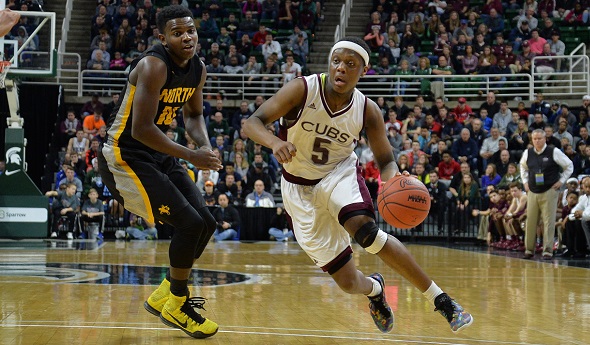
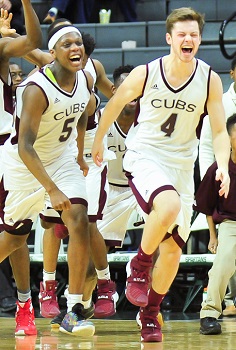
PHOTOS: (Top) Detroit U-D Jesuit's Cassius Winston (5) looks for an open lane during Saturday's Class A Final against North Farmington. (Middle) Winston (left) and teammate Matt Schearer join the rest of the Cubs in beginning the title celebration.