

Vander Klay's Dedication to Wyoming Schools Netted 400+ Wins, Trip to Breslin
By
Dean Holzwarth
Special for MHSAA.com
April 6, 2026
WYOMING – Over the past 31 years, it was relatively easy to notice a boys basketball team coached by Thom Vander Klay.
 Athletic and tough-nosed players who competed hard while playing an up-tempo offense and in-your-face defense were trademarks of his teams at Wyoming Park and Wyoming High School.
“In some ways, at Wyoming Park, and then Wyoming, our athletes have been very similar through those 31 years of varsity,” Vander Klay said.
“Some teams were more skilled and more athletic than others, but they were the same. We never had big kids. We’ve always had kind of gritty kids that would compete hard and play fast, and we had quite a few of them on every team. That bled into what we did.”
Vander Klay will retire from teaching after 40 years at the end of May, and his time as the longtime basketball coach will end as well.
“It’s been a struggle, and it’s hard because it’s my home,” Vander Klay said. “I live in Wyoming, my kids went to Wyoming and I went to Wyoming (Park). I’m the youngest of three and my older brother and sister were Vikings and that’s who I was. I was Wyoming, and I still am, so it was really difficult to say I was going to step away from things I really enjoyed doing.”
Vander Klay has been coaching for 41 years. He was the junior varsity coach at Wyoming Park before replacing Kelly McEwen in 1995.
When Wyoming Park and Wyoming Rogers merged in 2012, he became the head coach at the new Wyoming High School.
During his tenure, he went 424-274 as a varsity coach and won nine conference championships, six District titles and one Regional title. He also helped coach football and track & field.
“So many memories and so many kids, and you love those kids,” said Vander Klay, who coached his two sons, Brock and Chase. “When I think back to when I started, guys like Jack VerDuin, Ron Engels, Dick Locke, Frank Grimm and Kelly McEwen were great mentors that I had. I go back to those days and blink, and here we are 40 years later and I'm the old guy.”
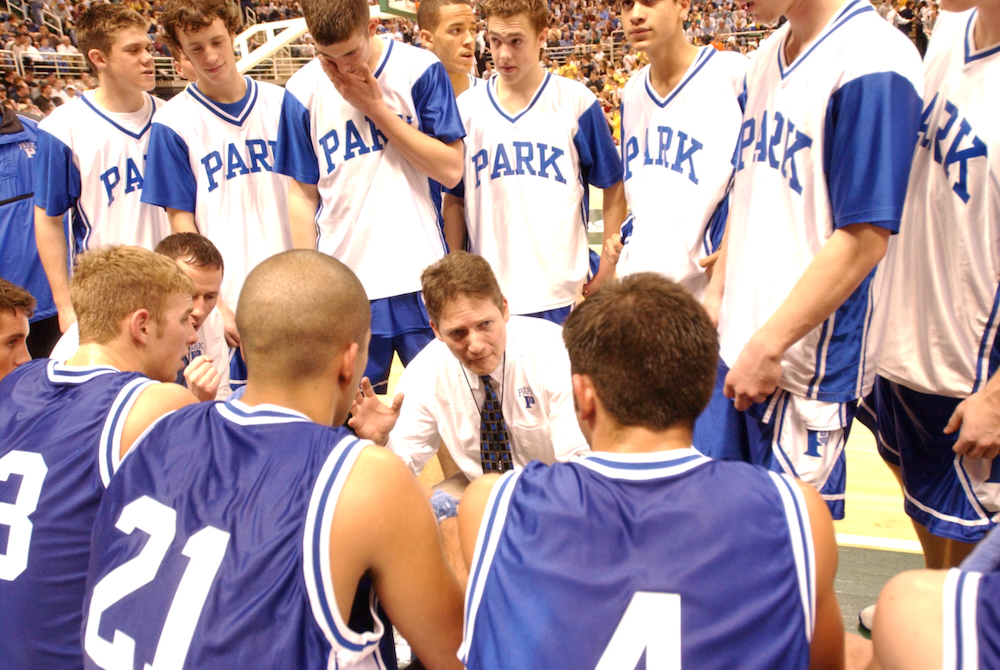
Vander Klay’s best season came in 2004 at Wyoming Park, led by eventual Michigan State standout Drew Neitzel. The Vikings advanced to the Class B Semifinals, losing to Detroit Renaissance.
 Vander Klay was named Class B Coach of the Year and enjoyed his time coaching Neitzel, the Mr. Basketball Award winner who is widely considered one of the best players in program history.
“Drew was so well-rounded,” Vander Klay said. “A great leader, great student, great attitude and just mentally tough and so skilled.
“Coaching him was more about trying to get all five guys on the same page, but those teams that Drew played on, we had good players other than him, too. It wasn't just him because we had other guys who stepped up – but he was the best player in the state.”
Jacob Underhill, Vander Klay’s longtime assistant and junior varsity coach, said Vander Klay has been more than just a mentor.
“He has been the blueprint for the teacher and coach I strive to be,” Underhill said. “He has always been incredibly gracious in sharing his knowledge of the game and his wisdom on how to lead young men. Every decision he makes is filtered through a single focus: doing what is best for the students and athletes of Wyoming.
“While his retirement marks the end of an era, his legacy is undeniable. Since the merger of Wyoming Park and Wyoming Rogers, he has been the heartbeat of the basketball program. He has had a profound impact on my professional career, and I cherish the time we’ve spent serving the community together.”
Underhill has witnessed firsthand the influence Vander Klay has had on former players with whom he has reconnected.
“It’s a true testament to his character,” Underhill said. “He is an exceptional human being who makes everyone around him better and ensures they recognize their own value.”
The 62-year-old Vander Klay is keeping his options open in terms of a return to coaching elsewhere.
“I’ll take some time off and maybe there is something else out there,” he said. “I'm wide open to anything, and maybe I’ll coach again and maybe not. We will see what the future holds.”
Two other longtime Grand Rapids-area coaches also stepped down after longstanding careers on the hardwood.
Unity Christian coach Scott Soodsma retired after 43 years on the sidelines. He won more than 800 games and three MHSAA Finals championships as a boys and girls coach. Soodsma coached his last game in the Division 2 Boys Basketball Final at Breslin Center. The Crusaders lost to Freeland, 42-32.
Sparta boys basketball coach Scott Berry also retired after 34 seasons. He won 245 games at Comstock Park and Sparta.
 Dean Holzwarth has covered primarily high school sports for Grand Rapids-based WOOD-TV for five years after serving at the Grand Rapids Press and MLive for 16 years along with shorter stints at the Ionia Sentinel and WZZM. Contact him at [email protected] with story ideas for Allegan, Kent and Ottawa counties.
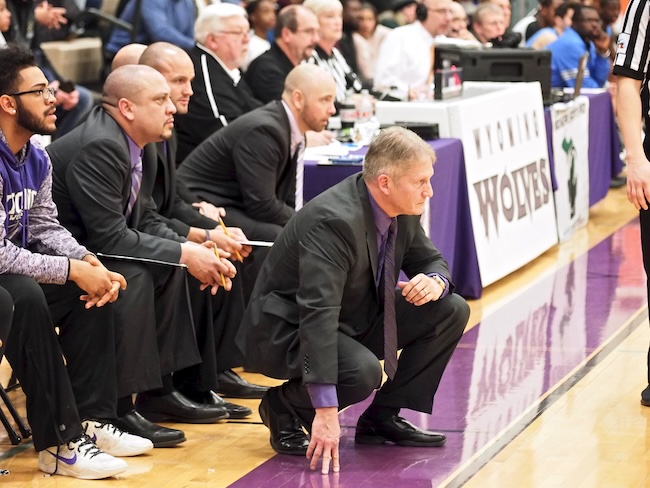
PHOTOS (Top) Coach Thom Vander Klay (kneeling) talks to his Wyoming Park team during a break in its 2004 Class B Semifinal at Breslin Center. (Middle) Vander Klay (kneeling) coaches his Wyoming High team. (Top photo from MHSAA archives; middle photo submitted by Thom Vander Klay.)
Breslin Bound: Boys Report Week 2
December 19, 2016
By Geoff Kimmerly
Second Half editor
 Basketball season generally is broken down into three sections – and we’re in the midst of an exciting first as schools prepare for a break from class but not the action on the court.
The first month of the season features nonleague tilts between top teams from all over the state – see our “Week in Review” presented by MI Student Aid for some of last week’s best – and keep an eye out for more as we move into the final week of December before that second phase – the heating up of league competition.
Week in Review
The countdown of last week’s five most intriguing results:
1. Flint Beecher 59, Detroit U-D Jesuit 57 (OT) – Beecher, the reigning champion in Class C, has played arguably the toughest schedule in the state so far but came back from an early-week loss to reigning Class B champion Detroit Henry Ford by downing the reigning Class A champion Cubs during Super Saturday at Southfield.
2. East Lansing 59, Lansing Everett 53 – As noted in last week’s report, Everett handed the Trojans their first and only loss last season on the way to the Class A Semifinals; East Lansing and star Brandon Johns again are expected to be title contenders.
3. Wayland 77, Detroit Henry Ford 54 – The Wildcats, 17-3 a year ago, handed the reigning Class B champion its first loss during the Battle for I-96 showcase after Ford had downed Beecher just days before.
4. Freeland 54, Alma 48 – The undefeated Falcons trailed late before coming back to beat their Tri-Valley Conference Central rival; last season, Alma won the league with a sweep of second-place Freeland (which won 19 games) and then beat Freeland again during the Regional.
5. Detroit East English 79, Macomb Dakota 63 – Also Saturday at Southfield, East English added to an earlier win this season over Beecher by ending Dakota’s 41-game regular-season winning streak.
Watch List
With an eye toward March, here are two teams in each class making sparks:
CLASS A
Kalamazoo Central (4-0) – The Maroon Giants are always in the championship mix, so this start is nothing new. But it’s included four double-digit wins including 67-55 over Battle Creek Central in the opener and 62-45 over Detroit Western.
Dearborn Heights Crestwood (4-0) – After finishing 10-12 and last in the Western Wayne Athletic Conference Blue last season, Crestwood has matched reigning co-champ Belleville with a 4-0 start. A big test comes Tuesday against the other 2015-16 co-champ, Romulus.
CLASS B
Bridgeport (4-0) – The Bearcats have finished third, sixth and fifth in the TVC East the last three seasons, respectively, but moved into prime position early with last week’s 69-59 win over reigning co-champion Frankenmuth. They’ll meet again Feb. 10.
Detroit Mumford (4-0) – The Mustangs won six and seven games, respectively, over the last two seasons, and are approaching those totals with four more games to go this month. They’ve pulled off a pair of close calls, by five over Gibraltar Carlson and four over Detroit Southeastern.
CLASS C
Iron River West Iron County (3-0) – After winning four games last season and two the season before that, West Iron is close to surpassing both by the end of the first week of January. The highlight so far probably was last Monday’s 61-43 win over Crystal Falls Forest Park, a 22-game winner last winter.
Marlette (4-0) – The Red Raiders are coming off back-to-back 15-7 finishes and after starting 2-2 a year ago. They could turn into a heavy favorite to claim the Greater Thumb Conference East title outright after sharing last winter; after two weeks, Marlette is the only team in the league with a winning overall record.
CLASS D
Baldwin (4-0) – After squeezing past Scottville Mason County Central by three in its opener, Baldwin has won its last three games by an average of 32 points. The Panthers won their District and fell in the Regional Semifinal last season.
Lansing Christian (4-0) – Since making the Class D Semifinals in 2013, the Pilgrims have fallen as low as five wins and built back with 10 two seasons ago and 14 last winter. They play in the Greater Lansing Activities Conference with all bigger schools, so they will see only a few opponents their size the rest of the way.
Can't-Miss Contests
Be on the lookout for results of these games coming up:
Monday – Powers North Central (3-0) at Menominee (0-1) – The Class B Maroons might be the last tall obstacle to stand in the reigning Class D champion's way as it pursues the MHSAA record for longest winning streak (see last week’s report); Menominee fell only 64-60 in the teams’ second meeting last season.
Tuesday – Detroit U-D Jesuit (2-1) at Macomb Dakota (3-1) – This is a rematch of last season’s Class A Semifinal, won by Jesuit 72-51, as the Cubs went on to win the MHSAA championship.
Tuesday – Ann Arbor Pioneer (3-2) at Ann Arbor Skyline (2-2) – Skyline lost to Pioneer three times and Ann Arbor Huron twice in finishing 13-8 last season; Skyline is coming off a 95-92 triple-overtime win over Huron and will now try to avenge against this local rival as well.
Tuesday – Traverse City St. Francis (2-2) at Frankfort (2-0) – Frankfort won the Northwest Conference title last winter, but one of its two regular-season losses came to St. Francis, 69-68, as the Gladiators went on to finish second in the Lake Michigan Conference.
Tuesday – Boyne City (2-0) at McBain (3-0) – This should help in some early sorting out of the top Class C teams in the northern Lower Peninsula; McBain made the MHSAA Semifinals last season and Boyne City made the Semifinals the season before.
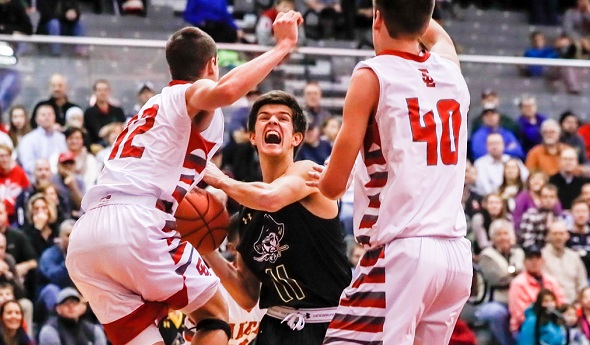
PHOTO: A pair of Spring Lake defenders wall off a driving Grand Haven player during Friday’s 53-52 overtime win by the Buccaneers. (Photo by Tim Reilly.)