

'Ville' Coach Driven to Make Difference
By
Tom Markowski
Special for Second Half
December 30, 2015
DETROIT – It’s unlikely. But if Juan Rickman ever gets bored, he would be a prime candidate to participate in a sleep-deprivation study.
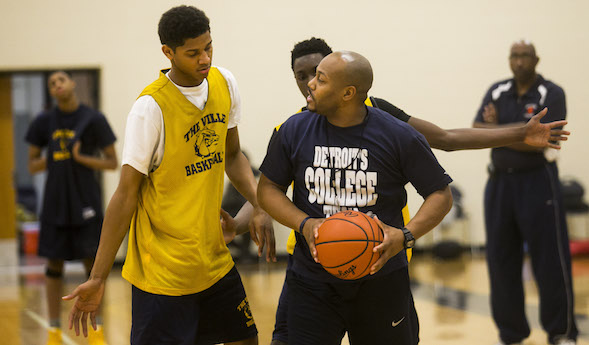
 Rickman, 32, spent five seasons as the boys basketball coach at Detroit Crockett, then became the coach at Detroit East English Village Prep when Crockett merged with Detroit Finney for the start of the 2012-13 school year.
His fulltime job is serving as an attendant agent for the Detroit Public Schools. In layman’s terms, he’s a truant officer. He also works for Wayne County in its juvenile detention department.
And if that’s not enough, Rickman and a partner are in the process of starting a medical transportation business. Rickman said he has the drivers lined up. Purchasing the vehicles is the next step.
Rickman also is a husband and a father. He and his wife Kateena have a 16-month-old daughter, Amira.
A graduate of Detroit Cass Tech and the University of Michigan-Dearborn, Rickman is driven. Achievement is the driving force that supplies the motivation for himself and his family, and for the students for whom he is responsible.
“I’m grinding, just grinding,” he said. “My wife and I have a budget.
“She’s totally into my life. You want a means to an end. We want to buy a house.”
A typical day for Rickman begins at 7:45 a.m. at East English. School ends at 3:30 p.m., and then study table begins a half hour later for his players and lasts an hour and a half. Practice runs from 5:50-8 p.m. His job with Wayne County begins at 11 p.m. and he’s off at 7 – then he’s back at East English.
Rickman isn’t Superman, so this routine isn’t played out every day. But there are weeks where he’ll work three nights for Wayne County, then work a Sunday.
“There are some days I don’t sleep,” he said. “This past week I got up Monday morning and didn’t sleep until 11 (p.m.) on Wednesday.
“When my wife wasn’t working, I had to (work extended hours). Sometimes I’ll take some time off (from Wayne County). The thing is, I know when I need to tone it down.”
Kateena returned to work for an insurance company soon after giving birth. Though this helps monetarily, it also forces the Rickmans to send their child to day care.
 It can be a dilemma, and it is a balancing act. But they’re determined to create a good life for themselves and their child.
Juan Rickman said he planned on cutting back on his hours during the holidays to spend more time with his family.
Along with the rewards financially from their hard work is the satisfaction of knowing they are contributing to their community. Because of his jobs within DPS and Wayne County, Juan Rickman deals with many troubled youths. He knows he’s in a position to set an example as a positive role model, and there is a responsibility to fulfill these expectations.
“I take it seriously,” Rickman said. “A big part of my job is to get these kids into college. I’ve had six of my players go on to a Division I school, but what I’m most proud of is the others. I didn’t have to work hard to get the Division I kids in school. College coaches came after them. I’m more proud of the D-II and the (players who went to) NAIA (schools). Look at Jaylin McFadden. We worked hard to get him into Ferris State.
“And these players come back around. Even the ones I kicked off the team come back. It’s a good feeling.”
Rickman and others at East English also helped the team manager earn a scholarship. Devin Smith is a senior and he’s earned a scholarship to Madonna University in Livonia through a fund the university set up.
East English is off to a 1-2 start, but the Bulldogs are expected to be a significant factor in the race for the Public School League title.
“I’m content coaching high school basketball,” Rickman said. “I’ve had opportunities to go to the next level. I didn’t like the situation.”
 Tom Markowski is a columnist and directs website coverage for the State Champs! Sports Network. He previously covered primarily high school sports for the The Detroit News from 1984-2014, focusing on the Detroit area and contributing to statewide coverage of football and basketball. Contact him at [email protected] with story ideas for Oakland, Macomb and Wayne counties.
PHOTOS: (Top) Detroit East English boys basketball coach Juan Rickman works with his players during a practice. (Middle) Rickman, with wife Kateena, holds daughter Amira. (Photos courtesy of the Rickman family.)
Next Generation Chargers Make C Final
March 23, 2017
By Geoff Kimmerly
Second Half editor
EAST LANSING – Carson Meulenberg and Trenton Koole had never played a game of this magnitude before taking the Breslin Center floor Thursday.
But their dads had, and perhaps indirectly that provided them a little experience. At least it seemed like it.
Covenant Christian didn’t seem bothered by any of the usual anxieties teams face when they play during the final weekend for the first time. The Chargers – in an MHSAA Semifinal for the first time since winning Class D in 1994 – got ahead early and never slowed in downing Manton 62-35 to earn a spot in Saturday’s Class C championship game.
Koole’s dad Scott played on that 1994 team that beat Eben Junction Superior Central 79-70 in the championship game. Scott Koole also played with Dave Meulenberg on the 1993 team that beat Muskegon Western Michigan Christian 53-42 to win the Class D title that season as well.
“To just stay calm, keep your composure, play your best,” Carson Meulenberg recalled of the advice his father gave him before Thursday. “Don’t worry about a lot of things. A lot of it is worrying about nothing, so just go play your game.”
And Covenant Christian’s game this season frequently has focused on defense, which was lockdown against the Rangers and will be especially key in Saturday's 4:30 p.m. Final against Flint Beecher.
Koole blocked Manton’s first shot of the game, and Covenant Christian had three blocks during the first five minutes. The Rangers still hung in to trail only 11-7 at the end of the first quarter, but the Chargers (21-5) scored the first 19 points of the second and never led again by fewer than 20.
They held usually sharp-shooting Manton (21-5) to 22 percent success from the floor, including 16 percent from 3-point range.
“Finally,” Calvin Christian coach Tyler Schimmel said. “To be honest, since the first District game, we haven’t played that well. I told the guys before (this) game, you’re due for one, especially defensively.
 “This year, we actually have (had games like this). That’s why I kept telling my guys they’re a good team. They’re capable of doing those types of things.”
Koole led Covenant Christian with a game-high 14 points and eight rebounds, and Meulenberg and junior forward Zach Kaptein both had 10 points. Senior guard Benji Kuiper had six points, seven rebounds, six assists and five steals, and junior Tyler Cammenga had nine points and seven rebounds.
Manton’s top three scorers this season were juniors and sophomores; junior Jayden Perry led again with 13 points, and junior Hunter Ruell had eight points.
“On film, we knew they were going to be athletic just by watching them,” Manton coach Ryan Hiller said. “Once they started getting offensive boards, and the transition game, and I don’t know how many shots they blocked that first half … through the first five minutes, we saw a trend there, and we had to adapt the things we normally do, and we struggled there.”
Manton was playing in its first Semifinal since 1996. The Rangers had been eliminated in the District Finals the last three seasons, losing those games by a combined seven points.
Covenant Christian is riding a streak of 14 wins in 15 games, and now has some bragging rights at home in addition to Saturday’s opportunity.
“He talks about it all the time to me, brags and says he made it this far,” Koole said of his dad's Finals memories. “Now I can go back to him and tell him I did the same thing.”
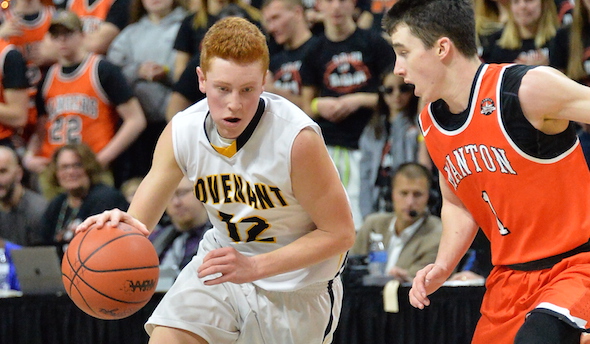
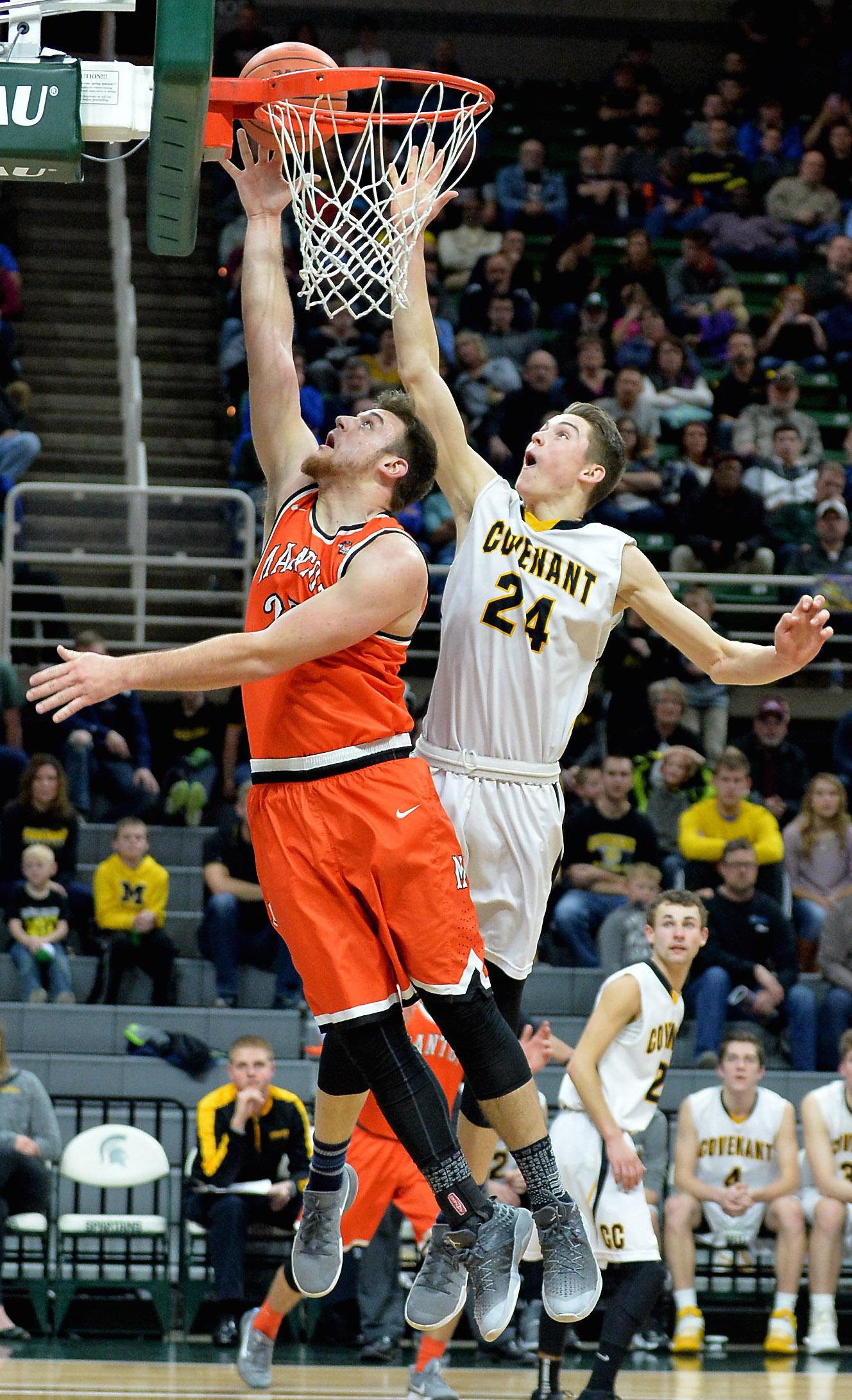
PHOTOS: (Top) Covenant Christian’s Benji Kuiper (12) works to get around Manton’s Jayden Perry during Thursday’s Semifinal. (Middle) The Rangers’ Wyatt Baker gets up a shot with the Chargers’ Carson Meulenberg (24) defending.