

Menken Giving Back Through Coaching, Telling Story of Donor's Life-Saving Gift
By
Pam Shebest
Special for MHSAA.com
November 17, 2026
KALAMAZOO — In 2017, Andrew Nicholson was a 19-year-old senior at Holly High School.
 Roy Menken was a 52-year-old bowler who was dying of Alpha-1 antitrypsin deficiency, a fatal lung disease.
The two had never met, but through tragedy, the teen saved Menken’s life.
Menken, an assistant bowling coach at Kalamazoo Central, was given about six months to live when he got a call at 5:45 a.m. on May 24, 2017, from University of Michigan Health.
After waiting for 27 months, Menken was finally getting a new pair of lungs.
“Normally they give you about four hours to get to U of M,” Menken said. “In my case, Andrew’s lungs didn’t match anyone else in the U of M program, so I was the only one called.”
With his wife driving “like a mad person,” they made it to the medical center in Ann Arbor in less than two hours.
Preparing for the surgery, he said, he felt “a little scared, because you never know. Actually, I felt sad for the person who had passed. We were told that it was a young man, and he was involved in an accident.”

The teen was killed the day before in a welding accident.
Working in a junk yard, he was asked to weld some 55-gallon drums, which, unknown to him, still had some lacquer thinner in them.
“A week before I showed my son how to weld,” said Keith Nicholson, Andrew’s dad. “He made an eighth-inch weld and it burned through and blew up. Broke his neck, broke his forearm, broke his shoulder, broke his whole left side of his body, crushed his head.”
Fortunately for Menken, when the teen got his driver’s license at age 16, he checked the donor box.
“The day my ex-wife took him to get his driver’s license, she was standing there next to him and he said, ‘Donor, what’s that mean?’” Keith Nicholson said. “She said if you die, they can take your organs and help other people.
“Andrew shrugged his shoulders and said, ‘Well, they’re not going to do any good for me.’”
Those organs not only helped Menken, but saved four other lives, were life-changing for 12 more people (bones, etc.) and life-altering for another 33 (skin, science, etc.)
Menken sent a letter to Gift of Life Michigan through the hospital, hoping it would be forwarded to the donor’s family. The family answered, beginning a life-long friendship.
Keith Nicholson said he responded because “I was more curious making sure everything was all right. I’m really happy. I couldn’t ask for a better recipient.”
They have not only become “family,” but on the two-year anniversary of the transplant, Keith Nicholson went to Kalamazoo from Trenton to pick up the classic 1959 Impala that Menken started restoring before the surgery but could no longer finish.
Nicholson completed work on the car and said Andrew would have done it himself if he’d had a chance.
“The only thing I ever said to Roy (about the transplant) was when we were out in the shop welding on the car, he tried to sneak out there (to help)," Nicholson recalled.
And that question was a stark reminder.
“I stopped welding, looked at him and said, ‘Is this what you think of my son’s gift to you?’”
Living a full life
Fueled by healthy new lungs, Menken wasted no time getting back into sports.
The transplant was in May 2017, and by that September he was playing golf. He started bowling in November.
When he walked into Continental Lanes that first day, he saw his son, Donald, who was working there.
“You could just see the emotion on his face,” Menken said. “So was (manager) Dave Fawley and my other son, Perry.
“I slowly got back into the leagues that January and haven’t quit bowling since except when COVID hit.”
Bowling at least five days a week is no problem for Menken. The hardest part, he said, is wearing a mask when he is around people, something transplant recipients are supposed to do.
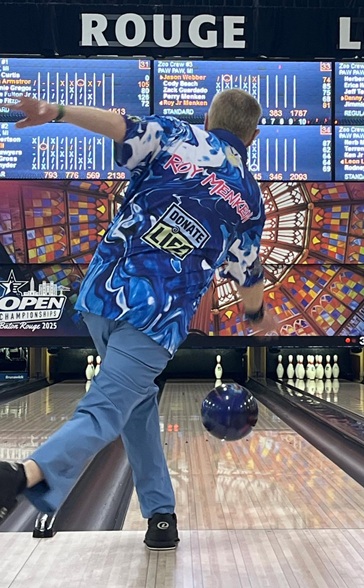
The mask hasn’t interfered with his game. He’s shot a couple of 300 games since then.
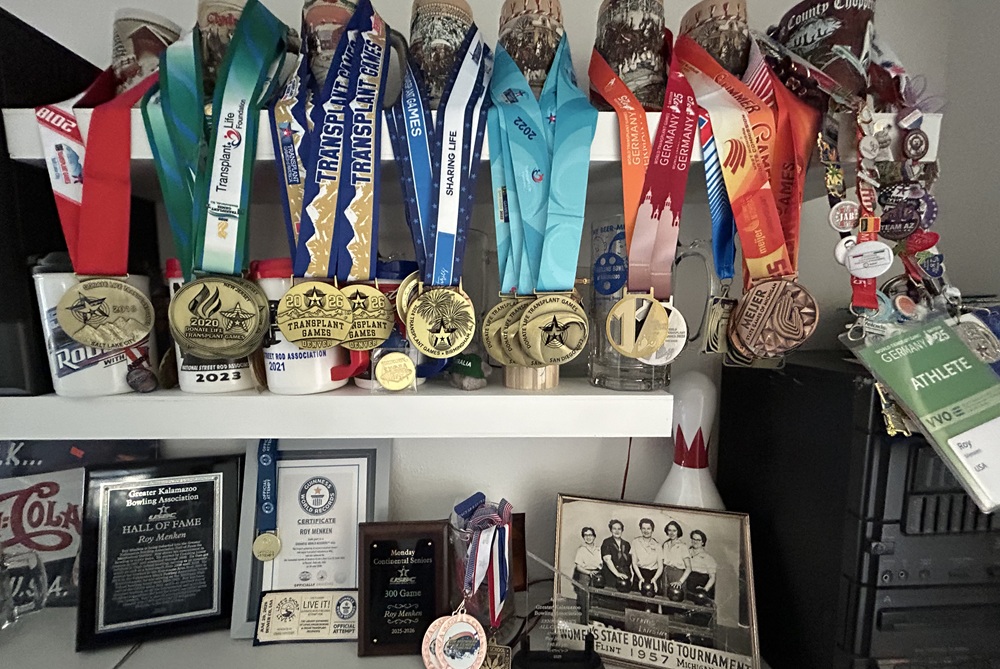
Menken also competes in Transplant Games of America and World Transplant Games. Several of his 12 gold medals came from both tournaments, including a mixed doubles gold in the U.S. Games with Becky Sheets from Charlotte, who was six months out from a heart transplant.
Traveling is no problem for Menken and his wife, Jan. The World Games, held every two years, move from country to country. Last year they were in Dresden, Germany, and next year will be in Belgium.
Menken still has to travel to Ann Arbor for checkups every three months and gets weekly infusions of Prolastin (an enzyme his liver doesn’t release) at home.
He is also in chronic rejection and relapsed twice before rebounding, which he attributes to how active he is and the 12 morning pills and 16 evening pills he takes each day.
As a teen, Menken was diagnosed with sports-induced asthma and began using inhalers.
He said doctors never really discovered that he had Alpha-1 until one day in 2013, while he was working as a building operator for Kalamazoo County and had trouble catching his breath.
“They sent me to their doctor, and he said do you realize you are disabled?” recounted Menken, who refused to believe it.
It was not until he went to Ann Arbor for tests that he was diagnosed with end-stage lung disease and given two years to live.
He and his wife “left U of M and we were both in shock,” he said.
After returning home, he was put on two liters of oxygen and could no longer work at his job. Once he got the call for surgery, Menken said he was more afraid that something would happen to cancel the surgery than he was of dying.
The operation lasted 14 hours and when he woke the next day, he wasn’t scared but knew the operation was a success when he saw “my wife and her Aunt Marcia Godisak, who was also one of my respiratory nurses, just the looks on their faces, even though I couldn’t speak because I was still on a ventilator.”
Coaching a passion
Menken coached bowling at Portage Northern for 10 years, then started at Galesburg-Augusta until COVID-19 shut down the program. He has helped coach at Kalamazoo Central the past two years and spends time talking to clubs and schools about his journey and organ donations.
He is also in charge of the Saturday morning junior bowling leagues at Continental.
“He brings a lot of bowling knowledge that I don’t have,” K-Central head coach Krys Briggs said. “I have not had the experience, so I find people I know that are definitely more knowledgeable than I am.

“The kids love him.”
The coach also said she passed around an article about Menken’s transplant journey for the bowlers who did not know about it.
“Personally. it makes me want to work on my health and make sure that I’m healthy just so that I don’t have to go through that,” said junior bowler Kaeden Lutzka, who heard Menken speak during one of his classes. “If I stay healthy and someone needs my organs, I can be a donor since I’m a donor on my license.”
Menken said the feeling of survivor’s guilt still haunts him.
“We honor Andrew every day,” he said.
Keith Nicholson said, “The biggest misinterpretation, and I know people say it because it’s the most common, but it’s not that we lost a son. I know where he went. I know what happened. He was just an amazing kid. He touched a lot of people’s hearts.
“Roy had less than six months to live. I’m happy for him.”

Pam Shebest served as a sportswriter at the Kalamazoo Gazette from 1985-2009 after 11 years part-time with the Gazette while teaching French and English at White Pigeon High School. She can be reached at [email protected] with story ideas for Calhoun, Kalamazoo and Van Buren counties.
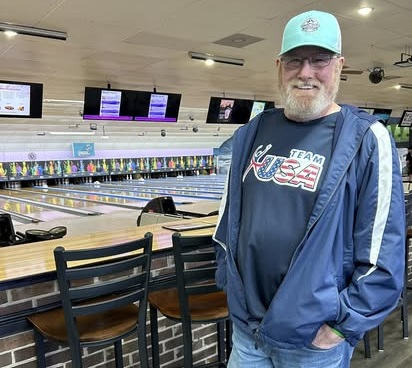
PHOTOS (Top) Roy Menken’s collection of bowling awards includes several medals earned competing in national and world games for bowlers who have received organ transplants. (2) Andrew Nicholson, as an organ donor, provided lungs that have extended Menken’s life. (3) Menken, at a bowling center, is an assistant coach for Kalamazoo Central. (4) Menken rolls for a spare during tournament play. (5) Kalamazoo Central head bowling coach Krys Briggs and junior Kaeden Lutzka. (Menken, Nicholson and awards photos courtesy of Roy Menken. Headshots by Pam Shebest.)
Traverse City Athletes Taking LEAP into Coaching, Officiating
By
Tom Spencer
Special for MHSAA.com
March 18, 2022
Set. Spike. Jump – rather maybe leap?
 Nothing new to many female high school student-athletes.
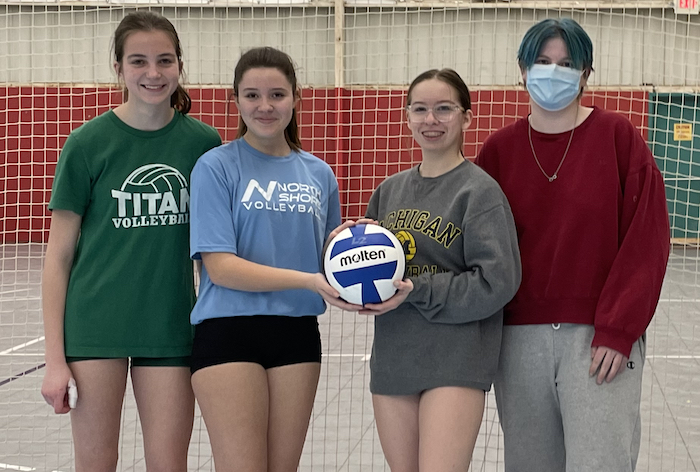
But this spring, Abigail Hicks, Keira Castle, Madeline Bildeaux and Honorae Shore made THE LEAP — as in Learning, Enrichment and Athletic Programs (LEAP). They actually leaped into coaching and officiating roles.
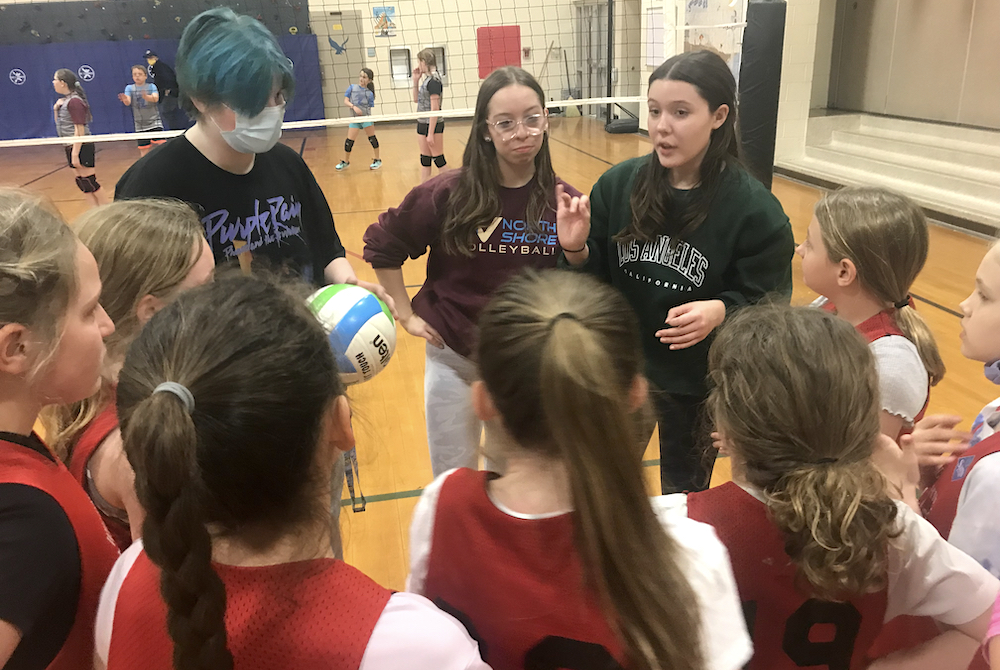
Hicks, Castle and Shore stepped into LEAP as coaches for Willow Hill Elementary School’s volleyball team. Bildeaux became a referee for LEAP’s 4th and 5th grade volleyball program.
All four girls are part of the North Shore traveling volleyball club. And, all four are a part of Future Coaches, its 4-year-old program preparing athletes to become effective coaches through LEAP, which is operated through Traverse City Area Public Schools.
Bildeaux and Castle played their first high school volleyball seasons last fall at Traverse City West. Hicks did the same at Traverse City St. Francis. Shore attends Greenspire, a Grand Valley State University-sponsored charter school located in Traverse City.
Parents, grandparents and school administrators love having the high school girls on the sidelines. The girls may love it even more though.
“The most rewarding aspect of teaching young girls is seeing the excitement they get when they get the hang of playing or when they win a game,” noted Castle, who started with the coaching program as an eighth grader. “I also love knowing that I've helped some of these girls fall in love with a sport.”
There may not be anyone more thrilled with the girls taking the leap than David Payne, elementary sports manager for LEAP. The student coaches help LEAP meet its vision of providing preschool through 12th-grade students with increased opportunities for engagement beyond the school day with activities to improve learning, health and wellness.
“The high school girls have a love and knowledge of the game that they share with the elementary kids,” Payne said. “Parents that were not comfortable or able to coach are finding the excitement and interaction between the high school girls and the elementary kids is very positive.
“At times the high school coaches look like cheerleaders on the sidelines,” he continued. “They keep the energy level high while supporting their team.”
The four ninth graders are the latest to make the “leap.” Jordan Bates, founder of the Future Coaches program, first connected the players as coaches with LEAP as COVD-19 shortened the 2020 season. The very first high school volleyball player to make the leap was Phoebe Humphrey, now a Traverse City Central sophomore. Humphrey coached Cherry Knoll as an eighth grader during the 2020 brief season. She is now coaching Eastern Elementary.
The pandemic also resulted in the cancellation of the 2021 elementary season. This season will conclude next week.
“The opportunities for these athletes to coach their own teams is extraordinary,” Bates said. “It would not have happened without David Payne.
 “His support, scheduling acumen, and love of sports has made this program pretty amazing.”
Veronika Caughran, who plays for Traverse City Central, is helping Cherry Knoll Elementary in Traverse City. Anissa Wille, Suttons Bay High School; Jenna Flick, TC West; and TC Central’s Natalie Bourdo and Lily Briggs have coached North Shore travel teams. Briggs, Bourdo and Humphrey have been coaching in North Shore’s beach program for the past three years.
Hicks, who recalls Gladiators varsity players helping coach her in volleyball as a fifth grader, said the girls can’t go it alone. She’s found the Willow Hill school community to be extremely supportive.
“We have received lots of positive feedback from parents, our coaches, our team, and other LEAP coaches,” she said. “All the parents have been very kind and grateful and always willing to support the team by bringing in snacks for after the game — not only for our players but for the opposing team — along with being willing to help line judge and run the scoreboard.”
The high school players-turning-coaches have been attending classes with Bates and guest coaches mostly from the North Shore club. Topics covered include coaching philosophy, how to be a great referee, practice planning, tournament preparation and health and wellness.
Bates said the program benefits go beyond the participants.
“Perhaps the biggest struggle is for athletes and parents to realize how valuable coaching is to an athlete,” he said. “It not only helps them with communication, structure, planning, and strategizing, but also it makes them better athletes earlier in their journey.”
Adding fun too is important, Hicks noted.
“I hope I help make practices a fun environment and for them not to worry about making mistakes and helping them know that not everything is their fault,” she said. “And … how to learn from their mistakes.”
Castle, who started playing volleyball as a fourth grader at Willow Hill, agreed. She recalls fondly the difference past coaches have made in her life, including Bates.
“While I've been coaching I've also noticed how (Willow Hill players) interact with each other and cheer each other on, and it's been such a great experience,” she said.
“I remember the feeling I felt when a coach made me love volleyball, and from coaching these girls I'm starting to see what that's like from a coaching point of view.”
Bates created the program with interscholastic competition and the student-athlete in mind.
“There is also the coaching shortage, so creating opportunities for these athletes to coach, and ref, just made sense,” Bates said.
Castle is preparing to meet the growing needs.
“I plan to continue coaching volleyball until the end of high school,” Castle said. “In a year or two, I want to start coaching middle school volleyball.
“When I get to college I plan to either continue coaching or find a job as a ref.”
Hicks indicated her experience has increased her love for the game of volleyball and respect for coaches.
“I learned that coaching is a little more complex than it looks, and you have to plan practice and be prepared for them to have a bad attitude or unfocused after a long day of school,” she said. “You, as the coach, have to have a good attitude, have lots of patience, be ready to problem solve and get them back on track.”
Teamwork, sportsmanship and the value of hard work are among the strengths Castle and the other future coaches bring to the table.
“We had our girls practice sportsmanship by saying ‘good game’ and waving to the other team,” Castle said. “In practice, we have taught them to work as a team and to always give it your all.”
Hicks recommends coaching to all high school athletes.
“I’ve learned a lot,” she said, “and this has been a positive, fun experience that I definitely recommend.”
 Tom Spencer is a longtime MHSAA-registered basketball and soccer official, and former softball and baseball official, and he also has coached in the northern Lower Peninsula area. He previously has written for the Saginaw News, Bay County Sports Page and Midland Daily News. He can be reached at [email protected] with story ideas for Manistee, Wexford, Missaukee, Roscommon, Ogemaw, Iosco, Alcona, Oscoda, Crawford, Kalkaska, Grand Traverse, Benzie, Leelanau, Antrim, Otsego, Montmorency, Alpena, Presque Isle, Cheboygan, Charlevoix and Emmet counties.
PHOTOS (Top) From left, Honorae Shore, Abigail Hicks and Kiera Castle coach their Willow Hill elementary volleyball team this season. (Middle) Madeline Bildeaux, far left, also has joined Castle, Hicks and Shore as part of the LEAP coaching and officiating program. (Top photo by Tom Spencer, middle photo courtesy of Allie Walters.)