

Menken Giving Back Through Coaching, Telling Story of Donor's Life-Saving Gift
By
Pam Shebest
Special for MHSAA.com
November 17, 2026
KALAMAZOO — In 2017, Andrew Nicholson was a 19-year-old senior at Holly High School.
 Roy Menken was a 52-year-old bowler who was dying of Alpha-1 antitrypsin deficiency, a fatal lung disease.
The two had never met, but through tragedy, the teen saved Menken’s life.
Menken, an assistant bowling coach at Kalamazoo Central, was given about six months to live when he got a call at 5:45 a.m. on May 24, 2017, from University of Michigan Health.
After waiting for 27 months, Menken was finally getting a new pair of lungs.
“Normally they give you about four hours to get to U of M,” Menken said. “In my case, Andrew’s lungs didn’t match anyone else in the U of M program, so I was the only one called.”
With his wife driving “like a mad person,” they made it to the medical center in Ann Arbor in less than two hours.
Preparing for the surgery, he said, he felt “a little scared, because you never know. Actually, I felt sad for the person who had passed. We were told that it was a young man, and he was involved in an accident.”
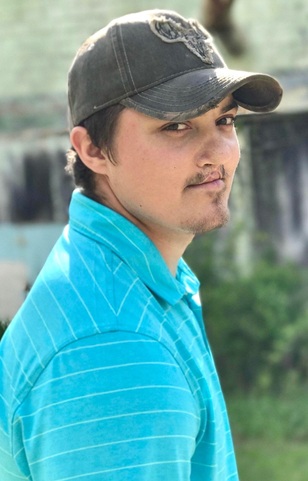
The teen was killed the day before in a welding accident.
Working in a junk yard, he was asked to weld some 55-gallon drums, which, unknown to him, still had some lacquer thinner in them.
“A week before I showed my son how to weld,” said Keith Nicholson, Andrew’s dad. “He made an eighth-inch weld and it burned through and blew up. Broke his neck, broke his forearm, broke his shoulder, broke his whole left side of his body, crushed his head.”
Fortunately for Menken, when the teen got his driver’s license at age 16, he checked the donor box.
“The day my ex-wife took him to get his driver’s license, she was standing there next to him and he said, ‘Donor, what’s that mean?’” Keith Nicholson said. “She said if you die, they can take your organs and help other people.
“Andrew shrugged his shoulders and said, ‘Well, they’re not going to do any good for me.’”
Those organs not only helped Menken, but saved four other lives, were life-changing for 12 more people (bones, etc.) and life-altering for another 33 (skin, science, etc.)
Menken sent a letter to Gift of Life Michigan through the hospital, hoping it would be forwarded to the donor’s family. The family answered, beginning a life-long friendship.
Keith Nicholson said he responded because “I was more curious making sure everything was all right. I’m really happy. I couldn’t ask for a better recipient.”
They have not only become “family,” but on the two-year anniversary of the transplant, Keith Nicholson went to Kalamazoo from Trenton to pick up the classic 1959 Impala that Menken started restoring before the surgery but could no longer finish.
Nicholson completed work on the car and said Andrew would have done it himself if he’d had a chance.
“The only thing I ever said to Roy (about the transplant) was when we were out in the shop welding on the car, he tried to sneak out there (to help)," Nicholson recalled.
And that question was a stark reminder.
“I stopped welding, looked at him and said, ‘Is this what you think of my son’s gift to you?’”
Living a full life
Fueled by healthy new lungs, Menken wasted no time getting back into sports.
The transplant was in May 2017, and by that September he was playing golf. He started bowling in November.
When he walked into Continental Lanes that first day, he saw his son, Donald, who was working there.
“You could just see the emotion on his face,” Menken said. “So was (manager) Dave Fawley and my other son, Perry.
“I slowly got back into the leagues that January and haven’t quit bowling since except when COVID hit.”
Bowling at least five days a week is no problem for Menken. The hardest part, he said, is wearing a mask when he is around people, something transplant recipients are supposed to do.
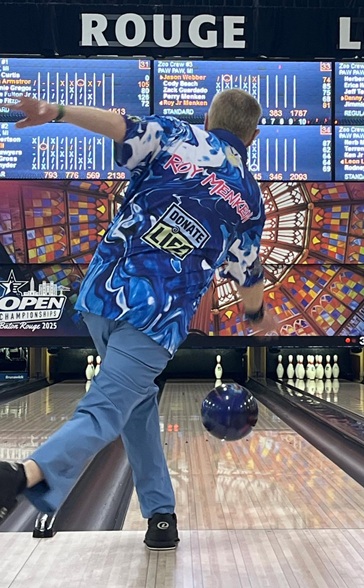
The mask hasn’t interfered with his game. He’s shot a couple of 300 games since then.
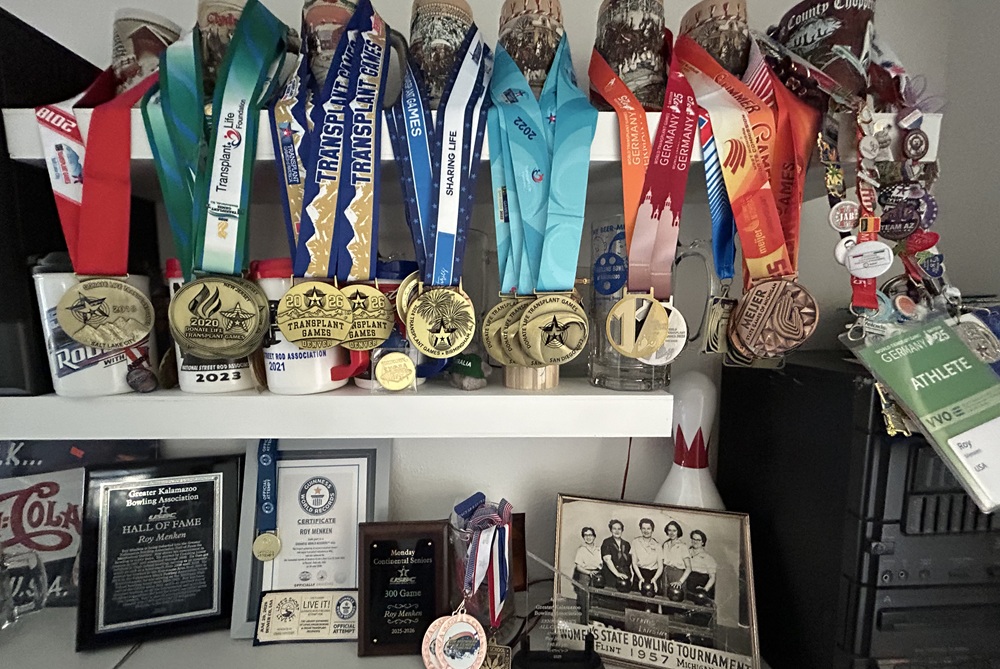
Menken also competes in Transplant Games of America and World Transplant Games. Several of his 12 gold medals came from both tournaments, including a mixed doubles gold in the U.S. Games with Becky Sheets from Charlotte, who was six months out from a heart transplant.
Traveling is no problem for Menken and his wife, Jan. The World Games, held every two years, move from country to country. Last year they were in Dresden, Germany, and next year will be in Belgium.
Menken still has to travel to Ann Arbor for checkups every three months and gets weekly infusions of Prolastin (an enzyme his liver doesn’t release) at home.
He is also in chronic rejection and relapsed twice before rebounding, which he attributes to how active he is and the 12 morning pills and 16 evening pills he takes each day.
As a teen, Menken was diagnosed with sports-induced asthma and began using inhalers.
He said doctors never really discovered that he had Alpha-1 until one day in 2013, while he was working as a building operator for Kalamazoo County and had trouble catching his breath.
“They sent me to their doctor, and he said do you realize you are disabled?” recounted Menken, who refused to believe it.
It was not until he went to Ann Arbor for tests that he was diagnosed with end-stage lung disease and given two years to live.
He and his wife “left U of M and we were both in shock,” he said.
After returning home, he was put on two liters of oxygen and could no longer work at his job. Once he got the call for surgery, Menken said he was more afraid that something would happen to cancel the surgery than he was of dying.
The operation lasted 14 hours and when he woke the next day, he wasn’t scared but knew the operation was a success when he saw “my wife and her Aunt Marcia Godisak, who was also one of my respiratory nurses, just the looks on their faces, even though I couldn’t speak because I was still on a ventilator.”
Coaching a passion
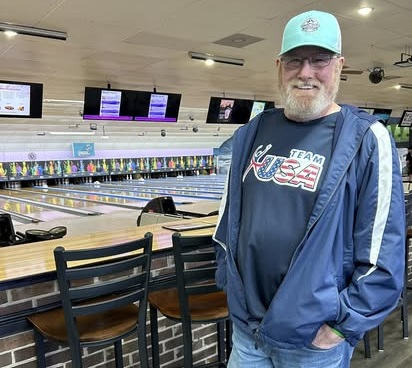
Menken coached bowling at Portage Northern for 10 years, then started at Galesburg-Augusta until COVID-19 shut down the program. He has helped coach at Kalamazoo Central the past two years and spends time talking to clubs and schools about his journey and organ donations.
He is also in charge of the Saturday morning junior bowling leagues at Continental.
“He brings a lot of bowling knowledge that I don’t have,” K-Central head coach Krys Briggs said. “I have not had the experience, so I find people I know that are definitely more knowledgeable than I am.

“The kids love him.”
The coach also said she passed around an article about Menken’s transplant journey for the bowlers who did not know about it.
“Personally. it makes me want to work on my health and make sure that I’m healthy just so that I don’t have to go through that,” said junior bowler Kaeden Lutzka, who heard Menken speak during one of his classes. “If I stay healthy and someone needs my organs, I can be a donor since I’m a donor on my license.”
Menken said the feeling of survivor’s guilt still haunts him.
“We honor Andrew every day,” he said.
Keith Nicholson said, “The biggest misinterpretation, and I know people say it because it’s the most common, but it’s not that we lost a son. I know where he went. I know what happened. He was just an amazing kid. He touched a lot of people’s hearts.
“Roy had less than six months to live. I’m happy for him.”

Pam Shebest served as a sportswriter at the Kalamazoo Gazette from 1985-2009 after 11 years part-time with the Gazette while teaching French and English at White Pigeon High School. She can be reached at [email protected] with story ideas for Calhoun, Kalamazoo and Van Buren counties.
PHOTOS (Top) Roy Menken’s collection of bowling awards includes several medals earned competing in national and world games for bowlers who have received organ transplants. (2) Andrew Nicholson, as an organ donor, provided lungs that have extended Menken’s life. (3) Menken, at a bowling center, is an assistant coach for Kalamazoo Central. (4) Menken rolls for a spare during tournament play. (5) Kalamazoo Central head bowling coach Krys Briggs and junior Kaeden Lutzka. (Menken, Nicholson and awards photos courtesy of Roy Menken. Headshots by Pam Shebest.)
Bush Legacy: Culture of Opportunity
By
Doug Donnelly
Special for MHSAA.com
April 6, 2018
By Doug Donnelly
Special for Second Half
CHELSEA – For the first time as Chelsea High School athletic director, Brad Bush has to hire a football coach.
 What’s more, he has the unenviable task of replacing himself.
“I would say that nobody cares more about Chelsea football than I do,” Bush said. “It’s important to me that we find the very best person we can.”
Bush has coached the Bulldogs for 21 seasons. But, his coaching background goes much deeper than that.
He played at Ypsilanti High School for Hall of Fame coach Bill Giarmo, graduating in 1988. After playing quarterback at Cornell University in the Ivy League, he returned to Michigan, graduating from Eastern Michigan University, and started coaching for Bill Kohn, another inductee to the Michigan High School Football Coaches Association Hall of Fame. Bush then went to East Kentwood to coach with Giarmo.
Through his own playing days, coaching with those legends of the game and absorbing everything he could from afar, Bush has developed an impressive culture at Chelsea.
“Friday nights in Chelsea are a big deal,” he said. “We want to keep that tradition.”
Bush became the varsity head coach at Chelsea in 1997. At the time, Chelsea had only two playoff appearances. Bush’s Bulldogs went 3-6 that first season. After that, Chelsea didn’t have a sub-.500 finish for 15 years. The Bulldogs have been kept out of the playoffs only once since 1998.
Chelsea has had only three head coaches since 1965.
“I’m fortunate,” Bush said. “I went for a few more years than the other guys. It’s a great place to coach.”
Temperance Bedford head coach Jeff Wood was an assistant with Bush at Ypsilanti during the 1990s and said he thought then that Bush was going to develop into a great head coach.
“We knew he was going to accomplish greatness, not only as a football coach, but as a father, husband and professional in education,” Wood said. “Brad has always won and lost with great class and dignity. He’s a true Hall of Famer.”
If Bush never coaches at Chelsea again, his lasting legacy might be that culture surrounding the Bulldogs program. It’s known for its large number of football players, from middle school through the varsity, and a system that ensures every student athlete on every team leading to the varsity will play in every game. Teams at the middle school, freshman and junior varsity levels all start 22 players each game – with no two-way starters. For a Class B/Division 3 school, that isn’t the norm.
“We’ve had the same philosophy for 20 years,” he said. “Everybody plays in every middle school, freshman and junior varsity game. That’s how we do it. We start 22 kids on every level. Our kids know they will have the opportunity to play.
“Every kid on every level is going to play in every game. On most nights, we play more kids than the other team has players.”
While every school loses some athletes, or potential athletes, along the way, Bush said this system helps maintain a student’s interest in the sport. Often, he said, a player who may not necessarily be a starter as a freshman will learn the game, develop and turn into a starter by senior year.
“We feel that, over time, with repetition and practice, a kid will become an expert at his position,” he said. “For us, this is a big piece. … That was my thing here. I didn’t invent it. I absorbed it, watched it at other places.”
It’s tough to argue with the results. Chelsea won or shared Southeastern Conference championships in 1999, 2000, 2001, 2003, 2004, 2006, 2007, 2008, 2011, 2012, 2015, 2016 and 2017. The Bulldogs won seven District championships during the Bush era and played in the 2015 Division 3 championship game, falling to Orchard Lake St. Mary’s at Ford Field
He said he learned how to build a program from Giarmo and how to coach a football team under Kohn. Bush was quick to credit his assistant coaches who have remained with the program for years and helped build the culture. He said the program has sacrificed win-at-all-cost at the lower levels with the goal of developing varsity football players.
“You have to manage it,” he said. “That’s why you need a great staff. We have been lucky here with a great, dedicated group of guys. They always have the ultimate goal in mind.”
Bush said he won’t hamstring the next coach into running his system, but anticipates whoever is hired will buy into the culture after seeing what it’s about.
“The next coach has to run it the way he wants to run it, but I do believe we have created a culture here and we’d like to maintain that. You want to hire the right person who is going to handle the kids the right way.”
In addition to coaching at Chelsea and leading the entire athletic program, Bush also is heavily involved in the Michigan High School Football Coaches Association as a past president, serves on the Michigan High School Athletic Association football committee and has served on the National Federation football rules committee. He’s coached in all-star games and is a true believer in high school sports.
His record at Chelsea is 169-60.
“I have great energy,” Bush said. “I love coaching. I have a great passion for it, but I also know when you need to do certain things. I felt this was just the right time for the athletic department and the football team. It wasn’t one thing that led me to this.
“I love the game. I’m going to be very much involved.”
 Doug Donnelly has served as a sports and news reporter and city editor over 25 years, writing for the Daily Chief-Union in Upper Sandusky, Ohio from 1992-1995, the Monroe Evening News from 1995-2012 and the Adrian Daily Telegram since 2013. He's also written a book on high school basketball in Monroe County and compiles record books for various schools in southeast Michigan. E-mail him at [email protected] with story ideas for Jackson, Washtenaw, Hillsdale, Lenawee and Monroe counties.
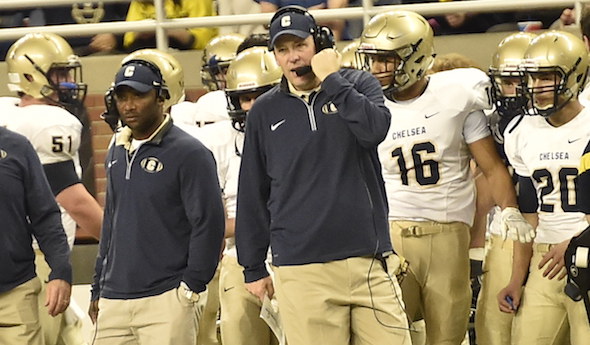
PHOTO: Chelsea's Brad Bush coaches his team during the 2015 Division 3 Final at Ford Field.