

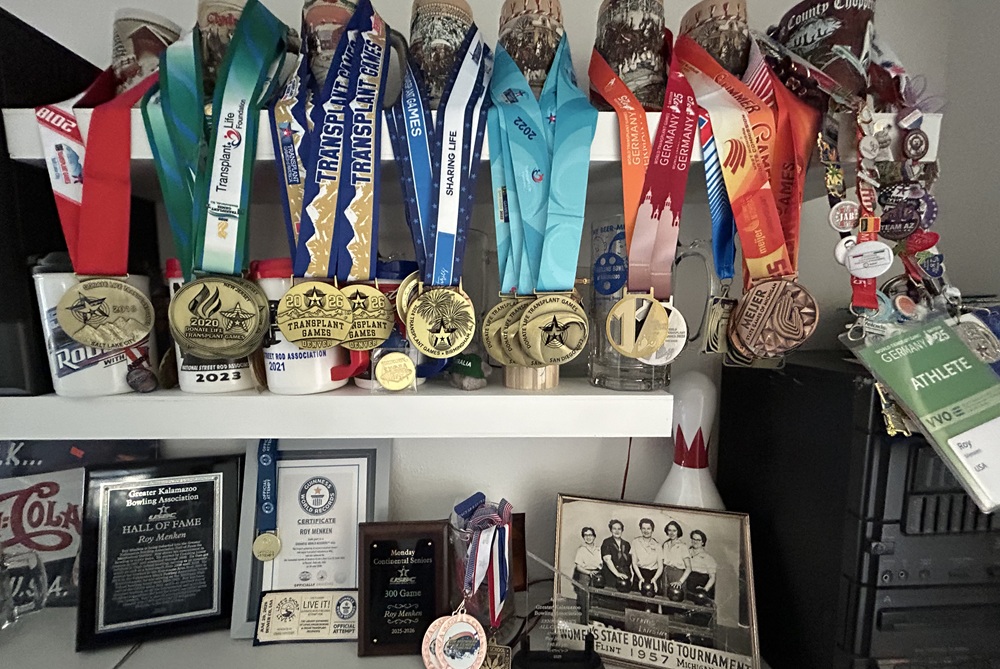
Menken Giving Back Through Coaching, Telling Story of Donor's Life-Saving Gift
By
Pam Shebest
Special for MHSAA.com
November 17, 2026
KALAMAZOO — In 2017, Andrew Nicholson was a 19-year-old senior at Holly High School.
 Roy Menken was a 52-year-old bowler who was dying of Alpha-1 antitrypsin deficiency, a fatal lung disease.
The two had never met, but through tragedy, the teen saved Menken’s life.
Menken, an assistant bowling coach at Kalamazoo Central, was given about six months to live when he got a call at 5:45 a.m. on May 24, 2017, from University of Michigan Health.
After waiting for 27 months, Menken was finally getting a new pair of lungs.
“Normally they give you about four hours to get to U of M,” Menken said. “In my case, Andrew’s lungs didn’t match anyone else in the U of M program, so I was the only one called.”
With his wife driving “like a mad person,” they made it to the medical center in Ann Arbor in less than two hours.
Preparing for the surgery, he said, he felt “a little scared, because you never know. Actually, I felt sad for the person who had passed. We were told that it was a young man, and he was involved in an accident.”
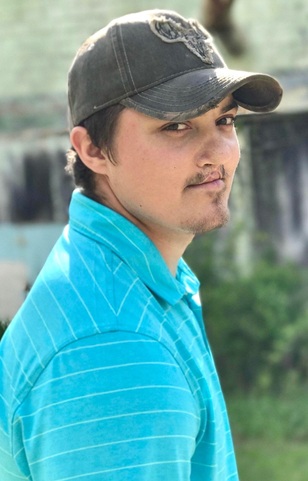
The teen was killed the day before in a welding accident.
Working in a junk yard, he was asked to weld some 55-gallon drums, which, unknown to him, still had some lacquer thinner in them.
“A week before I showed my son how to weld,” said Keith Nicholson, Andrew’s dad. “He made an eighth-inch weld and it burned through and blew up. Broke his neck, broke his forearm, broke his shoulder, broke his whole left side of his body, crushed his head.”
Fortunately for Menken, when the teen got his driver’s license at age 16, he checked the donor box.
“The day my ex-wife took him to get his driver’s license, she was standing there next to him and he said, ‘Donor, what’s that mean?’” Keith Nicholson said. “She said if you die, they can take your organs and help other people.
“Andrew shrugged his shoulders and said, ‘Well, they’re not going to do any good for me.’”
Those organs not only helped Menken, but saved four other lives, were life-changing for 12 more people (bones, etc.) and life-altering for another 33 (skin, science, etc.)
Menken sent a letter to Gift of Life Michigan through the hospital, hoping it would be forwarded to the donor’s family. The family answered, beginning a life-long friendship.
Keith Nicholson said he responded because “I was more curious making sure everything was all right. I’m really happy. I couldn’t ask for a better recipient.”
They have not only become “family,” but on the two-year anniversary of the transplant, Keith Nicholson went to Kalamazoo from Trenton to pick up the classic 1959 Impala that Menken started restoring before the surgery but could no longer finish.
Nicholson completed work on the car and said Andrew would have done it himself if he’d had a chance.
“The only thing I ever said to Roy (about the transplant) was when we were out in the shop welding on the car, he tried to sneak out there (to help)," Nicholson recalled.
And that question was a stark reminder.
“I stopped welding, looked at him and said, ‘Is this what you think of my son’s gift to you?’”
Living a full life
Fueled by healthy new lungs, Menken wasted no time getting back into sports.
The transplant was in May 2017, and by that September he was playing golf. He started bowling in November.
When he walked into Continental Lanes that first day, he saw his son, Donald, who was working there.
“You could just see the emotion on his face,” Menken said. “So was (manager) Dave Fawley and my other son, Perry.
“I slowly got back into the leagues that January and haven’t quit bowling since except when COVID hit.”
Bowling at least five days a week is no problem for Menken. The hardest part, he said, is wearing a mask when he is around people, something transplant recipients are supposed to do.
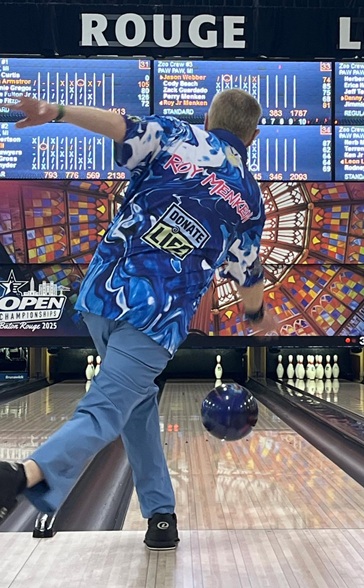
The mask hasn’t interfered with his game. He’s shot a couple of 300 games since then.
Menken also competes in Transplant Games of America and World Transplant Games. Several of his 12 gold medals came from both tournaments, including a mixed doubles gold in the U.S. Games with Becky Sheets from Charlotte, who was six months out from a heart transplant.
Traveling is no problem for Menken and his wife, Jan. The World Games, held every two years, move from country to country. Last year they were in Dresden, Germany, and next year will be in Belgium.
Menken still has to travel to Ann Arbor for checkups every three months and gets weekly infusions of Prolastin (an enzyme his liver doesn’t release) at home.
He is also in chronic rejection and relapsed twice before rebounding, which he attributes to how active he is and the 12 morning pills and 16 evening pills he takes each day.
As a teen, Menken was diagnosed with sports-induced asthma and began using inhalers.
He said doctors never really discovered that he had Alpha-1 until one day in 2013, while he was working as a building operator for Kalamazoo County and had trouble catching his breath.
“They sent me to their doctor, and he said do you realize you are disabled?” recounted Menken, who refused to believe it.
It was not until he went to Ann Arbor for tests that he was diagnosed with end-stage lung disease and given two years to live.
He and his wife “left U of M and we were both in shock,” he said.
After returning home, he was put on two liters of oxygen and could no longer work at his job. Once he got the call for surgery, Menken said he was more afraid that something would happen to cancel the surgery than he was of dying.
The operation lasted 14 hours and when he woke the next day, he wasn’t scared but knew the operation was a success when he saw “my wife and her Aunt Marcia Godisak, who was also one of my respiratory nurses, just the looks on their faces, even though I couldn’t speak because I was still on a ventilator.”
Coaching a passion
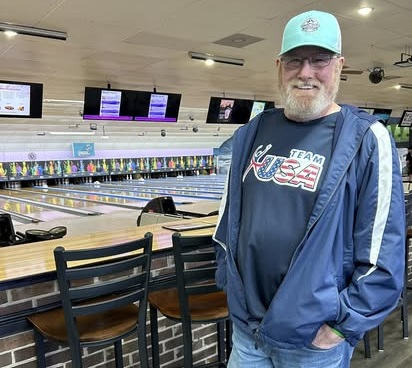
Menken coached bowling at Portage Northern for 10 years, then started at Galesburg-Augusta until COVID-19 shut down the program. He has helped coach at Kalamazoo Central the past two years and spends time talking to clubs and schools about his journey and organ donations.
He is also in charge of the Saturday morning junior bowling leagues at Continental.
“He brings a lot of bowling knowledge that I don’t have,” K-Central head coach Krys Briggs said. “I have not had the experience, so I find people I know that are definitely more knowledgeable than I am.

“The kids love him.”
The coach also said she passed around an article about Menken’s transplant journey for the bowlers who did not know about it.
“Personally. it makes me want to work on my health and make sure that I’m healthy just so that I don’t have to go through that,” said junior bowler Kaeden Lutzka, who heard Menken speak during one of his classes. “If I stay healthy and someone needs my organs, I can be a donor since I’m a donor on my license.”
Menken said the feeling of survivor’s guilt still haunts him.
“We honor Andrew every day,” he said.
Keith Nicholson said, “The biggest misinterpretation, and I know people say it because it’s the most common, but it’s not that we lost a son. I know where he went. I know what happened. He was just an amazing kid. He touched a lot of people’s hearts.
“Roy had less than six months to live. I’m happy for him.”

Pam Shebest served as a sportswriter at the Kalamazoo Gazette from 1985-2009 after 11 years part-time with the Gazette while teaching French and English at White Pigeon High School. She can be reached at [email protected] with story ideas for Calhoun, Kalamazoo and Van Buren counties.
PHOTOS (Top) Roy Menken’s collection of bowling awards includes several medals earned competing in national and world games for bowlers who have received organ transplants. (2) Andrew Nicholson, as an organ donor, provided lungs that have extended Menken’s life. (3) Menken, at a bowling center, is an assistant coach for Kalamazoo Central. (4) Menken rolls for a spare during tournament play. (5) Kalamazoo Central head bowling coach Krys Briggs and junior Kaeden Lutzka. (Menken, Nicholson and awards photos courtesy of Roy Menken. Headshots by Pam Shebest.)

Task Force Building Multi-Sport Message
November 11, 2016
By Geoff Kimmerly
Second Half editor
Walled Lake Western’s Cody White draws his perspective on high school sports from a background that, while perhaps not unique, has to be close.
The Warriors senior is one of the top college football prospects in Michigan, a Big Ten-caliber player who has committed to continue his career at Michigan State University after he graduates in the spring.
Our state has a handful of athletes like that every year, of course. But White also is the son of former NFL player and Detroit Lions executive Sheldon White – and has followed his father’s Dayton, Ohio, footsteps in playing three sports during his high school career.
White plays football, basketball during the winter and baseball in the spring, in addition to travel basketball and baseball during the summer. He has played these same sports throughout high school. His freshman year he also competed in track & field, along with baseball. As of May – when White and his multi-sport experience were featured on Second Half – he hadn’t ruled out returning to track & field, in addition to baseball, as a senior.
“I couldn’t see myself not competing in those sports,” White said at the time. “I love them so much. I want to finish my senior year playing all three.”
It’s White’s experience, and the benefits enjoyed by so many who have shunned the recent trend toward specialization, that is driving the MHSAA’s Multi-Sport Task Force as it aims to promote the value of a varied sports experience through high school, even for athletes considered “elite” in a sport they’ll go on to play at higher levels.
The Multi-Sport Task Force met for the third time Oct. 27 and includes coaches, administrators and teachers with diverse experiences in athletics at schools large and small; urban, suburban and rural and in both the interscholastic and club settings.
The idea of moving away from specialization and back toward playing multiple sports has gained steam in recent years with pronouncements of how doing so paid off for nationally-recognized stars like professional golfer Jordan Spieth, baseball Hall of Famer John Smoltz and a number of members of the U.S. women’s soccer national team who played multiple sports through high school.
The MHSAA’s task force is working to develop that message, package it in the most digestible formats, and deliver it to the key decision-makers to benefit athletes at the age where the message can have the heaviest impact on their sports careers and growth into physically fit adults.
“This is a fundamental topic in school sports,” MHSAA Executive Director Jack Roberts told the task force during its most recent meeting. “This is something we’ll be talking about five and 10 years from now.”
The task force is charged with a series of goals that will be discussed below and are still in development. But there’s no doubt coaches will play a significant part in promoting and carrying out this important mission.
“Growing up was a little different (for me) than the usual kid. Going to Lions games and just being around football all the time. I think I love the game more because I was around it so much. But I think playing three sports helped me, too. The twisting of your hips in baseball, when you swing the bat, you’re using different muscles. And all the jumping you do in basketball. You have to move in tight spaces. With football, you’re with the football guys. By doing all three you meet different people.” – Cody White, “Western’s White Enjoys ‘Special’ Career” – May 4, 2016
What we’ve learned
The task force’s first meeting in April included discussions with Dr. Tony Moreno of Eastern Michigan University, a frequent Coaches Advancement Program instructor, and Dr. Brooke Lemmon of the MSU Sports Medicine Clinic. Among points from their focus on medical issues that result from specialization:
• Specialization has chronic, long-term affects; young people who do not learn physical literacy – how to solve movement problems – are less likely to be physically active and, hence, less likely to be physically fit. This is becoming an expensive health issue for society.
• The loss of physical education from schools is the root of these problems and has led to the creation of “privatized PE” for those who can afford a club sports experience. Physical education in schools, done correctly, can create a relatively noncompetitive environment that increases student interest in becoming physically active.
• More time spent in one activity will lead to more injuries, especially of the chronic nature. The number of hours per week a child spends on one sport activity shouldn’t exceed that child’s age (8 hours per week for an 8-year-old, for example).
Dr. Dan Gould, the director of the MSU Institute for the Study of Youth Sports, talked to the task force during its second meeting about how children perceive sports – and the need to adjust parents’ expectations for their kids’ success. He explained how kids can lose their identity focusing on just one sport, and also the importance of free play – the games kids make up themselves while playing in a structure-free environment.
Bob Mancini of USA Hockey visited with the task force most recently, explaining how his was the first governing body to tell athletes it wanted them to play their sport – but in order to do so well, play other sports also. USA Hockey’s American Development Model was launched in 2009 to in part promote multi-sport participation – and is growing hockey in the process, with increased participation seen at youth levels over the last three years.
“It’s just really fun to do different things. We don’t have a lot of the numbers, but we have the people who are willing to put in the hard work, even if it’s not their best sport. Each season is only three to four months at the most. So it keeps things exciting.”— 2016 Bronson graduate Kelsey Robinson, a defensive specialist in volleyball, former cross country runner, guard in basketball and a third baseman and centerfielder in softball, “Multi-Sport Experience ‘Special’ for Bronson” – February 2, 2016
Questions & Answers
The task force will meet again Feb. 8, and in the meantime there are a number of questions – and answers – to be considered.
The group has pinpointed a series of goals:
1. Partner with groups promoting diverse physical activity.
2. Encourage those promoting more and better physical education.
3. Prepare tools for administrators for use in interviewing prospective coaches, conducting meetings with their coaching staffs and encouraging them to “walk the talk” of balanced participation.
4. Assist in the explanation of the multi-sport experience to parents through a variety of media, including a guidebook and video explaining its benefits.
Carrying out these aspirations comes with plenty to discuss.
Who most needs to hear the message of multi-sport participation? It’s most likely junior high and middle school parents, or even those of elementary students just starting to experience organized athletics.
 What do these parents and children most need to know? Parents are stakeholders in their children’s athletic ventures. The challenge is convincing them our way is best for their kids’ futures, from a health and development standpoint.
Who should deliver this message? Celebrities obviously carry clout when they talk about how their multi-sport experiences led them to become successful adults. But there also could be a strong emotional tug from current student-athletes who tell their stories.
How can coaches and athletic directors help spread the word? The MHSAA, with input from the task force, will develop tools to help. But the options are many: could it come in video form, eye-catching graphics for use at coaches meetings, or live interaction at regional summits?
We are looking for ideas, both for getting out the message and incentivizing taking part in the multi-sport experience. Schools already are doing great things to promote multi-sport participation, and we’d love to hear about what's working.
To that vein, we’ll close with a final success story from this fall about a team that benefited from a lineup of multi-sport athletes:
Grosse Pointe Woods University Liggett on Oct. 15 ended an eight-year championship run by Ann Arbor Greenhills at Lower Peninsula Division 4 Boys Tennis Finals. Knights coach Matt Sobieralski relied on a roster filled with multi-sport athletes, including No. 1 singles player T.J. Dulac, who also ran cross country this fall.
Only one player on the Liggett roster plays only tennis, and Sobieralski says his players’ multi-sport participation served them well.
“It makes you tough, mentally tough and strong. And they’re competitive. That’s important. I think tennis, a lot of times, is 80 percent mental and 20 percent ability. You win a lot of matches with guts and just hanging in there. I always say a good player can win even when they’re not playing their best, because they’ll try something different and they keep fighting. That’s the team I’ve got. I’m really proud of their fight.” – Matt Sobieralski, “Liggett Ends Greenhills’ 8-Year Reign” – October 16, 2016
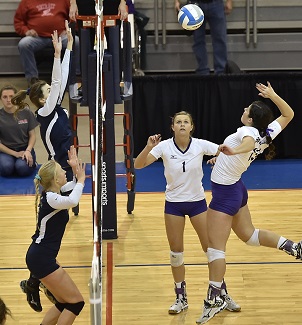
PHOTOS: (Top) Walled Lake Western's Cody White runs ahead of a group of Lowell defenders during last season's Division 2 Semifinals. (Middle) Bronson (right) goes for a kill during last season's Class C Semifinal against Traverse City St. Francis. (Top photo courtesy of Walled Lake Western athletic department.)